Are you looking to reduce costs and streamline your restaurant’s operations? To achieve these goals, consider supplier consolidation. This is the process of reducing the number of suppliers you work with to simplify your inventory management and operational processes. In this article, we will explore the benefits of supplier consolidation for restaurants and how to […]
The post Consolidating Suppliers | What are the benefits for my restaurant? appeared first on Tenzo.
]]>Are you looking to reduce costs and streamline your restaurant’s operations?
To achieve these goals, consider supplier consolidation. This is the process of reducing the number of suppliers you work with to simplify your inventory management and operational processes.
In this article, we will explore the benefits of supplier consolidation for restaurants and how to effectively manage this process.
Consolidating suppliers has always got to be the best thing; you’re increasing your purchasing power and building better relationships. Buy as much as possible from as little as possible. – Scot Turner, Founder and MD at Auden Hospitality

What is Supplier Consolidation?
Supplier consolidation is the process of reducing the number of suppliers that a restaurant uses to streamline operations and improve efficiency.
This can be achieved by selecting a few – or even one – key suppliers that can meet your restaurant’s needs, from food and beverage to equipment and supplies. By consolidating suppliers, you can simplify your ordering process, reduce costs, and build stronger relationships with your suppliers.
Consolidating suppliers must be a strategic process, and the number that restaurants can reduce to depends on the type of restaurant and the nature of the business. For example, some restaurants will get fish from one supplier, and meat from another, so in this case, consolidating suppliers could be based on reducing the suppliers for each inventory group.
How to Manage Consolidating Suppliers
Assessing your current situation is vital to developing a strategy for consolidating suppliers. It’s important to focus on the quantity and quality your restaurant requires and any contracts with your current suppliers.
For multi-site locations, it’s also important to consider that supplier consolidation may have to happen regionally, with individual locations consolidating their supplier as opposed to the overall business.
To successfully manage supplier consolidation, it is important to build good relationships with your chosen suppliers. This includes open communication, regular meetings, and providing feedback on their products and services.

Benefits of Supplier Consolidation for Restaurants
Consolidating suppliers can bring several benefits to restaurants. Improving the relationships and communication between businesses working together opens up new opportunities to grow both businesses and control costs in the process.
Reduces Costs
Consolidating suppliers can help reduce the cost of goods sold for your restaurant in various ways. By working with fewer suppliers, you can benefit from cheaper delivery costs as you can consolidate orders and reduce the number of deliveries.
It also increases buying power and allows you to negotiate better prices or pricing deals and longer payment plans with your suppliers. Minimising price volatility is another benefit, as you have more security with your suppliers, which reduces the risk of sudden price increases.
Increasing the order quantity of specific items and buying in bulk can also help to further reduce overall costs. Buying one 5kg box of tomatoes often works out as cheaper than buying four 1kg boxes of tomatoes due to the reduced labour and packaging costs. If you’re a multi-site restaurant business that can benefit from sharing suppliers, ordering a pallet would be significantly cheaper again. Altering the menu to increase usage of excess items, or adding specials is another way to keep the cost of goods sold down.
Increased Negotiating Power
Consolidating suppliers gives your restaurant more buying power, which in turn increases your negotiating power.
Negotiating powers work to improve the quality and delivery of orders, as well as influence prices. The more leverage you have allows you to request higher quality items and ensure that you’re one of the first on the delivery list to allow for maximum prep time.
Increased mutual dependence also allows restaurants to be able to request specific goods, and develop an agreed level of quality that you expect. It is easier to ensure that suppliers are compliant with the values you live by in your restaurant.
More Efficient Account Management
Consolidating suppliers can lead to more efficient account management for your restaurant. With fewer suppliers to manage, your accounting department will have less to deal with in terms of invoices, payments, and reconciliations.
A smaller chain of suppliers means that you can have more of an impact on each supplier and ensure that they align closely with your restaurant’s values and standards. Managing this can be crucial for some restaurants, but with too many suppliers it’s almost impossible. Consolidating your suppliers allows you to spend more time with them, and learn from each other.
Development of the menu can also benefit from a good relationship with suppliers. Being the first to know about the newest and most popular cuts of meat, or the best quality seasonal vegetables can help restaurants create the best menu for their customers, and therefore boost sales.

Risks of Consolidating Suppliers for Restaurants
It’s important to note that whilst consolidating your suppliers can lead to many benefits, reducing it too much, to a single supplier, can bring some risks from over-dependency.
Mutual Dependence
Reliance on one supplier can be risky during slow periods, for both restaurants and suppliers, with the risk of one becoming insolvent.
If your restaurant relies on just one supplier for all of its ingredients, equipment, or other essential items, you are putting all your eggs in one basket. If that supplier goes out of business or fails to deliver, it can leave your restaurant in a difficult position, negatively impacting business and reducing restaurant performance.
Also, if there are any compliance issues with that supplier, such as food safety violations or unethical business practices, it can damage your business’ reputation. Profitability can also be affected as looking for inventory on short notice will likely lead to increased costs, and therefore reduced profit margins.
Limited Flexibility
Relying on a single supplier can limit your options and flexibility. If you only have one supplier, you may not have access to a wide range of products or competitive pricing.
It can lead to a lack of innovation and creativity.
When you work with multiple suppliers, you have the opportunity to explore different options and try new products. This can help keep your menu fresh and exciting for your customers.
However, if you consolidate suppliers and limit yourself to just one, it may result in you missing out on the chance to discover new and unique ingredients that can set your restaurant apart from the competition.
Conclusion
In conclusion, consolidating suppliers for your restaurant can bring numerous benefits including:
- Reducing costs
- Increasing negotiating power
- Allowing for more efficient account management
By streamlining your supply chain, you can save time and money while ensuring high-quality products for your customers. To maximise these benefits, it is important to carefully consider the potential drawbacks and weigh them against the benefits before deciding on supplier consolidation.
Overall, supplier consolidation can be a strategic move that helps your restaurant thrive in a competitive industry.
The post Consolidating Suppliers | What are the benefits for my restaurant? appeared first on Tenzo.
]]>Menu engineering is a crucial aspect of restaurant operations that shouldn’t be neglected. It’s an opportunity to solidify restaurant branding and supercharge restaurant performance. A great menu will result in increased sales and happier customers. It’s not only an operational tool to create a more profitable restaurant, but it is also an opportunity to use […]
The post Menu Engineering | How a great menu can improve restaurant performance appeared first on Tenzo.
]]>Menu engineering is a crucial aspect of restaurant operations that shouldn’t be neglected. It’s an opportunity to solidify restaurant branding and supercharge restaurant performance.
A great menu will result in increased sales and happier customers. It’s not only an operational tool to create a more profitable restaurant, but it is also an opportunity to use marketing techniques to drive sales at the final point.
Below, we break down how menu engineering can have an impact on your restaurant’s performance and tips you can implement when going through the menu engineering process.
Fine dining restaurants tend to have higher SPG and design their menu carefully, follow up on reviews . Whereas, QSRs might care more about boosting transactions, and increase SPG by upselling extra products. – Maria Gully, Customer Success Manager at Tenzo
Menu Engineering | Items on the menu
Arguably, the menu items are the most critical aspect of menu engineering – they are likely why customers will keep coming back.
Aligning the menu with customers’ favourites increases the likelihood of returning customers. Ideally, the best-selling dishes will all be those with the highest profit margins – stars! Adapting the ingredients or dishes to improve popularity and profitability is vital.
When thinking about items on the menu, they can generally be placed into one of four terms – stars, plow horses, dogs, and puzzles. These terms are used to describe the popularity and profitability of menu items simultaneously.
Stars are menu items that are highly profitable, and popular. Whereas plow horses are those that are popular with customers but have low profitability. The strategy for dealing with plowhorses is to use these to draw in customers, and then find a way to make them more profitable without weakening the value too much.

It can be hard to judge which dishes are actually the best-selling, often employees’ conversations with customers can influence the perception of this. Making an assessment of customer favourites can be done through human behaviour, but the most accurate way is through data.
Using data-based decision-making is more accurate and more likely to result in increased sales and profits. Many point-of-sale (POS) systems will already collate information on menu item popularity for you, making the data really easily accessible. However, this isn’t the full picture and restaurants can’t always identify the high sellers and good margin items.
Focus on time periods and assess what the attachment percentage of each menu item is. It’s important to understand that menu items will experience seasonality, and optimising for different items should be done accordingly throughout the seasons.
Calculating Profit-Margin of Menu Items
We’ve mentioned how important it is for a menu to be full of high-profit margin items, but how is this calculated?
Menu profit margin = (Menu Price – Raw Cost) / Menu Price
Profit margins on menu items need to be on a median at about 70%, the actual vs. theoretical usage should be taken into account when considering recipes. Outgoing costs for restaurants are more than just inventory costs: labour costs, taxes, and rent all need to be considered.
Menu Engineering | Menu Size
The length of the menu doesn’t only influence the customers’ experience, but it also has a huge impact on operations.
Traditionally, large menus were considered to positively impact sales due to a wide offering that would appeal to more potential customers, and keep them coming back for more.
However, smaller menus have now become more popular; allowing restaurants to cut costs, reduce wastage, and improve profits. This is known as creating a minimum viable menu. Using the same ingredients in multiple dishes also helps reduce costs by buying in bulk.
Operationally, having more simplified menus increases efficiency and quality. Labour costs will be lower as there is less to prepare and ticket times are likely to be shorter with less staff needed.
A simplified menu is more targeted. Not only does it streamline inventory management, but reduces COGS (cost of goods sold) by needing fewer ingredients.
Customers are able to make faster decisions with a smaller menu, decreasing the decision-making process and making it more straightforward for them. They’re more likely to be happy with a menu with no outliers, which in turn reduces wastage and allows for more ‘stars’ and less ‘dogs’.
Menu Engineering | Portion Sizes
Portion sizes can affect profits and wastage. This can come down to how the portions have been designed, as well as over-portioning.
Restaurants that serve large portions can lose money unnecessarily, especially if lots of food is coming back on the plates as waste. These large portions can affect customer experience too by compromising on quality and using low-cost ingredients to bulk up meals to justify large price tags.
Over-portioning can result in unaccounted-for losses for restaurants that will affect performance. This can be reduced by introducing small wares to help during busy services, or using scales to ensure expensive ingredients aren’t over-portioned. Thinking about takeaway portions is vital too, it needs to be easy for staff to give the correct size for both eat-in and takeaway.
Offering varying portion sizes can be an operational strategy to improve average transaction value, whilst reducing the likelihood of wastage. If normal and large portion options are given to the customers, their experience is improved by not being over or underwhelmed, and restaurants aren’t wasting inventory.
Menu Engineering | Menu Psychology
There is so much information that could be included on menus, but based on the type of restaurant, what’s included on the menu varies.
Calories on the menu
A good example of this is calories. This is only a legal requirement in the UK if the business has more than 200 employees and as a result generally only larger restaurant chains have included them.
Calories were introduced on menus to tackle obesity, with the aim to encourage customers to think more about their health. However, this was met with backlash with over 50% of young women between 18-29 not agreeing, with the change due to negative impacts on those with eating disorders.
It’s likely that calories also dictate customers’ choices whether they’re counting calories or not, bringing down ATV (Average Transaction Value) due to people ordering less. It adds another dimension to menu engineering: creating menu items with lower calories to appeal to a wider customer base.
Prices
Pricing is always included on menus, to ensure that customers know how much they’re spending.
There are techniques to increase sales by helping customers dissociate from the prices. Removing the currency helps to remove the association with money, and allows customers to assume the currency based on location.
The pricing of menu items is an essential aspect of menu engineering and should be decided when considering profit margins and the menu items included. However, how the price is shown is more psychological.
Exclusive establishments tend to use round numbers for their pricing, as it is already high, however, more affordable restaurants are likely to use .95 in their prices to let them appear more reasonably priced.
Adding more expensive menu items can make the high-profit, low-popularity (puzzles) menu items seem more appealing and therefore more likely to be sold.
Extra Information
Menus can have a range of information on them, for most restaurants the story behind their business and the food being served is really important. But how that information is displayed can affect sales.
The backstories behind restaurants help establish an emotional connection with customers and increase sales by making a more memorable dining experience. However, it can be too much information for customers, so using a QR code is a good way to provide this.
The wording surrounding food items can also have an influence on which items are chosen. Descriptive labels can slow down decision-making, but, they can also increase sales by 27% through creating an emotion surrounding the food and angling customers towards higher profit margin items.
Menu Engineering | Digital Menus
With the rise of QSRs, digital menus are becoming more popular. Digital menus can come in a couple of different forms, for some restaurants this is an electric board presented above the point-of-sale, and others use kiosks.
Digital menu boards allow for more control of the consumers’ decision-making. It is easy to advertise promotional menu items and test marketing strategies giving them the best chance of success.
Digitalisation allows for easy menu adaptation in real-time. This means restaurateurs can alter the price, adding discounts for items going to waste and pushing them above those that are almost at stock-outs – reducing disappointment and wastage.
This also allows for dynamic, or surge, pricing; when restaurants alter the price of menu items throughout the day to align with demand and supply. For example, if it’s a busy period with a known popular dish you can hike the price to increase profit margins.
Kiosks have been found to increase sales compared to counter sales, with them on average seeing a 10% increase in sales. This is due to increased customer comfort, not having to order from a person, but also increasing ATV through easy upselling.
Conclusion
Menu engineering is a powerful tool that helps balance the menu between popularity and profitability. Successful menu engineering can massively improve the performance of restaurants; with the potential to increase profits by 15%. But, it relies on deep customer knowledge to the optimise menu accordingly.
There are so many aspects to menu engineering, but the main aims to improve performance come from promoting high-profit margin items and improving or removing low-profit margin items.
If you want to find out more about how technology can help with menu engineering, request a free consultation today!
The post Menu Engineering | How a great menu can improve restaurant performance appeared first on Tenzo.
]]>Cost of Labour (COL) in restaurants is an important metric to be monitored at all times. It can be a huge part of overall costs with most restaurants averaging at about 35% labour cost as a percentage of sales. Following the pandemic, and the rising cost of living, high staff turnover has become a universal […]
The post Labour Productivity | Drive restaurant performance and staff retention appeared first on Tenzo.
]]>Cost of Labour (COL) in restaurants is an important metric to be monitored at all times. It can be a huge part of overall costs with most restaurants averaging at about 35% labour cost as a percentage of sales.
Following the pandemic, and the rising cost of living, high staff turnover has become a universal challenge for restaurants and the hospitality industry. Nearly 4 out of 5 restaurants are understaffed leading to a reduced capacity for sales, whilst increasing the risk of staff burnout due to them feeling overwhelmed. Hiring staff can also be expensive, so ensuring you have loyal, happy employees is vital in controlling costs by improving labour retention.
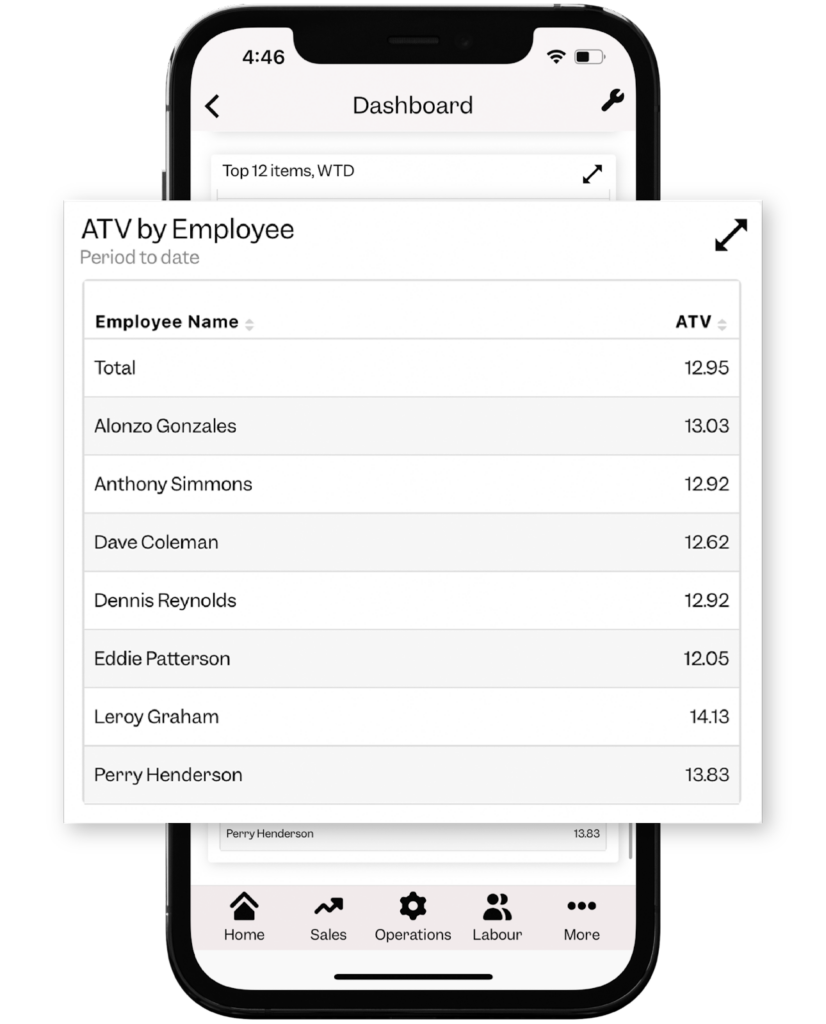
Labour productivity is another factor that should be taken into consideration when analysing labour costs; it’s how much revenue is taken in per labour hour spent. Encouraging employees to improve their productivity is a great way to control labour costs and create a more cost-effective business.
My customers that manage labour most efficiently have very strict labour budgets that flex with revenue. They create a culture that values sticking to labour budgets, as a way of maintaining consistent revenue within the business. – Maddie Pellico, Customer Success Team Lead at Tenzo
Improving performance with labour productivity and retention
Increased Staff Retention
High employee turnover is costing the hospitality industry £275 million a year, as each new hire can cost 1.5 to 2 times the amount of the existing employee’s salary, Not only does employee turnover cost money, but it’ll also lessen morale within the team and likely encourage more staff to leave.
Champion your Team
Set goals and targets for your staff, and business, based on metrics and quantifiable values; these could be set for either general business sales or specific staff members’ performance.
Creating targets gives employees something to work towards, and an understanding of the level they should be performing at. Targets provide an opportunity for you to champion your employees, and really make them feel proud of the work that they’re doing.
78% of employees feel more engaged when they feel strong recognition from their employers decreasing the likelihood of staff turnover. But it’s important not to meet underperforming staff with any resentment and ensure they are given the support and feedback they need to aid their development.
Push for a great company culture
Employee satisfaction increases to 87% when they feel that they have a thriving workplace culture, so ensuring that your business does everything to create a happy working environment is important.
Company events that aren’t focused on work are a great way to improve employees’ relationships and create a positive working environment. Team building events such as bowling or after-work drinks can also help improve internal communications whilst outside of the workplace.
59% of people in hospitality experience mental health issues making it imperative that employees feel supported by their team members, and have good relationships with colleagues that they can rely on. Creating buddy schemes, or having a dedicated team member to check in is a useful way to ensure everyone is feeling heard.
Attracting top staff
There are currently many more open jobs in the hospitality industry than employees to fill them. Junior and senior positions alike are tricky to find the perfect candidate for. If you’re not able to fill all the available vacancies, then filling as many as possible with experienced candidates will put you above the rest.
Employer branding
Employer branding is vital in attracting both experienced and junior staff; it’s an outward message from the company about who they are and what makes them special. It not only helps to attract new potential prospects but also prospects that are likely to resonate with your company and its values.
Offering good company benefits and competitive salaries is one way to ensure that your company stands out above other restaurants. Benefits could include private healthcare, training budgets, and good holiday allowances.
Demonstrating company culture is another good way to be successful in employer branding. It shows that relationships within your company are fulfilling’ and that time and resources are spent ensuring your employees are happy and developing.
Progression Opportunities
Clear progression opportunities not only attract staff that are looking to succeed in their careers, but it also promotes productivity and encourages employee retention. Employees with long-term business knowledge are valuable and save money in hiring.
Providing professional development with clear progression paths also encourages hospitality to be seen as a long-term career, and not a stopover between jobs. Without the stability of a future, and growth within the industry many will leave in search of a ‘career’.
Improving labour productivity
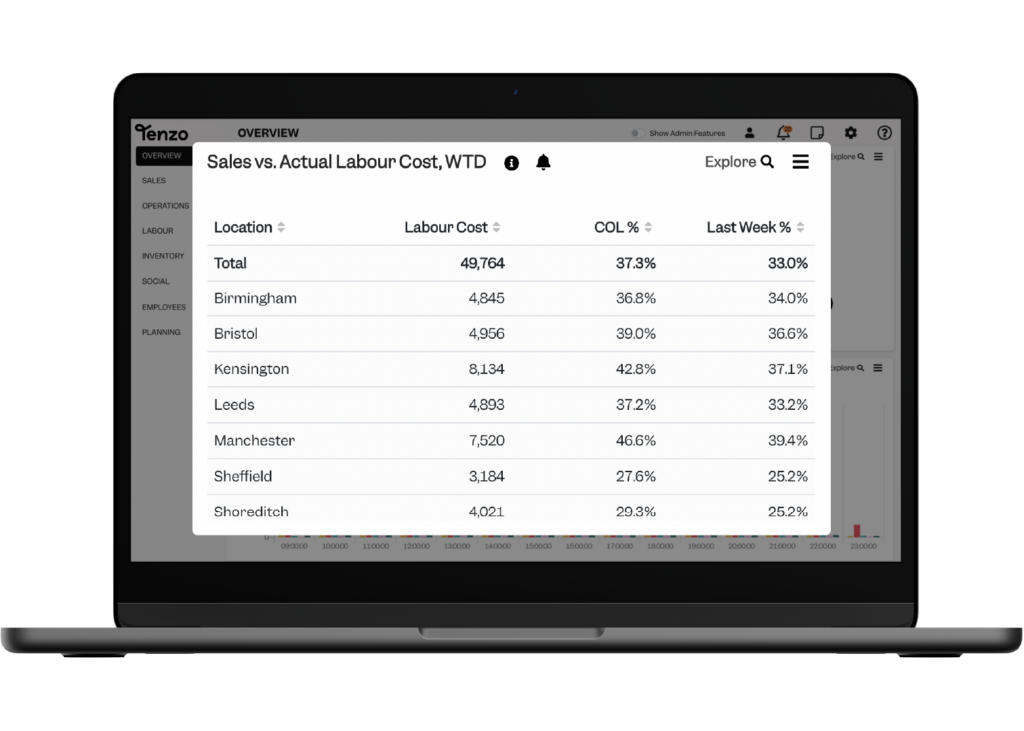
Labour productivity is one of the most important metrics to monitor when it comes to restaurant performance. Managing sales by labour hour means controlling costs by optimising your labour spend; this can be based on either improving employees’ productivity or the restaurant as a whole through effective deployment.
Effective deployment of staff
Staffing according to demand is really important so that staff neither feel overwhelmed nor bored, but that there are also enough people to deal with busy periods. Demand forecasting allows you to prepare for the number of covers during each service so that you can deploy staff appropriately and boost restaurant performance.
Shift patterns within restaurants can be rigid with everyone’s shifts ending or starting at the same time, this either leads to staff feeling unsure of the current restaurant’s customer needs or having both teams having to overlap for a long period. Implement a staggered handover time where one person from each team overlaps shifts with everyone else – leaving the restaurant running smoothly with high customer and employee satisfaction.
Trends and technology
Introducing technology within your business reduces the requirements for employees to do time-sapping administrative tasks; your team is more likely to enjoy their work if they feel it’s of value to the business.
Data collation is another task that has previously been a huge part of the general manager’s role. For example, Nona’s GMs used to spend 2 hours every week collating and understanding data, that time is now freed up to implement the changes that increase performance.
Using your own restaurants’ data to improve team productivity can be useful. Trends can help to identify which of your team are the highest performing. These team members can be an asset in training up the rest of the team: allow underperforming team members to shadow them so restaurant sales continue to improve.
Training
Staff training programmes are a great way to enhance labour productivity, helping to increase sales and profitability, while also helping staff gain more skills for their careers. Low training was cited as the main reason for leaving by 34% of staff.
Another benefit of good training schemes is that you’re able to employ less experienced staff, with the knowledge that they should be up to your restaurant’s standards very quickly. Saving the business more money, and expanding the potential talent pool.
Conclusion
High staff turnover is a prevalent issue within the hospitality industry at the moment with everyone feeling a pinch in applicants and the necessary resources to pull in the few there are. Working on improving your restaurant retention rate is a great way to avoid this problem, and save money on the hiring process.
Take advantage of the resources available to you to manage your staff efficiently, ensure that they don’t feel overwhelmed and help them improve their productivity so that your restaurant sees the benefits of improved performance.
The post Labour Productivity | Drive restaurant performance and staff retention appeared first on Tenzo.
]]>The Tenzo team spent a few days at Hotel, Restaurant & Catering (HRC) in March. Hosted at the ExCel Centre in East London, we got to chat with some of our partners and customers as well as a lot of new faces! Attending also had the added benefit of hearing from some of the best […]
The post Hotel Restaurant Catering (HRC) | Key learnings to boost performance appeared first on Tenzo.
]]>The Tenzo team spent a few days at Hotel, Restaurant & Catering (HRC) in March. Hosted at the ExCel Centre in East London, we got to chat with some of our partners and customers as well as a lot of new faces!
Attending also had the added benefit of hearing from some of the best in the industry – learning about new practices and technologies within the restaurant industry.
We thought we’d pull together everything we found out over the three days – here’s what we learnt!
Our top learnings from HRC to drive restaurant performance
Improving Employee Retention
Craig Prentice, the founder of mum, chatted with Olajibe Alabi and Kerry Crompton who work in people and well-being at Turtle Bay and The Compass Group, respectively.
Everyone knows staff turnover and labour shortages are prevalent issues within the restaurant industry at the moment, with 34% of restaurants in the UK experiencing struggles with retaining staff, but the speakers had some great advice for retaining the talent you have.
Here are some of our key takeaways from the talk:
- The first 6 months are the key focus when trying to improve your employee retention – it is the make-or-break period for most staff; and the time when turnover is the highest.
- Invest in employer branding, It is a candidate’s market, and you need to use it to sell your brand – showing you’re the best possible employer. Gen Z are more likely to work somewhere they feel shares their values.
- Engage with your staff and understand what they would like as part of benefits packages, or before moving forward with initiatives. They can be expensive to implement, so understanding what would stand out to prospective candidates and your current employees is really useful – this goes a long way in fostering trust.
The Digital Worker
Aneesh Gupta, the Founder and Managing Director of Centelli, led discussions with Neil Cryer, from Village Hotels, and Melanie Cole from the Clermont Hotel Group on how digital workers can improve efficiency and reduce the workload for overstretched staff.
Some of their top tips were:
- When implementing new technologies, start small and build up from there.
- Staffing shortages make automation a solution and give staff time to focus on tasks that bring value to your guests, and therefore business.
- New technologies can be met with resistance; ensure there are champions within your business that are on board with the latest ideas: their enthusiasm makes the entire team’s transition easier.
- Customers are often unaware of automation processes altering their experience, whilst the operators have access to all the benefits.
- Systems can work for 24 hours, meaning there aren’t any missed opportunities.
Building a Sustainable Future
Robert Richardson, the CEO of the Institute of Hospitality, led a talk with Andrew Coney, Erin Ling, Daniel Pedreschi, and Tej Wallia (from The Hari Hotel Belgravia, University of Surrey, PPHE Hotel Group, and Foxhills Club and Resort respectively).
Key points of their discussion on how technology can help build a more sustainable industry included:
- Take into account the social impact of implementing new processes.
- Use consultants, who have experience working with operators, to ensure that you make the changes most suitable for your business.
- Training is vital in ensuring the success of new rollouts, staff not properly trained result in increased costs and reduced sustainability – they can also damage the assessment of new technologies.
- Factor in energy usage as part of staff bonuses, at the newest PPHE hotel they managed to save 34% on energy costs with incentives to reduce usage.

Dark Kitchens
Chris Joliffe and Joe Heather, from Kobas and Deliverect respectively, discussed the shifting definition of dark kitchens. Previously they were thought to be one kitchen cooking for multiple delivery brands, but now, many restaurants are using dark kitchens to facilitate the growth of their brand.
Some of our key takeaways included:
- Increasing consumer intelligence, and awareness of spending, is pushing the quality of deliveries to improve, promoting this shift in dark kitchen usage.
- Dark kitchens can add incremental revenue to your business, using the excess capacity within the current restaurant kitchen space and employees to provide external income.
- Using your main restaurant as a central production kitchen and outsourcing the finishing processes is crucial to the success of expansion. It ensures the continuity of the brand and the quality of food whilst taking advantage of the already strong team in place.
- You generally have 6 weeks to ensure success with dark kitchens, use your data and technology to make sure every single order is high quality.
- If you’re starting a brand from scratch, focus on what you have a passion and drive for.
Tech for Pubs
The CEO of BII (The British Institute of Innkeeping), Steve Alton, led discussions on how technology should be higher up the priority list to help overstretched pubs and bars. He was joined by Mark Robson, Director of New Dawn Pubs, Mark Holden, a BII ambassador and the director of Inn Cornwall, and Tom Brady; the Co-Founder of GigRealm.
Food and energy are crucial parts of business for restaurants and pubs, and inflation is causing booming costs. This, alongside increasing labour costs, means that there are lower profit margins.
Some of the key points of discussion when considering technologies were:
- Identify the need first and then find solutions to plug it in that will make a difference.
- Find different data solutions that will integrate and talk to each other, allowing for a more holistic understanding of your business.
- Think about, and make sure, you’re improving the customer journey or the efficiency of your business with every tech addition.
- Voltage management systems can help to control energy consumption, and manage costs in real-time – this saved New Dawn Pubs around 15%.
- Installing solar panels is a great way to inject sustainable energy into your business, and save costs. Inn Cornwall installed over 40 solar panels, and in some months this saved them 19%.
Return on Investment in ESG
Domini Hogg, the Founder of Tried and Supplied led the discussion with members of the audience on measuring return on investment for introducing sustainable processes.
Key points of discussion included:
- Implementing sustainable processes takes time, and results take even longer, making measurable ROI challenging.
- Looking at ESG investments as part of a marketing strategy, tapping into consumers’ drive to be more sustainable is useful. Use it as part of a long-term brand awareness investment, rather than an immediate increase in revenue.
- There’s a huge amount of value in consumers’ understanding of the farm-to-fork journey. Provide emotive supplier stories, with sustainable messaging, helping to drive a passion for the product.
- Make information accessible to consumers with QR codes on menus, or links on your website championing your primary suppliers.
Marketing with a Budget
Gemma Rollason, Partnerships and Fundraising Manager at Hospitality Rising led the talk with the Founders of The Burnt Chef Project, The Love Your Pub Group, and Fired Up Collective.
Key takeaways from their discussion included:
- Government support for businesses in the UK is ending, and due to inflation, it leaves businesses in a worse position than during the pandemic.
- Marketing can be an area that many restaurants feel does not need a budget, so being able to market on a budget is really valuable.
- Social media is one of the easiest ways to drive traffic to your restaurant, but it can be time-consuming. Be omnipresent and use every communication tool possible.
- Pull on varying demographics within your team for ideas, and use them to find how to best resonate with your target audience.
- Optimise your SEO to boost customer numbers. Write blogs to increase website traffic; promote the industry, suppliers and venues. Be relatable to consumers and industry professionals, without trashing the industry.
- Be adaptable and make changes to always stay relevant. Change graphics and copy of adverts to keep things interesting.
- Follow the data, and understand what works best for you by looking at the trends.
Conclusion
It was great to hear from so many amazing speakers at HRC 2023. Restaurant performance is always at the forefront of Tenzo’s mind; so hearing about successful initiatives from operators to combat the constant new challenges in the hospitality industry is always a great opportunity.
Focussing on all aspects of your business, from marketing and ESG to employee retention and technologies; keeping an eye on what other businesses are doing helps you to stay ahead of the challenges, and boost performance.
The post Hotel Restaurant Catering (HRC) | Key learnings to boost performance appeared first on Tenzo.
]]>As the first employee of Tenzo to go on maternity leave, I was faced with the challenge of creating a new return-to-work plan. With no established policy beyond the statutory one from the UK government, I wasn’t sure what to expect. However, I saw this as a fantastic opportunity to create a plan that would […]
The post Creating a Return-to-Work Plan: My Experience appeared first on Tenzo.
]]>As the first employee of Tenzo to go on maternity leave, I was faced with the challenge of creating a new return-to-work plan. With no established policy beyond the statutory one from the UK government, I wasn’t sure what to expect. However, I saw this as a fantastic opportunity to create a plan that would help any employee returning from leave, whether it be parental or health-related, feel welcome and supported.
To gather ideas for the plan, I reached out to my local mum’s network, a WhatsApp group with over 300 participants. I asked them to share their experiences returning to work and to tell me what their companies could have done to make the transition smoother for them and their families. After collecting their feedback, I was able to create a comprehensive return-to-work plan.
Tenzo’s return-to-work plan includes;
Phased Return
One thing I was not ready to hear before I got pregnant was how my life would completely change (including my professional life). Even if I had everything ready on paper and I had set a date for my return, when the time came to leave my child for a few hours, it was harder than I could ever imagine. This is commonly known as separation anxiety and it can have an impact on both parent and child, especially when returning to work.
By implementing an optional phased return plan that allows parents to gradually build up their hours over the first few weeks back at work, it can have a really positive impact on both moms and babies to get used to being apart, and the children start getting used to their new carers without it being a shock to the system.
At Tenzo, I was given the option of working 3 days a week during the first month, then transitioning to 4 days during the second; and using my annual leave days I had accrued during my leave to still be able to receive my full salary which I am very thankful for since childcare costs can be quite expensive in the UK. I also noticed many moms used this approach at work (or wished their companies allowed them to do so!)
Flexible Working Hours
One of the benefits of working at Tenzo is that we get flexible working hours on a hybrid working model (it’s only mandatory to come into the office on Wednesdays) regardless if you’re a parent or not.
We have adapted to the new normal and have really seen the benefits of providing the team with the freedom to work wherever they can perform their best (either at home or in an office).
In my case, as a full-time working mum, having the flexibility to jump on a call while I was walking my baby to the nursery, or leaving the office early and finishing my tasks just after bedtime on my own terms made things way less stressful and takes away the pressure to “bounce back” to my old 9-5 routine pre-kids.
Better Communication
Since day one (and even before my return), I have been in constant communication with my managers. I used my Keep in Touch days to receive the latest updates from the company and kept an eye on my inbox so I wouldn’t be drowning in emails on my first day back.
From my own experience in Tenzo, my team was always very vocal about how excited they were to welcome me back and likewise, I felt safe to share with them my feelings when things were not going great.
There were times when I noticed I was slower, it was harder to concentrate and I had made a mistake or two in tasks I was doing. It seems like I am not the only one who feels the same. Mom brain – where new mothers might be a little bit more forgetful due to all the hormonal changes after birth – has been recognised as a real phenomenon (something I can definitely attest to!).
So being compassionate, empathetic and understanding is the key. Knowing that the employee might forget some things, and might need a reminder or two on the first week about all updates, news, changes, etc (internal and external) that have happened during their absence. Also, having an open and honest conversation about what the expectations are and plans for their return can help to ease anxiety and boost confidence.
Re-Onboarding
At Tenzo, we realised that returning to work after a leave of absence can be like starting a new job, especially after long leave periods. To help ease the transition, we developed a re-onboarding process in Notion that included reintroducing the employee to the team and updating them on any changes that occurred while they were away.
Some of the items to cross off include:
- 1-1 catch-ups with the team
- Intro with new team members
- Product updates
- Internal updates
- Customer updates
- Handover process
- Quarterly goals
- Library of important links and information
Not only for Parents
Tenzo prides itself on being an inclusive workplace, and although there is a lot we still need to work on, I think we have created a blueprint for the new parents and any employee that returns to work from an extended leave (e.g. Sick leave, Compassionate leave, Sabbatical, etc) and hopefully this is one less thing they will need to worry about when the time comes.
Summary
To sum up, this is what Tenzo has implemented for our return to work experience:
- Offer a phased return over the initial months
- Have flexibility around working hours
- Keep an honest and open communication
- Offer a safe environment for new mums: (eg breast pump if needed, a private room for pumping in the office)
- Use of different channels of communication (email, slack, calendar) as reminders
- Re-onboard is very similar to how we would onboard a new joiner
- Kindness: acknowledge the employee needs time and support while they get adjusted
On a personal note, I want to thank Tenzo for the support. Before, during and after my leave, I feel very lucky to work with a company that truly cares about their people.
The post Creating a Return-to-Work Plan: My Experience appeared first on Tenzo.
]]>The COVID-19 pandemic brought about a huge boom in delivery orders, with the industry growing by £3.7bn in 2020, and one in twelve people ordering food to be delivered for the first time; leading many people to pivot towards a delivery model. However, gone are the days of being stuck indoors(!) and the reopening of restaurants alongside […]
The post Food Delivery Apps | How to stand out on them post-COVID appeared first on Tenzo.
]]>The COVID-19 pandemic brought about a huge boom in delivery orders, with the industry growing by £3.7bn in 2020, and one in twelve people ordering food to be delivered for the first time; leading many people to pivot towards a delivery model.
However, gone are the days of being stuck indoors(!) and the reopening of restaurants alongside the rising cost-of-living has caused a decline in the number of orders, with Just Eat seeing a 10% fall in UK orders. Not only is the number of orders decreasing, but the amount being spent on each order is too – with Deliveroo’s average gross transaction value falling by 4%. All is not lost though, maximising your ROI and standing out on delivery apps is still more than possible, below are some tips to help you on your way!
The cost-of-living crisis is affecting everyone, being predominantly caused by inflation outstripping salary increases. The annual rate of inflation hit a 41-year high in October at 11.1% thanks to increasing costs of consumer goods and rising energy prices.
Rising food prices are also a key driver in inflation, with the average transaction value increasing for supermarket shops but the number of items purchased decreasing. Now, we can all get a lot less for our money than we used to: food and non-alcoholic drink prices have increased by 14.6% in the 12 months before September.
How to combat growing costs and succeed on food delivery apps
Create Virtual Brands
If you’re a restaurant looking to branch out into the delivery scene, or you’re already part of it, and you’re looking to accelerate success there are a number of ways that you can stand out and increase sales: starting with creating a virtual brand.
Creating a menu for a restaurant can be very different than for delivery, creating a virtual brand gives you the opportunity to create a new revenue stream by adapting a menu solely for delivery use. Not only this, but restaurants can create a number of virtual brands out of the same kitchen, all with different themes, massively increasing the chances of receiving orders.
Virtual brands also provide an opportunity to use products usually wasted in the restaurant. The entire brand, or menu items within it, can be created with the focus of using up products that aren’t being used by your restaurant normally.
Tackle the Delivery App Commission Charge
One of the issues that restaurants face when thinking about launching on delivery apps, is the amount of commission that these apps take, meaning that the profit margins are much lower than when selling food traditionally from their restaurants.
Deliveroo and UberEats typically charge restaurants 31% and 25% commission respectively, making it tricky for restaurants to maintain their profit margins. One way to get around this is menu inflation – increasing the price of menu items to combat commission costs, but it could also be off-putting for customers as on average they’re spending 23% more on a takeaway app than when ordering direct from the restaurant.
Another way to avoid such high commission costs, is to become exclusive with one delivery service; some apps allow a waive in costs if you’re only available with them.
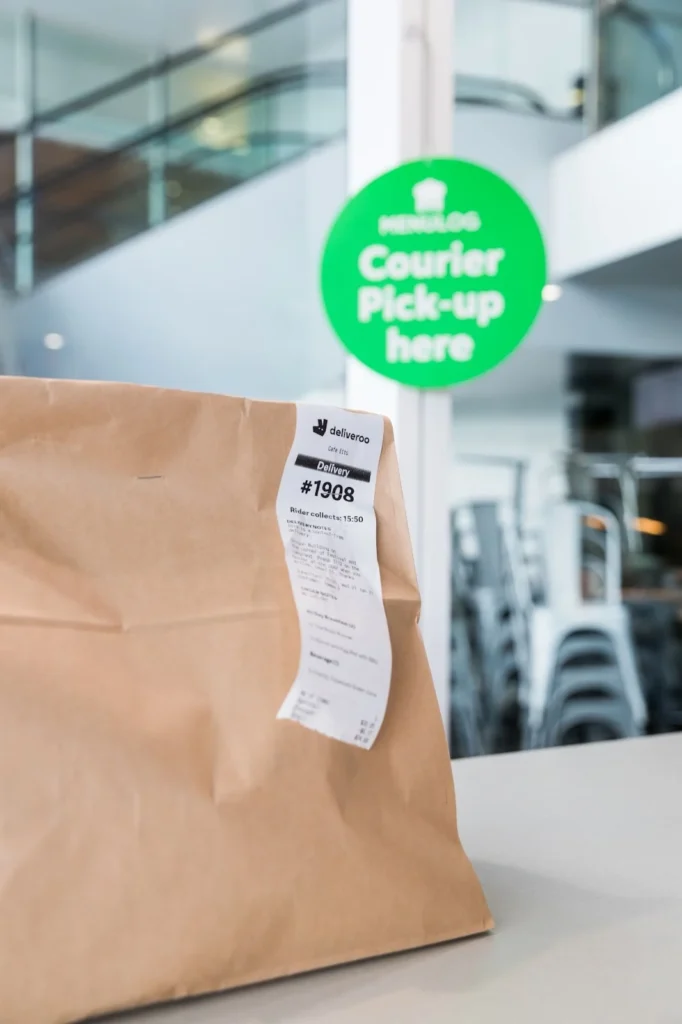
On the other hand, appearing on more than one delivery app could increase sales by up to 70%. Managing orders from multiple delivery apps means using multiple tablets, this multiplies exponentially if running virtual brands, causing operational issues. Most can’t connect to your POS or kitchen display system, requiring someone to have to input this information manually.
This process is inefficient, but can be simplified by using a delivery aggregator, like Deliverect, that aggregates all your online orders from different sources. All your orders print in one location, so you don’t have to run multiple systems, or manually enter orders into your POS. Instead of guessing which app your customers are using, you can be on all of them – and reach more customers – without the extra hassle of managing each one separately.
Improve Your Ranking on Delivery Apps
Improving your restaurant’s ranking on these delivery sites is a great way to boost sales and make the most out of this extra revenue stream. There are a number of ways to ensure your ranking is higher than your competitors, including using pictures on your page.
Using Images
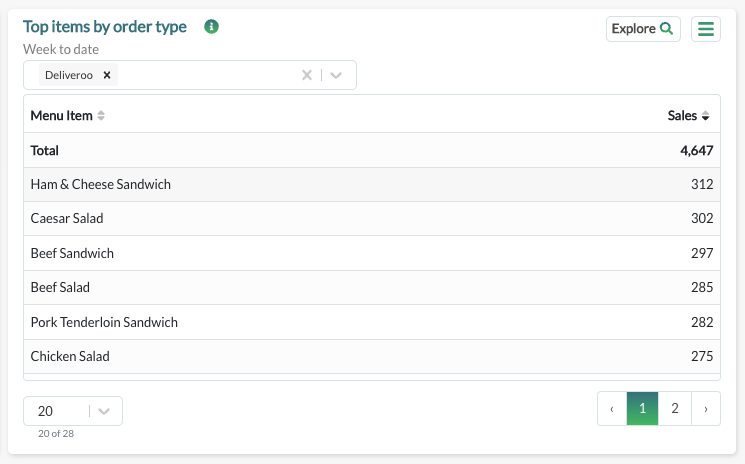
Pictures are a great way to show your potential customers how good your food looks and this can boost your sales by 24%.
Tenzo can help you identify which might be the best dishes to photograph; using graphical data to show you which are your best-selling dishes.
Customer Reviews
Customer ratings are a huge part of increasing your standings with individual delivery apps, and a number of factors can influence how well a customer would rate your restaurant including taste, delivery accuracy, the temperature on arrival and speed of delivery.
Temperature of Food on Arrival
Speed of delivery is another important factor for both customer satisfaction, 60% of consumers say this is a key factor in ordering online, as well as the temperature of the food on arrival – the faster the delivery the warmer the food.
Packaging is also an important aspect of ensuring the correct temperature of food on arrival, you should encourage drivers to have insulated bags and separate hot and cold items within them.
Busy Mode
Busy mode is a really useful tool to not get overwhelmed by orders during your busiest periods, or maybe when you’re understaffed. However, leaving busy mode on for too long or using it too regularly can damage your ranking on the apps due to not receiving many orders, compared to other restaurants. Get alerted when you haven’t had new orders within the last 30 mins to ensure it’s not left on.
Preparing for Demand
Preparing correctly for the busiest times is essential so that you can accept as many orders as possible, understand your demand forecasts for your busiest days and hours so that you can maximise your sales potential by preparing with the right amount of labour and food.
Increasing Page Traffic
Increasing traffic to your pages on delivery apps is another great way to improve your ranking within them. One of the easiest ways to do this is to let your loyal dine-in customers know about your presence on delivery apps by giving them special discounts to use.
You could also advertise on your social media pages, this is essentially a free advertising method, reaching out to those who are already interested in your business – putting a link on your social media page is an easy way to direct people to your page.
In-app Promotions
In-app promotions increase the likelihood that you’ll be ranking higher on delivery apps, as well as increasing your number of sales. Generally, you’ll rank higher on apps during your busiest periods; identify these periods and offer in-app promotions during these times to further boost sales. This further solidifies your position as being a popular restaurant during these periods, allowing you to develop a consistent workflow.
Another way to decrease costs, whilst also boosting sales, is to promote menu items you’re in excess of by putting discounts on these specific items; increasing the chances of someone purchasing them – and reducing waste!
Conclusion
Finally, keeping on top of trends is always important within the restaurant industry, but if you’re new to the delivery sector, this is an especially good idea to keep an eye on. If menu items are continuously performing badly, get rid of them. If there are menu items that are performing well, create more like them.
Delivery apps are taking a bit of a hit in sales after a huge boom post-COVID, but that’s no reason to suggest that they’re not great ways to boost sales. Standing out on these apps and being high-up in their rankings is hard and it comes down to a number of factors, but delivering great quality food, within expected times, is a great place to start!
If you’re interested in speaking to one of our restaurant experts about how we can help you get the most out of deliveries, please reach out!
The post Food Delivery Apps | How to stand out on them post-COVID appeared first on Tenzo.
]]>Much of a restaurant’s value is in its inventory. Inventory valuation is also a major factor in calculating your net profit. But how do you calculate the substantial investment represented by inventory? And how does inventory value apply to your profitability? And how do you do it most accurately? The answers lie in the choice […]
The post Guest post: What Food Costing Methodology Are You Using? appeared first on Tenzo.
]]>Much of a restaurant’s value is in its inventory. Inventory valuation is also a major factor in calculating your net profit. But how do you calculate the substantial investment represented by inventory? And how does inventory value apply to your profitability? And how do you do it most accurately?
The answers lie in the choice of your costing method. There are various tried and true methods of inventory valuation and food costing methods that are widely recognized as effective.
It’s Easy to Get it Wrong: Mistakes in Inventory Costing
There are effective costing models, but many restaurants make inventory costing mistakes, like:
- Ignoring waste, spoilage, and theft: restaurants relying on manual inventory management may miss waste, spoilage, or theft when calculating inventory costs, leading to incorrect inventory counts and inaccurate profitability estimates.
- Incomplete inventory counting: failing to account for ALL inventory items when calculating costs leads to inaccurate inventory valuations.
- Using inaccurate data: using outdated, incorrect inputs, or inaccurate cost data when calculating inventory costs leads to inaccurate inventory costing.
To avoid these mistakes, managers need to be sure that they are accounting for all inventory items, accounting for waste, spoilage, and theft, using up-to-date and accurate data, and correctly applying the most appropriate inventory costing model. And as any veteran restaurant manager knows, regular physical inventory counts are required to compare and reconcile inventory on-hand with the theoretical inventory on the books. Accuracy is a necessity.
The Start: Calculating Inventory Valuation
Restaurant inventory valuation is the process of assigning monetary value to a company’s products. In a restaurant that means the items on the menu.
Inventory is the stocktake, food, and ingredients in your storerooms, fridges, and freezers. When it comes to inventory valuation, however, everything that goes into making a menu item is taken into account. The total calculation needs to take into account:
- Overhead cost: labour, utilities, technology, advertising, marketing, and other budget items that keep your restaurant running.
- Food cost: your food cost is what’s sitting on your shelves, fridges, and freezer.
- Direct materials: what other materials are needed to make each dish? This includes the average cost of kitchen equipment, cooking utensils, and plates.
Delivery cost: If you offer delivery service, the cost of food prep for travel, delivery drivers, and gas should be factored into your inventory valuation, as well.
The Methods of Food Costing
To know the cost and value of your food inventory, you obviously need to know first what’s in your inventory. After that, use your chosen food costing model. There are common ways to determine inventory value. The best one for your restaurant will depend on the kind of inventory you carry and your business model.
WAC
The weighted average cost of inventory is determined by the total cost of goods sold (COGS) divided by the number of goods in inventory.
To figure out your inventory cost using WAC, take a look at your inventory software solution. Find the cost of each food or ingredient, and then divide it by the amount of that item in your inventory.
This gives you a more consistent value of your stocktake, rather than a value based on when the goods were purchased.
To calculate WAC, calculate the average cost of each item by dividing the total cost for that category by the number of items you have in that category.
If your restaurant bought 10 lbs of apples at $.060 per lb on Monday and then bought another 10lbs on Friday at $0.65 per lb, calculate your valuation using the oldest price up to the point of the price change.
So, the weighted average cost for all the apples you have would be:
(10 x 0.60) + (10 x 0.65) = $0.63
FIFO
With First In First Out, ingredients with the latest expiration date are used first. With the continuing rising cost of food, this means a restaurant is spending more, but the financial burden is minimized because there is less food waste.
The formula for the FIFO method looks like this:
Cost of Oldest Inventory per Unit x Units Sold
If your restaurant bought 10 lbs of apples at $.060 per lb on Monday and then bought another 10lbs on Friday at $0.65 per lb, calculate your valuation using the oldest price up to the point of the price change.
LIFO
The Last In First Out method isn’t quite as popular unless the business model uses a large stock of non-perishable goods. With LIFO, older items cost less to purchase, so using more expensive newer items and valuing them at cost offsets those expenses.
Calculating LIFO is simply a matter of tweaking the FIFO formula:
Cost of Newest Inventory per Unit x Units Sold
If you bought 20 cans of tomato sauce at $2.00 per can last month and the same amount at $2.50 per jar this month, you would work backwards, using the more expensive price until the date the price went down.
Inventory Replacement Cost
With this method, the cost is assigned by the amount of money spent to replace items in your inventory. This number fluctuates frequently, depending on the market.
Specific Identification Costing
This method tracks the cost of each item of inventory. This method is usually used for high-value items or items with unique characteristics, such as fine wines or speciality cheeses.
Net Profit and Inventory Valuation
The food costing and valuation method you choose has a direct impact on net profit. If you choose the FIFO method, for example, you may have a higher net income because you’re selling the goods that cost you less money first but selling them at current market prices. On the other hand that also gives you more taxable income.
Choosing the Right Inventory Valuation Method for Your Restaurant
FIFO is the one most used by restaurants, particularly for those with a menu focused on perishable goods. This method enables a reduction in food waste and maximizes the cost efficiency of their stocktake, which can offset higher taxes.
LIFO is less popular, simply because it usually doesn’t suit many restaurants’ business models. Most restaurants do not use more non-perishable items than perishable ones.
The WAC method may be a good fit for restaurants that deal with a consistent, high-volume inventory. This model often creates a clearer picture of each item category without spending time figuring out the cost of each item while considering current market value.
When owner/operators apply their inventory valuation method – whichever one they use – a deep understanding of what’s in inventory is required to start. How much does each item cost and what are the costs associated with each menu item? How much of each item do you sell and how much sitting inventory do you have?
Effective inventory valuation is deeply tied to best practices in inventory management.
Inventory Management and Inventory Costing
It’s estimated only 50% of restaurants use back-of-house automation to make tedious and time-consuming tasks like inventory management more efficient. That means 50% of restaurant managers are relying on spreadsheets and checklists and that weekly “inventory tour” of the fridges, stock rooms, and shelves.
Inventory is time-consuming. And tedious. IT. IS. A. CHORE. But it is a fundamental task for food costing. Automating inventory management can help optimize inventory costing. Streamlining and simplifying inventory management reduces the risk of errors and provides real-time analytics into what impacts profitability.
Automating Labour-Intensive Inventory Management Tasks
Inventory costing can be improved by more accurate inventory management. Manual inventory management can be difficult and error-filled. In fact, restaurants can reduce inventory mistakes and overstocking by 17% by implementing an inventory management application.
Here are some ways replacing manual inventory management with an automated inventory management software platform can help:
- Automated tracking of inventory levels: automatically tracks inventory levels by monitoring sales, purchases, and production, eliminating manual tracking and reducing the risk of data entry errors.
- Intelligent Inventory data: provides real-time data and business intelligence on inventory levels, costs, and usage, and can help managers make more informed decisions about purchasing, pricing, vendor selection, and cost control.
- Automatic inventory costing: flexibly calculates inventory costs using various methodologies, such as weighted average cost, first-in, first-out, or last-in, first-out. This can save labour time, reduce the risk of errors, and increase profitability.
- Integration with other systems: inventory management systems can integrate with other systems, such as front-of-house point-of-sale platforms and accounting software, to provide a real-time picture of inventory levels, costs, and sales.
- Ease labour shortage pains: Software as a Service (SaaS) and the appropriate restaurant technology allows restaurant managers to do more with less – eliminating profit-draining manual and time-consuming tasks. The reality is that automated inventory management can cut hours off a manager’s weekly inventory.
- Easier vendor management: generates automated purchase orders when inventory levels fall below a certain level, which can streamline the ordering and replenishment process and ensure that inventory is always stocked.
Inventory management platforms provide business intelligence in real-time and help restaurants save time, reduce errors, and make more informed decisions about inventory costing, purchasing, and cost control. By using an inventory management system, restaurants can improve their inventory costing processes and maximize profitability.
MarketMan is an inventory management platform that helps restaurants keep costs under control and efficiently manage inventory by automating back-of-house operations. MarketMan’s cloud-based inventory management and purchasing solution simplifies all back-of-house operations, streamlining everything from inventory to budgeting, reporting, and supplier management. MarketMan empowers restaurants to: save time, save money, and gain control.
The post Guest post: What Food Costing Methodology Are You Using? appeared first on Tenzo.
]]>Before joining Tenzo, I served as a U.S. Army reconnaissance and operations officer from the Platoon to Division level (about 10,000 soldiers) and experienced how crucial proper data and intelligence is to mission success. I’d like to share my insights from the Army and working with restaurateurs to explain how a data strategy will help you […]
The post The Tactical Restaurateur: What can be learnt from a US Army officer. appeared first on Tenzo.
]]>Before joining Tenzo, I served as a U.S. Army reconnaissance and operations officer from the Platoon to Division level (about 10,000 soldiers) and experienced how crucial proper data and intelligence is to mission success. I’d like to share my insights from the Army and working with restaurateurs to explain how a data strategy will help you grow your top line and become a tactical restaurateur.
NOTE: We’ve previously written about how Tenzo and a proper data plan can affect the other end of your balance sheet by decreasing your labor costs and food waste by 10%.
As a US Army reconnaissance officer, I gathered information on the enemy – location, disposition, movement – and fed that to my command.
As an operations officer, I experienced how my reports and data sources were critical for our commanders to develop a successful battle plan to exploit our enemy’s weakness.
After the Army, I wanted to work at Tenzo because I realized how difficult and time consuming it was for restaurateurs to use their data to paint an accurate picture of what was happening at their restaurants. Their data was inaccessible, unsorted, and un-actionable. Their decisions had to be based mostly off intuition, not the proper “recon” reports I previously had. Tenzo is your restaurant command center, making sense of the numerous reports and data you receive.
1. Create a growth plan based on quantitative data
Report only what you observe – this is a fundamental of reconnaissance that was hammered into me. I learned to steer away from gut decisions and use only the quantifiable information available, because our intuition is full of bias and can often result in poor decisions especially when you’re tired from working around the clock on reconnaissance missions. I needed to feed the rawest data possible to my commander so our intelligence team could use that information and their knowledge on the overall situation to interpret my data and reports.
The same fundamentals of reconnaissance apply to your restaurant operations. Executives and managers must analyze the data, not just their intuition, to decide how to best grow. Will you increase footfall, average guest spend, or sell more of your higher margin menu items? Is it mission critical to achieve this during a certain meal period or a day of the week?
Tenzo integrates with your current data sources to bring all your sales, labor, and inventory data together, so you can develop the right growth plan for your business. You’ll know where your past growth has come from, when it occurred, and at which locations.
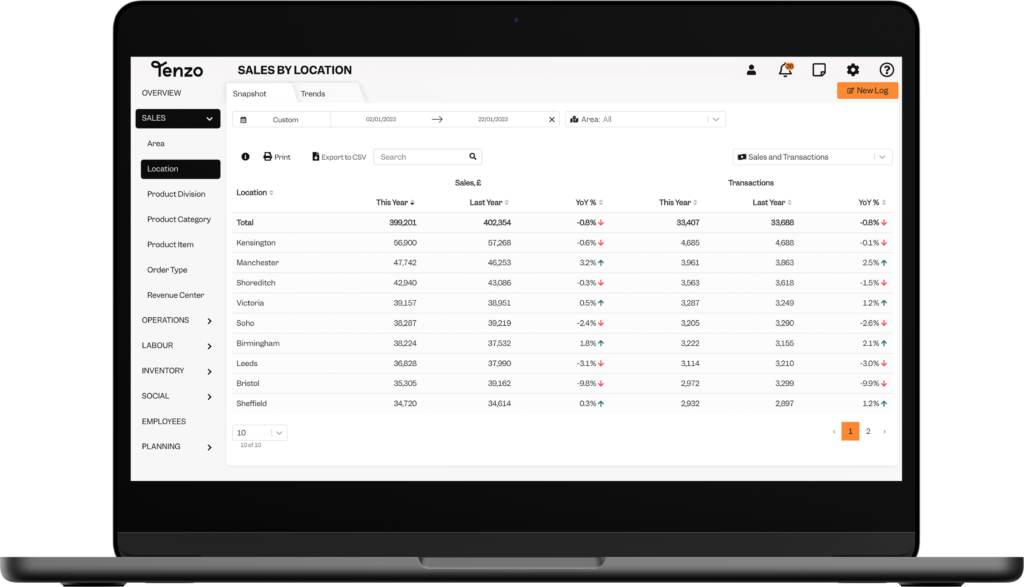
For example, with this fictional restaurant chain (image above), it becomes quantifiably apparent that the previous Year on Year (YoY) growth has come through increasing the number of transactions by 16.9%, but your average spend has only grown 0.2%. Additionally, this growth hasn’t been true for all the locations, with Leeds experiencing a 37% decline in transactions.
The right growth plan for this restaurant might be to increase average transaction size while maintaining or growing footfall, especially at Leeds, Bath, and Birmingham.
2. Empower your managers to achieve these objectives
An overall strategy for your restaurant is powerful, but each general manager and location will need to slightly tailor the plan for their unique situation and determine how to best achieve this. The Leeds manager might need to focus on increasing guest count while the others need to focus on guest spend.
The U.S Army employs “Mission Command”, which is the practice of empowering managers and junior officers to decide how to best achieve their individual objectives. This empowerment and decentralized command evolved because faster paced and more dynamic conflicts made it impossible for a central command to dictate every movement. This management style can pay huge dividends, but it requires that junior leaders have the necessary tools and information to make these decisions.
In the past, many restauranteurs have found this management to be difficult because data had been cumbersome to access. General and area managers did not have the time to download numerous CSV files full of data and create custom excel reports to understand their trends.
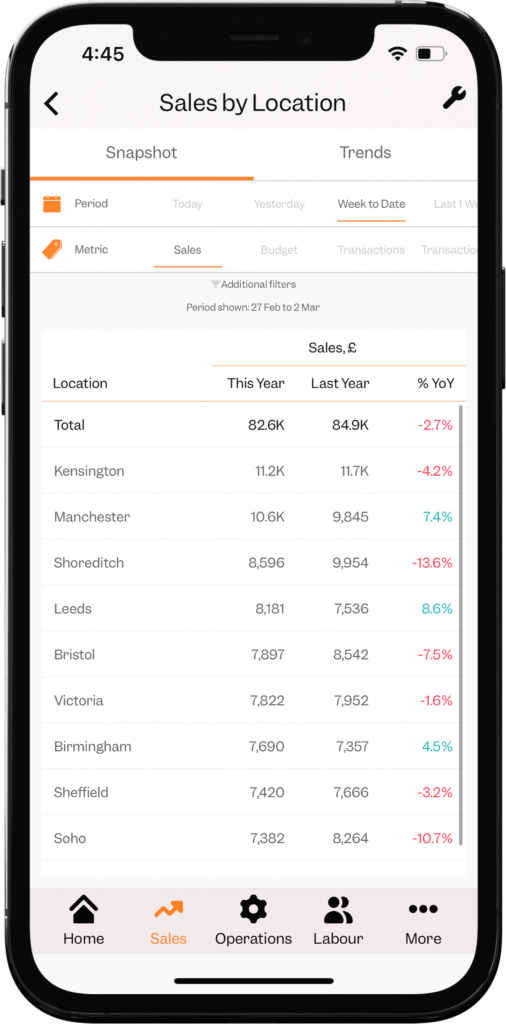
This isn’t the case with Tenzo. Tenzo will deliver actionable alerts to your managers when certain daily or weekly KPIs aren’t achieved and provide reports on their phone (iPhone and Android).
Now, the Bath General Manager can see that their particular location needs to focus on growth by increasing sales, specifically on Saturday, which is the only day they haven’t grown year on year.
3. Pull the right growth lever
The Bath manager needs to improve sales on Saturday, but how? Tenzo will alert this manager that Bath’s average guest spend has decreased, while footfall has actually increased. Now the manager knows they need to find a way to increase their average guest spend, which requires a much different technique than attracting more guests.
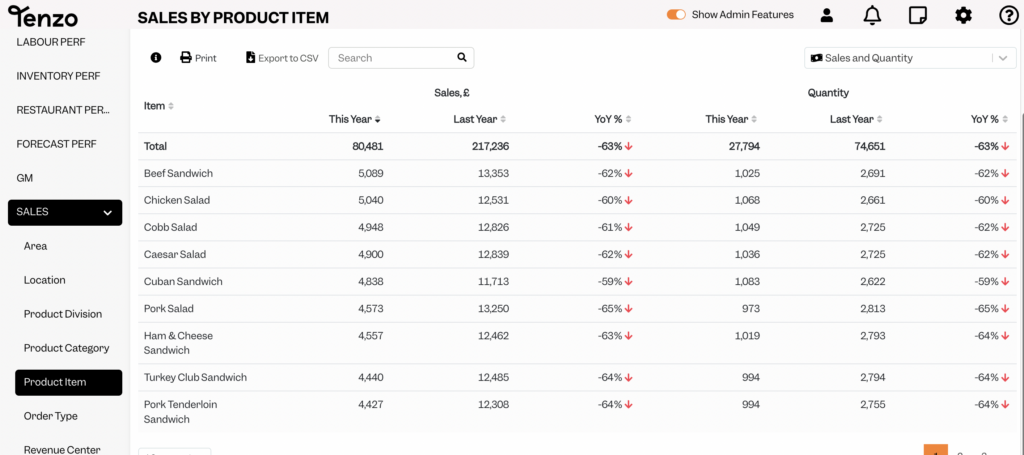
A common way to increase transaction size is to focus on increasing attachments, which typically are drinks, dessert, or starters. Tenzo will track attachment rate for this manager and alert them to which specific employees are selling the most attachments.
4. Ensure your team and managers stay coordinated
Growth is difficult and requires that the entire team is working towards the right goal and able to track potential warning signs. It is critical that your teams are able to stay coordinated and track their KPIs.
Tenzo helps with this through our Logbook and End of Day reports. This feature allows managers to create their end of day reports with Tenzo inserting the quantitative figures and KPIs. Tenzo will then compile every managers report and format them for the area managers and head office, saving time, increasing coordination, and allowing your team to easily access these reports.
.png)
5. Encourage competition, improve accountability
Competition and accountability were crucial factors keeping my army teams motivated. Restaurant staff are no different. However, creating an accountable and competitive environment in a restaurant is not so easy. Tenzo can help provide this environment through the use of leaderboards. For example, at the individual level, Tenzo provides performance accountability by ranking staff by average sales per hour as well as average transaction size and individual product item sales. At the team level, Tenzo can track location-level trends for social media reviews as well as individual location sales.
Data is crucial to increasing revenue
Basing mission plans on solid data made the army units I served in extremely successful. A data strategy is crucial to developing the right growth plan for your restaurant. AI and business intelligence are now becoming crucial in order to grow revenues, just reducing costs will not do, as reported by BCG. Tenzo is helping the restaurant industry achieve this growth.
If you’re ready to bring actionable insights to your business, please contact us to learn more.
If you feel you could use any help in understanding the tech eco-system which helps you gather data to make these actionable insights, then we highly recommend you reach out to Eposability. They specialize in helping you to drive growth from your systems and ultimately produce clear actionable data to make decisions from. We have also put together a short piece on what this eco-system could look like in our blog.
The post The Tactical Restaurateur: What can be learnt from a US Army officer. appeared first on Tenzo.
]]>January is a relatively slow time for both the restaurant business and most people’s social calendar after the madness of December, but restaurateurs and managers should not rest on their laurels this month. January is a time for renewed vigour and purpose, and you should be using the lull in business to re-assess, refresh, and […]
The post The Ultimate January Checklist for Restaurateurs appeared first on Tenzo.
]]>January is a relatively slow time for both the restaurant business and most people’s social calendar after the madness of December, but restaurateurs and managers should not rest on their laurels this month. January is a time for renewed vigour and purpose, and you should be using the lull in business to re-assess, refresh, and put together your plan of attack for 2019. If this year is going to be more successful than the last, riding the wave of purpose that January can bring along is absolutely essential. We’ve put together the ultimate January checklist for restaurateurs;
On the other hand, knowing where to begin and keeping track of all your tasks is a challenge in itself, especially with a head still reeling from NYE revelry. With this in mind, Tenzo have put together the ultimate restaurateur’s January checklist to set you off in the right direction. Follow this to get off to a galloping start in 2019.
For those who like pen and paper, the checklist is also available as a PDF to print out.
Alternatively, if you like to use a task-management tool, the checklists can be found here as a Trello board template. Just follow the instructions by clicking on the Tenzo logo inside the Trello board to make your own copy.
1. Set goals for your managers (or yourself)
High-level goals can be to improve three key metrics:
1.Sales – Target perhaps a 6% increase year-on-year. Be more ambitious if you are new in town. Do this via two paths:
A) Increase footfall by 3%. Closely monitoring your social reviews on platforms such as Google Places is one key to this – it has been found that 33% of restaurant customers won’t dine below 4 stars. Respond quickly and politely to bad reviews to increase the likelihood they will be retracted. Also make sure your concept is clear and your menu is 2019-ready (see other checklist items)
B) Increase upsell by 3%. Average Transaction Size (ATS) should be monitored regularly by optimising menu item combinations – (see other checklist item)
2.Cost of labour as a percentage of sales (COL) – 27% is a healthy goal. Perhaps target a 1% improvement each year, or choose to keep stable at around 27%. Technology such as a good labour planner coupled with Tenzo, our business intelligence platform, is a great path to reducing COL. Click here to learn more about Tenzo’s labour forecasting.
3.Cost of goods sold as a percentage of sales (COGS) – aim for a goal of 25%. Keep this stable or reduce it by a small increment at a time by paying attention to your menu items, portion sizes and prices, your suppliers, and your ordering efficiency/wastage. Tenzo’s best-in-class sales forecasting can drastically reduce wastage and improve COGS. Read how here.
2. Give each waiter a spend per head target
Look at spend-per-head averages for each of your waiting staff and set them realistic targets for improvement over the next few months. January is the perfect time to do this, as your staff will be primed for positive change, and the relative lull in business will give them the space to experiment and spend more time with customers. Base your targets on a realistic convergence with the spend-per-head of your strongest performers. Also, set your star performers targets; there is always room for improvement. Schedule check-ins with each staff member at monthly intervals to check on progress and renew motivation. Promising a bonus for those who smash their targets can help with motivation, but not always. If you sense that your staff are already well motivated to improve, offering a financial incentive can “crowd out” their desire to perform well for its own sake and actually cause them to lose motivation. For many, genuine praise, appreciation and the satisfaction of a job well done is a much stronger motivator than money.
Make sure there are up-selling opportunities available to your waiters.
Waiters can’t do much to increase spend per head if your menu is too rigid. Make sure you are offering enough add-ons and sides. Good examples of add-ons are guacamole added onto a brunch, vegan cheese added to a veggie-burger, protein add-ons for salads such as sliced chicken breast or grilled tofu, and edamame beans or bread and olive oil as an appetiser. Offering the option to upgrade the size of drinks, especially on more expensive items such as smoothies and wines, is another beneficial idea.Once added to the menu, educate your staff on which add-ons should be offered with which meals.
3. Recognise and reward your staff.
You may wish to reward or give special recognition to your staff, and particularly your strong performers this January. Your gratitude may not have shown during the hectic Christmas period, but don’t forget to let your staff know how much you appreciate them while you have the chance. January is the time for change and if they don’t feel valued, key staff members may do their own new year appraisals and leave your business. Show them some love.
Use quantifiable metrics
Make sure that if you single out particular staff members for recognition or reward, you do not sow resentment with others. A good way to avoid bad feeling is to make your rewards based on tangible, quantifiable metrics. Spend-per-head is a good one, as is average tips. You may also choose to recognise a member of staff for working a particularly high number of hours in 2018.
Don’t miss out on training opportunities
If one of your waiters had a particularly outstanding spend-per-head this past year, don’t miss out on the opportunity to let your other waiters learn from her. During the January lull, while your staff are less busy, they can be encouraged to take a step back and appraise their performance. Getting staff to observe a strong performer doing their stuff is a great way to have this happen organically. Just make sure the observation is subtle so as not to disturb customers. Tenzo can help provide quantitative sales performance metrics with its employee leaderboard module. Read more here.
4. Make sure your menu is ready for 2019 trends
The big food trend for 2019, as in 2018, will be an increase in the number of customers eating a vegetarian or vegan diet. The proportion of strict vegans to more traditional ovo-lacto-vegetarians is massively increasing, so be sure to add another fully vegan option to your menu. The gluten-free and wheat-free trend is also set to continue in 2019, so make sure you offer enough suitable options here too.
Also look out for other industry trend predictions, for example the results of the American National Restaurant Association’s annual “What’s Hot” survey. This year, the Chef’s surveyed predict that “globally inspired breakfasts” e.g. Shakshouka, plant-based sausages and burgers, and locally-produced spirits will be some of the big trends.
5. Identify your sales trends
During your January refresh, it’s a great idea to deep-dive into your sales data for the year to identify trends and opportunities. Determine which menu items are selling the best at specific times (time of day/day of week/seasonal), which helps focus your efforts in terms of inventory management. You never want to run out of ingredients for your most popular dishes, but on the flip side over-ordering these ingredients is a common cause of wastage in restaurants. Correct, accurate sales forecasting is key to ensuring you maximise margins.
Using sales data to engineer a menu is a complex topic deserving of its own checklist, but here are a few ideas to think about, that can quickly increase sales:
-
If you have one or a few items which dominate sales, consider adding similar items to your menu, and ensure that this item is customisable for all dietary requirements.
-
Poorly selling items are bad for your bottom line, regardless of how tasty they may be or how long they’ve been on the menu. Rarely ordered items cause ingredient wastage, so take a look at your bottom 20% of items. If you see that sales are not sufficiently high to avoid wastage, removing the item might be the best option. However, there may be other reasons why the item is not selling well, such as a bad name or description, or cannibalisation by another similar but more appetising item, so be sure to explore all possibilities first.
6. Schedule a short weekly social review meeting
Scheduling a regular meeting to go over reviews is incredibly important for your staff so they see all the latest feedback from guests. This provides both accountability and transparency of business performance, while also providing a platform to give credit to your staff when reviews are good. Tenzo’s social module allows staff to see all the latest reviews in real time as well as how each location is trending over any given time. Read more.
7. Build a calendar of local events and public holidays
Grab a few creative staff members to brainstorm whether promotions or special products can be planned for each calendared event. Festivals on your street are a huge opportunity to get a grill out and cook some unique takeaway food. Public holiday promotions are a great way to lure in passing foot traffic. The only limit here is your imagination. Build a detailed plan for 2019 events and schedule when you will start preparing for each.
8. Do an annual tech review
Make sure the tools and software you are using are still fit for purpose and best-in-class. The world of restaurant-tech has never moved so fast and solutions that were cutting edge two years ago may now be old-hat. Get rid of any software that isn’t being used or work out how to ensure that it will be used properly this coming year. Identify key problems with the solutions you are currently using that are causing staff a lot of headaches and see if you can find new, better solutions.
Software companies usually offer free demo calls so make the most of this amazing service to get a personal walk-through of the new tech available in 2019. You’ll be an expert in no time, and with very little effort.This year inventory management platforms such as MarketMan, staff schedulers such as Planday, and Restaurant BI platforms such as our very own Tenzo have matured and will become more widely used. We would recommend scheduling demos of all three!
9. Do a restaurant lay-out review.
Can efficiency be improved? Talk to your floor and kitchen staff about their working space. Do they wish things could be moved around? Sometimes a small switch can do wonders for efficiency and stress-levels. They may not be aware of the issues causing them stress, so also be sure to spend time observing how staff move around your restaurant. Look for bottle-necks and inconvenient placement of frequently used items. Also, consider how you can reduce the ‘cognitive load’ of your staff members – a major cause of stress. Efficient layouts can reduce the number of things that each staff-member must keep in mind. The benefits of reducing cognitive load are many – lower stress, better communication, better staff relationships, and staff who are more relaxed and charming with customers. Small changes can make a big difference here.
10. Schedule your team building activities for the year.
Let your team know the dates as soon as you can. January will seem much less bleak with something fun to look forward to. This will also help make your staff feel rewarded for their hard work over the winter holidays. Team building activities don’t have to cost much either; here are some great ideas.
11. Schedule bi-monthly one on one meetings with your team members.
Scheduling regular meetings with your team members is highly important. Firstly, it gives you valuable knowledge as to what is and isn’t working in your restaurant both operationally and on the customer service side – your floor staff have a lot of useful insights. Secondly, it allows you to both receive and provide feedback on performance whether that be your management effectiveness or their sales metrics. Regularly meeting will ensure information transparency, accountability and respect for both parties, as well as help to keep morale high.
12. Do an annual review of your electricity and gas supplier.
Use a tool like Compare the Market in the UK, Power2Switch in the US, to see if you can save money on your electricity and gas bills in the coming year. It takes minutes and could save you thousands!
UK
https://energy.comparethemarket.com/energy/v2/ https://energy.gocompare.com/
US
Even better, save money and the environment in one fell swoop by going green with an 100% renewable energy provider such as Bulb in the UK, CleanChoice Energy in the US (limited states). Given their great prices, they are also likely to be
cheaper than your current energy provider.
US
https://cleanchoiceenergy.com/
The post The Ultimate January Checklist for Restaurateurs appeared first on Tenzo.
]]>Let Tenzo help you transform the way you manage your data and your business. After graduating from University, like so many, I was unsure of what direction to take. I knew I had enjoyed my experience in hospitality. Since then I have worked in several hospitality businesses, as a bartender and shot-seller in a nightclub, […]
The post Tenzo creates happier teams and happier guests appeared first on Tenzo.
]]>Let Tenzo help you transform the way you manage your data and your business.
After graduating from University, like so many, I was unsure of what direction to take. I knew I had enjoyed my experience in hospitality. Since then I have worked in several hospitality businesses, as a bartender and shot-seller in a nightclub, as a head host in a cocktail bar and restaurant, and as part of the management team at two pubs.
I was looking for a new challenge and came across a role in the business development team at Tenzo. When I saw what Tenzo could do for the industry, I immediately wished the businesses I worked in had Tenzo.
Two key things stood out to me:
(As well as saving you time and money with accurate forecasting and collection of labour and sales data)
Firstly, Tenzo will help businesses have happier guests. Secondly, and no less importantly, Tenzo will help create happier teams.
How can Tenzo make my guests happier?
Using Tenzo has been shown to increase customer satisfaction by 19%!

How?…
- Labour forecasting helps minimise understaffing – potential customers who see a team stretched very thin often walk away! (Or write negative reviews when they are unsatisfied with service.)
- Accurate ordering minimises disappointed guests when products are out of stock.
- Consolidating social media in one place, and notifying you when you receive a negative review means you can respond to feedback in seconds from an app – sometimes a timely and genuine response to a negative review can resolve the issues that caused it.
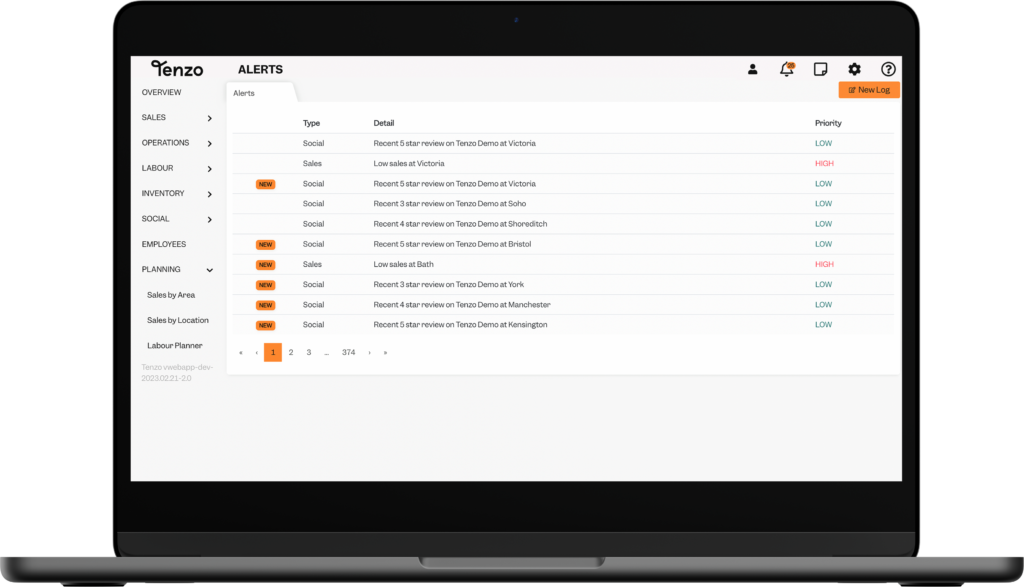
How can Tenzo make my team happier?
- Labour forecasting will ALSO help your team feel they can rely on you to give them the hours they need.
- With Tenzo your managers can be more in control of the business – too often teams are demotivated when management does not appear to know what they are doing.
- The fact that Tenzo shows you all your data in an app means managers can spend more time on the floor encouraging and overseeing the team instead of being holed up in an office juggling spreadsheets.
- Tracking employees’ individual sales statistics means managers can reward good work, and maintain standards – many businesses offer incentives to motivate their teams to maximise sales.
- Proper management is one reason behind the success of The Alchemist , where I worked as a head host. As well as having a unique and eye-catching brand, their intensive training programme produces managers who are up to speed on all areas of the business. They are also an example of a business that successfully uses incentives to get the most out of their teams.
Richard Branson, someone who is no stranger to success in business has said. “I have always believed that the way you treat your employees is the way they will treat your customers, and that people flourish when they are praised.”
As well as providing a better service, teams who trust their management and feel looked after are more likely to stay, in an industry where staff turnover is often problematically high. According to Yougov in August 2018, the annual staff retention rate in hospitality was at 70%, well below the UK average of 85%. When workers were asked what factors would make them less likely to leave:
- 52% said more stable income and guaranteed hours.
- 32% said more transparency from employers regarding shifts/scheduling.
Tenzo can help make improvements on both these counts. Accurate forecasting allows businesses to inform their staff of what hours they will be needed for with confidence, and provides an objective, data-driven way of making decisions.
A happy team and happy guests puts your business in the best possible position to thrive and grow. Tenzo can help you achieve this.
Josh Rampton (Business Development Manager)
For any questions email [email protected] or to arrange a demo with one of our team follow this link.
The post Tenzo creates happier teams and happier guests appeared first on Tenzo.
]]>