Are you looking to streamline operations in your restaurant? To ensure smooth and efficient operations, it is crucial to have integrated tech solutions in place. These solutions can help automate processes, improve communication, and provide real-time insights into your restaurant’s performance. In this article, we will explore what integrated tech solutions are and how they, […]
The post How can integrated tech solutions help streamline the operations of my restaurant? appeared first on Tenzo.
]]>Are you looking to streamline operations in your restaurant?
To ensure smooth and efficient operations, it is crucial to have integrated tech solutions in place. These solutions can help automate processes, improve communication, and provide real-time insights into your restaurant’s performance.
In this article, we will explore what integrated tech solutions are and how they, as a combination of best-in-breed technologies, can boost restaurant performance.
“We believe an ecosystem strategy with partners on each operational challenge of the restaurant is the only way to keep focus, working as a team to help restaurateurs thrive.” – Sebastian Arrese, Senior Partnerships Manager, Tenzo
What is an Integrated Tech Solution?
Integrated tech solutions are best-in-breed software solutions that ‘communicate’ with each other to allow for data to be shared between the two tools. These integrations must be built into the back-end of software by the companies to allow for the data to be integrated between them.
The businesses behind the software work as partnerships, working together to provide specialised tools to address the complex challenges faced by restaurants. An example of this is when a restaurant’s POS (point-of-sale) system is integrated with its inventory management system. This allows the restaurant to view its sales data within its inventory management tool, and vice versa.
Building a Tech Stack
Integrated tech solutions are combined into tech stacks of multiple best-in-breed software to streamline the operations of your restaurant. These solutions can include point-of-sale systems, inventory management software, employee scheduling tools, and more. By implementing integrated tech solutions, you can automate processes, reduce manual errors, and improve efficiency in your restaurant.
To implement integrated tech solutions in your restaurant, start by identifying the specific areas where you need improvement. Then, research and choose the best software solutions that address those needs.
Build a tech stack that integrates well with each other, ensuring seamless data flow and efficient communication between different systems. Train your staff on how to effectively use the integrated tech solutions to maximise their benefits.
Combining Best-In-Breed Software to Boost Performance
Best-in-breed software refers to using top-performing software solutions in each specific area of your restaurant’s operations. Instead of relying on a single software provider for all your needs, you can choose the best software for you in each business category and integrate it to create a customised tech stack that caters specifically to your restaurant’s unique requirements.
By using best-in-breed software, you can leverage the expertise and specialisation of different providers to solve the complex challenges faced by restaurateurs. This approach allows you to have access to the systems which work best for your restaurant instead of trying to fit a square peg in a round hole with an all-in-one system.
Why Best-In-Breed Works Best
Best-in-breed software works best for restaurants because it offers solutions that are specifically designed to address the unique problems faced by your business. Whether it’s inventory management, employee scheduling, or customer relationship management, choosing software tailored to your restaurant’s needs ensures that you have the right tools to overcome challenges and achieve your goals.
When selecting best-in-breed software, it’s important to consider how well the different solutions can integrate. Integration is key to creating a seamless workflow and avoiding data silos. By choosing software that can easily share data and communicate with each other, you can ensure that all stakeholders in your restaurant have access to the same information, leading to improved communication, collaboration, and decision-making.
Improving Operations with Integrated Tech Solutions
When it comes to running a restaurant, there are many areas where integrated tech solutions can help streamline operations. They can have a positive impact in all areas of restaurant operations, from labour to inventory management.
For example, with an integrated POS system, you’re eliminating the need for manual data entry and reducing the risk of errors whilst easily being able to track sales, manage inventory, and process orders all in one place.
By implementing these solutions, you can streamline your operations, reduce manual work, and ultimately, provide a better experience for both your staff and customers.
Real-Time Operational Insights
Real-time operational insights are crucial for the smooth functioning of your restaurant. By integrating tech solutions like Tenzo with the rest of your tech stack, you can have access to real-time data on sales, inventory, and labour. This allows you to make informed decisions and act as fast as possible to combat any issues that may arise.
With real-time insights, you can identify trends and patterns in your sales data, allowing you to make better decisions about menu planning, pricing, and promotions. By combining sales data with inventory control, you can ensure that you have the right amount of ingredients on hand, reducing waste and improving efficiency.
Combining sales data with labour control costs can help you optimise staffing levels. By understanding how sales fluctuate throughout the day, week, or month, you can schedule your staff accordingly, ensuring that you have enough employees to handle busy periods and not overspend on labour during slower times.
One Source of Truth
Integrating tech solutions into your restaurant operations can help streamline your business by providing one source of truth for all your data. This reduces the risk of human error and ensures that everyone works from the same accurate data.
With an integrated tech stack, you can easily share data across all stakeholders, from front-of-house staff to back-of-house managers, and all the way to head office. This improves communication and allows for fast, actionable, data-led insights throughout the business.
Having one source of truth means that everyone is on the same page and can make informed decisions based on accurate and up-to-date information. This leads to more efficient operations and a smoother-running restaurant.
Increased Restaurant Performance
The increased communication and efficiency provided by integrated tech solutions can hugely improve the performance of restaurants and boost sales, through both new and returning customers.
Improved customer loyalty generally comes from good experiences, and the integration of POS systems with CRMs, labour, and inventory tools allows restaurants to increase data collection on their customers to provide them with a better experience through personalisation. Automatically sending personalised recommendations and discounts, based on previous visits, to customers improves satisfaction and loyalty.
POS systems can also be integrated with online delivery apps. These integrations help to improve order accuracy and speed; crucial aspects of performing well on delivery apps. With increasing competition, being able to be seen by more customers massively helps boost sales via alternate revenue centres.
Conclusion
In conclusion, integrated tech solutions can greatly streamline the operations of your restaurant. By combining best-in-breed software to build a tailored tech stack, you can boost performance and improve efficiency.
With real-time operational insights and a single source of truth, you can make better decisions and optimise your operations. Embracing integrated tech solutions is the key to streamlining your restaurant and achieving success in a competitive industry.
The post How can integrated tech solutions help streamline the operations of my restaurant? appeared first on Tenzo.
]]>Are you looking to supercharge your restaurant’s success? To make data-driven decisions that can drive growth and profitability, it’s crucial to have access to the right information. In this article, we will explore the concept of a Restaurant KPI Dashboard and how it can help you track and analyse key performance indicators to make informed […]
The post Supercharge Restaurant Success with a Powerful KPI Dashboard appeared first on Tenzo.
]]>Are you looking to supercharge your restaurant’s success?
To make data-driven decisions that can drive growth and profitability, it’s crucial to have access to the right information.
In this article, we will explore the concept of a Restaurant KPI Dashboard and how it can help you track and analyse key performance indicators to make informed decisions.
To effectively boost restaurant performance, my customers have felt that the most important metrics to be monitoring are ATV, Guest Count and Sales Comparisons compared to last week or last year and so on. – Maria Gully, Customer Success Manager at Tenzo
– ATV or SPG (which one they use depends on each restaurant/POS) – Guest count or Transaction count (same as above) – Sales comparison (to last week, last year, etc)
What is meant by a Restaurant KPI Dashboard
A restaurant KPI dashboard is a tool that provides a visual representation of key performance indicators (KPIs) specific to your restaurant. It provides an opportunity to effectively communicate a business’s KPI progress to its stakeholders.
Unlike traditional reporting methods, a KPI dashboard allows restaurant owners and managers to easily track and monitor important metrics in real time. It provides a comprehensive view of the restaurant’s performance, allowing for data-driven decision-making and the ability to quickly identify areas of improvement.
Best KPIs to include in Restaurant Dashboards
When it comes to restaurant dashboards, there are several KPIs that are essential to monitor to boost restaurant success.
These KPIs can be in-line with sales, labour, or inventory aspects of restaurant businesses. By tracking these metrics, restaurant owners and managers can gain valuable insights into the financial health of the business, optimise labour costs, and ensure efficient inventory management.

Sales
Sales KPIs are crucial for measuring the financial performance of a restaurant. These are likely to be the most useful metrics for monitoring the success of the business and will impact how revenue is spent.
At Tenzo, we feel the most useful metrics to monitor on your dashboard when tracking sales performance are:
- Sales Week-To-Date compared with Last Week-to-Date
- Sales vs. Budget by Day
- Transactions Last four weeks compared with Last Year
- ATV Last four weeks compared with Last Year
- ATV by Employee
Tracking your sales compared to last week, and how sales compare to budget gives restaurants an immediate evaluation of whether the restaurant’s performance is improving. Ensuring the sales are hitting the budget allows operators to know that their costs are covered by revenue.
Monitoring ATV and Transactions over the last four weeks, and ATV per employee helps restaurants understand whether changes in sales are coming from more customers or more transactions. This helps target sales and marketing strategies.
Labour
To boost your restaurant’s performance, it’s crucial to monitor key performance indicators (KPIs) related to labour.
We believe that some of the most important KPIs to monitor on a restaurant’s dashboard for labour performance are:
- Cost of Labour as a percentage of sales by location and day of the week
- Planned vs. Actual labour Cost
- Labour Percentage by Day of the Week
- Average Sales vs Actual Labour Cost by day
- Sales vs. Labour Mix
- Sales & Forecast vs. Actual & Planned Labour
Monitoring the cost of labour as a percentage of sales allows restaurateurs to ensure that labour costs are in line with revenue and make adjustments accordingly. This, alongside the Sales vs. Labour Mix, helps to track labour productivity and ensure that labour processes are optimised. This also helps make sure staff aren’t overrun and at risk of burnout. Tracking this by the day of the week also ensures that productivity is maintained throughout the week and that profits can be maximised on fast and slow days.
Looking at planned hours and comparing these to actual hours worked, or the sales relating to those periods also helps to optimise labour costs. Planned hours are based on what restaurants have put into the labour tool, and this is likely from predicted sales for that period. Aiming to match the actual labour hours to these is likely to create stability for your team, and be able to predict revenue spend more accurately.

Inventory
Inventory KPIs are crucial for effective inventory management in a restaurant. By tracking these KPIs, restaurant owners and managers can minimise food spoilage and reduce inventory carrying costs; leading to a more sustainable industry.
The most effective metrics to track to optimise inventory management are:
- Theoretical Use, Actual Use, Wastage, and unaccounted for as a percentage of sales
- Sales, Cost of Labour, and Cost of Goods Sold after Transfers
- Wastage by Category
- Inventory Price Changes by Vendor
Waste is an incredibly important aspect of inventory for restaurants. Not only does it have environmental impacts but it can be a huge financial cost. Tracking wastage by location, and then by item, helps ensure everyone is using the correct processes and portioning as per the recipes.
Inventory price changes are important to monitor especially for restaurants that use multiple suppliers for the same items. With the current rates of inflation, prices are changing all the time, but at different rates for different suppliers. Tracking this helps restaurants get the best price for all their items, as well as leveraging quality.
Restaurant KPI Dashboards for Specific Roles
It is important to tailor the restaurant KPI dashboard to specific roles within the restaurant, such as business directors, general managers, and chefs. Each role has different goals and responsibilities, and their dashboard should reflect the metrics that are most relevant to their role so that they can maximise the insights gained.
Business Directors
Business directors in restaurants are responsible for the overall success of the business. Generally, there will be roles within the directors that are responsible for the overall financial performance of the business and expansion, as well as all operations and people within the business.
Their goals may include increasing revenue, improving profitability, and managing costs. The metrics they focus on provide insights into the financial health of the business as a whole and help guide strategic decision-making, whilst taking into account the front-line operations.
We believe that the most important KPIs for business directors to focus on are both high-level and more granular. It’s important to know what is going well in a zoomed-out view with a Flash P&L: incorporating all factors of COGS, labour and sales, to determine how much profit the restaurant is making.
Senior stakeholders need to be able to go more granular quite quickly to understand where the improvements, or mistakes, are being made. For example, labour spend could look positive over the month, but in reality, it equated to overspending at the beginning and having to reduce spend to remain within budget towards the end.
When diving further into their data, for COGS and inventory, labour productivity and wastage should be focused on. For multi-site operators, it’s important to have granular information on individual locations as well as overall contributing factors.

General Managers
General managers play a crucial role in overseeing the day-to-day operations of a restaurant. They are responsible for managing staff, ensuring customer satisfaction, and meeting financial targets.
The KPIs that would most help general managers will identify areas for improvement, optimise staffing levels, and ensure a positive dining experience for customers.
Empowering general managers to use their data is vital. Normally, time restraints mean that they don’t have time to be diving into spreadsheets throughout the day. However, creating a dashboard focused on information important to them and making it easily digestible allows them to use their data in real time.
Tenzo believes that quick data values for their specific locations such as ATV, Number of Transactions, Labour Cost Percentage, and Recent Social Reviews are the most important. It’s valuable to compare this weekly so that recent changes in operations or staffing can be evaluated easily.
Conclusion
In conclusion, using a restaurant KPI dashboard can supercharge performance. It allows you to track key metrics and make data-driven decisions.
Focusing on KPIs from all areas of the business; sales, labour, and inventory, is vital to create a sustainable business and maximise profitability.
A KPI dashboard provides valuable insights and empowers restaurant owners and managers to make informed data-driven decisions that promote success.
The post Supercharge Restaurant Success with a Powerful KPI Dashboard appeared first on Tenzo.
]]>Business Intelligence (BI) tools are focused on transforming the operational data of businesses into valuable information that can be used to improve performance. They add strategic value and a data-forward approach to the decision-making process. If you’re thinking of implementing a restaurant Business Intelligence tool in your business, this article will explain all the aspects […]
The post Business Intelligence for Restaurants | Evaluating Your Options appeared first on Tenzo.
]]>Business Intelligence (BI) tools are focused on transforming the operational data of businesses into valuable information that can be used to improve performance. They add strategic value and a data-forward approach to the decision-making process.
If you’re thinking of implementing a restaurant Business Intelligence tool in your business, this article will explain all the aspects you need to think about.
|”People buy analytics to be able to act on their data and see an impact from it” – Christian Mouysset, CEO and Co-Founder at Tenzo
Why Is Business Intelligence Needed For Restaurants?
It’s no secret that Business Intelligence tools bring value to restaurants. Harnessing your restaurant data provides the roadmap and directions to controlling costs, driving growth, and as a result supercharging your profitability.
But, many Business Intelligence setups are more focused on providing accounting reconciliation and end-of-month reports rather than surfacing and delivering operational insights.
And this leaves a lot of opportunity on the table.
These limited opportunities can lead to missed chances for the business. A proper restaurant Business Intelligence setup enables front-line workers to engage with the data in order to make better daily decisions to hit targets and boost performance, while also giving back-office teams the required strategic and accounting visibility.
For example, Managers should know if next week’s staff schedules are aligned with forecasted sales and which items they’re typically over-ordering.
While Head Office should be able to measure the impact of the new happy hour and how to bring lower-performing sites up to the average.
Problems With The Current Restaurant Business Intelligence Tools
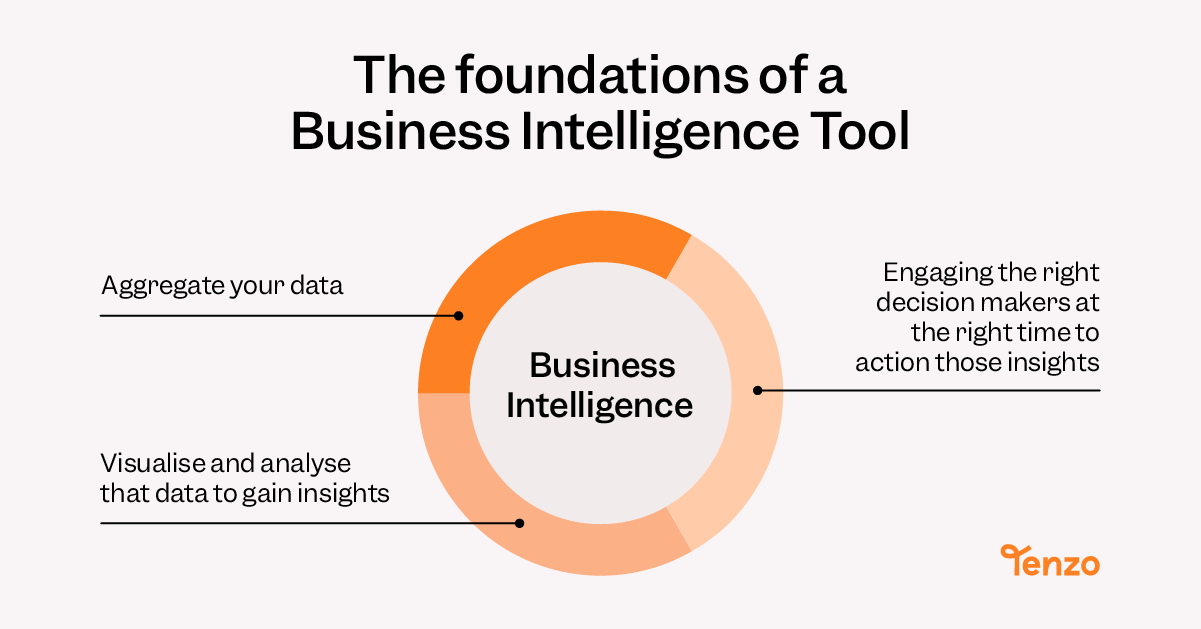
To make your organisation more data-driven, you need to (1) aggregate your data (2) analyse it and (3) engage the right decision-makers at the right time to action those insights.
Many non-restaurant-specific Business Intelligence tools, such as Power BI and Tableau tools really struggle to do (1) and (3).
Power BI and Tableau can be great for other industries but restaurants are inherently different. I.e. restaurant businesses typically don’t have large in-house IT teams with developers.
This makes piping data into these BI tools difficult. And their lack of native integrations means data is often not real-time or requires constant maintenance. Plus, it’s quite difficult to get POS tools to expose their API (if they even have one).
Even if you solve the integrations piece, Business Intelligence tools’ fixed, static views (that generally aren’t mobile-friendly) have been designed with data analysts in mind, not restaurant operators.
They don’t lend themselves to GMs on the go, and the lack of manipulative ability and ‘so what’ makes it hard for them to understand how to action the insights without going through the chain of command.
On top of this, these tools’ complexity and sophistication can cause data paralysis for many restaurant operators leading to potential overwhelm for front-line workers who already have so many fires to fight without adding complex data analysis to the mix.
Missed Opportunities With Restaurant Business Intelligence Tools Not Engaging Operators
To really see improvement in business performance, both head office and front-line workers need to be able to access Business Intelligence data. By predominantly focusing on head office a lot of opportunities for improving performance are missed, for example:
- Reducing food waste and stock-outs
- Deploying the right number of labour hours
- Analysing menu performance
- Improving sales performance
General managers need to be able to understand their data and be shown where they are missing these opportunities in real time in order to maximise results. This not only allows them to hit the goals above, but it also helps them align closely with their targets.
Finding The Right Restaurant Business Intelligence Solution
Finding the right restaurant Business Intelligence tool for your business is just as important as the rest of your tech stack.
A good restaurant Business Intelligence tool is one that will grow with your business, providing you with the flexibility and scalability to grow.
It’s likely that restaurants looking to implement Business Intelligence software already have a tech stack in place with POS, labour and inventory tools, so looking for a Business Intelligence tool that integrates with multiple data sources is vital. The more sources the tool can connect to, the more visibility you’ll have over your entire business’s operations.
Aligning the data delivery capabilities of the solution with the use cases throughout your business is essential. Understanding how the tool will be used – strategically and operationally – will highlight the best options.
Operationally, finding a tool that allows those making everyday business decisions to understand insights garnered is essential in boosting performance. To provide operators with access to the correct information, ensure that it’s easily interpreted and offers real-time, fast and intuitive insights.
Tenzo vs. Traditional Business Intelligence Functionality
All business intelligence tools will provide useful information for businesses through access to data visualisation and many provide automated emails and allow for advanced data manipulation and report building.
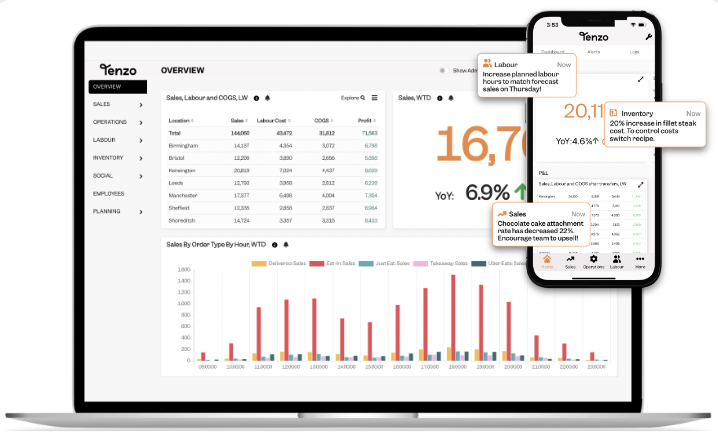
However, as already mentioned, the real difference in boosting performance comes from engaging and empowering operators. Not only does Tenzo provide depth and complexity in the drill-down reporting and AI sales forecasts for head office, but it also lends itself to operators and General managers.
Tenzo’s mobile-first, real-time approach to reporting makes it easily accessible for GMs on the move.
Tenzo is intuitive and fast in providing insights, with tailored dashboards for individual users to allow for General Manager use as well as 95% of the strategic use cases needed by head office. It can also be used as a data warehouse to feed into Business Intelligence tools such as Power BI, should this be required.
Tenzo vs. Traditional Business Intelligence Implementations
When considering new software, it is important to not only think about functionality but implementation as well. Generally, from the moment you sign up for the software, you’ll be paying for it, but you might not get anything out of it.
Business Intelligence tools can take up to 12 months or more to implement with no guaranteed success – they have very high opportunity costs with expensive set-up fees and ongoing expenses.
Tenzo allows you to access and gain insights from your data within weeks. We already have integrations set up allowing for immediate data aggregation and reporting so that operators can utilise their data as soon as possible.
Not only does Tenzo empower General Managers to take charge of their restaurant’s success, but the AI predictions for sales alongside GM knowledge, allow for accurate demand forecasting.
“Tenzo’s exceptional support team went above and beyond to help us optimize our operations and achieve our goals. Thanks to their robust BI platform, we were able to extract valuable insights from our data and drive our business forward. I would highly recommend Tenzo to any hospitality business looking for an analytics tool with outstanding support.” – Nora Kanawati – Head of Technology & Digital Transformation, Sisban Holdi
Conclusion
Business Intelligence is an increasingly important tool for restaurateurs, especially for large, enterprise businesses with many locations. Choosing the right tool is challenging, but we advise considering the use cases before doing so.
The best way to improve performance is by empowering operators and front-line employees to take charge of their own success. Although most Business Intelligence tools will provide the head office with strategic data delivery, Tenzo differs by allowing operators to easily engage.
Engaging front-line restaurant workers and operators by providing useful insights and a dashboard suited to them creates more opportunities for restaurateurs to supercharge their performance.
If you would like to speak to an expert, don’t hesitate to reach out for a tech consultation with the Tenzo team.
The post Business Intelligence for Restaurants | Evaluating Your Options appeared first on Tenzo.
]]>Technology has taken off across all industries and restaurants are no exception. Growth within the technology sector is exponential, and COVID has shown how restaurants need to invest in it to boost their performance. The vast amount of technology available to restaurateurs can make it overwhelming to know what tech stack to pick, especially with […]
The post A Guide to New Technology by Restaurant Type appeared first on Tenzo.
]]>Technology has taken off across all industries and restaurants are no exception. Growth within the technology sector is exponential, and COVID has shown how restaurants need to invest in it to boost their performance.
The vast amount of technology available to restaurateurs can make it overwhelming to know what tech stack to pick, especially with some technology more suited to some restaurants than others.
Despite the challenges, setting up the right tech stack from the start is essential. Making sure you’re future-proof means understanding where you want to go with your business, and picking a tech stack that has scalability.
Easy-to-use systems that slot into existing processes help keep a good culture in place: where decisions are data-driven and employees aren’t frustrated with administrative tasks or poorly functioning technology.
When considering technology for your restaurant it’s important to consider the needs of your customers and employees. Personal interaction is a big part of hospitality, and knowing where this is necessary for success in your restaurant is crucial.
One of the main things we want from any platform we work with is that it keeps the team on the floor looking after the customers and reduces the amount of office time. We’d much rather keep everyone focussed on the customer’ it was a huge help in ensuring that keeps happening. – James McLean, Founder at Truffle Hunting
Technology all restaurants should consider
Although some technology is more suited to the needs of particular types of restaurants, there are three technologies that all restaurant operators should consider – POS (Point of Sale), Inventory Management, and Labour Planning.
Some software providers offer an all-in-one solution to these three operational challenges, but we find best-of-breed solutions to be the best to get the best possible system for each. Each operational aspect of running a restaurant has become so complex due to the number of integrations required (delivery apps, loyalty programs, accounting, etc.) that a different tool is required to each to ensure full focus.

Point-of-sale systems
POS stands for a point-of-sale system: it is software for capturing transactions. Many of them function as more than a till; they provide an immediate transaction, an online ordering tool and a system to collect sales data.
Why is having a POS so important? On top of being the tool for financial transactions, and in many countries a legal necessity, it also;
- Keep track of employees’ performance. Knowing your top, and lowest, performing employees helps to bring everyone up to the same level with training.
- Manage trends in your Average Transaction Value 1(ATV). Understand the varying factors to manage the results – such as upselling.
Inventory Management
Inventory Management tools are especially important for restaurants, as businesses with very perishable inventory. To run a restaurant effectively you need to minimise the gap between the theoretical and actual usage – inventory tools help to do this.
Poor inventory management results in loss of revenue as well as damage to the environment with increased food wastage. It’s important to choose the right inventory management tool to avoid this, plus it also gives you:
- Ordering technology to manage all inventory orders in one place. The ability to track when orders have been placed, their status and the invoices attached across multiple locations – so that you always have stock.
- Waste Management. Inputting your recipes allows you to track your waste, helping identify areas of improvement and reduce unaccounted-for items.
- Menu planning. Improve performance with practical recipe costing tools and data-led decisions on which menu items yield the most profit.
Labour Scheduling
Labour is consistently a hot topic within the hospitality industry. All types of restaurants struggle with the same challenges of a decreased employment pool, and difficulties keeping up with wage increases.
Labour planning, alongside the difficulties of recruiting new staff, means software that helps is vital in ensuring the success of your business. It can help to boost restaurant performance, alongside improving operations by:
- Reducing the impact of labour shortages. Simplify employee scheduling and deploy staff efficiently.
- Optimising labour costs. Staff according to demand and predicted sales, to maximise sales potential when busy and control costs during quiet periods.
- Improving team communications. One source of truth for scheduling and hours worked helps to improve team relationships and empower managers to improve operational organisation.
QSR – Quick Service Restaurants
Quick Service Restaurants, or QSRs, are focused on providing their customers with fast service. They typically have limited seating, a casual atmosphere and an inexpensive menu.
As with all restaurants; there are peaks at meal times – but QSRs’ consistent product and low price point mean they tend to be busy throughout the day, and throughout the night for some.
Pre-prepared and pre-packaged foods are a defining feature of QSRs, and most of it is taken away, so the service must be as fast as possible. This is helped by having a consistent menu, with the occasional promotional item.
Customers are looking for quick service primarily, so technology that provides this for them, and improves operational efficiency is vital. There is less of a requirement for face-to-face interactions, so technology can operate in the place of servers.
Kiosk Ordering
Kiosk ordering is a perfect tool for QSRs to control costs and boost sales. This technology involves digitalising your menu and ordering channels to enable customers to process their orders.
The hardware can also link with other tools such as POS to ensure operations run smoothly – they have several benefits:
- Improving ATV (Average Transaction Value). Lack of ‘shame’ associated with overordering when a person takes someone’s order, increases the likelihood of larger orders.
- Increased orders. Queues are lower and therefore capacity for orders may increase, up to the point that the kitchen can handle them.
- Better labour deployment thanks to the lower number of FOH staff needed to take orders if the restaurant moves fully to the kiosk system.

Digital Menu Boards
Digital Menu Boards are cloud-based digital menus, normally displayed behind the point-of-sale, in addition to kiosks or traditional long-paper form menus.
This hardware should be completely user-friendly, customisable and functional. For most parts, they are a very straightforward tool to see improvements in performance from:
- Boosting marketing strategies. Promotional menu items can get increased exposure and results are seen faster.
- Reducing waiting time at the till. People are encouraged to make decisions from further away or typically are driven to order what they see.
- Increasing ATV. Upselling can be made easier, and reducing human push, by tailoring the digital menu to whatever is selling well in that period. People are also 30% more likely to order more when they see pictures of the food.
Example QSR: Neat Burger.
Casual Dining
Casual Dining maintains the QSR’s relaxed atmosphere but has much more of an emphasis on in-restaurant dining. They have table service and relatively large simple menus.
They usually cater to families who might make multiple visits so loyalty apps are well-suited to them. The rushes of service are more acute during traditional meal times.
With the increased service element, labour shortages are felt more here than in QSRs. Due to the family style of restaurants, they tend to be very busy with a large number of covers. Finding areas to cut down on labour costs can be tricky as a result.
QR Codes
QR codes can be used in casual dining restaurants to view the menu, order, and pay, but consider the level of service you want to give your customers when thinking about what you want to automate with technology. You can always choose to use the QR for the payment piece, but keep paper menus and ordering through a server.
These are straightforward to set up and use for consumers. Examples include Mr Yum and Store Kit. The benefits seen by restaurants can include;
- Fully customisable menu. Promotional items can be added to the menu at short notice, and missing items can be taken away to reduce customer disappointment.
- Controlling costs. Labour costs can be reduced as less of a need for FOH (Front of House) staff to tend to customers. Upselling can be driven through technology rather than face-to-face interactions.
- Reducing time per cover. Allowing for QR payments means customers can pay whenever they’re ready to leave, improving customer experience from reduced wait time and reducing the time between seatings.
- A deeper understanding of consumers. Customers often pay separately with QR codes, as opposed to one big group payment, allowing for a more accurate understanding of ATV and SPH (spend per head).

Robot Servers
Actual robots are programmed to deliver food from the kitchen to customers’ tables. They’re spatially aware and know to avoid people and objects in the restaurants, whilst delivering food.
This is a relatively new concept that few restaurants have onboarded, but the advantages of using them for casual dining restaurants could be huge:
- Alleviate the impact of labour shortages, and reduce labour costs. Robots can lower the requirements for runners and they deliver orders with 99.99% accuracy.
- Reducing customer wait time. The robots have a much larger capacity than humans so can take multiple orders out simultaneously.
It’s important to note that due to these being relatively new, they could cause some issues. The lack of face-to-face interactions could reduce customer satisfaction. The decreased speed in wait time is dependent on the kitchen being able to produce food at a higher rate, so may require more kitchen staff.
Loyalty Apps
These apps are designed to give rewards or discounts in exchange for customer data. Loyalty apps, alongside the family atmosphere and prices, further encourage repeat customers.
Loyalty could be rewarded through discounts or free items, based on purchase amount or a subscription-based loyalty program. Advertising on other platforms can boost success and help improve these results;
- Increased revenue. Rewarding customers with free items, if a certain amount is spent, will encourage repeat purchases of promotional items, and repeat customer visits, and as a result, increases ATV.
- Boost Customers’ lifetime value. Increasing engagement helps to drive increased revenue over a long period. It can cost 5 times more to acquire new customers than retain existing ones.
- Marketing strategy. Personalised marketing can be rolled out as a result of purchased and personal information input to receive rewards.
Example Casual Dining: Vapiano’s
- POS, Lightspeed
- Labour, Planday
- Inventory, Marketman
- QR Codes, Mr Yum
Another Casual Dining Example: Fat Hippo
- POS, Lightspeed
- Labour, Planday,
- Inventory, Marketman
- Loyalty Platform, 5loyalty
Fine Dining
Fine dining restaurants are some of the most high-end forms of hospitality. People tend to visit them on special occasions and expect a high level of service; it is all about the experience.
Often they open for lunch and dinner services, but peak during the evening. Menus are complicated, with preparation all happening on-site, with top-quality ingredients ordered from speciality suppliers.
Food Ordering Platforms
Apps such as Rekki cater to fine-dining restaurants that need to order specialised ingredients from multiple suppliers. They offer a safe platform to access, order and pay for goods online, with suppliers and restaurants both needing verification to use.
Apps like these are changing the game for restaurants that previously spent hours phoning suppliers individually. They help by:
- Improving inventory management. Keeping track of previous orders helps manage the burn-through rate of stock easily. Ordering is made easy and fast.
- Access to new suppliers. New ingredients and specialised suppliers are more accessible and can help broaden the menu.
- Reducing admin for kitchen staff. All payments are processed online, and flexible payment schemes and easily accessible invoices make keeping on top of it easy for chefs.
Reservation Platforms
These platforms allow customers to make reservations online and for restaurants to take a deposit or card number to charge in case of no-shows.
Although this is important for all restaurants to have access to, the increased costs of labour and inventory at fine dining establishments make effective reservation tracking vital.
- Reduces food waste. Preparation of food is done throughout the day, and knowing definitively how many covers you’ll have decreases the likelihood of wastage.
- Labour planning is improved. This accurate forecasting means knowing how busy a service will be and makes labour deployment based on sales easy.
- Improved financial security. Taking a deposit helps to cover the cost of labour and inventory, and the missed revenue, from customers not turning up.
Food Hygiene Apps
Generally, fine dining restaurants are small independent businesses that don’t have a head office with lots of admin staff; the restaurant management team have to do it all.
Busy kitchens and long shifts can mean that compliance with the strict health and safety regimes associated with restaurants can be forgotten about, so reminders are always helpful.
Food hygiene apps help remind and encourage all the necessary measurements and checks to comply with HACCP (Hazard Analysis Critcial Control Point) guidelines. This can have massive advantages for the business such as:
- Maintaining proper health and safety. Reminders given to staff at the correct times help to ensure that all measurements have been taken and your business complies with the laws.
- Keeping on top of audits. Paper trails of old measurements can be hard to follow, but online apps make it easy for auditors.
- Reducing food waste. Malfunctioning equipment is quickly noticed and avoids food spoiling prematurely due to poor conditions, or wastage due to poor inventory management.
Example Fine Dining Restaurant; AKA Restaurants
- POS, Lightspeed
- Inventory, MarketMan
- Labour, Planday
- Reservations, Sevenrooms
Pubs
Pubs are a large part of the hospitality industry in the UK and globally. They primarily focus on selling drinks (wet-led pubs), but the majority also sell food. Some pubs, typically gastropubs, are also food-led.
Typically, the kitchens in pubs are very small. The menu is basic and the food is normally pre-prepared and easy to cook.
Pubs are generally quite traditional, with many of the customers wanting this experience to continue. This can make introducing technology difficult, but it doesn’t mean operations can’t be made smoother with technologies that don’t affect the customer experience.
Solar Panels
COVID and inflation have had a significant impact on pubs. These reduced profit margins have resulted in 150 pubs closing this year. One cost pubs have had to contend with is the soaring price of energy. Solar panels help to mitigate the massively increased energy costs, on average around £18,400 annually, but supply the business with sustainable, free energy (beyond the initial start-up cost).
Some more modern solar panels, such as Solar Edge, are equipped with real-time data tools allowing you to manage your consumption.
Although they can be expensive to set up, the benefits are worth it:
- Saving costs on energy. Immediate reduction in costs due to energy being supplied from sustainable sources. Inn Cornwall reported savings of 19%.
- Reducing energy consumption. Access to real-time data on energy consumption empowers operators to pinpoint high-consuming products and work on reducing the run time of these.
Tipping Apps
COVID brought about several changes within the hospitality industry, and globally. One of the biggest changes has been the adaptation to cashlessness.
As customers are regularly encouraged to pay with cards now, fewer and fewer carry cash. This has resulted in industries, like hospitality, where the staff rely heavily on tipping, suffering.
This is particularly prevalent for pubs as they typically do not charge service charge and rely solely on cash tips.
Online tipping platforms allow customers to give teams cashless tips easily by providing a scannable QR code where you can then input a custom amount. Benefits include:
- Staff incentivised to provide hospitality. Customers rewarding staff with tips helps to boost productivity and create a positive working environment where employees want to please the customers.
- Improves employee morale and teamwork. Team members will be encouraged to help each other improve service and be more satisfied with the working environment as a result.
Example Pub, East London Pub Co.
Cafes
Cafes generally have a relaxed atmosphere with a daytime focus. Busy periods are usually during breakfast and lunch but customers continue to come in throughout the day.
A simple menu or pre-prepared food options are typical features of a cafe with a strong emphasis on hot drinks. Although table service can happen, food is often ordered at the till.
Since working from home became a common feature, cafes have seen an increase in people sitting for long periods using their wifi. Being able to take advantage of this is important.
Wifi Email Capture
Wifi Email Capture software works by collecting guests’ contact information when they try to use the wifi. The contact information collected is up to the consumer.
As mentioned above, working in cafes is incredibly common. Using email capture software allows you to benefit from supplying users with wifi:
- Customer mapping. Being able to select which information customers put in allows you to develop a good understanding of your customer base; altering the business and marketing strategies to build on this.
- Increased marketing contacts. Getting marketing contacts organically as a restaurant can be tricky, but using wifi capture helps to build up a big list of marketing targets whilst following GDPR.
- Increasing sales. With improved marketing contacts and an improved marketing strategy based on your target market, increased sales will likely follow.
Advanced Ordering Platforms
Although some people like to sit for extended periods in cafes, others are simply looking for a quick coffee.
Advanced ordering platforms or apps allow customers to pre-order drinks or food for them to collect at a specific time. They can choose their order from a digital menu, similar to kiosks, with optional extras being possible.
This can help cafes to boost performance through:
- Improving customer experience. Being able to order online allows for the queue at the till to be much smaller, and also for the experience for those ordering online to be very efficient.
- Preparing for busy periods. Staff can see when a busy period is going to happen a bit further in advance, allowing them to check their stock and prepare before the orders need to be ready.
- Reduced labour costs. Instead of having two people working behind the counter, cafes could only have one, to make the drinks, and encourage customers to order online pre-arrival.
Example Cafe; Chestnut Bakery
- POS, Lightspeed
- Inventory, Marketman
- Labour, Harri
- Email Capture Tool, Captive Wifi
Dark Kitchens
Dark kitchens are also known as cloud kitchens or virtual brands. They are online brands that exist only on delivery apps or online platforms.
These can sometimes be part of larger restaurants with extra capacity, or completely virtual brands that have multiple businesses operating out of the same kitchen. Some companies also use their primary restaurant as a centralised kitchen and send food to be finished in virtual locations further away to increase profit potential thanks to a larger delivery area.
The fundamental nature of virtual restaurants is that they’re built on technology, so introducing new technologies shouldn’t be too alarming. Often, speed of service and accuracy are crucial aspects of success for virtual restaurants, so technology facilitating this is most important.
Delivery App Integration Software
Virtual brands can receive orders from multiple delivery apps at the same time.
However, delivery apps don’t directly send orders to POS systems, instead, they issue a tablet per brand and per app. This can lead to a huge number of tablets each accepting orders, making tracking and preparing extremely difficult for the kitchens.
Software that seamlessly integrates all delivery apps into one place can help restaurants succeed by:
- Tracking sales from all channels. Understanding where the highest number of orders are coming from helps to boost marketing efforts and allows you to optimise for the best-performing channels.
- Streamlining process. Removes administrative tasks and potential mistakes from manually transferring orders from tablets to POS.
- Improves performance on delivery apps. Can help to track the speed of orders which is a huge factor in how highly rated you are on the apps.
Online Kitchen Display Systems
These types of hardware are often connected to, and available from, POS suppliers. It is a digital system in the kitchen to display orders, as opposed to the traditional, printed ticket method.
Virtual restaurants tend to get incredibly busy with several orders coming through at the same time. Busy periods can be hard to manage, but display systems help to:
- Prioritise orders. Orders can be organised to come through colour coded so that kitchen staff know immediately which to prioritise.
- Keep on top of incoming orders. Orders come through in real-time, and due to digitisation, fewer orders are likely to be missed.
- Effectively manage the speed of orders. Staff can be alerted as to how long each menu item takes to prepare, increasing the speed of orders and improving ratings on delivery apps.
Example Dark Kitchen; Crepe Affaire
- POS, Lightspeed
- Integration app, Deliverect
Conclusion
The tech opportunities for restaurants are huge, and the tech offering is growing exponentially. This makes building the perfect tech stack for your restaurant confusing. It’s important to identify the specific needs of your restaurant and research software accordingly – there are consultants that can help to make this easier, such as Twice Baked!
Spending time and resources on finding the tech stack that suits your restaurant’s needs is essential in boosting restaurant performance. Getting on top of your data, and using it, in real time allows for huge improvements in operations.
It’s important to consider that implementing new technologies can be complex, and meet resistance from employees. Ensure that all users are onboarded properly and fully understand the benefits of using it to see the most improvement in performance.
 ︎
︎The post A Guide to New Technology by Restaurant Type appeared first on Tenzo.
]]>We’d like to share how we see the restaurant tech market map evolve over the next few years. Here at Tenzo, we see the industry moving from an integrated world where systems would span multiple verticals to one where a collection of specialised systems in each vertical work together. Below is our view of a […]
The post Restaurant Tech Market Map: Integrated vs. Best In Class appeared first on Tenzo.
]]>We’d like to share how we see the restaurant tech market map evolve over the next few years. Here at Tenzo, we see the industry moving from an integrated world where systems would span multiple verticals to one where a collection of specialised systems in each vertical work together.
Below is our view of a restaurant tech market map;
Integrated World
In the “integrated world” of restaurant tech, a small number of systems manage the restaurant. There would typically be a point-of-sale (POS), such as NCR, Positouch or Zonal where the data would sit on a computer in a back room, a back of house system such as Fourth Hospitality and an accounting system such as Sage. These systems would sometimes talk to each other. The tech lacked in depth functionality as they were stretched over many verticals. It would be difficult to get insights out as the data was fragmented and not readily available.
The Best In Class World
The “best in class world” that has now emerged is one in which many systems built by different entities communicate with each other to deliver more value to the restaurant. It also means that restaurants have more choice in each vertical and therefore have the opportunity to choose the best in class.
When choosing a technology in the best in class, you should make sure that the data they collect is available to other systems via an API.
We’ve explored the main verticals and some of the options available:
Tablet POS platforms
These companies offer tablet-based point-of-sale systems for restaurants, aiming to give team members faster and more mobile ways to process transactions. There are a number of options here. Revel and Lightspeed have both raised in excess of $100m. Most have robust systems with reliable APIs which can connect to your accounting software, loyalty systems, payment systems.
Staff Scheduling
When I Work (have raised $24m) and Nimble Schedule have a large installed base and offer APIs that will allow you to pull relevant data out of their system.
On-demand labour
There are several companies that are helping restaurants plug short term gaps in their staff by offering on-demand team members. Notable ones include Catapult and TotalJobs.
Internet-of-Things (IoT)
These include footfall sensors (like Hoxton Analytics), smart kitchen sensors (such as Casabot), guest wifi (like purple wifi), digital displays (Enplug) or phone charging stations (powermat).
Customer loyalty
The main players in the restaurant loyalty space include FiveStars ($90M in funding), LevelUp ($53M in funding), and Belly ($26M in funding). These companies reward systems, offer points and sometimes pay-by-phone options for customers, as well as limited analytics and marketing options for restaurants.
Purchasing and inventory
Companies like BlueCart ($4M in funding) or SimpleOrder help restaurants track inventory, improve supplier communications, aggregate supplier orders, and analyse costs.
Reservation platforms
There are several platforms here but one that is emerging from the crowd is Velocity.
Restaurant music
These startups provide smart music systems for restaurants and cafes. Ambie.fm matches the right music the store. TouchTunes ($65M in funding) offers a “digital jukebox” with a companion mobile app for guests, while Rockbot ($6M in funding) gives clients like McDonalds, Panera, and Buffalo Wild Wings a digital music dashboard with curated music stations.
Actionable Insights
Tenzo can bring all the data that these systems collect, apply machine learning and data science to them in order to deliver short actionable insights to the right person, at the right time on the right device.
The post Restaurant Tech Market Map: Integrated vs. Best In Class appeared first on Tenzo.
]]>Restaurant tech in 2019 is evolving at a rapid pace. Not only is there a vast number of apps available for the restaurateur but they are also becoming highly specialized and sophisticated. At Tenzo, we see specialization necessary due to the complexity of tasks these apps are tackling, as they require a vast amount of […]
The post Restaurant Tech in 2019; How To Prepare Your Restaurant appeared first on Tenzo.
]]>Restaurant tech in 2019 is evolving at a rapid pace. Not only is there a vast number of apps available for the restaurateur but they are also becoming highly specialized and sophisticated. At Tenzo, we see specialization necessary due to the complexity of tasks these apps are tackling, as they require a vast amount of time and resources to be reliable solutions. However, the potential downside for restaurant tech is two-fold:
For restaurateurs, the requirement in juggling multiple apps could potentially lead to human error in handling increasingly complex business data; and, specialized tech apps are blind to other data sources making them less valuable to the restaurateur.
It is for these reasons that technology apps are starting to work together through integrating systems. Integrations allow suppliers to share data and therefore provide more powerful insights. Integrations allow for a more easily manageable technology infrastructure allowing smoother transitions between apps for managers.
We understand there is a vast number of solutions available on the market (Figure 1 below), so in this article, we break down some of the main categories as well as provide a few example solutions.
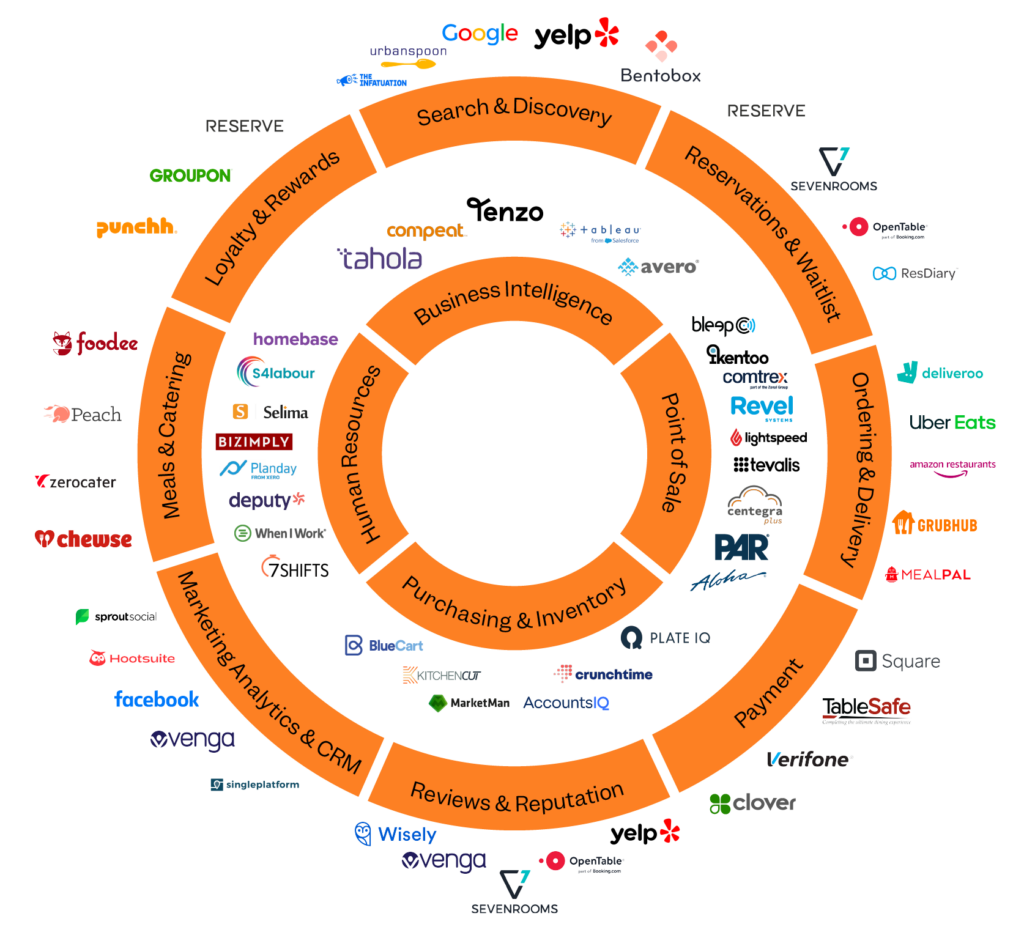
Figure 1: Restaurant Technology Ecosystem Wheel
Point of Sale (POS) Technology
The POS is an app allowing restaurants to record transactions in the simplest way possible and gather them in one place. It has evolved from being crank-operated cash registers to simple tablets. POS’s have also evolved towards being an analytics app when used with APIs, which allow connections with other software products such as business intelligence, inventory, or employee management apps.
POS Companies

Lightspeed is very adaptable to your restaurant with a customizable menu and real-time updatable floor plans. It also allows you to gather your integrations, staff, and loyalty programs.
iKentoo is the most advanced iPad-based POS and business management system on the market for the hospitality industry. iKentoo offers seamless, intuitive, and reliable solutions for restaurants, multi-site chains, food trucks, festivals, bars, hotels, coffee shops, and delis.

Tevalis is specially designed for the hospitality industry. Tevalis has always managed to meet the demanding and constantly evolving requirements of people working in the industry. With a client-focused approach, Tevalis offers you a tailored solution for your business needs.
Human Resources Technology (Staff Scheduling, Labor Apps)
These apps help to schedule employees hours depending on their availability (shifts/holidays), their skills, and in compliance with the law. The staff schedule can be published for employees to see their shifts in advance. The apps enable businesses to track and organize their workforce in real-time.
Human Resources Companies

Planday makes communication with and between employees easier, provides a business overview of staff activity, and lets managers choose how much autonomy their employees should have to schedule their own hours. Bonus feature: mobile availability.

Deputy helps manage the unique complexity of your workforce by giving you the best shift structure for your business and picking the best employees for each shift. With a mobile-first approach, Deputy is a user-friendly end-to-end workforce management app and is easily integrated with other HR software.

Bizimply is an all-in-one HR management platform that simplifies communication between employees and managers. Scheduling and attendance tracking become seamless processes thanks to both employee and manager apps that gets everyone involved
.
Purchasing & Inventory Technology
These apps ease the process of paying vendors, provide cost insights on food and beverage supplies, and cut down bookkeeping costs through automation.
Purchasing & Inventory Companies


Kitchen Cut‘s main focus is to bring innovation and automation to the kitchen while remaining very simple to use and entirely scalable as your business grows. The real-time alerts and notifications give actionable insights into your business.
Business Intelligence (BI) Technology
BI apps typically centralize the software to help businesses run more efficiently. The data is drawn from POS and Staff Scheduling provides sales analytics, sales forecasting, and measures staff performance. An advantage of these apps include overlaying the data to provide quick and novel insights such as measuring the cost of labor as a percentage of sales at any given time. The data drawn from social media platforms can also be collated to give easy access to reviews, trend analysis, and detailed metrics. Real-time push alerts are also available to help determine review trends and statistics.
Business Intelligence Companies
Tenzo provides actionable and relevant insights on your hospitality business, defining where and how you can save business resources. Tenzo manages this by integrating with many POS, Staff Schedulers, Inventory, and Social Review platforms. Furthermore, Tenzo provides highly accurate sales forecasting thanks to its proprietary machine learning algorithms.
Reviews & Reputation Management Technology
Created to help consumers find restaurants, pubs, cafes, bars, hotels and all kinds of hospitality establishments. These establishments can be broken down by location, food type, atmosphere, and ratings. It also allows the user to rate and write reviews on the places you’ve been depending on your experience there. This feedback is valuable both for restaurants and customers: restaurants get to know how to improve their service, food, necessary repairs, and future customers can get a feel before actually visiting the location.
Reviews & Reputation Management companies

Reservation & Waitlist Technology
These apps help restaurants track how the dining space is used in order to optimize as well as predict how long new customers will be waiting. They also help customers to reserve tables online in order to avoid waiting. The aim is to eventually maximize the capacity of restaurants, optimize revenues, extend venue reach and make reservations as easy as possible.
Reservation & Waitlist Companies
OpenTable helps find the perfect place to book a meal – it takes into account location, the price range you want to pay, type of cuisine, reputation of the restaurants, discounts, ratings, free slots for a reservation, and seating options. Once you’ve chosen the restaurant, the reservation process is easy and fast using this centralized service.
Loyalty & Rewards Technology
These apps allow customers to send vouchers or reach loyalty thresholds based on purchasing history, earning them discounts, free meals, and more. These softwares enhance relationships by simplifying and rewarding consumer interactions.
Loyalty & Rewards Companies

ResyOS is a complete restaurant reservation and waitlist system, including table management, ticketing, web and app booking, CRM, a POS integration, and more.
Ordering & Delivery Marketplaces/Corporate Meals Technology
These apps aim is to get any meal delivered to your door. They present consumers various restaurant options in their vicinity and send delivery people to collect and deliver the order.
Another feature of these apps is to have meals/snacks delivered and served routinely to offices. The company delivers tailored menus and snacks depending on a predefined budget. They can also be used for event catering.
Ordering & Delivery Marketplaces/Corporate Meals Companies

Grubhub is a food ordering and delivery marketplace dedicated to connecting diners with local takeout restaurants. The company’s online and mobile ordering platforms allow diners to order from more than 95,000 takeout restaurants in over 1,700 U.S. cities and in London. There is also Grubhub work service were offices can search restaurants and schedule an order tracking it up to their door.

Uber Eats partners with hundreds of restaurants where the consumers can place their order. After the order is placed a delivery partner will pick it up by car, bike, or scooter and deliver to the specified location. The consumer can track the whole process of the order, from preparation until delivery. Uber Eats is available on Android, iOs, and web.
Payment Technology
Payment software allows you to pay wherever and whenever you wish and easily register all your bills. A few tech companies also sell cheap, easy-to-use hardware to allow smaller restaurants to take credit card payments.
Payment Companies

Square makes it very easy, fast, and cheap for you to accept the different means of payment from customers (chips, contactless, etc). You can accept payment by any means – by phone, in person, invoice, or online. The free app offered by square makes the product very intuitive and easy to use giving insights on your business as well as the ability to see reports in real-time.
Marketing Analytics & CRM Technology
These apps help manage social and marketing data by tracking restaurant reviews, centralizing customer data, and automating marketing campaigns.
Marketing Analytics & CRM Companies

Toast’s CRM can integrate with your point of sale (POS) system, allowing you to easily gather crucial information about your customers. If customers sign up for a loyalty program, Toast will use this information to create a personalized profile for each customer where managers can view their purchasing habits and history. Using this information, you can create customized marketing messages and promotions for that customer to encourage them to visit your restaurant again.
Food Waste Technology
Food waste tech allows restaurants to solve one of the big issues in the catering industry – managing food waste. Different solutions are being offered to cut waste such as selling leftovers at lower prices to customers, more accurate forecasting/inventory management, and quantitatively recording food waste to build reports and allow further transparency of wastage.
Food Waste Companies

Winnow allows the kitchen staff to identify everything they throw away, where all the waste is weighed and costs estimated. The software then analyzes the daily waste amounts to give chefs key metrics and reports to help them cut future food waste.

Copia helps companies that work with food such as restaurants, hotels, hospitals, and other businesses to schedule pick-ups of their surplus food to be delivered to non-profit organizations.
Hospitality Training Technology
These apps are designed to quickly and efficiently train people working in the catering/hospitality industry. The apps help keep staff up to date in a fast-evolving field as well as help keep training costs low when staff turnover is high.
Hospitality Training Companies

Typsy is a company dedicated to providing information and materials to companies related to the hospitality industry where they can access knowledge and tips that would help to increase the value of their businesses. Typsy’s lessons can be accessed online to have them anywhere and at anytime.
In summary
At Tenzo, we understand that choosing the technology apps that best suit your business is not an easy decision. As Tenzo is uniquely positioned between a range of solutions, we feel qualified to work with you to identify the best software infrastructure. So please don’t hesitate to reach out if you have any questions or are looking for advice.
The post Restaurant Tech in 2019; How To Prepare Your Restaurant appeared first on Tenzo.
]]>Restaurant tech is evolving at a rapid pace. Not only is there a vast number of tools available for the restaurateur but each are becoming highly specialised and sophisticated. At Tenzo, we see specialisation as necessary as the tasks these tools are tackling are highly complex and so require a vast amount of time and […]
The post Restaurant Tech; Is Your Restaurant Tech-Ready for 2019? appeared first on Tenzo.
]]>Restaurant tech is evolving at a rapid pace. Not only is there a vast number of tools available for the restaurateur but each are becoming highly specialised and sophisticated. At Tenzo, we see specialisation as necessary as the tasks these tools are tackling are highly complex and so require a vast amount of time and resources in order to be reliable solutions. However, the potential downside is two-fold:
1) For restaurateurs, the requirement to juggle multiple tools could potentially lead to confusion in the workplace and;
2) Specialist tech tools are blind to other data sources making them less valuable to the restaurateur.
It is for these reasons that tech tools are beginning to work together. Integrations allow suppliers to share data and therefore provide more powerful insights. Furthermore, this also provides a more easily manageable tech infrastructure allowing smoother transitions between the tools for the managers.
We understand there is a vast number of solutions available on the market (see Figure 1), so in this article, we endeavour to breakdown some of the main categories as well as a few example solutions in each.
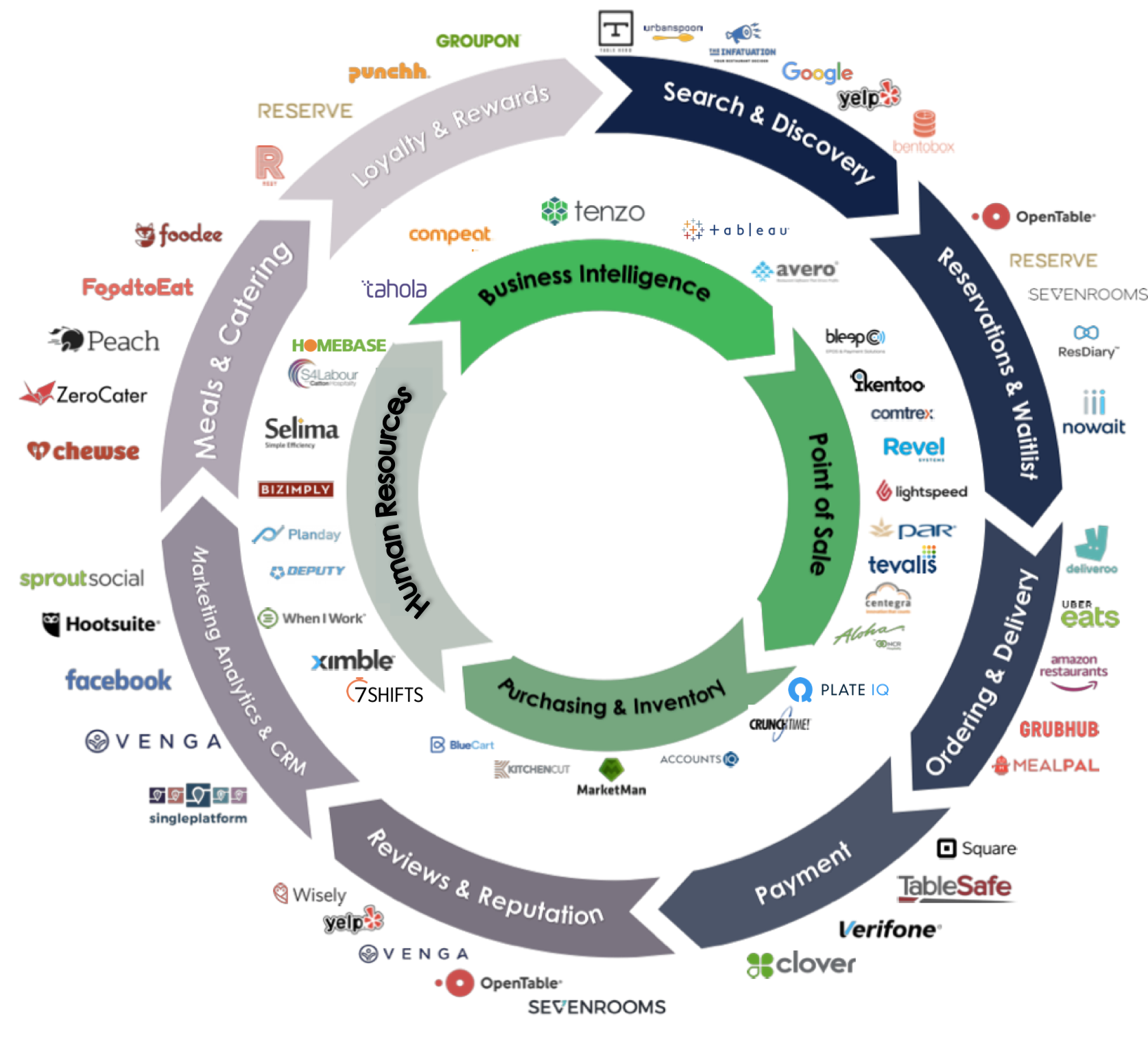
Figure 1: Restaurant Tech Ecosystem Wheel
Specialised Restaurant Tech for Complex Solutions
Point of Sale (POS)
The Point of Sale (POS) is a tool allowing restaurants to record transactions in the simplest way possible and to gather them in one place. It has evolved from being crank-operated cash registers to simple tablets. POS’s have also evolved towards being an analytics tool when used with APIs, which allow connections with other software products such as business intelligence, inventory or employee management tools.

Lightspeed is very adaptable to your restaurant with a customisable menu and real-time updatable floor plans. It also allows you to gather your integrations, your staff and your loyalty programs.
Website – https://www.lightspeedhq.co.uk
iKentoo is the most advanced iPad-based Point of Sale and business management system on the market for the hospitality industry. We offer seamless, intuitive and reliable solutions for restaurants, multi-site chains, food trucks, festivals, bars, hotels, coffee shops and delis.
Website – https://www.ikentoo.com/en/ikentoo-ipad-pos
Specially designed for the hospitality industry, Tevalis has always managed to meet the demanding and constantly evolving requirements of people working in the industry. With a client focused approach, Tevalis offers you a tailored solution to your business needs.
Website – https://website.tevalis.com/
Human Resources (Staff Scheduling/Labour Tools)
These tools help to schedule employees hours depending on their availability (shifts/holidays), their skills, and in compliance with the law. The staff schedule can be published for employees to see their shifts in advance. The tools enable businesses to track and organise their workforce in real-time.

Planday makes communication with and between employees easier, provides a business overview of staff activity and lets managers choose how much autonomy their employees should have to schedule their own hours. Bonus feature: you can get all of this available on mobile.
Website – https://www.planday.com/
Deputy helps you manage the unique complexity of your workforce by giving you the best shift structure for your business and picking the best employees for each shift. With a mobile first approach, Deputy is a user-friendly end to end workforce management app and is easily integrated with other HR software.
Website – https://www.deputy.com/
Purchasing & Inventory
These tools ease the process of paying vendors, they provide cost insights on food and beverage supplies and they also cut down bookkeeping costs through automation.

A Cloud-based inventory software, easing collaboration between suppliers and buyers. It helps you to keep a close watch on all your back-office operations, supplying processes and your purchasing history. It allows you to have real-time updates and information about exchanges between suppliers and customers.
Website – https://www.marketman.com/
Kitchen Cut’s main focus is to bring innovation and automation to the kitchen while remaining very simple to use and entirely scalable as your business grows. The real-time alerts and notifications give you actionable insights into your business.
Website – https://www.kitchencut.com/
Business Intelligence
These tools typically centralise the software to help businesses run more efficiently. The data drawn from the POS and Staff Scheduling provides sales analytics, sales forecasting and measures staff performance. An advantage of these tools includes overlaying the data to provide quick and novel insights such as measuring the cost of labour as a percentage of sales at any given time. The data drawn from social media platforms can also be collated to give you easy access to reviews, trend analysis and detailed metrics. Real-time push alerts are also available to help determine review trends/statistics.

Tenzo gives you actionable and relevant insights on your hospitality business, outlining where and how you could save time and money on your business. Tenzo manages this by integrating with many POS, Staff Schedulers, Inventory and Social Review platforms. Furthermore, Tenzo provides highly accurate sales forecasting thanks to its proprietary machine learning algorithms.
Website – https://www.gotenzo.com/
Reviews & Reputation Management
Created to help consumers find restaurants, pubs, cafes, bars, hotels and all kinds of hospitality establishments. These establishments can be broken down by location, food type, atmosphere and ratings. It also allows the user to rate and write reviews on the places you’ve been depending on your experience there. This feedback is valuable both for restaurants and customers: restaurants get to know how to improve their service, food, necessary repairs and future customers can get a feel before actually visiting the location.

Websites – https://www.tripadvisor.co.uk/ – https://www.google.co.uk/business – https://www.facebook.com – https://www.yelp.co.uk
Reservation & Waitlist
These tools help restaurants track how the dining space is used in order to optimize as well as predict how long new customers will be waiting. They also help customers to reserve tables online in order to avoid waiting. The aim is to eventually maximise the capacity of restaurants, optimise revenues, extend venue reach and make reservations as easy as possible.

OpenTable helps find the perfect place to book a meal: it takes into account your location, the price range you want to pay for your meal, the type of cuisine, the reputation of the restaurants, discounts, ratings, free slots for a reservation and the seating options. Once you’ve chosen your restaurant, the reservation process is centralized on the website which makes it easier and faster.
Website – https://www.opentable.com/
Loyalty & Rewards
These tools allow customers to send vouchers or reach loyalty thresholds based on purchasing history, earning them discounts or free meals etc. These kinds of software enhance relationships by simplifying and rewarding consumer interactions.

ResyOS is a complete restaurant reservations and waitlist system, including table
management, ticketing, web and app booking, CRM, POS integration and more.
Website – https://os.resy.com/
Ordering & Delivery Marketplaces/Corporate Meals
These tools aim is to get any meal delivered to your door. They present consumers various restaurant options in their vicinity and sends delivery men to collect and deliver the order to their doorstep for a small delivery fee.
Another feature of these apps is to have meals/snacks delivered and served routinely to offices. The company delivers tailored menus and snacks depending on a budget you predefine. They can also be used to help you cover events catering.
Deliveroo partners with more than 17,000 restaurants to deliver food to your doorstep. All you have to do is enter your postcode and the app or website will find you the restaurants nearby and your food will be delivered. You can filter your search (by type of cuisine, restaurant but also by different categories such as “guilty pleasures”, “desserts”, “healthy food” and many others) to find the exact food you want.
Website – https://deliveroo.co.uk/

City Pantry is designed to deliver a menu tailored for you and your work team as regularly as you wish. Your order is personalized depending on your preferences, events, budget per person, dietary concerns or types of cuisine.
Website – https://citypantry.com
Payment
Payment software allows you to pay wherever and whenever you wish and easily register all your bills. A few tech companies also sell cheap, easy-to-use hardware to allow smaller restaurants to take credit card payments.

Square makes it very easy, fast and cheap for you to accept the different means of payment from your customers (chips, contactless etc). You can accept payment from any means e.g. by phone, in person, by invoice or online. The free app offered by square makes the product very intuitive and easy to use and gives you insights on your business as well as the ability to see reports in real-time.
Website – https://squareup.com
Marketing Analytics & CRM
These tools help manage social and marketing data by tracking restaurant reviews, centralising customer data and automating marketing campaigns.
Toast’s CRM system can integrate with your point of sale system, allowing you to easily gather crucial information about your customers. If customers sign up for a loyalty programme, Toast will use this information to create a personalised profile for each customer where managers can view their purchasing habits and history. Using this information, you can create customised marketing messages and promotions for that customer to encourage them to visit your restaurant again.
Website – https://pos.toasttab.com/
Food Waste
Food waste tech tools allow restaurants to solve one of the big issues in the catering industry – managing food waste. Different solutions are being offered to cut waste such as selling leftovers at lower prices to customers; more accurate demand forecasting/inventory management and; quantitatively recording food waste to build reports and allow further transparency of wastage.

Winnow allows the kitchen staff to identify everything they throw away, all the waste is weighed and costs estimated. The cloud then analyzes the quotidian waste to give chefs key metrics and reports to help them cut future food waste.
Website – https://www.winnowsolutions.com/

A simple-to-use app where restaurants register any leftovers for the day which are then displayed to the public. Consumers can then pick up the food at a lower price thus avoiding food waste.
Website – https://toogoodtogo.co.uk/en-gb
Hospitality training
These tools are designed to quickly and efficiently train people working in the catering/hospitality industry. The tools help keep staff up to date in a fast-evolving field as well as help keep training costs low when staff turnover is high.

“Flow has been designed to inspire learning through our comprehensive portfolio of innovative and engaging online modules. We also deliver control and visibility of all learning and development activity through our versatile and intuitive management system, The Flow Zone.”
Website – https://www.flowhospitalitytraining.co.uk/
In summary
At Tenzo, we understand that choosing the tech tools that best suit your business is not easy. As Tenzo is uniquely positioned between a range of solutions, we feel qualified to work with you to identify the best infrastructural fit. So please don’t hesitate to reach out if you have any questions or are looking for advice.
The post Restaurant Tech; Is Your Restaurant Tech-Ready for 2019? appeared first on Tenzo.
]]>Not a single day passes without Machine Learning being mentioned in the news. The technology has either advanced driverless vehicle technology or defeated the world chess champion. But what about Machine Learning in the restaurant industry? First, you may be surprised to learn that Machine Learning already helps restaurants in many ways by: In this […]
The post What is Machine Learning and why it’s useful in the restaurant industry appeared first on Tenzo.
]]>Not a single day passes without Machine Learning being mentioned in the news. The technology has either advanced driverless vehicle technology or defeated the world chess champion.
But what about Machine Learning in the restaurant industry? First, you may be surprised to learn that Machine Learning already helps restaurants in many ways by:
- Forecasting sales more accurately
- Identifying staff theft
- Matching customers to restaurants based on their pre-selected taste profile
- Teaching robots how to cook
- Identifying the contents of food at a molecular level
In this article, we’ll provide a short definition of Machine Learning and discuss additional ways it can help the restaurant industry, specifically by forecasting sales more accurately and teaching robots how to cook.
What is Machine Learning?
Machine Learning describes the ability of algorithms to learn from data processing. The more data they process, the more they learn, and the more accurate they are at responding to a question.
How Can the Machine Learn?
For starters, an interesting question to ask an algorithm may be: Is this object a car, a pedestrian or a tree?
When algorithms try to answer a problem, they estimate a solution by taking into account several parameters. In our example above, the algorithm can examine an image and estimate the type of object in the image taking into account the shape, colour, and motion.

Example of algorithm estimating traffic
Naturally, most of an algorithms initial predictions will be wrong. The algorithm learns by testing what was predicted against by what really happened – this type of Machine Learning is called supervised learning. For each round, the algorithm modifies internal parameters or parts of its structure based on the initial fallacies and tries again. This process continues, which includes discarding the changes that reduce the algorithm’s accuracy and keeping the changes that increase the accuracy. The algorithm is said to have “learned” when new images are presented and are accurately classified.
How Machine Learning can help the restaurant industry?
Improve Sales Forecast accuracy with Machine Learning
Basic algorithms not using Machine Learning
Basic algorithms can forecast future sales based on simple parameters such as sales for last week and year as well as taking into account holidays, weather, etc.
As an example, to forecast tomorrow’s sales a basic algorithm will:
- Calculate the average between last year sales the same day and last week sales the same day
- Increase sales by 20% if it’s an holidays day
- Increase sales by 20% if it’s a sunny day
However, all those parameters do not have the same impact for your restaurants. For instance, weather can be an important game-changer for an ice cream restaurant next to the beach but a small factor for a pizza restaurant in a mall. A basic algorithm cannot personalise the forecast and understand that every restaurant is different.
Algorithms Using Machine Learning
Algorithms can help increase forecast accuracy over time personalising every parameter for each location, which means learning while processing data the parameter that has the greater impact on sales for a specific location.
At Tenzo we are forecasting experts. Our experience has shown the most relevant parameters to forecast restaurant sales are:
- All previous data (i.e. seasonal data, weekly data, growth trend)
- Weather (i.e. temperature, precipitation, sun hours)
- Holiday (i.e. bank holidays, half-term, Mother’s day)
- Events tailored by customers (i.e. football matches, theatre production)

The Tenzo algorithm combines the above mentioned parameters to forecast future sales. Then we assess accuracy by looking at the actual results.
For each new forecast, Tenzo’s algorithms modify the impact of each parameter based on the initial fallacies and try again. As previously stated, the algorithm keeps the changes that increase accuracy while discarding changes that decrease the accuracy. The more data we process, the more we learn, and the more accurate we are with our next forecast.

MAPE (Mean Absolute Percent Error) – This is how we expect our software to increase accuracy over time
Using Machine Learning we demonstrate up to 50% improvement in forecasting accuracy vs. basic forecast algorithms and up to 30% vs typical manager generated forecasts.
Our forecasting predicts demand hourly, which saves restaurants staffing costs by optimising labour schedules. Tenzo also reduces inventory wastage by preparing the optimal inventory level.
Teach Robots How to Cook using Machine Learning
California-based Miso Robotics is a startup focused on AI-driven robotic solutions for the kitchen environment. The company’s flagship AI kitchen assistant “Flippy” combines 3D, thermal, and regular vision to assist with grilling, frying, prepping, and plating.
In this example, Machine Learning was used to teach the robot:
- To recognise a steak, a cooked steak, and a cheese slice
- When to flip the steak and when to stop grilling it
For the recognition process, we explain below how colours and shapes are parameters used to recognise an object from another one. Each time, the algorithm modifies internal parameters or parts of its structure based on the initial fallacies (burnt or not cooked steak) and tries again. In the end, the algorithm will understand a brown steak is a cooked steak.

Example of how the robots can analyse the grill
To understand if it’s the right time to flip and if the steak is cooked, the algorithm can examine its different sensors and predict an answer according to those parameters.
In this example the most relevant parameters are:
- Temperature of the grill
- Temperature of the steak
- Colour and shape of the steak
- Time spent on the grill
Then during the supervised learning, a human assesses accuracy by looking at the steak.
For each new steak, the algorithms modify the impact of each parameter based on the initial fallacies and try again. The more data the robot processes, the more it learns, and the better the steaks are cooked.

The Flippy Robot
Conclusion
Machine Learning has many applications in restaurants from helping cooks in the kitchens to forecasting future sales which in turn helps work out the requirement for labour and inventory management.
Ultimately it can help restaurants run more efficiently, for example, by helping to reduce the 600 million tons of food wasted by restaurants globally and allowing restaurateurs to focus on where they can add the most value.
The post What is Machine Learning and why it’s useful in the restaurant industry appeared first on Tenzo.
]]>Two weeks ago, we had the pleasure of attending Restaurant and Bar Tech Live. The two days were a blur of demoing, meeting with partners and scrambling from talk to talk. It was hectic, busy, and everything we could have hoped for from the biggest event for restaurant tech of the year. Plus, with so […]
The post Restaurant Tech | 2020 Tech Trends Revolutionising the Industry appeared first on Tenzo.
]]>Two weeks ago, we had the pleasure of attending Restaurant and Bar Tech Live. The two days were a blur of demoing, meeting with partners and scrambling from talk to talk. It was hectic, busy, and everything we could have hoped for from the biggest event for restaurant tech of the year. Plus, with so many industry big-wigs and influencers in attendance, we had an opportunity to learn all about the upcoming trends in the industry.
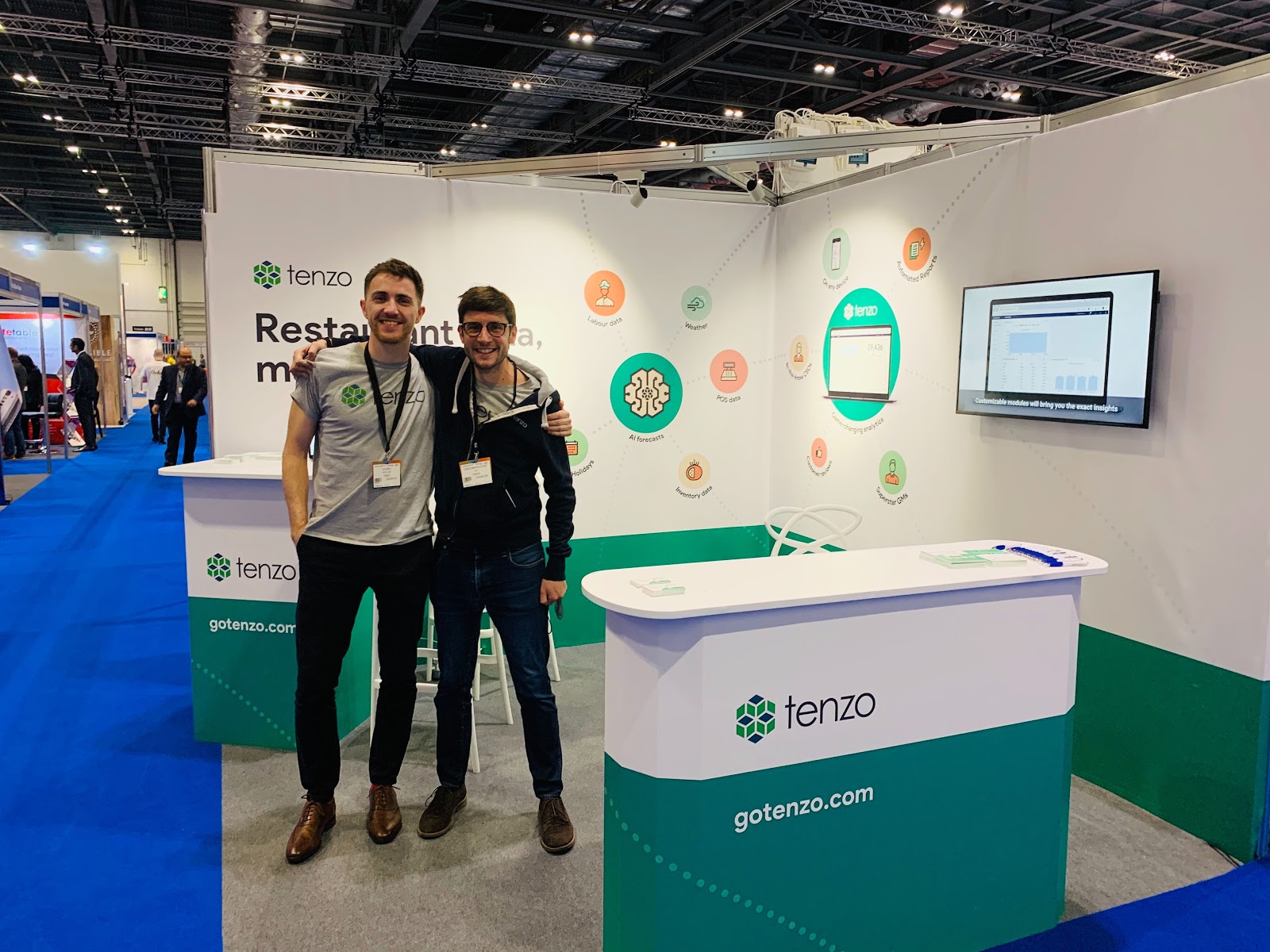
Here’s our breakdown of everything we learnt over the two days about the direction tech is heading in the industry.
People over tech
Ironically, the first talk that we went to – a keynote by Cain Savazzi, Operations Director at TGI Fridays – promoted the idea that tech should come in second-place in your business. What should come first, you ask? According to Cain, it’s your people – TGI Fridays has a people-led strategy, with tech being an enhancement, not a replacement, for those people.
According to Daniel Davis of Honest Burgers, this is the worst labour market since World War 2. Retaining staff by investing in them and making them feel appreciated may be the answer to this problem. Tech solutions built with staff-empowerment in mind – dedicated training apps ,for example – are a way to integrate the efficiency of technology, while still putting your people first.
Tenzo is an example of staff-empowerment tech. A few examples: our real-time analytics allow GMs to be better decision-makers, and our forecasting can make shift schedules more reliable – a big factor in retaining staff.
Alternatively, training apps that incorporate gaming like those created by Attensi encourage employees to engage with both the company and each other. We’ve seen successful case studies of this from both Itsu and Starbucks. In fact, Itsu found that their onboarding time was halved thanks to the new gaming concept. Gamifying training encourages people to keep using the app to get higher scores while simultaneously repeating simulations that will make them more confident and effective workers.
Robots
It’s happened: the robots are here. Marius Robles, co-founder of Food by Robots, showed us how far robotics has come along in the food industry over the last few years. Now, robots can not only be programmed to perform one task but can easily be reprogrammed for the next one. This allows the same robotic device to be used for several different tasks, revolutionary when you think of all the tasks required in a kitchen! The takeaway here is that we have got to the point where a robotic arm is actually a sensible investment for many commercial Kitchens and not just a novelty.
We’ve already seen their implementation in new concepts such as Spyce in Boston, a fully automated quick-service restaurant. Robots run the show there, from taking orders, preparing the food, and delivering it to the consumer.
In Asia, they’re way ahead of the curve. Alibaba has rolled out Robots.He in their Hema supermarkets in China, a robot-powered eatery that allows you to select items from the supermarket to be prepared for you. Their competitor, JD.com, has also embraced robotics in the food industry and plans to have 1,000 robotic restaurants in China by 2020. These restaurants are fully automated, from food preparation to service. They incorporate AI and self-driving technology to safely manoeuvre within the space. The restaurant has a VR immersive eating area to provide diners with an even more futuristic experience.
Gen Z and digital engagement
We now live in the kind of hyper-connected world that means that the average twenty-year-old gets distracted every twenty-eight seconds by a new notification, according to Paul Wickers, founder and CEO, at Huggg. This means that to stand out from the crowd, any kind of advertisement must compel the consumer to convert as quickly as possible.
Olive Garden is one restaurant chain who have managed to do just this. They send their most engaged customers text messages, sometimes up to three times a week! They only contact customers who have signed up to receive text messages from the brand, meaning that they are already fans of Olive Garden. By capturing this audience, and sending out news or offers in this medium, they are able to incite repeat visits from loyal customers and reward them.
With a whole new generation of consumers coming of age, it’s important to know what makes them different from their predecessors. Gen Z, according to several industry insiders, will be far less loyal to one restaurant than the millennials that came before them. They are much more open and prefer to try new things each time they go out. Finding a way to keep them loyal is therefore imperative.
Harnessing the power of search
In 2019, whenever we want the answer to pretty much any question, Google is our first port-of-call. Same thing goes for restaurant recommendations. If we’re in the mood for something to eat, we don’t search for branded terms like ‘Five Guys’ but instead for unbranded terms like, ‘good burgers near me’. One key to increasing footfall is to be the first result for that unbranded search term.
Lee Zucker, from Yext, showed us how Five Guys did just that. And it was no simple task. We don’t realise how many separate terms need to be analysed to give us the answer we want on Google. Searching ‘good burger place near me with free wifi’ may seem pretty straightforward, but it actually requires Google to trawl through millions of data points, from menu information, reviews, and location information, to information on specific restaurants, and bring it all together for the customer.
For restaurants to achieve that elusive top search result, all of their information needs to be within easy reach for Google. According to Lee, it is seemingly important to lay bare all of the things that you offer. (The official name for this is a knowledge graph). Say you have activities for kids and great children’s menu, shout it loud and clear on the web. So next time someone searches for ‘best kid-friendly restaurant’, you’ll be on the radar.
Sustainability
Last, but absolutely by no means least, we saw a serious upsurge in interest in sustainability. Just walking around the stands at all the expos involved in the wider Food Entrepreneur Show, anyone could see that sustainability was at the forefront of everyone’s minds, whether it was eco-takeaway boxes, straws made of actual straw, more eco-friendly waste disposal, or brands targeting food waste such as Too Good To Go.
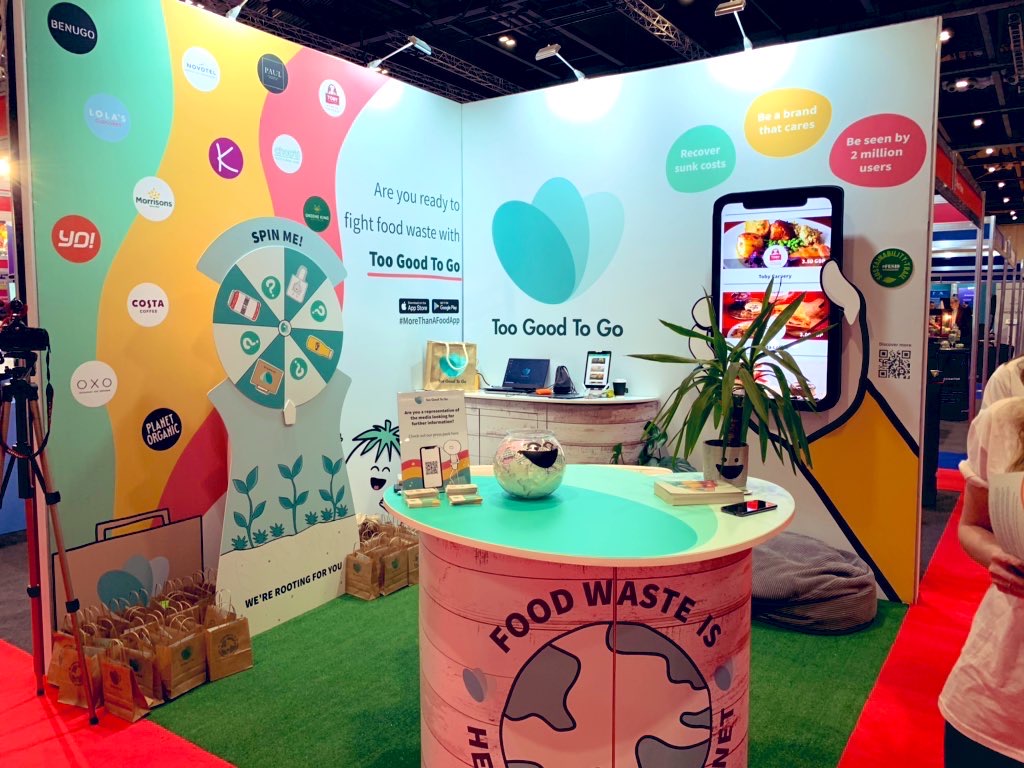
From a technology perspective, our own CEO and co-founder, Christian Mouysset, pointed out the huge issue of food waste in the restaurant industry during a panel discussion about “leveraging technology to streamline operations”. Using Tenzo’s AI forecasting allows restaurateurs to know, with much greater accuracy, how much food will be needed in order to reduce over-ordering and more waste.
Conclusion
Trends like these prove that the next era of hospitality has begun – the technological revolution. Things that might have seemed like science-fiction just five years ago, are now becoming reality.
Furthermore, in this internet-age, the reach that restaurant brands can now have is unprecedented. Using these next-generation tools to appeal to as many people as possible has become crucial.
These trends are here to stay and are bound to take the whole industry by storm.
We had such a great time at Restaurant & Bar Tech Live and we definitely learnt a ton. We can’t wait to be back next year!
The post Restaurant Tech | 2020 Tech Trends Revolutionising the Industry appeared first on Tenzo.
]]>In a week’s time, Tenzo’s fearless leader, co-founder, and CEO, Christian Mouysset, will be speaking on a panel at Restaurant & Bar Tech Live about leveraging technology to streamline operations. The other participants will include Sahib Gulati, co-founder of Zeffu Technologies, Tim Malbon, founding-partner at Made by Many, and Ross Tracey of Ceridian. In the […]
The post Restaurant Operations; how to streamline by leveraging tech appeared first on Tenzo.
]]>In a week’s time, Tenzo’s fearless leader, co-founder, and CEO, Christian Mouysset, will be speaking on a panel at Restaurant & Bar Tech Live about leveraging technology to streamline operations. The other participants will include Sahib Gulati, co-founder of Zeffu Technologies, Tim Malbon, founding-partner at Made by Many, and Ross Tracey of Ceridian.
In the run-up to the event, we thought we’d break down how we think technology can make running a restaurant a little easier. To find out more, be sure to stop by Panel Theatre Hall 5 at the show at 3pm on Wednesday the 20th of November.
How to embrace technology in your business
When you first start a restaurant you quickly realise that you need some way of tracking your orders, your staff rota and your inventory. This may lead you to lean on the free programmes that we’re all accustomed to already such as Google Sheets. At the beginning this may work for you, but eventually you might find yourself praying for a solution that takes away the hours of human effort that keeping spreadsheets up-to-date requires.
First steps

This is where technology can step in to help. Automating some of these processes makes life a lot easier. For example, using a modern POS system, like Zeffu, that incorporates iPads or table-side ordering reduces stress for your servers who can rest assured that as soon as an order is taken it’s sent to the kitchen display screen. On top of that, you’ll be able to more easily track what menu items are selling well and order inventory accordingly. Having a solid POS system in place is definitely the first step in your technological journey.
Next consider how you schedule your staff. Are you still relying on written timetables that set your schedule in stone for the week? If so, it may be time to consider switching to a labour scheduler like that offered by Ceridian. Using a technological solution to keep all your employees in the loop means that things like shift-swapping and holiday-days become simple and communication lanes are far more open, saving time for your managers and making staff happier. Most modern labour schedulers also offer some HR features, so you can, for example, make sure you stay compliant with all employee laws.
Once you’ve adopted these two technologies, it’s time to start thinking about what you can do with the buckets of data that you’re now generating. That’s where a platform like Tenzo comes in. Tenzo aggregates the data from your POS system, labour scheduler, reviews platforms and other systems, automating all that annoying report-building, and allowing you to get at essential insights a lot faster. Find out, for example, your cost of labour as a percentage of your sales, who of your servers has the biggest average transaction size, and much, much more. And as a cherry on top, you can now more accurately forecast your future sales using AI.
Expanding your tech stack
If you’ve implemented all of the above, you’ve covered all the basics. But there’s even more you can do.
Dealing with vendors can be time-consuming. You might find that you are spending too many precious hours on inventory procurement, tracking orders, organising deliveries, and managing your accounts with suppliers. A specialist inventory management system, such as Marketman, allows you to track all this stuff in a convenient platform. Managing orders through a modern platform also allows you to more easily adjust your orders according to Tenzo’s AI forecasts. Lastly, a good inventory management platform can really help with reducing food waste.
It may be at this point that you start thinking that technology might not be able to solve problems that are very specific to your business. If you work for or run a large business, you might want to get a bespoke product built that will solve your specific issues. That’s when you call in the experts at Made by Many who can counsel you from the very first iterations of your idea all the way through to the production of a tech product that makes running your business as hassle-free as possible.
What can you expect once you welcome technology into your business?
Saved time
Engaging with technology means that the time you previously spent manually reviewing different aspects of your restaurant can now be automated. Obviously this means time saved, but you might not realise just how much. Instead of having to compile reports yourself, your systems can now do it for you, meaning that all the time you wasted before can now be spent making changes based on the insights you receive. Just take a look at The Breakfast Club. They cut their reporting time down from four hours-a-week to just one half-hour thanks to implementing Tenzo.
Augmented data

When you harness the power of technology, you get to go above and beyond traditional analysis. Restaurants generate a huge amount of data, but it only comes into its own when you put it all together and generate the insights you need. In many ways, data is the soil from which your business can grow. But you also need to know what kind of plants grow best in your soil. This somewhat questionable metaphor is meant to bring home how important knowing what is working, and what isn’t, is to the success of your restaurant, and it helps to have cold hard data to back up your decisions.
Better communication
In our personal lives, technology has become the norm for communication, so why isn’t it the same for restaurants? Being able to send colleagues updates with the click of a button or the swipe of a finger keeps everyone in the loop and on the same page. When you can receive alerts instantly on your mobile, actions can be taken to rectify a situation way before it gets out of hand.
What to expect in the future
The good news is once you’ve embraced technology and seen how well it can work for you, you’re going to want to experiment even more. And don’t you worry, the rise of restaurant technology is only just beginning: it’s not only your operations systems that are future-fying themselves. The restaurant itself will soon become a new technological experience. We’re already seeing front-of-house implementation, such as table-side-ordering and mobile integration. But soon, we’re sure to see more and more futuristic inventions in the back-of-house. That’s right: the robots are coming.
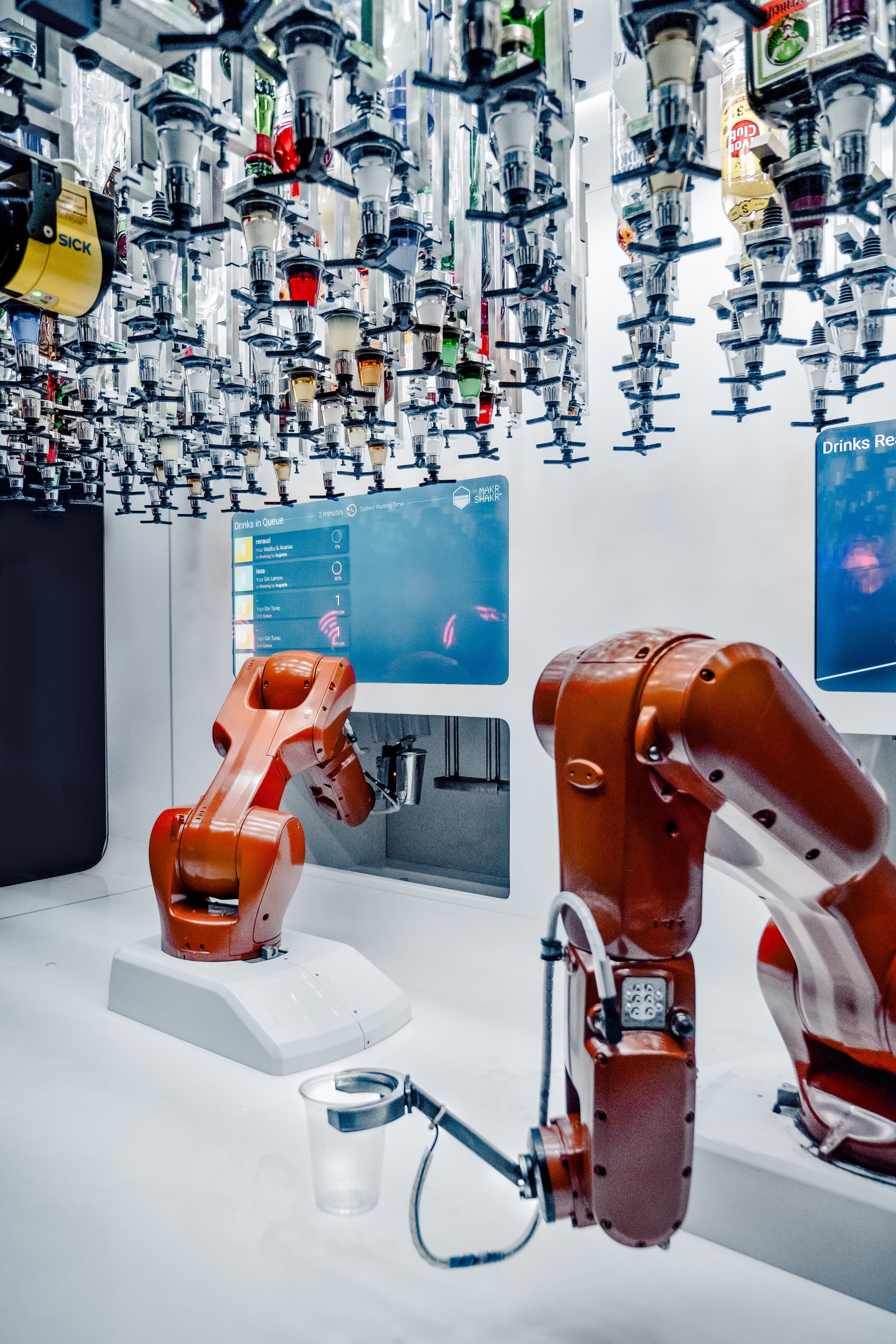
We’ve already seen robots capable of making pizzas from scratch, flipping burgers and pouring drinks (see above). However, unlike the sci-fi dystopian society that we’ve been sold in films and tv, robots won’t be making human involvement completely superfluous just yet. Robots will be used in addition to manpower, augmenting the creative capabilities of a great restaurant team.
In terms of food waste, technology may also be our saving grace. Smart fridges will let chefs know what produce or protein needs to be used first as well as adjust their temperature to optimal levels to slow food spoilage. Smart bins, like the ones Winnow produces, can tell you exactly what you’re throwing away so you can reduce over-ordering and over-prepping. Smart ovens can tell you exactly how long and at what temperature certain foods should be cooked and automatically shut themselves off when the ideal temperature has been reached, so you never have to throw away burnt food again. With food waste at pandemic proportions, technology may be the answer to solving this environmental emergency.
For more information on reducing your food waste, check out our food waste reduction guides.
Conclusion
Technology is invaluable to your operations. The restaurant world is changing quickly and soon customers will have specific expectations when they visit a restaurant, so keeping up with technological advances will be imperative. Plus, it’s very clear that technology makes the running of a restaurant much easier, reducing stress and creating a far calmer atmosphere. Obviously, technology is not the solution to everything – just ask Christian, who had to deal with robbery and fires while running Hummus Bros – but it can certainly help and take a little bit of the load off of the restaurateur’s shoulders.
Find out what Sahib Gulati, co-founder of Zeffu Technologies, Tim Malbon, founding-partner at Made by Many, and Ross Tracey of Ceridian have to say on the topic as well as more from Christian at their panel at Restaurant and Bar Tech Live 2019!
The post Restaurant Operations; how to streamline by leveraging tech appeared first on Tenzo.
]]>