According to a report from the Food and Agricultural Organisation (FAO), global food wastage per year is approximately 1.3 billion tonnes, which is roughly a third of the food produced in the world for human consumption. On a more local scale, waste in UK restaurants is approximately 1.6 million tonnes per year with around 600,000 tonnes of this […]
The post Reducing Food Waste | Strategies to help boost restaurant performance appeared first on Tenzo.
]]>According to a report from the Food and Agricultural Organisation (FAO), global food wastage per year is approximately 1.3 billion tonnes, which is roughly a third of the food produced in the world for human consumption. On a more local scale, waste in UK restaurants is approximately 1.6 million tonnes per year with around 600,000 tonnes of this being food. Breaking this down: 30% is from plate waste (customer leftovers); 5% from spoilage; 65% from prep waste (food not used after preparation). Reducing food waste is vital to boost restaurant performance and control costs.
Why exactly is this such a problem? Firstly, global population is on the increase with 10 billion people expected by around 2050. Therefore demand will be significant and without an increase in supply prices will rise. Added to this, climate change has the potential to create further difficulties in food production as extreme weather events such as droughts and floods will lower crop yields. Together, these issues could have disastrous consequences on food security leaving millions starving.Attempting to address this problem may seem daunting however, there are strategies restaurants can implement to contribute to reducing food waste.
Best strategies for reducing food waste
1. Utilise preparation waste for the creation of other menu items.
For example, SiloLondon utilises broccoli cores in the creation of one of its dishes.
2) Offer a greater range of portion sizes or encourage the use of doggy bags for your customers.
3) Calculate and monitor your ‘actual wastage’ with the help of vigilant stocktaking.
For example, by connecting menu items with their ingredients i.e. the cheeseburger needs 1 beef patty, 2 buns, a slice of cheese and pickle etc. When you take the dishes sold and multiply this by the recipes of each menu item you get the “theoretical usage”. When you do the stock count you can work out the “actual usage”. Minus the “theoretical usage” from the “actual usage” and you get “actual wastage”.
For simplicity:
Theoretical usage = Total dishes sold x individual recipe items
Actual usage = Ordered food items — remaining food items
Actual wastage = Actual usage — theoretical usage
The difference between the theoretical usage and actual usage will typically come down to:
- Portion sizes being bigger/smaller than defined in the recipe. More training of the kitchen team can help improve this.
- Items that are free and therefore not entered in the till (eg: staff meals or deliveries from third parties). To be able to identify the cause of the waste, it’s important to make sure that these are entered in the till and discounted to zero so that they are counted as part of the theoretical usage.
4) Buy and prep the right amount of food each day.
This may seem like an obvious point to make but it is actually a very difficult task to get right. This is because there are a large number of variables which will affect your sales for any given day for example seasonal variations, overall growth trends as well as local weather and events.
Technologies are now available to accurately forecast sales, from the store level right down to the individual item level taking into account the previously mentioned variables. Tenzo has this capability by utilising cutting edge machine learning algorithms (or artificial intelligence). This technology has a proven track record of reducing food waste. Click here for more information and if you’re interested in a demo you can sign up here.
At an individual level these contributions are quite small, however, collectively (across all restaurants) they are huge and can have a significant effect on food prices and sustainability. For inspiration, here is a list of the most sustainable restaurants in the UK. Have a look — you may get some great ideas!
To learn more about reducing your restaurants’ food waste visit the Too Good to Waste Campaign run by the Sustainable Restaurant Association.
The post Reducing Food Waste | Strategies to help boost restaurant performance appeared first on Tenzo.
]]>Worldwide, one-third of all food produced is lost or wasted costing us around one trillion dollars. Food waste is a substantial part of the waste produced by the hospitality sector. It accounts for over 50% of the waste produced by certain kitchens There are three main effective ways to reduce food waste in busy kitchens. Firstly, technology […]
The post Tackling Food Waste in Commercial Kitchens appeared first on Tenzo.
]]>Worldwide, one-third of all food produced is lost or wasted costing us around one trillion dollars. Food waste is a substantial part of the waste produced by the hospitality sector. It accounts for over 50% of the waste produced by certain kitchens
There are three main effective ways to reduce food waste in busy kitchens. Firstly, technology can help you manage your kitchens and prevent food waste from happening. Secondly, it’s important to accurately forecast future demand to prepare the optimal amount. Finally, if you still have leftover food you can use a platform to sell it, instead of tossing it (along with your profit).
For this article we’ve joined together with Too Good To Go and Winnow to discuss how to minimise food waste, help the environment and your margins at the same time.
Shine a Light on Food Waste in Your Kitchen

Reducing food waste comes with great opportunities for the hospitality and food service sector. It saves money and contributes to the environment at the same time. Investing in the right technology is the most effective way to shine a light on food waste, prevent it, and reduce it.
For a long time resource efficiency within the hospitality and food service industry was focused mostly on heating, electricity, and water solutions. In recent years, however, the industry is waking up to the opportunities lying in food waste reduction. Some of the world’s most renowned brands, such as AccorHotels, Compass Group, IKEA, and Costa Cruises, have set targets to reduce their food waste.
With the introduction of digital tools, chefs are now able to automate many of the administrative tasks required to measure waste. What gets measured gets managed. The first step for any kitchen to capitalise on the opportunity food waste presents is to gather accurate data. Winnow’s vision for the kitchen of the future is one where waste management is automated. This gives teams better visibility, as well as giving chefs more time to focus on what they love doing: cooking.
Winnow was launched five years ago with a simple belief that food is too valuable to waste, and that in the hospitality sector food waste could be reduced by introducing digital tools to measure and manage waste.
Working with thousands of chefs from all over the world, Winnow’s latest report also shares strategies to cut food waste at key stages such as:
- Labelling techniques to minimise spoilage.
- Developing standard recipe banks for your teams to reduce cooking errors.
- Preparing food in smaller batches over service to reduce overproduction.
Today Winnow operates in 30 countries and are trusted by Compass Group, Accor Hotels and IKEA. But we are really just at the beginning of a wholesale system change. Soon we will see the entire sector look for ways to reduce their food waste, having an enormous impact on the environment while increasing the efficiency of their operations.
Read more about Winnow

Forecasting Daily Demand to Prepare the Optimal Inventory Levels

Understanding your waste habits is critical to reducing future waste and Winnow is an excellent tool. An accurate forecast is the next step to reduce your food waste.
When forecasting your future demand it is important to look at:
- Past Sales
- Over Growth Trends
- Annual Seasonality
- Weather
- Significant Events – Sports, Holidays, Festivals
Forecasting daily sales is complex because you need to segment your past data and compare similar data sets. For example, if you are forecasting for July 5th, a Thursday, you can’t simply look at July 5th last year. You need to look at the first Thursday in July for the past few years and then compare what the weather and events were on that day.
A forecast will return your predicted demand, but how do you use this in conjunction with data on your past waste?
Easy! Let’s say that Winnow showed you that last Thursday you experienced 100 customers, prepared 10kgs of steak, but only sold 9kgs of it – you had to throw out 1kg of steak.
Now, If you forecast 140 customers then you should prepare 12.6kg of steak (40% more than 9kgs). Understanding your past waste data allows you to take advantage of an accurate forecast.
If you want to improve and automate your forecasting, Tenzo can help. Their AI has beaten in-house forecasting teams by 20-40% and reduced error by over 50% – saving you time and money!
Turning Surplus into Profit

Even the most well optimized kitchens will have a margin of error. Who can prepare for that rainstorm at lunch reducing customer footfall in the area? Equally, when the sun comes out and everyone wants your fresh salads you don’t want to be caught short.
Too Good To Go is the world’s largest marketplace for surplus food, allowing your business to reach hungry customers eager to save the world and your food! The app based platform works by having a set amount of portions available daily for customers to pre-purchase and collect at the end of service. These numbers are easily adjustable to work with your supply and demand, also allowing you to refund any orders you can’t fulfil.
The biggest benefit of reducing surplus food for businesses is the ability to recover sunk costs. Reports by WRAP suggest that it costs businesses 97p per plate of food wasted. This means that you actually lose money on any food not eaten. As well as allowing you to recoup these costs, the app works as a marketing platform for you, bringing customers to your store who may have never tried your food before. Give them a great experience and they’re more than likely to return as a full paying customer when they’re next in the area.
Finally, in the age of increased consumer conscience and CSR, don’t you want to be a business who cares? Customers are more aware than ever about the costs of consumerism and are opening their eyes to bad business practice. A quick look on twitter will show you all the eagle eyed consumers calling out local businesses leaving bags of wasted food by the bins. Stand out from the wasters and do your bit for the world.
Find out more about Too Good To Go
The post Tackling Food Waste in Commercial Kitchens appeared first on Tenzo.
]]>A key challenge for kitchen operators is deciding the quantity of food to prepare. If managers under prepare, they lose sales. If they over prepare, they waste labour and food costs. This article will give managers a statistical method to optimise food preparation to maximise profit. Typically, managers base their prep sheet off how many […]
The post Food Prep: How to Maximise Profit appeared first on Tenzo.
]]>A key challenge for kitchen operators is deciding the quantity of food to prepare. If managers under prepare, they lose sales. If they over prepare, they waste labour and food costs. This article will give managers a statistical method to optimise food preparation to maximise profit.
Typically, managers base their prep sheet off how many customers they have forecast for the next day. For example, if I expect 100 customers I’ll prepare 100 pizzas worth of inventory.
However, preparing for your estimated forecast is generally not profit maximising – because lost sales hurt. Should managers over prepare, under prepare and by how much?
It Depends.
We’d like to teach you a method to increase your profit by determining the optimal amount of food to prepare! To do this we’ll use a fictional case study of Anthony’s Burrito Shack. To keep it simple, Anthony only offers one type of burrito.
Problem to Solve: How many burritos should Anthony prepare tomorrow?
Optimise Food Preparation to Increase Profit Using Forecasting
1. Understand your Average Demand and Variation
First and foremost, Anthony needs to estimate his demand tomorrow. Anthony has tracked how many customers visited per day over the last few months. Most managers will know their average demand – but variation is important as well. Variation reveals the probable range that Anthony can experience.
Anthony uses Excel’s “=AVERAGE” and “=STDEV” to gain insights on how many customers to expect tomorrow.
This returns an average of 500 and a standard deviation of 60 for Anthony.
On average, Anthony experiences 500 customers and his standard deviation reveals that he usually experiences between 380 and 620 customers .
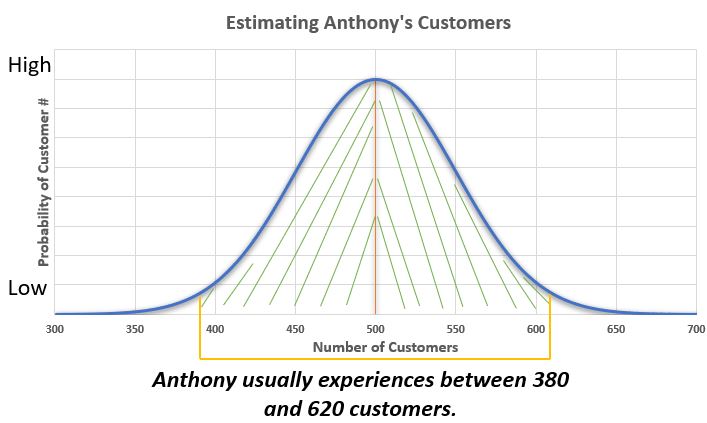
Anthony knows his average demand and range but how many customers should he prepare for? How should he balance lost sales vs wasted inventory?
Next, we need to examine his costs before determining how many burritos to make (Hint: the answer is not 500).
2. Understand your Costs & Margins
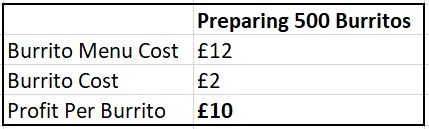
- Overage Cost: If Anthony over-prepares , he loses £2 per burrito
- Underage Cost: If Anthony under-prepares, he loses £10 per person – this is a lost sale
Note: We simplified Anthony’s shack – he only has one type of burrito. Usually, a percentage of your customers will order something else off the menu if you’re sold out. If Anthony offered two types of burritos he could take that into account and adjust his Underage Cost.
3. Balance Lost Sales vs Wasted Inventory – “Critical Ratio”
Now that Anthony understands his costs, he can calculate how many burritos to prepare!
In order to do this, Anthony needs to find his “critical ratio”.
This ratio determines the amount to prepare based off your costs. In other words, it optimises the amount of burritos that should be prepared to maximise profit by weighing lost sales vs wasted inventory.
Anthony finds that his Critical Ratio is 0.83, given by:
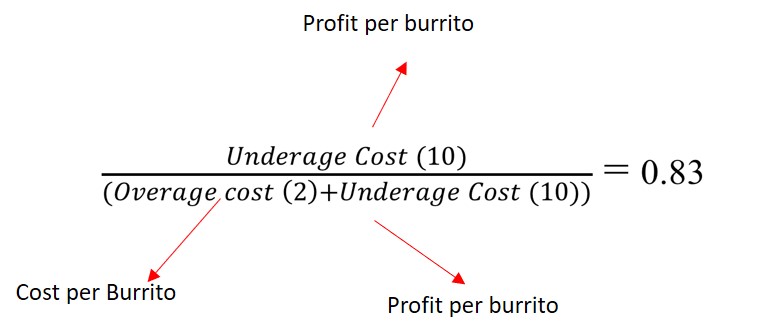
The 0.83 critical ratio means that he should prepare the number of burritos required to match customer demand 83% of the time. In other words, 17% of the time (about once a week) Anthony will probably not have enough burritos for every potential customer.
Anthony then needs to use Excel to find how many burritos will satisfy customers 83% of the time.
Use: =NORMINV(Critical Ratio, AVG Customers, Standard Deviation))) – This function will give the key number!

This function returns 558, which is the amount of burritos to prepare.
Anthony should prepare 558 burritos to maximise profit – even though his average is 500 customers!
4. Proving the Accuracy of the Critical Ratio.
I’ll show the results of Anthony preparing 500 Burritos vs 558 Burritos to prove that using your critical ratio is profit maximising.
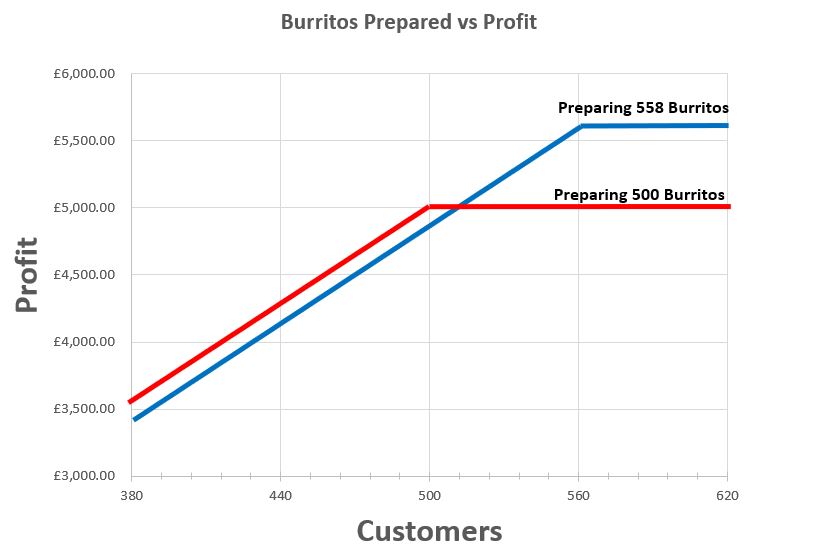
The chart above shows that preparing for 558 customers has a lot more upside than preparing for 500 customers. Conversely, If the customer demand is below 500 you barely make less money.

The critical ratio means that preparing more than 558 is not efficient! If Anthony made 580, because he wanted no lost sales, he would only make £4,770 on average – because the cost of the unsold burritos would outweigh the additional sales.
5. Should Anthony always prepare more than average demand?
The profit maximising quantity is based on your margins – your overage and underage costs. If the cost of Anthony’s ingredients raises to £10, the optimal quantity to prepare is 441, not 558, because unsold inventory is more damaging than lost sales.
6. How can we model more accurately?
If Anthony wants to improve his model he should examine the costs that go into his overage costs. Currently his overage cost is only determined by: Revenue of a Burrito – Cost of A Burrito (£12-£2 = £10).
However, the true cost is likely greater than that. He should look at storage costs for each burrito made (refrigeration costs) and staff costs that go into each burrito. Anthony might find that preparing the 58 extra burritos requires him to employee one more staff member.
Anthony might also be able to sell his leftover burritos at discount at his store, or over one of the great food reduction apps like Too Good to Go or Karma! This would also lower his overage cost – depending on the quantity and price of the reduced food.
Feel free to contact us for advice on how to include these more complex inputs!
7. How to maximize profit further!
Once you’ve been able to model your revenue maximizing quantity, the next step should be to increase the accuracy and precision of your demand forecast. We recommend using our forecasting module which has been shown to reduce forecasting error by over 50%!
The post Food Prep: How to Maximise Profit appeared first on Tenzo.
]]>So you’ve followed the advice in our ultimate guide to reducing food waste, eliminating waste generated in your kitchen down to the last crumb. But then the time inevitably comes when your plates must fly the nest and set forth into the cruel world of the dining room, where fussy eaters, over-orderers, and people with […]
The post Reducing Food Waste: A How-to Guide for Restaurants appeared first on Tenzo.
]]>So you’ve followed the advice in our ultimate guide to reducing food waste, eliminating waste generated in your kitchen down to the last crumb. But then the time inevitably comes when your plates must fly the nest and set forth into the cruel world of the dining room, where fussy eaters, over-orderers, and people with tiny appetites dwell. If seeing your food return to the kitchen uneaten is breaking your heart, then this guide is for you.
As a follow up to our ultimate guide to reducing food waste in restaurants, we now tackle the specific problem of the food that diners leave uneaten, AKA; plate waste.
As we saw in our previous article, according to a study by WRAP, more than 30% of all food waste in restaurants comes from diners’ plates. This is an enormous amount that can and should be avoided. It’s an incredibly inefficient use of funds, and adds to the enormous impact that food waste has on the environment.
From another perspective, the waste left on plates should go to a much better home than a landfill. 8.4 million people in Britain struggle to afford to eat and a further 40 million go hungry in the United States. We therefore have a serious responsibility to eliminate this unnecessary waste. Fortunately, this guide is here to show you how simple reducing plate waste can be.
Why do diners waste food?
But first, it may be worth exploring why some diners leave food behind. According to a study carried out by WRAP, restaurant patrons are separated into two categories: those who see meals as functional and a means to ‘refuel’ (44%) and those who see meals as a ‘collective treat’, broadly a social occasion (55%). It’s this second group who are more likely to leave food on their plates. Because they see the dining experience as a treat, they are more likely to order more courses and not finish everything.
When it came to not finishing food, 20% of ‘meal leavers’ reported that their reason for not eating everything was due to the portion being too large, and a further 10% claimed that it was due to over-ordering. Interestingly, 11% left food because they perceived it as the social norm to leave a little bit on their plate, to not appear too greedy. This is the type of conception that needs to be changed if we want to fight food wastage.
So what can be done to reduce the amount of food left on plates at the end of a meal?
1) Assess your menu
The easiest place to start is by paying close attention to what comes back into the kitchen. As mentioned in our previous article, keeping tabs on how much plate waste is produced by putting it into a separate bin and weighing it at the end of the week can provide restaurateurs with the extremely valuable knowledge of how much of their food is simply not being eaten.
Some of the work involved in this can be avoided by using Winnow’s smart bins.
Once this data has been collected, it is time to start analysing exactly what food is being wasted. What dishes consistently come back half-eaten? The best way to find out is to ask your wait staff to be more communicative with the customer. When they notice leftover food, it’s important they ask why the food has not been eaten. The key is to approach the customer in a way that encourages them to be honest, such as asking if everything was ok in a concerned manner. Alternatively, providing customers with a survey to fill in that includes gender and age will give you even more information about who is or isn’t finishing their meals. Is it a question of there being too much food provided? Or did the customer simply not enjoy it? Both problems are solvable.
If certain dishes are too large for diners, then it’s a simple question of reducing the amount served – a win-win as there is less waste and the dish itself costs less to bring to the customer. If it is the taste that is putting customers off, then some recipe testing may be in order.
Another useful source of customer feedback that can sometimes provide insights about specific dishes is reviews on Google, TripAdvisor etc. Tenzo shows you all these reviews in one place, and also tracks trends in reviews, allowing you to more easily spot when the feedback is consistent enough to act upon.
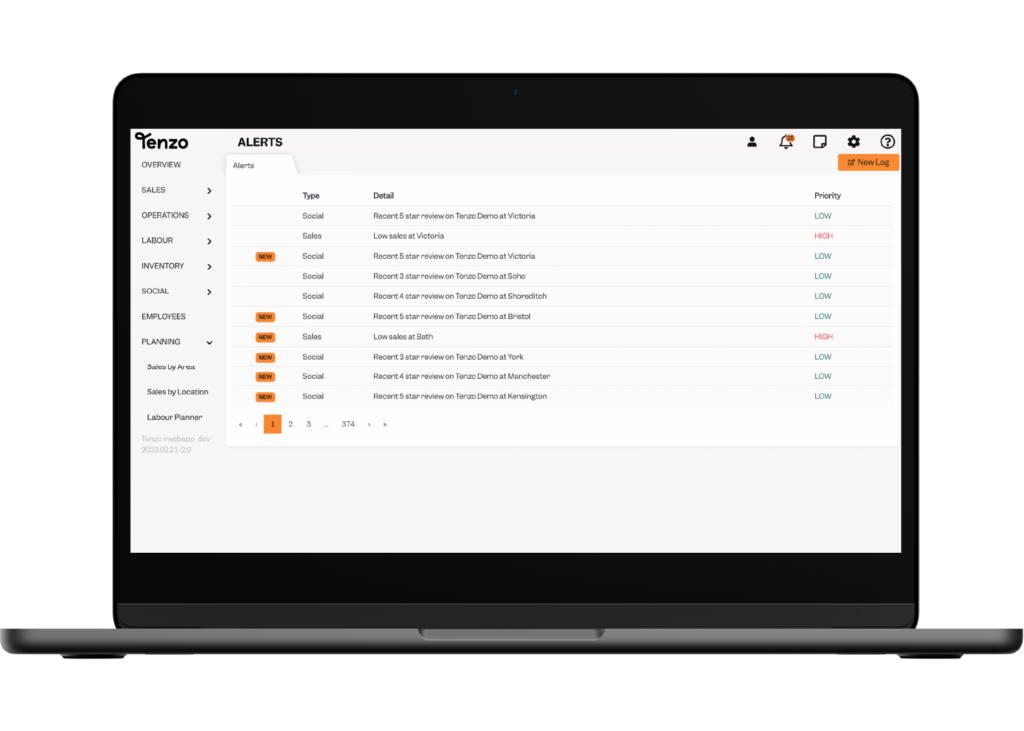
Want to track your reviews in one simple easy-to-use dashboard? Tenzo’s social module is right for you.
2) We all like options
Customers like to have options – we all know this – so why not allow them to decide how much they want to eat? If someone knows that they won’t be able to finish a full portion, then having the option to order a half portion for a reduced price is something that would make your restaurant stand out.
According to WRAP’s research, younger women are far more likely to leave food on their plates (61% of restaurant meal leavers are women), so offering smaller portions could lead to increased sales from the sought-after 18-36 female demographic. We can already see examples of this at restaurants such as Pizza Express, whose Leggera Pizzas (basically just pizzas with a big hole in the middle) have made a virtue of a smaller portion.
Furthermore, while most restaurants do have a children’s menu, it is worth noting that a two year old and a ten year old eat very different amounts. Giving toddlers less on their plates may also reduce the amount that ends up on the floor!
But it’s not only children who may require smaller portions. Elderly customers may find that having a reduced portion size means being able to finish their meal, but may like to have more sophisticated items than the burgers and nuggets on the children’s menu. Having the option to have anything off the menu in a reduced portion may improve the experience for older patrons. This also has hidden benefits. In 2015 the UK hospitality sector lost over £16 billion in potential revenue by ignoring older generations, so by catering to their needs you open a whole new revenue stream for your restaurant.
3) Doggy bags are the future
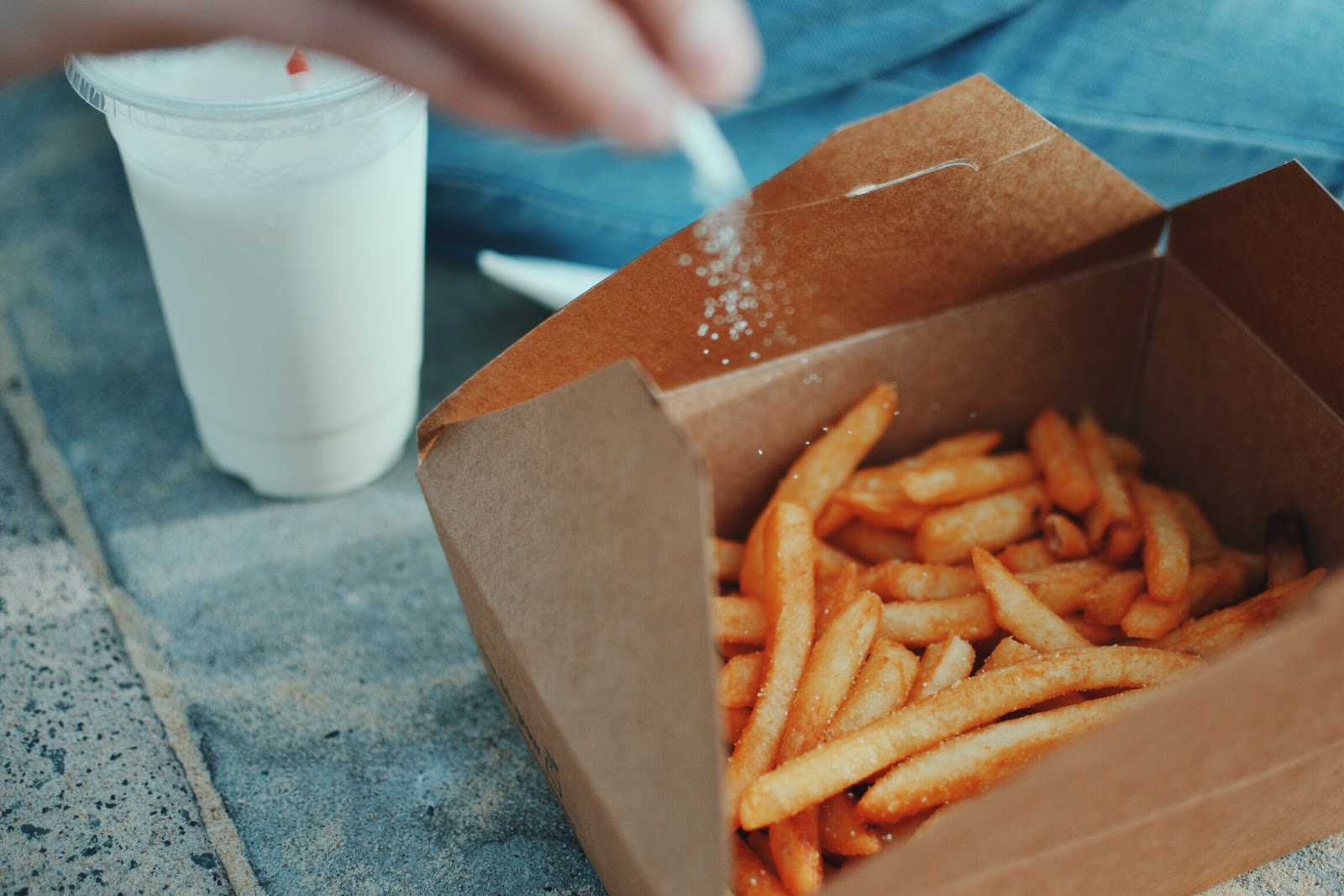
The US already has a strong culture of taking home leftovers from a restaurant, however this is less the case in the UK. For years there has been a slight but persistent stigma surrounding the notion of taking home whatever is left over, and some people are embarrassed to ask for a doggy bag.
In fact, 40% of diners in the UK are too nervous to ask for a doggy bag. However, even in the US, 55% of plate waste is not taken home and of the food that is, 38% is never eaten. If we are going to tackle the enormous food waste problem the stigma needs to change and it will be partly up to restaurateurs to encourage a doggy bag culture. Servers should be trained to ask if customers wish to take what is left on their plates home instead of putting the pressure on the diner to ask for themselves.
Another possibility is giving their doggy bag to someone in need. With homeless populations on the rise, hot food may be more appreciated than one would think. This idea could be casually suggested by wait staff when a wasteful customer doesn’t want a doggy bag for a considerable amount of leftover food.
In the UK, England can take inspiration from Scotland: their Good to Go campaign encourages restaurants to provide boxes so customers can take their leftovers home. They have seen that offering a bag to customers after their meal reduces plate waste by 42%. Their goal is to reduce total food waste by 33% by 2025.
Doggy bags may be the way forward for reducing food waste, but don’t forget about the environmental impact that all those plastic takeaway boxes have! Biopac are just one company creating boxes made from sustainable wood pulp and coated with a leak-proof compostable material.
4) Optical illusions

In the United States, we have seen the average portion size more than quadruple in the last fifty years. This means that portions sizes can now be eight times larger than what the USDA considers a standard serving size. Diners have now come to expect quantity as well as quality when dining out. A lot of this food can go to waste once they realise their eyes are indeed larger than their stomachs.
Fortunately, restaurateurs may be able to use a few optical tricks to give the illusion of heaping quantities of food while actually only serving what is going to be eaten. Here are a few options:

- Serve food on smaller plates or in shallower bowls: this may seem extremely obvious but human perception is something that can be played with. This is due to the Delboeuf illusion where identical circles will appear larger if surrounded by a small ring (as in a small dinner plate) and smaller if surrounded by a large ring (as in a large dinner plate). Plus it’s been shown that swapping a 24cm plate for a 21cm one can reduce food waste by 20%.
- Matching your plates to your tablecloth can also help with perspective, also due to the Delboeuf illusion where the continuation in colour stops us focusing on the size of the ring.
- Consider the colour of the crockery that food is served on. A portion served on a plate that contrasts in colour to the food is seen as larger as the contrasting colour allows you to focus on the food for itself. Moreover, it has been shown that people are likely to feel like they need less food if it is served on a red plate.
- Presentation can also trick the eye into seeing more than what is there. Foods shaped into a square appear larger than their circular equivalents. This can also be the case with placement on the plate: food placed slightly further apart can fill much more space on the plate without needing to increase portion size.
- Size of cutlery can even make a difference – one study showed that people eat less when presented with a bigger fork. Not to say that your diners should go hungry, but this tip could help with the realisation that they do not need to attempt to eat the massive portions that they are usually presented with.
- Finally, music can have a huge effect on how we eat. Matching your music to the food you are serving can increase diners’ enjoyment. Furthermore, a steady rhythm affects how quickly or slowly someone eats. To make your diners savour your food, a slower tempo may be more appropriate. One caveat though – don’t make your music too loud! A study has shown that eating with loud noise in the background can actually diminish the flavour of the food.
5) No need to make assumptions
Making the assumption that a customer expects a particular dining experience may be causing unnecessary waste. More formal establishments, for example, may assume that their customers expect a bread basket to be set on the table. However, more often than not, not all of it is eaten. The leftover rolls then have to be thrown away. Much of this waste could be avoided simply by asking the customer if they would like bread and serving single servings at a time.
The same can be said for sides. The most wasted sides are bread, chips and coleslaw. So giving diners the option to have a side in the first place or giving alternative sides for diners who may wish to have salad instead of chips, for example, could go a long way to reducing plate waste. Plate waste is low at fast food chains and this may be due to the fact that consumers are able to make their own choices when it comes to size and quantity. This is perhaps something that should be seen in more traditional restaurants as well.
Clarity is also key. Menus should be explicit when a portion is on the large side. Take steaks, for example. Though their size is usually listed in ounces, this might not be not an intuitive measurement for most people. Using descriptive words such as ‘enormous’ to indicate portion size may be more helpful.
6) Get your staff on side!
Explaining your aim to reduce plate waste to your staff can have a big impact on the amount of waste generated. Once they’re on board with the aim, staff can do a lot individually to create the conditions for less wasteful behaviour.
Front-of-house staff can be encouraged to up-sell drinks and lighter sides rather than larger mains, discouraging over-ordering while maintaining spend-per-head.
Furthermore, servers need to be well-versed on the entire menu and able to explain every dish in detail so that customers know exactly what to expect when their dishes arrive. Keeping customers well-informed makes sure they will order something they will enjoy (and finish). Waiters can also advise proactively on the amount of food ordered, whether it’s likely to be too much to finish.
When it comes to back of house, the fast food industry may again be the one to copy. In standardising measurements across all dishes they are sure to never over-portion, cutting back on unnecessary waste and saving money. Encouraging the use of scales or measuring cups and spoons when plating allows a restaurateur to know exactly how much needs to be served to the customer for the perfect-sized portion as well as exactly how much the dish is costing them.
Conclusion
There are plenty of ways of reducing plate waste without affecting the dining experience. However, perhaps the most effective method will be changing current outlooks and expectations. Some diners have come to expect overly large portions when they go out to eat simply as a sign of opulence. This is going to have to change if we have any chance of reducing the food waste epidemic that is plaguing the industry.
Additionally, more must be done to make consumers aware of the waste they generate. Many diners don’t give the food left on their plate a second thought once it is taken away, but a small nudge towards thinking about where that food ends up may make a world of difference. Even a small reminder at the bottom of the menu about ordering a reduced portion size or asking for a doggy bag to prevent unnecessary waste could go a long way in changing customers’ attitudes and behaviours.
Tenzo tip:This is something that we all need to be thinking about and the faster we can reduce waste the better. Of course, plate waste is just a part of the larger problem of food waste. An essential part of combating the problem will be accurate forecasting so that you know how much food to order. This is where Tenzo can help you. By collecting your data, Tenzo enables you to forecast the level of demand for your store, saving time, reducing waste and optimising your menu. |
The post Reducing Food Waste: A How-to Guide for Restaurants appeared first on Tenzo.
]]>We are extremely proud to announce that Tenzo is partnering up with WRAP to collaborate on food waste reduction through their The Food Waste Reduction Roadmap initiative and helping countries battling food waste around the globe! According to the FAO report, 1.3 billion tonnes of edible food is being thrown away annually, resulting in 3.3 […]
The post 10 most creative ways people are battling food waste around the globe appeared first on Tenzo.
]]>We are extremely proud to announce that Tenzo is partnering up with WRAP to collaborate on food waste reduction through their The Food Waste Reduction Roadmap initiative and helping countries battling food waste around the globe!
According to the FAO report, 1.3 billion tonnes of edible food is being thrown away annually, resulting in 3.3 billion tonnes of greenhouse gases being released into the atmosphere. Luckily, organisations like WRAP not only encourage businesses to embrace sustainability, but help them implement sustainable practices within their day-to-day operations.
Since the early 2000s, WRAP has played an active role in supporting initiatives around greater resource efficiency. They have partnered with communities, businesses and governments to create practical solutions and campaigns to help reduce consumption, prevent waste and recycle more.
In celebration of this new partnership, we’ve put together the top 10 most creative ways people are battling food waste around the world.
1. Canada – From Potato Peels to Plastic
Frozen potato manufacturing company McCain was growing frustrated with how much waste was created by unused potato skins in their manufacturing process and had the idea of giving discarded potato peels a second life by developing them into bioplastic composites – Chip[s] board was founded to do just that and now boasts a range of extraordinary bioplastics that are not just biodegradable, durable and recyclable, but are also sleek and aesthetically pleasing in design.
2. China – Feeding Food Waste to Cockroaches
With the population steadily increasing, more waste is being produced than landfills can handle. That is why in the outskirts of Jinan, a plant run by Shandong Qiaobin Agricultural Technology Co. is feeding 50,000 tonnes of food waste to a billion cockroaches on a daily basis. Not only do the bugs get rid of unmanageable mountains of scraps, but once the bugs pass away, they become nutritious food for livestock. “It’s like turning trash into resources,” the Shandong Qiaobin chairwoman says.
3. France – Perfume from upcycled flowers, berries and fruits
French perfume house, Etat Libre d’Orange, released a revolutionary fragrance that aims to create awareness about waste in the luxury industry. The fruity-floral perfume titled I Am Trash – Les Fleurs du Déchet (The Flowers of Waste), was created entirely out of unwanted and found objects.
4. Indonesia – Shoes from Chicken Feet Skin
You read that right. As a way to create environmentally friendly fashion products, a 25-year old entrepreneur, Nurman Ramdhany, started making shoes from discarded chicken feet he found in market rubbish bins. Operating under the brand name of Hirka, the company strives to educate people on the quality of chicken feet leather while promoting environmental sustainability.
5. Mexico – Cutlery from Avocado stones
Mexico is responsible for 50% of the world’s avocado supply. With that in mind, Biofase, a startup from Michoacán, figured out how to put discarded stones to good use. By using avocado stones bought from companies that produce guacamole, Biofase extracts a unique compound that they use to mold into 100% biodegradable cutlery and straws.
6. The Netherlands – 3D Printing Snacks from Food Scraps
Elzelinde Van Doleweerd and Vita Broeken created a process that recycles food that would have otherwise been thrown out. In partnership with 3D Food Company, the pair founded Upprinting Food, whose purpose is to promote sustainability within the restaurant industry. The production process is actually far from complicated. After mashing fruits, vegetables and bread they add herbs and spices to create ink for the 3D printer. After printing, the food is baked and dehydrated to create a deliciously crunchy snack.
https://www.upprintingfood.com
7. Singapore – Alcohol from Tofu byproduct
Tofu whey – the liquid that is generated during tofu production is often discarded and adds to pollution and oxygen depletion in waterways because of the soluble sugars that it contains. Scientists have discovered that by adding sugar and yeast to the liquid, it turns it fruity and floral in taste, with up to an 8% alcohol content. On top of reducing waste, “Sachi” also comes with a number of health benefits, such as prevention of cardiovascular disease, osteoporosis and some types of cancer.
https://sinfootech.com/product-list
8. Spain – Clothes made from discarded pineapple plant leaves
Piñatex® leather was developed when Dr. Carmen Hijosa saw an opportunity in using pineapple harvest byproduct to build a sustainable and scalable product as an alternative to mass leather production and chemical tanning. Hijosa’s vision is to develop farming communities by allowing farmers to use greater quantities of their waste leaves.
9. United Kingdom – Beer from recycled toast
Dubbed as planet-saving beer, Toast Ale is brewed from fresh bread surplus that bakeries would have otherwise thrown out – all to prove that the alternative to food waste is delicious and pint-sized. Company profits go directly to Feedback charity organization that addresses food waste issues across all stages of our food system.
10. United States – All-purpose cleaner from food waste
Motivated by all the Food waste rotting in landfills, Veles decided to turn all those sugars and acids into something more useful. Veles not only wanted to give this food waste a second life, but also wanted to create awareness about the benefits of using biomass as a cleaning agent. Packaged in a recyclable and refillable aluminum bottle, Veles all-purpose cleaner was created from 97% food waste by using a simple acid fermentation process, with natural fragrances representing the remaining 3%.
Conclusion
Food waste is definitely something we can all reduce, whether that’s at home or in restaurants, and is that something that has a direct impact on the environment. If you are as motivated as us to start making a better choices for the planet, do check out WRAP and their other initiatives to educate yourself on how you can start making a better impact today:
If you’d like to find out how you can use Tenzo to reduce food waste within your establishment, make sure to check out our forecasting module here.

The post 10 most creative ways people are battling food waste around the globe appeared first on Tenzo.
]]>We all know that we have to cut down on our carbon emissions. In our personal lives that may include reducing our air travel or meat intake, but the reality is that to have the kind of impact needed, companies and corporations also need to be doing everything they can to reduce their emissions and […]
The post The carbon neutral restaurant: a pipedream or an inevitability? appeared first on Tenzo.
]]>We all know that we have to cut down on our carbon emissions. In our personal lives that may include reducing our air travel or meat intake, but the reality is that to have the kind of impact needed, companies and corporations also need to be doing everything they can to reduce their emissions and the restaurant industry and food sector in general have a big role to play in that process. Becoming a carbon neutral restaurant seems almost impossible, but is it?
It’s been revealed that 2020 was tied with 2016 as the hottest year on record. This is despite the Covid lockdowns that momentarily caused emissions to be reduced. According to Prof Dave Reay at the University of Edinburgh, ‘the CO2 accumulating in the atmosphere is still going up fast. Unless the global economic recovery from the nightmares of 2020 is a green one, the future of many millions of people around the world looks black indeed.’
Climate scientists have calculated that we have until 2030 to make changes so that global warming does not exceed 1.5 degrees Celsius. To go higher would mean significant risks to a large portion of the world. The UN has therefore set a number of Sustainable Development Goals for the planet to reach by 2030. One of the most important for reducing our global emissions is Goal 12: Ensure sustainable consumption and production patterns. The current situation is that all the progress made since the industrial revolution has gone hand in hand with negative impacts on the environment. Goal 12 is ‘about decoupling economic growth from environmental degradation, increasing resource efficiency and promoting sustainable lifestyles.’
The science is clear, if there isn’t a significant shift in our actions surrounding carbon reduction, the consequences to our planet will be dire.
Where does the restaurant industry come into this?
According to the UN, the ‘food sector accounts for around 30% of the world’s total energy consumption and for around 22% of total Greenhouse Gas emissions.’ While the food sector is of course much further reaching than the restaurant industry, the more restaurants focus on reducing their carbon footprint, the more impact can be made in reducing these numbers.
The current restaurant model is far from being sustainable. Waste is a serious problem. In the UK alone, 1.1 million tonnes of food is wasted in the hospitality and food service sector each year, of which 75% is avoidable and could have been eaten. Food waste is an enormous contributor to carbon emissions (if it were a nation, it would be the third largest carbon emitter after the US and China), but that’s not where the waste ends. 1.3 million tonnes of packaging and 0.66 million tonnes of other ‘non-food’ waste is thrown away by the UK industry every year.
But waste is only one part of the wider problem. Emissions occur at every stage of the supply chain, all the way from harvest to the finished product. When it comes to sourcing ingredients, the products themselves have to be considered (are they grown or cultivated using sustainable methods?) as well as thinking about the energy consumed in getting them from their origin to your restaurant. Then you have to think about emissions coming from the restaurant itself thanks to your electricity and gas usage as well as all the single-use plastic we’re so accustomed to seeing in the kitchen (cling film, styrofoam). And finally, how do you get your food to your customers? Is there delivery involved, what kind of packaging or even crockery do you use?
It all adds up unfortunately and it can seem like an unsolvable problem, all these emissions must just be inherent to the industry. That may not be the case anymore. We’re now seeing more and more restaurants moving toward becoming fully carbon neutral.
The carbon neutral restaurant
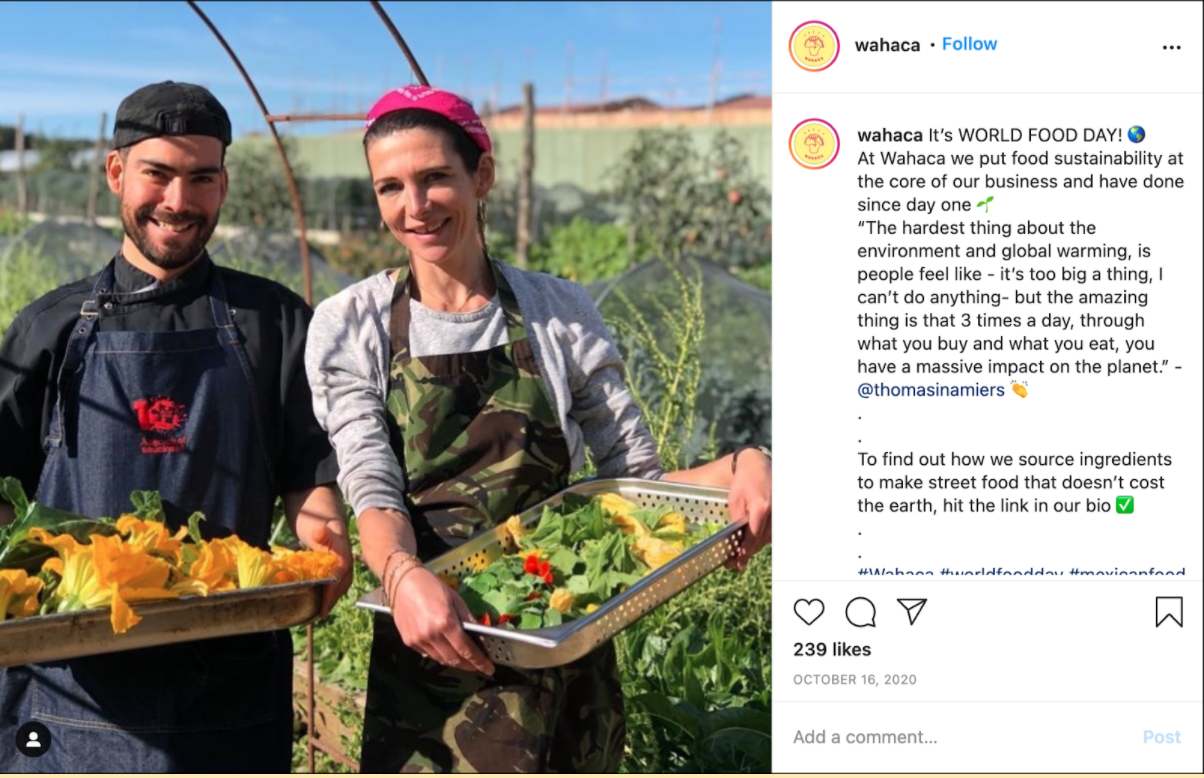
Carbon neutral restaurants and restaurant groups do indeed exist. Take the 13-strong London-based Mexican restaurant group Wahaca. In 2016 they became the UK’s first carbon neutral restaurant group in compliance with The CarbonNeutral Protocol. To achieve this, they reduced their emissions, found ways to improve sustainability in unique ways like using the heat energy created by fridges to heat the restaurants’ hot water, as well as carbon offsetting.
The Sustainable Restaurant Group in the US is another example of a fully carbon neutral group. They purchase the most sustainable products they can and then calculate their exact carbon footprint in the acquisition, transportation and production of their dishes. They then also offset any unavoidable emissions. They are one of the most transparent companies when it comes to showing exactly where their emissions are coming from, with a fully interactive map available on their website, keeping them fully accountable to their customers.
The problem is that carbon offsetting is expensive. If a restaurant needed to carbon offset their operations without making any significant changes to standard operating procedures, the cost would be prohibitive. So the first step to carbon neutrality is making changes inside the kitchen.
1. Audit the kitchen
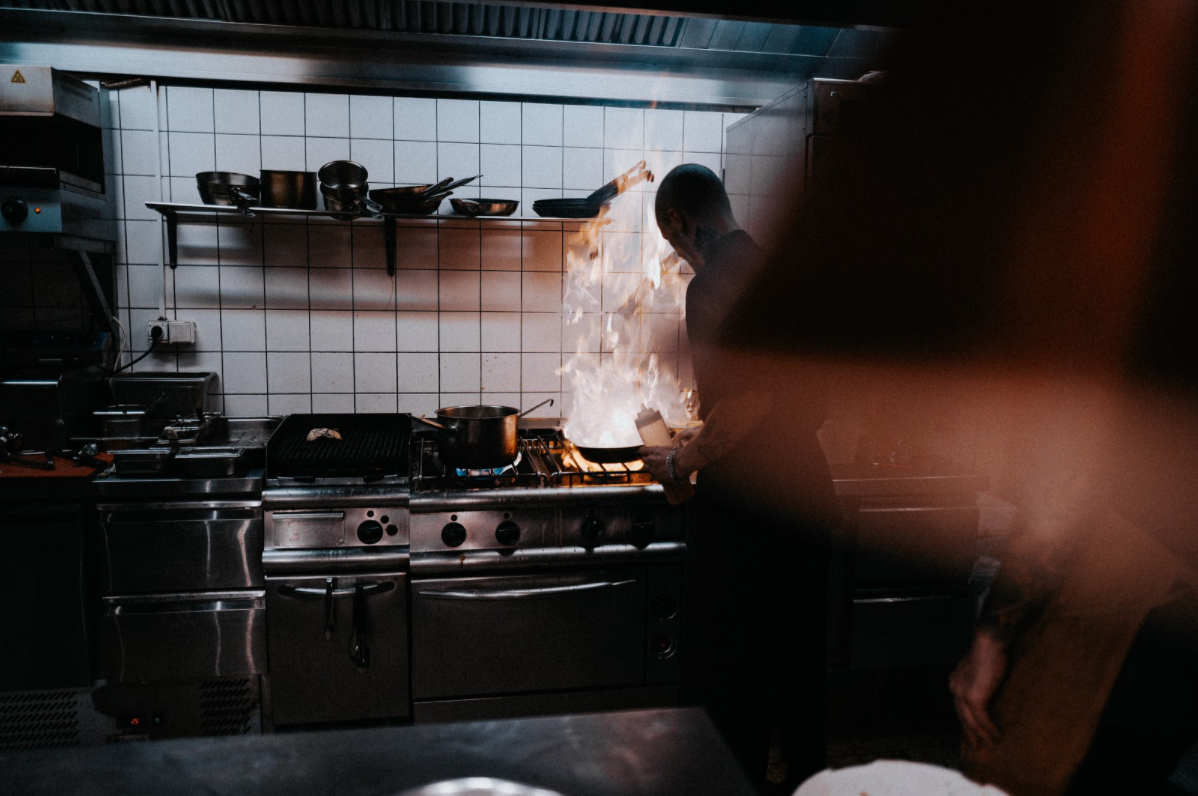
Photo by lasse bergqvist on Unsplash
The first thing to do is take a step back and observe where waste and inefficient energy use is occurring. Are you using an extreme amount of cling film, single-use containers, throwing away unused food because it’s gone bad or leaving ranges on all day? This can all be adjusted to help lower your environmental impact.
The first thing you can do is look at your electricity and gas provider and switch to fully renewable energy. We all know that renewable energy is the future, but with countries racing to reach deadlines set by the Paris Climate Agreement, burning fossil fuels is likely to become incredibly expensive with governments putting tariffs on non-renewable energy sources. It makes sense to make the switch now considering that renewable energy is no longer as prohibitively expensive as it once was.
Once you’ve taken care of your energy, you can move on to other sources of waste. The fine dining restaurant Spring, based in London’s Somerset House, has always been known for its seasonal menu making use of seasonally appropriate produce which reduced the need for exotic ingredients to be flown or sailed long distances. However, when it came to plastic use, they weren’t being as environmentally conscious as possible. According to Skye Gyngell, chef at Spring, ‘we worked out that we used over 3,600 kilometres of cling film a year. We just went cold turkey. We bought lids for everything, used beeswax and other compostable materials. We had ceramic ice cream cups made instead of using paper cups.’
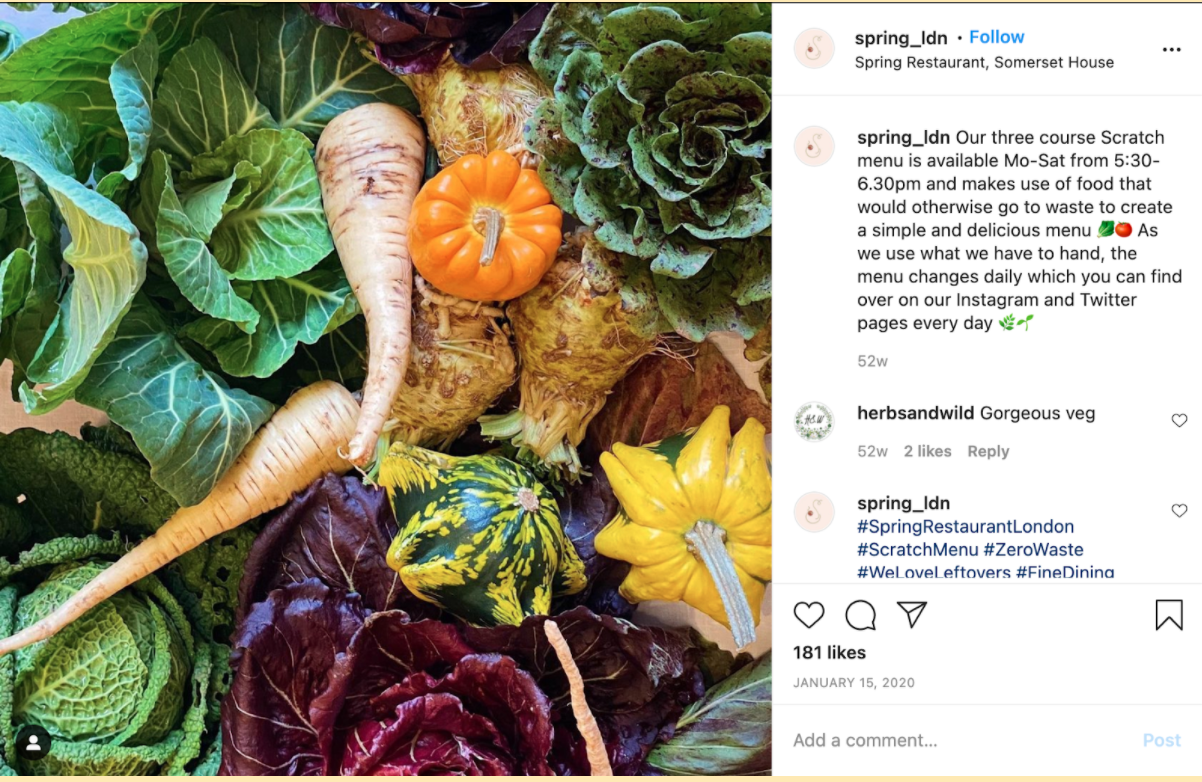
The restaurant also found a very creative way of reducing the amount of food wasted. They introduced a Scratch Menu, which is created solely with food that would otherwise go to waste. The chefs can only use ingredients from the ‘scratch shelf’ to create the dishes, forcing them to get creative and resulting in fun and new flavour combinations and meals for diners. This initiative reduced the amount of produce composted from 25% of their order to only 6%.
2. Adapt your menu
Your menu can have a huge impact on your carbon footprint. If your ingredients are all being imported from abroad in unsustainable ways, carbon emissions go way up regardless of what’s happening in the actual restaurant. Sourcing ingredients locally and focusing on what’s in season is the easiest way to cut down on all the carbon emissions involved in transportation. Many smaller independent restaurants are able to have close relationships with the farmers, butchers, fishermen, and any others who provide their ingredients and can therefore judge for themselves what’s being cultivated sustainably and what’s not.
This isn’t usually the case for large or global brands, as finding local suppliers can be difficult with hundreds of locations to procure food for. However, Nando’s UK proves that it’s not impossible.
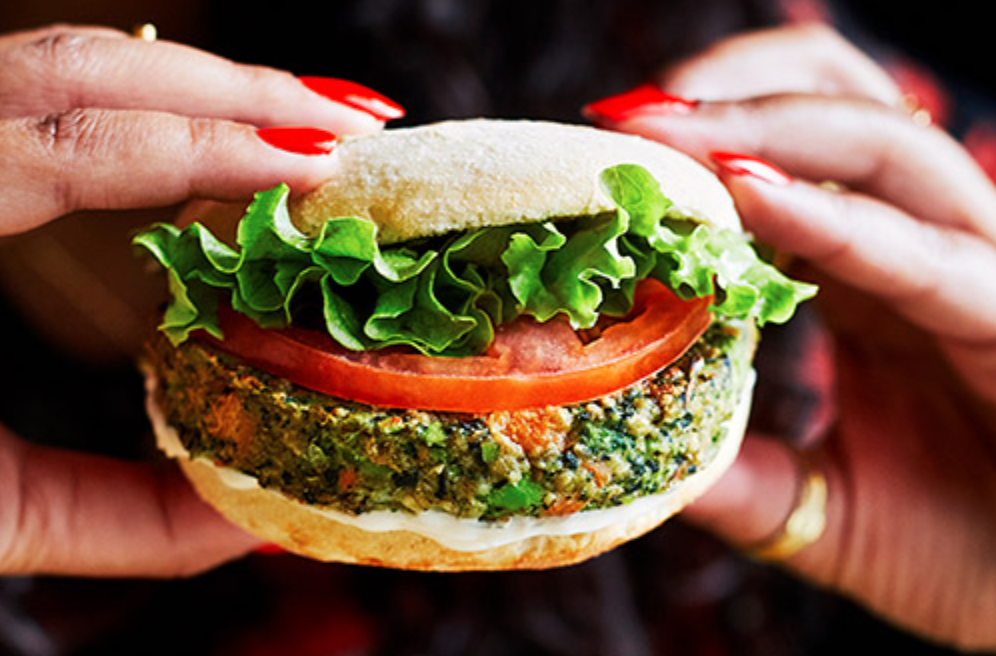
Photo by Nando’s
Nando’s has a great track record when it comes to operating in as sustainable a fashion as possible. Last summer, the group pledged to achieve zero direct emissions and reduce the carbon footprint of its meals by almost 50% by 2030. This comes after already having reduced the carbon footprint of its average meal by 40% since 2015. And crucially, they plan to do this without carbon offsetting, making changes to their operations so that they directly reduce the amount of carbon emitted. When it comes to sourcing their ingredients, the over 400-strong group is a true role model.
They source all of their chicken from the UK, as well as all of their eggs, milk and potatoes. They also get all their corn from the UK when it is in season. Plus all their chicken is Red Tractor assured which champions environmental protection as well as animal welfare and food safety.
But sourcing locally isn’t the only way to change your menu for the better. It’s becoming ever more apparent that plant-based foods are no longer a trend but a necessity. At current rates, the global population will reach 9.6 billion by 2050 and will require almost three planets to provide the natural resources to sustain current lifestyles. Livestock and the production of its feed currently takes up 80% of total agricultural land and produces 14.5% of CO2 emissions. Therefore, as the population increases and the desire for animal products remains the same, we will simply run out of land and continue to pump greenhouse gases into the atmosphere.
3. Collaborate with experts
Going completely carbon neutral without some external help is next to impossible. Once you’ve done all you can yourself it’s time to call in the experts. There are some specific organisations and movements that can help you in your journey to carbon neutrality.
In the UK, WRAP have created the Guardians of Grub campaign to empower restaurant workers to take control of their food waste. They provide resources including tracking sheets and calculators to deliver awareness of the amount of food being wasted. WRAP itself is committed to UN Sustainable Development Goal 12.3 to halve global food waste thanks to their Food Waste Reduction Roadmap which allows businesses to measure and report their waste, take targeted action to reduce food waste and help the UK deliver against environmental targets.
Also dedicated to the UN Sustainable Development Goals (SDGs), Chef’s Manifesto is a community of over 700 chefs all over the world, ‘equipped with a simple set of actions to drive progress against the food issues that matter most to them.’ The manifesto outlines how chefs can contribute to the SDGs in simple ways. It covers 8 areas that chefs are most passionate about working on, including environmental policies.
Beyond fostering communities, one nonprofit organisation doing as much as they can to reduce the impact of restaurants on the environment is Zero Foodprint (ZFP). They work with restaurants to calculate their ‘foodprints’; their term for the amount of CO2 emissions produced by a restaurant including all associated greenhouse gas emissions from ingredients, energy use, transportation and waste. They then offer solutions to reduce or totally offset those emissions.
In their research, ZFP found that on average 8kg of CO2 is emitted for every meal prepared in restaurants, with 70% of that being produced in the production of ingredients. So they came up with a solution – they would help farmers switch to renewable farming practices that actually reduce the amount of carbon in the atmosphere while still rearing animals like cows for food turning a traditionally inhumane and environmentally detrimental industry into a more humane and sustainable one.
Technology is also your friend when it comes to cutting down on emissions. There are several platforms that allow you to cut back on waste, in particular. Winnow, for example, uses AI-operated bins to figure out what you are throwing away and how often to give you insights in how to reduce the amount of food binned. And, of course, Tenzo can significantly improve your sales predictions and forecast the ingredients you will need more or less of depending on external factors like the weather and holidays. In fact, we’ve just embarked on a project that is set to reduce the amount of carbon emissions in restaurants by 4.5 million tonnes.

4. Shout it from the rooftops
Conclusions
The Covid-19 pandemic has also increased diners’ concern about the environment. 65% of consumers claim to be concerned about the environment as opposed to 47% pre-lockdown, as reported by the Sustainable Restaurant Association. A further three-quarters of those surveyed would be willing to opt for a sustainable dish on the menu. Considering these dishes make use of food that would usually otherwise go to waste or are made from low cost ingredients like vegetables, it’s a win-win for the restaurant.
The reality is that there are plenty of ways to reduce carbon emissions in restaurants and beyond them just being good for the environment, they can also lead to increased revenue. According to the National Restaurant Association, ‘about half of consumers report that a restaurant’s efforts to reduce food waste, recycle or donate food can be factors in choosing where to dine.’ Consumers, especially millennials and gen Z, are actively considering their impact on the environment and are more likely to choose to patron businesses that align with their beliefs.
Becoming fully carbon neutral may seem like herculean task for restaurateurs but the reality is that it soon may no longer be a choice. If the planet is going to hit the goals laid out by the Paris climate agreement and the UN, every industry will have to pull their weight including hospitality.
However, the hospitality space has already proven that restaurants of all sizes from the one location independent mom and pop shops to the large chains like Nando’s can make changes to their operations that allow them to reduce their emissions in large proportions. Additionally, consumer demand for sustainability-focused products in all areas of their lives is growing and making increased sustainable practices possible from an economic perspective.
Carbon neutrality is no longer something totally out of reach for restaurants. The tools needed now exist, they simply remain to be capitalised on.
What are you doing to reduce emissions in your restaurant? Let us know using the hashtag #tenzocarbonchallenge.
Tenzo is currently working on a project set to reduce carbon emissions by 4.5 million tonnes. In order to do this to the best of our ability we need your help! We’re putting together a panel of restaurateurs to help us understand how our forecasting tool can reduce as much waste as possible. If you’d like to take part please email [email protected].
The post The carbon neutral restaurant: a pipedream or an inevitability? appeared first on Tenzo.
]]>This post contains everything you need to know about how to reduce food waste in your restaurant business. Why you should reduce food waste. How to reduce food waste from your kitchen. And even how to stop your customers from wasting your food. Let’s get started then, with the why. Why you should reduce food […]
The post Reduce Food Costs And Eliminate Food Waste: The Ultimate Guide for Restaurants appeared first on Tenzo.
]]>This post contains everything you need to know about how to reduce food waste in your restaurant business.
Why you should reduce food waste.
How to reduce food waste from your kitchen.
And even how to stop your customers from wasting your food.
Let’s get started then, with the why.
Why you should reduce food waste
Food waste costs UK restaurants £682 million each year.
In the US, the scale of the problem is far worse, costing restaurants $25.1 billion annually. Restaurant owners and managers are acutely aware of the problem, with 52% of restaurant professionals naming high operating and food costs as a top challenge.
This waste takes a huge bite out of many restaurant’s profits, and it is also incredibly damaging to the planet.
Food waste as a whole is a huge waste of basic resources that could be used for nature, or for feeding hungry people. Take land as an example: the land used to grow food that is subsequently wasted makes up an area 58 times the size of the UK, or almost 3 times the size of the Amazon Rainforest.
The land that is used to grow food that is subsequently wasted makes up area 58 times the size of the UK
Food waste is also warming the planet: if food waste was a nation, it would rank as the third largest national emitter of greenhouse gases, after China and the US.
But, food waste also ranks among the easiest and biggest environmental opportunities available to us, probably because it’s a total win-win: not many solutions to climate change immediately save us money.
On average, businesses save 7 times what they invest in reducing their food waste! This means that pretty much any food waste reduction strategy you try will be a financial success.
We’ve put together a comprehensive list of all the things you can do to reduce your waste and save money on food. Find an approach that works for you, implement it, and you and the planet will soon be reaping the benefits.
This post focuses on kitchen waste, but we’ve recently posted blogs on plate waste and forecasting techniques for a complete view of everything you can do to reduce COGS.
How to measure your restaurant waste
What gets measured, gets managed, and the first step to a successful kitchen waste reduction plan should be to measure how much you are wasting, the cost of that waste, and what the sources of the waste are. If you measure your waste for a trial period as short as a week, you will get a pretty accurate idea of the current state of your food waste.
The simplest way to measure your food waste is by using separate bins / trash cans for different types of waste:
- Bin 1: Preparation waste – the waste generated while prepping food e.g. broccoli stems.
- Bin 2: Spoilage – Food that has gone off while sitting in your fridge or other storage.
- Bin 3: Plate waste – Served food that customers didn’t eat.
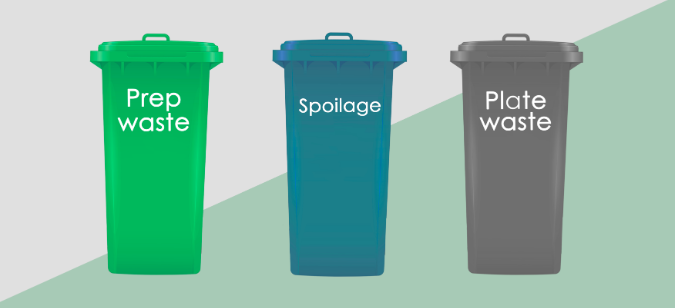
Weigh each bin at the end of each day, or even better at the end of each service. If you don’t currently own a set of bin / industrial scales and don’t want to spend the money for a short-term project – a good set of parcel scales can be strong enough to do the job.
From your week’s data, calculate how much waste you are producing each year. Then multiply this by the cost per tonne; the average figure in the UK is £3,500.
You will then know roughly how much wasting food is costing your business each year. It’s likely to be a surprisingly large number, but don’t be alarmed! Lot’s of practical advice for making improvements incoming…
Tech alternative: If you are running a large operation and really want to get to grips on your food waste, Winnow’s smart bins have an inbuilt scale and identify food items as they are thrown in, using AI.
How to get employee buy-in
Any successful food waste reduction program will rely on committed staff members. Without the buy-in of your employees, it will be an uphill struggle. Here are some tips on how to get them on board.
- Make sure there is no fear attached to tracking waste. The carrot is definitely better than the stick here, as waste can easily be covered up by popping it in the wrong bin and thereby ruining the accuracy of your waste tracking. Make sure that an open environment is created, where wasted food is not viewed as a result of poor performance on the part of staff. Communicate this clearly before you begin measuring waste.
- Hear and implement suggestions of employees. If staff feel that they are heard, they will take ownership of the project themselves, ensuring consistency and accuracy. Kicking off the project with a quick brainstorming meeting including all staff is a good approach.
- Go armed with data. It’s a good idea to complete your initial measurements before scheduling your kick-off brainstorming meeting. Staff will take the project much more seriously if they understand the huge losses associated with waste. They will also come up with better ideas if they can see where the waste is coming from.
- Make the ingredients sacred. Most people who work in kitchens have a huge love and respect for food – they all agree that good ingredients are sacred, and shouldn’t be wasted. Without being too preachy, stress this point, emphasizing the farms, farmers, animals, land and natural resources that have produced the food. Also emphasize the environmental issues involved with food waste. Stay tuned to this blog for our hard-hitting upcoming post on the environmental impact of food waste – print it out and pass it around the kitchen!
- Give them what they need. Make sure your staff have suitable equipment that will make the task of waste reduction as easy as possible. If staff see you investing cash and time in the project, they will recognise the importance of it.
How to set reasonable targets for waste reduction
Setting realistic targets for waste reduction will motivate your team and give everyone a great sense of satisfaction when you totally smash through them.
In Champions123’s research, which involved 114 restaurant sites across 12 countries all undertaking a waste-reduction program, the average result after 12 months was a 26 percent reduction of food waste by weight. After three years, the average result was a 58 per cent reduction by weight.
The best-performing sites achieved a reduction of over 95% of food waste weight. This is an inspiring achievement that shows what is possible, but to avoid disappointment, it may be best to shoot for the average.
Once you have measured your major sources of waste, compare your numbers to the average proportions – see the pie chart below. This will show you where you are falling short compared to the rest of the industry. Set more aggressive targets for the areas where you are doing badly, and more relaxed ones where you already do well.
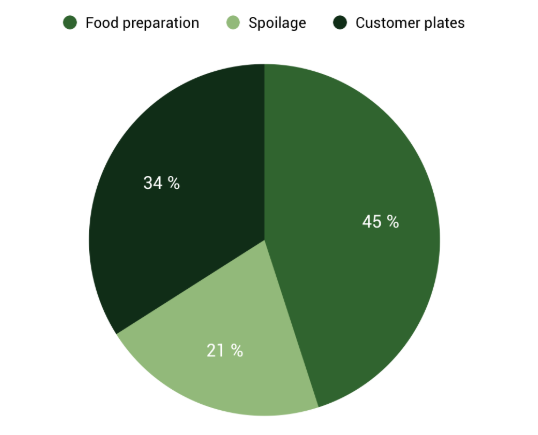 Where restaurant food waste comes from. Data from wrap.org
Part 1: How to reduce spoilage waste
Of the three major types of waste shown in the chart above, spoilage waste may be the smallest but is also the easiest to prevent, and in many ways, the most inexcusable. A careful commercial kitchen will have very little spoilage waste, and a very careful kitchen will eliminate it altogether. To state the blindingly obvious, letting expensive ingredients rot makes little business sense!
1. Avoid over-stocking ingredients
Forecast better
What are your expected sales on Wednesday? If the answer is “the same as last Wednesday”, chances are you’re going to miss the mark.
In a highly competitive industry with tight margins such as restaurants / F&B, accurate demand forecasts are often the difference between a business that is profit-making and one that’s destined to fail. The sales forecast determines not only your stocking levels for ingredients but also your labour schedule – in other words, all of your variable costs.
As forecasting specialists, we are constantly surprised by how primitive our clients’ and prospects’ forecasting methods are before they start using Tenzo’s automated AI forecasts. It’s very rare that there is a process defined. Konrad Edwards, one of the data scientists who built our restaurant forecasting software , likes to say that the general approach taken by most of the industry is to “hire a psychic”.
If you don’t currently have the budget for Tenzo’s automated forecasts (it’s great value!), that’s fine, there are probably a few things you can do to improve the accuracy of your current sales estimates, though it might not be easy.
Here’s some basic advice from Jiaxin Chen, one of our other data scientists at Tenzo, who focuses on creating ever more accurate sales forecasts.
- Consider corresponding past sales – Look at sales on the same day for the last 4 weeks. The most basic approach is then to average these numbers to get a four-week-moving-average, a decent forecast base. Even better, create a “weighted average” which favours the more recent sales figures.
- There is no forecast for all seasons – Seasonality is generally the most powerful predictor of sales volume. When it’s necessary, consider different seasons of the year separately. For example, identify when your summer busy season tends to begin, and adjust your 4-week-rolling-average base according to how big of a jump in sales you usually see in the spring to summer transition. If you skip this step, you could be caught out badly when the seasons change.
- Take into account events – If there is a large local event or national holiday on the day you are trying to forecast, such as Mother’s Day, or Valentine’s Day, your forecast needs to be adjusted. Look at the percentage jump you saw on the day of the event last year. If it’s a one-off event, your best bet might be to have a guess but take some time to consider the likely impact carefully. Also, when you are generating a four-week-moving-average, make sure you never include any days when such events occurred.
- Understand your key factors – This is the bit that the above mentioned “psychics” do based on gut-instinct. Consider what the key factors are that affect your sales – a restaurant on the seafront in a holiday town will have wildly different key factors than a QSR in the City of London. Key factors can include seasons, weather, events, or week-day, and each restaurant will have a unique mix. We recommend trying a data-led approach, figuring out from your past sales how much these factors affect your business and creating some simple guidelines to use when creating forecasts. You might need a bit of data analysis skill here.
 Jiaxin Chen – Tenzo forecasting scientist.
Need more practical advice on forecasting better? We will post a deep-dive on forecasting techniques in the next few weeks, so subscribe to be alerted!
Push sales of items you are overstocked on
Pushing sales of overstocked food items is a technique as old as time, but given the environmental imperative to reduce waste, it’s now more appropriate than ever. Here are the basic approaches:
- Get floor staff to recommend dishes containing overstocked items – Diners often ask waiters to recommend dishes. Most waiters simply recommend their personal favourite because they get little direction from the kitchen on which dishes need to be pushed. Set up a meeting before each service that ensures floor staff are always informed when a dish needs pushing, then show them how to push that particular dish. Even better, set up a competition and reward the staff member who sells the most – Tenzo users can do this easily by using the “% attachment by product item metric in the “employees” module. For a master-class in pushing specific menu items, watch this.
- Specials – I used to work in a sustainable fish restaurant where the head chef was a master at using his specials board to drive great COGS. When vendor prices were low for skate wing, for example, he would very quickly create a delicious new skate wing dish for the specials board, even if we had skate wing on the menu already. This drove more sales of the ingredient and allowed us to shift more of this high-margin item. He also used the specials board in a similar way to shift overstocked or slow-moving items, keeping waste very low. One important principle to follow when doing this is to make sure that the dish you put on the specials board is sufficiently different from the dish that you already have on the menu which contains the same principle ingredient – without doing this, the special will cannibalise your menu item and you won’t increase sales overall by much.
- Staff meals – every restaurant should be using staff meals as a lever to reduce waste. If a meal is made in error – managers should be on the lookout for a staff member who is due for a meal break who is willing to eat it. If an item is heavily overstocked, make that the staff meal for the day. Far too many restaurants use an inflexible (or overly flexible) staff meals policy that doesn’t aim to reduce waste. Note – restaurant staff often view enjoying staff meals as an important perk of working in the industry – ensure your managers don’t force staff to eat dishes they don’t enjoy, or you risk causing a major upset.
2. Be strict with vendors
Resist being sold more than you need
Some vendors will sometimes deliver more than was ordered, then charge you for it. Make sure that all deliveries are checked to make sure that they conform strictly to the original order. Reject anything additional.
Vendors also tend to use the hard-sell on items that they have overstocked, with special offers and discounts for volume. These can be great items to build high-margin specials on, of course, but caution should also be taken to ensure you don’t end up with more than you can sell. Look at the popularity of similar specials you have tried in the past before putting in a big order. Note: this is quick and easy with Tenzo, meaning you can check your past specials while the vendor waits.
Reject food likely to spoil quickly
Reject anything with visible spoilage on delivery – it will soon be on the way to the bin either way, and better the vendor’s bin than yours. Note: Blemishes and discolourations on fruit and veg don’t necessarily mean that the produce is on its way out. Make sure that staff inspecting deliveries know the difference between actual spoilage and mere ugliness – absurd retail standards for aesthetic produce are a major cause of food waste. You might even be able to negotiate a knock-down price for the “ugly” produce.
Reject food stored at the wrong temperature – Another thing to look out for is food stored at the wrong temperature. Meat, poultry, dairy, seafood, eggs, and anything cooked or ready to eat should be delivered below 5 degrees celsius. Any temperature higher than this is the “danger zone” where bacteria will start growing, increasing the rate of spoilage and the risk of food poisoning. Consider this: bacteria populations double every six days when kept at 1℃ (34℉), and double every six minutes at 22℃ (72℉)!
Get deliveries during slow or off hours – Often the reason for badly checked deliveries, or slow refrigeration (see section 4) is that deliveries are made when staff are busy with prep or service. Arrange to have deliveries made when your employees have time to deal with them quickly and correctly. If this isn’t possible, schedule an extra employee for days when you expect a lot of deliveries. You will save a lot more money in prevented spoilage and also make sure your ingredients are always fresh – customers will notice the difference.
3. Avoid over-prepping
Over-prepping is a common scourge of unprofitable kitchens and it often comes down to simple culture – kitchen staff, like overzealous boy scouts, hold the mistaken view that more preparation is always good. When it comes to food, this is not the case. Over-preparation will lead to wasted ingredients and in many cases having pre-prepped ingredients sitting around for hours impacts the quality of dishes.
A simple culture-shift is relatively easy to achieve, and will naturally emerge out of your company-wide waste-busting project. However, creating the optimal prep-sheet is an art-form, balancing risk of waste against the risk of running out of dishes.
Forecast better
Creating more accurate forecasts, as detailed in section one, will help you to adjust your prep-sheets in line with expected sales. See that section for more information on how to do this.
However, there is a lot of variation in which dishes sell that depends on weather, day of the week, season, and local events. Taking all this into account and adjusting preps sheets according can be roughly eyeballed by a very experienced chef, but simply cannot be done accurately – there are just too many factors to take into account!
Accurate item-level forecasts are somewhat of a holy grail for restaurants – optimising both ingredient use and kitchen staff time, while minimising the likelihood of disappointing customers by running out of dishes.
Tenzo uses machine learning to create extremely accurate menu-item level forecasts and automate the creation of prep-sheets for every service. The AI allows us to take into account far more factors than a human planner could. For more information on how these forecasts work, get in touch!
 Tenzo’s AI forecasting take into account all relevant information, including weather forecasts and local events, to automatically create item-level forecasts.
Be prepared to run out
Running out of dishes is obviously not a good thing. Customers can be fairly disappointed if their favoured dish is not available. However, balancing this risk with the risk of over-prepping and wasting ingredients means you have to accept an occasional let-down customer.
Having said that, there are some dishes you should aim never to run out of. Any dish that is a house speciality, is extremely popular, or that you are known for, should always be available. Also, there should always be options for special diets available – if you have a single vegetarian or vegan item on your menu, running out is a big deal.
Delist or alter dishes which drive waste
Tracking your waste will help you to identify those dishes which drive your over-prepping waste. Once you’ve identified these problem dishes, find a solution for each.
- Unpopular dishes that drive waste should probably be removed from the menu.
- Is it really necessary to prep for these dishes? Can they be made to order instead?
- If not, can the recipe be changed to remove the need for prepping?
- Should the ingredients be prepped in vacuum bags, so that they can be safely stored in the fridge for several days?
There are many possible solutions. Treat each dish as a separate puzzle, and you will quickly find solutions.
If you still over-prep, donate or sell online
Lot’s of amazing tech startups have been founded in recent years to combat the waste problem in commercial kitchens.
Olio, Food Rescue, and Food Rescue US, are all apps that connect food businesses with non-profits that can redistribute surplus food. They will arrange for pick up your food and deliver it to those in need in your community.
If you want to make a bit of money out of your daily surpluses, Too Good To Go, and Karma are both apps that allow budget-conscious consumers to browse nearby surplus food available for pick-up at the end of each day.
4. Improve storage methods
One of the easiest ways you can reduce waste is by putting in place simple checks and processes to make sure that food is stored correctly. It’s surprising how many restaurant kitchens do not strictly adhere to best practice.
Ensure food is stored at the correct temperature – Many fridges and freezers are not set cold enough. Here is a reminder of the most important guidelines for food storage:
| Fresh meats, produce, and dairy. | 1 to 2℃ (34 to 36℉) |
| Fresh fish and seafood. | -1 to 1℃ (30 to 34℉) |
| Freezers |
-21 to -18℃ (-5.8 to 0℉) |
Other things to do to ensure correct temperatures are to set up a regular maintenance program for all your refrigerators, and to fit curtains on your walk-ins. Doing a monthly clean of your filters is the best way to ensure good fridge performance and reduce chances of break-down.
Refrigerate deliveries as quickly as possible – A head of lettuce will lose one day of shelf life for every hour that it is not refrigerated. As mentioned in section 2, make sure that staff are trained and available to put away deliveries as soon as they come in, and schedule deliveries for slow or down time.
Use tech to increase shelf-life – There are various cheap technologies available that will dramatically prolong freshness.
- Bluapple, for example is a (fittingly named) blue, apple-shaped ball which absorbs ethylene gas – the signal that prompts fruit and veg to rapidly ripen. Popping one in the fridge can make produce last up to three times longer.
- Vacuum sealing is another great waste-busting technology. Nowadays cheap, these suckers can pack your ingredients in plastic and remove all the air. You can then cook them in a vacuum, pasteurising them, meaning they will last much longer in the fridge. It’s a great method which allows you to batch-prep meats and veggies on the day you receive them, and store them safely throughout the week.
Organisation – Keeping storage areas neat and tidy and storing similar items in the same section not only saves your staff time and headaches, but also helps to cut down on waste. Great organisation will cut down errors in your stocktake, and also prevent items from being put back in the wrong place to be “lost” and subsequently spoiled.
For example, having one fridge to receive all goods and one for all prepped food is a good health and safety practice but also helps with organisation.
Involve various kitchen staff in the reorganisation of your kitchen storage – this will ensure that the optimisation helps everyone, that they remember where the changes were made, and that they will be fully on board with the changes.
5. Use stock rotation best-practice
The FIFO rule – A first-in first out (FIFO) policy is the gold standard for restaurant storage – it’s hard to find a professional kitchen these days that doesn’t use it. However, it’s more rare to find a kitchen that successfully adheres to the FIFO rule 100% of the time. Bad labels, rushed staff, and disorganised fridges and freezers are the common causes.
Labelling. Don’t be tempted to save money on labels and use cheap masking tape instead. Investing in proper sticky labels that are fit for their specific purpose, like the selection available from dot it, is a no-brainer. Masking tape = chaos.
Left to right – Keep your oldest perishable ingredients on the right-hand-side of your fridges and freezers. When new food of the same type is added, put it on the left. Make sure you keep moving the oldest stuff to the right, and stick to the rule of adding newer food to the left, and you will cut down on waste, as well as saving time during service. Ensuring staff stick to this policy is the hard part – implement proper training, regular checks, and put signs on fridge and freezer doors to remind staff of the policy.
Keep great inventory records. Doing an accurate and thorough stock-take at the end of each day is of course essential. Make sure to build in a tidying process, so that the member of staff doing the stock-take ensure that the fridges are set up to make FIFO easy during the next service. Use a modern inventory system to keep your inventory. Tenzo recommends Marketman, Kitchen Cut, Caternet, and Simple-order – these are all great inventory software options – the benefits go far beyond more efficient stock-takes.
6. Reduce your menu size
Perhaps the most powerful thing you can do to reduce food waste in your restaurant is to reduce the number of dishes on your menu.
Having fewer items to order, store, prep, and serve, helps with almost every other point covered in this guide:
- It’s easier to identify sources of waste with fewer dishes.
- It is easier to forecast item demand for fewer items bought in higher quantity.
- It’s easier to conscientiously store and adhere to good stock rotation practices with fewer items
- It’s easier to ensure good prep training with fewer ingredients.
- It’s easier to track & compare vendor prices, and negotiate good deals with fewer ingredients.
Aside from preventing food waste, there are many other advantages to a smaller menu, including helping to define your concept, having to deal with fewer suppliers, and making customisation of dishes easier.
Smaller menus are also preferred by customers. Research says that 10 mains is the optimum number for a modern menu. Any more, and diners will be overwhelmed by the amount of choice. But be careful of going too spartan – many diners still appreciate having a variety of choices.
Part 2: How to reduce restaurant preparation waste
According to the Wrap.org research cited in the introduction to this guide (see the pie chart), preparation waste accounts for a huge 45% of restaurant food waste. That’s more than twice the waste that generally comes from spoilage, so getting this part right is absolutely crucial to successful food cost and waste reductions.
Generally, preventing preparation waste comes down to three simple, but hard to master, factors:
- Training chefs to reduce waste. A well-trained chef knows how to prep every ingredient with minimal waste, and how to repurpose trimmings. However, you can’t expect chefs to have perfected this art before they start working for you, so a great training process for new chefs, and regular prepping masterclasses will be required.
- Ensuring chefs remain conscientious about reducing waste. If the importance of reducing waste is not regularly communicated, kitchen staff can get lax. Keeping standards high requires great processes and communication.
- Use your scraps. Many food “scraps” from preparation are perfectly edible, nutritious foods. Converting th
The post Reduce Food Costs And Eliminate Food Waste: The Ultimate Guide for Restaurants appeared first on Tenzo.
]]>