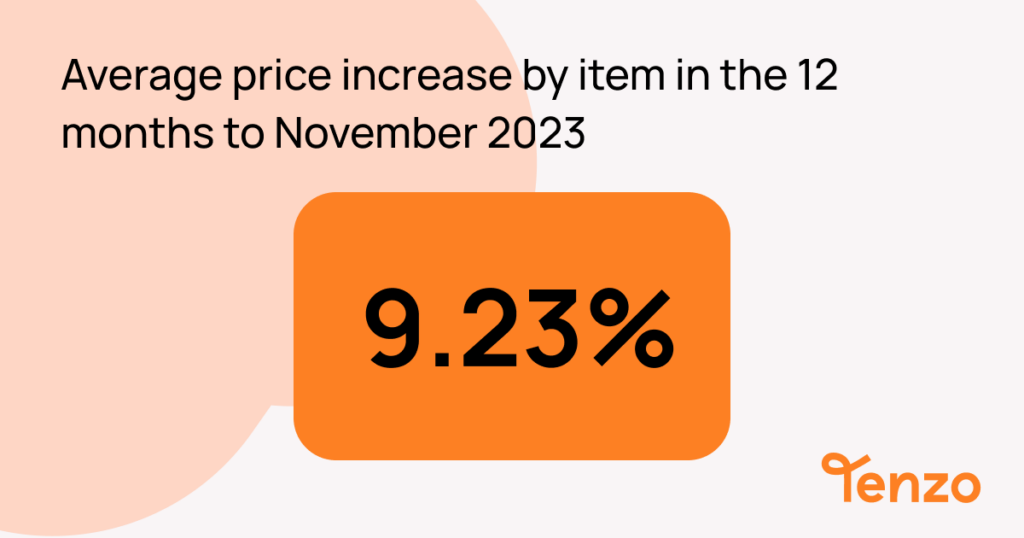
We took a deep dive into Tenzo data to see how prices of individual menu items have changed between November 2022 and today. By analysing a basket of over 60 items that have remained on menus over the last 12 months, we saw an average price increase of 9.23% per menu item. Inflation in the […]
The post How much have restaurant prices risen in the last year? appeared first on Tenzo.
]]>We took a deep dive into Tenzo data to see how prices of individual menu items have changed between November 2022 and today. By analysing a basket of over 60 items that have remained on menus over the last 12 months, we saw an average price increase of 9.23% per menu item.
Inflation in the food and drink space
It’s no secret that over the past year, inflation has been top of mind for restaurateurs. The cost of energy, food and drink rose at such an alarming pace that restaurants had no choice but to invest in revenue-driving actions – the most obvious of which is pricing.
But as the cost of living has risen for general consumers, restaurants have been concerned about increasing prices in line with inflation and spiralling costs for fear of pricing out regular customers. It doesn’t look like those fears have come to fruition though, as the number of transactions across the industry is not dropping.
So, as inflation falls, costs stabilise, and a hint of optimism in the forecasts, we thought we’d take a look at average menu item prices this November compared to November 2022 across a range of businesses and menu categories to see how restaurants have reacted to external pressures over the last 12 months.
How we put our basket together
Tenzo works with hundreds of locations across the globe so has a large amount of data on menu item prices. We pulled this research together by selecting 10 businesses of different sizes and types (bars, casual dining, quick service, fine dining, pubs) and choosing a random selection of dishes and drinks that were sold both in November 2022 and November 2023 and comparing the prices.
What we found was very interesting. There were no consistent increases e.g. where a business had put up prices by a fixed percentage. Every business has a different strategy.
In some examples, prices were raised the most on mains, but sides and drinks remained stable, whereas others only saw large increases in the price of add-ons such as drinks or desserts.
Some prices were increased by over 20%, but others actually decreased. It just goes to show that there are many routes to successfully increasing prices and that every business is unique.
By aggregating all this data, we saw that the average price increase was 9.23% across all businesses and items between November 2022 and November 2023.
How Tenzo’s research compares to other trackers
According to the ONS, the 12-month inflation rate in October 2023 in restaurants and hotels was 7.6%. However, food and non-alcoholic beverages saw the rate fall from 12.2% in September to 10.1% in October. In comparison, the Consumer Prices Index (CPI) only rose by 4.6% in the 12 months to October 2023.
As of publication, Truflation has the current rate of food and beverage inflation at about 8.3% in November, higher than the general rate of 3.89%.
The CGA Prestige Foodservice Price Index, which tracks the wholesale price of food for the industry, has dropped below 20% to 16.7%, the lowest since August 2022, but still far above the current rate of price increases.
What we believe we’re seeing is prices finally catching up with inflation and increased costs. When costs first spiked, businesses were unable to raise their prices at the same rate – the changes had to be more gradual.
What this means for the hospitality industry
With inflation finally slowing, businesses can now plan out their pricing strategies for 2024 rather than having to react to constantly rising costs.
We’re not completely out of the woods yet as the national minimum increases and UK wage inflation remains at 8%, but at least operators can plan for these and include them in their 2024 budgets.
With the most fruitful month of the year about to begin, let’s hope the strains on restaurant businesses are easing and that we’re entering a new era of success.
The post How much have restaurant prices risen in the last year? appeared first on Tenzo.
]]>Inflation is prevalent in everyone’s lives at the moment, but it’s having an especially large impact on the hospitality industry. Why? Well, it’s because food and drink inflation is the highest of all categories at 12.2% in September 2023. This has caused a significant increase in costs for restaurants, which already operate on tight profit […]
The post Rising Costs: The Impact of Inflation on Restaurants appeared first on Tenzo.
]]>Inflation is prevalent in everyone’s lives at the moment, but it’s having an especially large impact on the hospitality industry.
Why? Well, it’s because food and drink inflation is the highest of all categories at 12.2% in September 2023. This has caused a significant increase in costs for restaurants, which already operate on tight profit margins.
In this article, we will discuss the rising costs in the restaurant industry, how inflation has affected dining habits, and what restaurants can do to combat decreasing profit margins.
“Restaurants are affected by food, labour & energy inflation. This means they need to increase their prices to protect margins which in turn may reduce demand. It’s a tough balance to keep.” – Christian Mouysset, Tenzo’s Co-Founder
Rising Costs in the Restaurant Industry
Inflation’s impact on restaurants is clear when you consider all the rising costs and shrinking margins. As inflation affects customer habits, restaurants are facing challenges in cost control and profitability as well as generating revenue. The increasing costs in the restaurant industry are putting pressure on businesses to find ways to maintain their margins.
Rising labour costs and staffing challenges have also contributed to the shrinking margins in the restaurant industry. Minimum wage increases and the rising cost of living have led to higher labour costs for restaurants. This has created a labour shortage for some businesses that cannot afford to compete with larger establishments, further decreasing the labour pool in the hospitality industry. Labour costs have been increasing by 10% monthly since April 2021, adding to the financial strain on restaurants.
Increasing Cost of Goods Sold
The cost of goods sold in restaurants has been significantly affected by inflation. Food and drink inflation is at over 10%, as of September 2023, leading to higher expenses for restaurants.
In the past, the cost of goods as a percentage of revenue was much lower compared to now. This disruption to the normal COGS means restaurants are now spending a larger portion of their revenue on purchasing the ingredients and supplies needed to run their business. As a result, profit margins are shrinking and it is becoming more challenging for restaurants to maintain profitability.
Rising Labour Costs and Staffing Challenges
Rising labour costs and staffing challenges have become major challenges for restaurants.
Not only has the London Living Wage increasing put a strain on labour costs, making it more difficult for restaurants to maintain their profit margins, but the global rising cost of living has meant that labour cost demands are increasing, putting further pressure on restaurants.
Labour costs have been increasing since April 2021, adding to the financial burden for restaurants. With higher wages, restaurants are finding it harder to afford the necessary staff to run their operations smoothly. This has led to understaffing issues, which can impact the quality of service and overall customer experience. Restaurants having to allocate more of their budget towards labour costs leaves less room for other expenses such as food and equipment.
The labour shortage in the hospitality industry has made it even more challenging for restaurants to find and retain qualified staff. With limited options and competition from larger establishments, smaller restaurants are struggling to attract and keep employees. This can lead to increased turnover rates and a lack of consistency in staffing, which can negatively impact the overall efficiency and productivity of the restaurant.
As a result, restaurants are having to come up with creative solutions to address the staffing challenges, such as offering higher wages or implementing flexible scheduling options.
How Inflation Has Affected Dining Habits
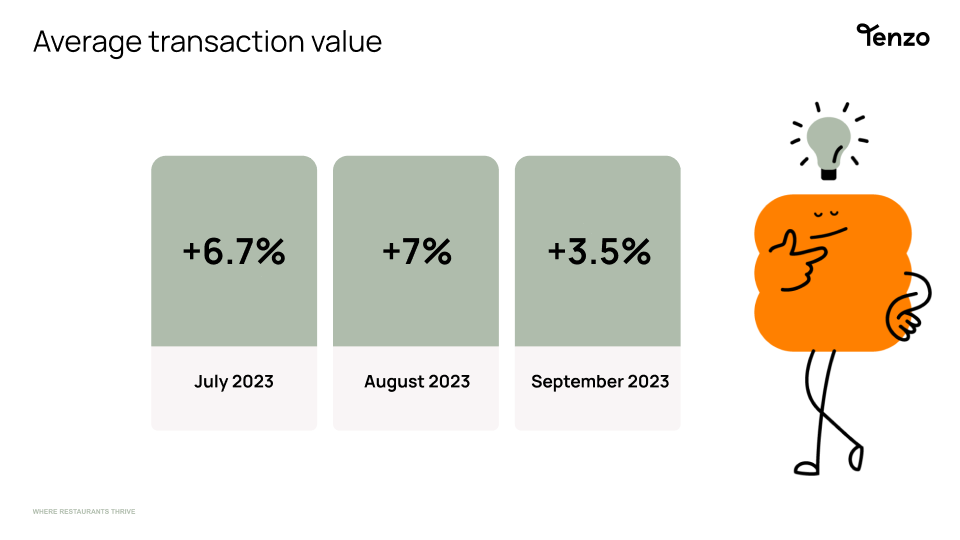
Inflation has also had an impact on dining habits, with customers adjusting their spending patterns. Speculation suggests that while the average transaction value (ATV) has increased, the number of transactions has decreased.
How much are customers spending?
Over the last year, the average transaction value (ATV) for restaurants in the South East of England increased by 5.7% compared to the previous year. This likely means that, on average, customers are spending more money when they go out to eat.
The increase in ATV could be due to rising restaurant prices. As inflation pushes up the cost of ingredients and other expenses for restaurants, they pass on these costs to the customers by raising their prices. This would result in customers spending more money per transaction, but, due to the cost of goods sold increasing, businesses aren’t getting anymore out of each transaction. With tightening margins, it’s likely they’re getting less.
Despite the rising costs, customers may still be willing to pay higher prices for their favourite meals or for the convenience of eating out. This willingness to spend more could be driven by factors such as a desire for social experiences, and because people may be going out less regularly.
Changes in dining-out habits
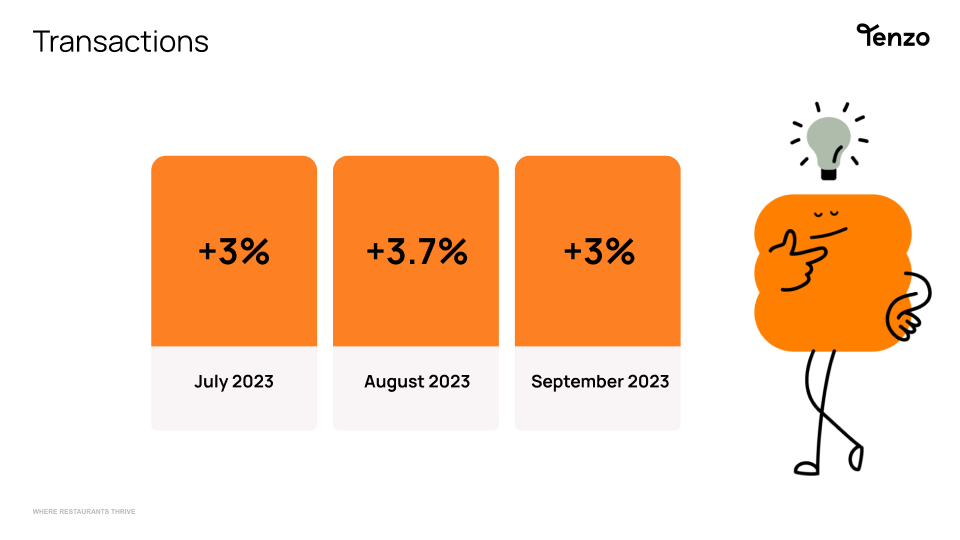
We have also looked into changes in the dining-out habits of diners in the South-East of England over the last year. Many believed that the number of transactions would decrease, with increasing ATV. However, the number of transactions has increased by 2% between September 2022 and September 2023.
This unexpected increase in the number of transactions, alongside rising costs, may mean that diners are choosing to eat in more affordable restaurants. Customers may be spreading their disposable income out and shifting from fine-dining restaurants to casual, or fast-casual, restaurants.
This could also mean that when customers are eating out they are splitting the bill more. The figure for the number of transactions does not tell us how this aligns with the number of covers.
What can restaurants do to combat decreasing profit margins?
To combat decreasing profit margins caused by inflation, restaurants can take several steps to boost their profitability. This can involve all aspects of the business; from menu engineering to labour efficiency, and improving the guests’ experience.
Personalising the guest experience is another strategy that restaurants can employ to improve profit margins. By creating a loyal customer base, restaurants can ensure repeat business and customer satisfaction. Personalising experiences using reservation and CRM systems to build a database on customers, such as their birthdays and favourite wines, allows restaurants to send personalised deals and offers to keep customers coming back.
Menu Engineering
Menu Engineering is an essential strategy for restaurants to use to combat decreasing profit margins. All aspects of menu engineering can lead to improved sales and decreasing costs: boosting profit margins, but we’re going to focus on pricing and menu size here.
Pricing can be a huge challenge for restaurants, but it’s essential that pricing is altered to align with inflation, taking into account the rising costs of ingredients and other expenses. However, it is important to strike a balance and not set prices too high, as this can push customers away and towards competitors. Small increases of 50p or £1 on best-selling dishes can have a huge overall impact on revenue.
Review the price of all menu items, both food and drink and see how the cost of each item compares to the sale price. It’s also important to understand each menu item’s impact on overall revenue. For example, increasing the price of a low-selling menu item by 5% might have a minimal impact on margins and revenue, so might not be worth doing.
Another menu engineering strategy to boost performance is reducing the menu to create a more efficient kitchen. By streamlining the menu and focusing on the most popular and profitable items, restaurants can reduce labour and inventory costs. This allows for better control over expenses and helps to maintain profit margins.
Reducing the menu can also lead to faster service and improved customer satisfaction. With a smaller menu, the kitchen staff can focus on perfecting the preparation of a limited number of dishes, resulting in quicker turnaround times and a more efficient operation overall. This can help to attract and retain customers, even in the face of rising costs and shrinking margins.
Labour Efficiency
Labour efficiency is another business area that restaurants should focus on to improve performance and profit margins. By using data to monitor labour productivity, restaurants can identify areas where optimisation is necessary and make adjustments accordingly.
Another way to improve labour efficiency is to get the most out of your current labour costs. This means not using time and resources to make something that can be better, and cheaper, sourced elsewhere. By outsourcing certain tasks or using pre-made ingredients, you can save time and money while still delivering high-quality food to your customers.
Improving labour productivity can also come from understanding best practices and learning from top employees. By observing and learning from your most efficient and skilled employees, you can implement their techniques and strategies across your entire staff. This can lead to faster and more efficient service, ultimately boosting your margins through increased sales.
Personalising Guest Experience
Personalising the guest experience is essential in the restaurant industry. By creating a loyal customer base, you can ensure repeat business and increase revenue – returning customers provide 67% more revenue in their lifetime than the equivalent of new customers.
To achieve this, it is important to give customers an experience that they believe is worth the money. This means going above and beyond to exceed their expectations and provide exceptional service. These changes in going-out habits are more about finding a balance between cost and quality, with customers seeking value for their money.
One way to personalise the guest experience is by using a CRM system to build a database of your customers. This allows you to gather information such as birthdays, favourite wines, and dietary preferences. With this knowledge, you can personalise deals and offers sent to them, making customers feel special and encouraging them to keep coming back.
Conclusion
In conclusion, the impact of inflation on the restaurant industry has led to rising costs and shrinking profit margins. With cost of goods sold and labour costs increasing, it makes it harder for restaurants to maintain their performance whilst being affordable to their customers.
To combat these challenges, restaurants can focus on menu engineering, optimising labour efficiency, and personalising the guest experience. It’s crucial to ensure that costumers feel they are getting value for their money, if you’re having to increase prices personalise experiences and make customers feel more special, and their experience more memorable.
Overall, navigating the effects of inflation requires strategic decision-making and adaptability in order to maintain profitability in the restaurant industry. Using restaurant data is vital in monitoring the success of business changes and tracking performance.

The post Rising Costs: The Impact of Inflation on Restaurants appeared first on Tenzo.
]]>Mother’s Day 2021 is certainly going to look very different from years gone by, we’ve put together a Mother’s Day Guide based on previous years. Check out our updated blog about current restaurant trends and how they might affect Mother’s Day sales for more up-to-date-info. Whether you celebrate “Mothering Sunday”, or its secular cousin “Mother’s […]
The post Mother’s Day guide: What sales patterns to expect for restaurants appeared first on Tenzo.
]]>Mother’s Day 2021 is certainly going to look very different from years gone by, we’ve put together a Mother’s Day Guide based on previous years. Check out our updated blog about current restaurant trends and how they might affect Mother’s Day sales for more up-to-date-info.
Whether you celebrate “Mothering Sunday”, or its secular cousin “Mother’s day”, there are few busier days in the year for restaurants – when many consider it their sacred filial duty to take their dear old mum for Lunch or Dinner.
However, many restaurateurs and publicans don’t recognise how huge the mother’s day weekend can be – and don’t prepare accordingly.
As the big day approaches, is your business prepared to make the most of this huge opportunity? We looked into the vast Tenzo database to uncover exactly what happens to restaurants and pubs during this day of maternal appreciation. Hopefully, these insights can help your business to record a profit this weekend that would make your mother proud!
Interested in more seasonal insights from the Tenzo database? Check out our posts on Valentine’s day and extreme weather, or subscribe to receive our data blogs in your inbox!
Overall Sales Patterns On Mother’s Day Weekend
Looking at the Tenzo database, we observed some very interesting effects:
-
Mothering Sunday will not be the only day to see a boost in sales – expect a similar, if not even bigger, increase on the Saturday.
-
The weekdays preceding the Mother’s Day weekend do not appear to benefit from the boost.
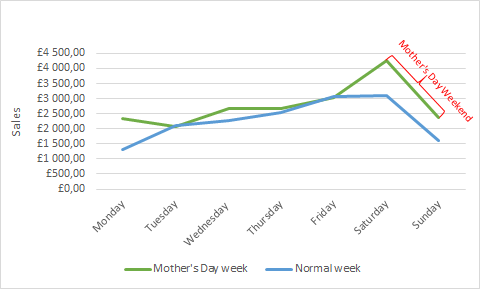
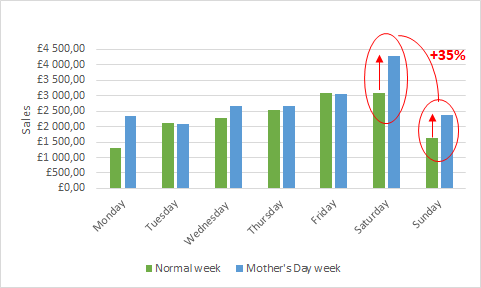
Different types of restaurants are not affected in the same way on the Mother’s day weekend. We will break down the rest of this post into insights and tips for fine dining restaurants, casual dining restaurants, and gastropubs.
Mother’s Day Guide for different restaurants;
Feel free to skip to the section relevant to your business:
Note: The numbers given will be based on a comparison between the week of Mother’s day and the week after.
Fine Dining
What was the impact of Mother’s day on the whole weekend?
On Mother’s day, sales at the fine dining restaurants using Tenzo increased by about 35% compared to a typical weekend. Clearly many sons and daughters want to treat their Mother’s to something special.
In general over the entire Mother’s Day weekend, sales grew around 20%.
Which was the busiest part of the day?
Restaurateurs, get ready! People are more likely to offer a great dinner to their mum rather than a fancy lunch – the number of transactions at dinner on Mother’s day was 50% higher compared to at lunch on the same day.
Mother’s Day dinner had a higher transaction number (+56% on the average) in most restaurants than any other Sunday dinner of the year (in some restaurants in the UK, the May bank holiday pipped mother’s day to the post).
Tip: Tenzo’s advice would be to take a look at your staff scheduling and make sure you have a full complement of your best floor staff – Mother’s day is an opportunity to make a great impression with exceptional service, and it would be a shame to miss out on this opportunity because your waiters are too busy to give their best.
What did customers order and how much did they spend?
Spend per head decreased on Mother’s day last year, compared to a typical Sunday as diners ordered lower value main courses, and reigned in their spend on drinks. Our interpretation here is that while offspring get to choose the location to treat their Mothers, the Mother’s are hesitant to go crazy on their child’s credit card.
As maternal instincts kicked in to protect kid’s bank balances, we saw large decreases in attachment rate for alcoholic beverages overall (down 30%), with sparkling wines and champagne some of the items hit the hardest. On the other hand, attachment rate of sides involving that most modest of ingredients, potatoes, shot up 57%!
Tip: While it’s incredibly important to make the Mother’s feel like VIPs on their special day, don’t let your staff allow them to take control of ordering. Instruct them to encourage the sons and daughters to do the ordering – they will spend more. Perhaps also encourage floor staff to suggest higher-value items such as sparkling wines – it’s a day to make all mothers feel loved and spoiled, and should be helping to facilitate the spoiling!
How many people should you expect on Mother’s Day?
The number of guests increased by 25% and transaction number around 34%. Transaction size increased compared to a classic Sunday: bills were £4 higher than usual. This indicates a larger average group size than usual.
Tip: Make sure you have enough larger tables suitable for families in your restaurant. You might have to combine smaller tables and optimise your layout around your new configuration.
Casual dining
What was the impact of Mother’s day on the whole weekend?
Casual dining restaurants using the Tenzo platform saw even bigger boosts over the mother’s day weekend compared to fine-dining establishments. Sales increased by 27% over the weekend as a whole. The biggest increase was actually on the Saturday (+31%!), nevertheless, sales on mothering Sunday itself increased by 23%.
Which was the busiest part of the day?
Casual dining establishments should be prepared to be very busy throughout the entire day on both Saturday and Sunday. According to our data, all three mealtimes are important. While breakfast/brunch’s sales increased by around 16%, lunch’s sales grew by 13% on average. Dinner is the big winner here with 30% more sales compared to a usual Sunday!
Tip: Make sure you schedule enough staff and think about their breaktimes in advance – there might not be an obvious time to let staff members have a rest, as business will continue flowing all day. Make sure your staff are not all worn out by dinner – which will be the main event.
What did customers order and how much did they spend?
The main story here was the huge increase in sales of kids menu items – We saw an increase here of 58% were sold compared to a normal Sunday! Ordering patterns did not show many other clear patterns – the rising tide lifted all ships.
In regards to spending patterns, we observed the same effect as in fine dining restaurants – with spend per head decreasing by 2%. This spend per head decrease was probably due to two factors, one, the increased number of children dining, and secondly the effect of mother’s not wanting to go too crazy at their offspring’s expense – see the Fine Dining Section.
Tip: Make sure you are well set up for the arrival of families – have colouring pencils at the ready, as well as enough dustpans and brushes. Your floor is about to receive a good scattering of squashed chips, ketchup, and surreptitiously discarded vegetables.
Tip: As for fine dining, we would recommend instructing your staff to encourage son’s and daughters to spoil their mothers – don’t let the Mothers do the ordering!
How many people should you expect on Mother’s Day?
At casual dining establishments, we recorded an increase of 14.5% more guests in comparison with a typical Sunday. Transaction number increased by 10% and transaction size remained around the same. These patterns suggest that you should expect a mild increase in group size – but not a dramatic one.
Gastropubs and Country Inns
What was the impact of Mother’s day on the whole weekend?
In contrast to fine dining and casual dining businesses, pubs made most of their sales on Sundays during the Mother’s Day weekend. Pubs increased sales on Sunday by a huge 60% compared to a typical Sunday!
Tip: Aside from the hectic Christmas period, Mother’s Day was the second busiest day of the year for the foody pubs using the Tenzo platform. It’s, therefore, an extremely important weekend – make sure you don’t neglect it as many publicans do – it can provide a huge early spring lift to your bottom lines, after a slow start to the year. Prepare to smash it!
Which was the busiest part of the day?
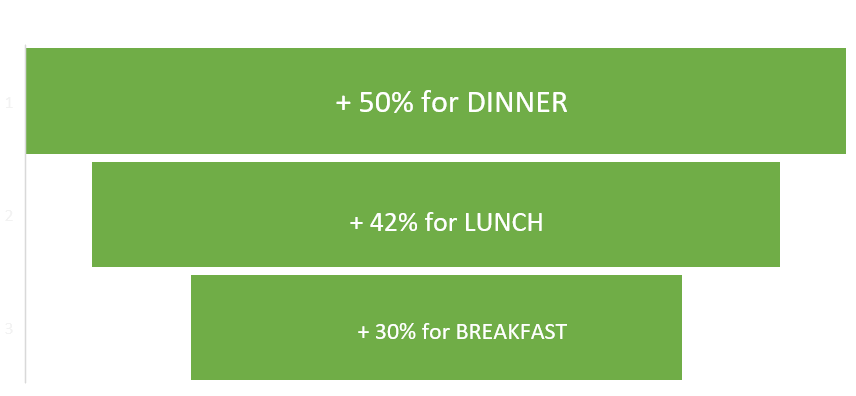 While examining the Mother’s Day data compared to a classic sunday, we observed that sales increased a lot at all three mealtimes. The winner was dinner with +50%, lunch second with +42% and finally breakfast with +30%.
Tip: Prepare to be busy all day, building to a grand crescendo at dinner time – when you will be truly rushed off your feet. Make sure you have enough staff and that you have planned enough time to let them have a good rest between the huge lunch and dinner services.
What did customers order and how much did they spend?
Customers in gastropubs and inns went mad for specials on the mother’s day weekend (+60%) and ordered a lot more starters (+30%) and drinks such as beer and wine (+40%).
In contrast to the other restaurant types explored in this article, spend per head at gastropubs increased by a huge £10! Sales of Kid’s Meals also increased massively: by 50% compared to the Sunday after! The increase in spend per head is likely due to an increase in food orders compared to a typical sunday – when many punters show up just for drinks.
Tip: For a special occasion, you need great specials. We suspect that the gastropubs using Tenzo prepared a set of “Mother’s Day” specials. It’s hard to know what exactly will be a hit here – our inkling would be lighter dishes with delicate flavours – fish, salads, and spring vegetable accompaniments.
Tip: Just as we suggested for casual dining restaurants – make sure you are well set up for the arrival of families – have colouring pencils at the ready, as well as enough dustpans and brushes. Your floor is about to receive a good scattering of squashed chips, ketchup, and surreptitiously discarded vegetables.
How many people should you expect on Mother’s Day?
Again, we saw a huge boost in the number of guests: a rise of 45%! Transaction number increased by +27%. These numbers indicate that you should expect larger groups on the Mother’s day weekend compared with a regular weekend – Mum’s will show up with their whole clan in tow.
Conclusion
What you should remember ahead of Mother’s Day:
Mother’s Day is very special day for many families, when they express gratitude and try to show their appreciation. The fact that they have chosen your restaurant shows that they think of your place as special – it’s a great honour! Make sure you return the appreciation by making sure their experience is joyful.
Like any special day, preparing for Mother’s Day requires a deep understanding of your sales patterns and mider business, and an accurate idea of what your sales will be. Don’t hesitate to book a demo with Tenzo to learn how we can help.
Written by Clara Meyer & Marianne Roy de Lachaise
The post Mother’s Day guide: What sales patterns to expect for restaurants appeared first on Tenzo.
]]>Valentine’s day is one of the most important days of the year for restaurateurs: love is in the air, prompting romantic gestures that can result in record-breaking sales if you get your approach right. Our Valentine’s Day lessons have helped us devise strategies to prepare restaurants effectively for 2020. This blog post will present what […]
The post Valentine’s Day Lessons from 2019 and 9 ways to prepare for 2020 appeared first on Tenzo.
]]>Valentine’s day is one of the most important days of the year for restaurateurs: love is in the air, prompting romantic gestures that can result in record-breaking sales if you get your approach right. Our Valentine’s Day lessons have helped us devise strategies to prepare restaurants effectively for 2020.
This blog post will present what we learned from Valentine’s day 2019 by looking into the huge Tenzo database to find actionable insights that you can use to prepare for Valentine’s 2020.
Overall Sales Pattern
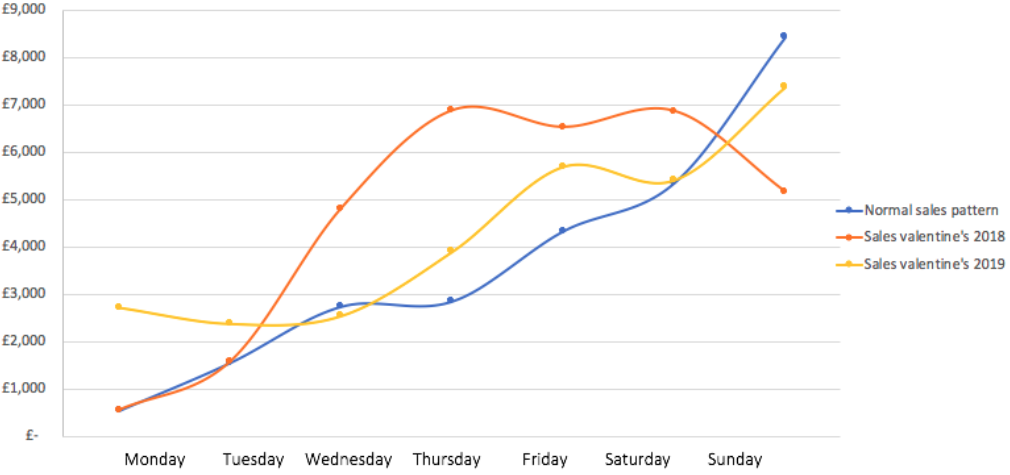
In 2018, we saw that a Wednesday Valentine’s day had a powerful positive effect on sales for the rest of the week – the valentine’s afterglow.
This year, however, Valentine’s day fell on a Thursday. For whatever reason, we did not see a repeat of the afterglow effect: sales were actually lower than usual on the day after (the Friday). Punters seemed to be tired after their romantic exertions – perhaps with the Thursday Valentine’s day being so close to the weekend, they gave in to the temptation of an extra bottle of champagne, and felt under the weather the next day.
The graph below shows general sales patterns for a normal week, and the weeks of Valentine’s day 2018 and 2019. Note that the dramatic effect of Valentine’s day last year was not repeated this year.
Let’s dig into some more details.
Below are some valuable insights broken down by restaurant type: fine dining, casual dining, and gastropubs/country inns.
All of the following metrics are based on comparisons between Valentine’s day 2019 and the same day of the week (Thursday) one week earlier.
Fine dining
The fine dining restaurants which use Tenzo increased their sales at an average of 35% on Valentine’s day 2019 in comparison with the previous Thursday. Valentine’s dinner is a great opportunity for fine dining restaurants!!
Transaction size generally showed little change: perhaps because fine dining establishments are ordinarily full of romantic tables-for-two on a regular (non-valentine’s) Thursday night.
However, the number of transactions exploded on Valentine’s day with an average increase of 45%. We also saw an average increase in the number of guests by 16%. Restaurants were evidently serving a lot more tables and will have been fully booked from early dinner to closing time.
The following graph shows that on Valentine’s day, fine dining establishments were packed from around 6pm till late. The purple line shows a more normal pattern.
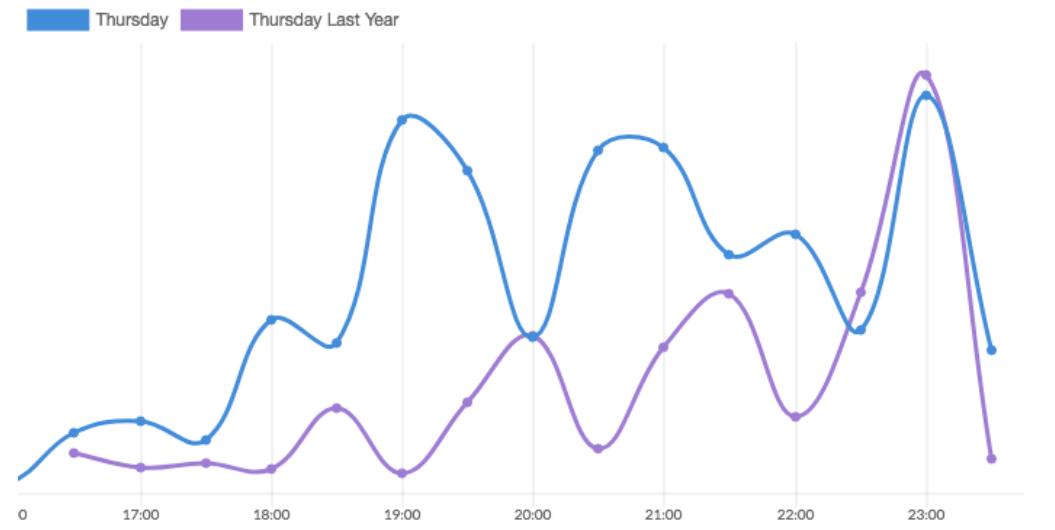
Metric: Total daily sales
Tip 1 – Make sure you are fully staffed from 5.30 or 6pm to keep up with the early rush.
Spend per head was £2.5 more than on a usual Thursday. This made a very significant difference to the bottom line, but what exactly did our lovebirds order?
- 30% more cocktails
- 26% fewer beers
- 50% more red wine
- 20% more desserts.
Tip 2: Prepare your staff to up-sell cocktails, desserts and wine in order to increase spend per head. Great time to up-sell a really nice bottle of Bordeaux!
Casual dining
Casual dining restaurants also did very well, with an average increase in sales of 30%!
Transaction size was flat or even lower than usual. However, this is to be expected as restaurants fill their space with as many small tables-for-two as they can.
We observed an increase in transaction number, also due to the smaller 2-people tables. The number of guests did not greatly increase: probably because Thursdays are usually very busy nights at the locations on our platform.
What made sales better than usual was the improvement in average spend per head. People spent £2 more than usual. Most of the extra money wa spent on sides and desserts (50% more desserts ordered).
Tip 3: The key to a successful Valentine’s dinner for casual dining businesses is to focus on up-selling sides, drinks and desserts to increase transaction size for 2-person tables.
Tip 4: Figure out how to squeeze as many 2-person tables into your place as you can. If you don’t have enough small tables, consider hiring some, and temporarily moving out your larger ones.
Tip 5: In order to handle the increasing number of transactions, restaurateurs should take a look at their staff scheduling – everyone will be extra busy tonight, and have more tables to look after than usual.
Tip 6: Also make sure you have enough mobile POS units and that they are fully charged before 6pm – they will see a lot of use!
Gastropubs & Country Inns
Tenzo has many higher-end country inns and pubs on our platform: beautiful places well suited to a romantic Valentine’s getaway.
These types of restaurants made an absolute killing on Valentine’s day. Customers flocked to the gastropubs and country inns on our platform: we saw an average of 70% boost in sales for Tenzo-using gastropubs!
Transaction size increased at an average of 53% in gastropubs. Transaction number also increased: people ordered more times than usual – perhaps as they visited the bar for a second bottle of wine. Number of guests increased on average 40%.
The average spend/head grew by 20%. Cocktails were the great champions here: normally popular only over weekends, cocktail orders increased 778% here!
Tip 7: Be ready to serve a lot of cocktails! If your bar staff are likely to be over-stretched – create a special Valentine’s cocktail list with a few choice drinks – and only serve these. Do as much cocktail prep as you can ahead of time.
Tip 8: Prepare your staff: this is not exactly going to be a walk in the park. More orders, bigger orders, and more guests require another level of preparedness.
Tip 9: Don’t forget to look after your regulars – even if they are single. We can’t prove this conclusively with the data, but we have an inkling that this crowd also gets caught up in the romance of the evening and spends more – their extra enthusiasm can probably provide an unexpectedly big boost to sales.
The post Valentine’s Day Lessons from 2019 and 9 ways to prepare for 2020 appeared first on Tenzo.
]]>Any restaurateur worth their Maldon salt will tell you that rain is generally bad for business. As people hide inside to stay dry and cozy, they cancel reservations and opt for comfort food and a Netflix binge instead. See our past analysis of rain effects here. Restaurants in winter are another story, so what about […]
The post Restaurants in Winter; the effects of snow on the hospitality industry appeared first on Tenzo.
]]>Any restaurateur worth their Maldon salt will tell you that rain is generally bad for business. As people hide inside to stay dry and cozy, they cancel reservations and opt for comfort food and a Netflix binge instead. See our past analysis of rain effects here. Restaurants in winter are another story, so what about snow?
With the Met office anticipating freezing weather this coming January, being aware of how your business might be affected by snow should be a top priority.
Does the winter romance of a blanket of white encourage people to bundle up and venture out to eat? Or does the hunkering-down instinct kick in here too? Should you expect to be snowed under, or left out in the cold? We looked into the vast Tenzo database to find out.
The impact of snow for restaurants in winter
The Cold Snap
The last time the UK had a widespread white Christmas was 2010, way before Tenzo started collecting data, so we will focus on the latest period of extreme cold weather which occured in 2018 between the 28th of February and the 3rd of March.
During this period, nicknamed ‘The Beast from the East’, strong winds brought air to the UK from the direction of Finland, and it got seriously cold. As ‘the Beast’ collided with warmer, wetter air from Storm Emma rising from the south, the UK was blanketed with a thick layer of snow on the 2nd of March.
On 28th February a man died after falling into a frozen lake in a London park. Glasgow airport was shut among major disruption to roads, rail, and air travel. Thousands of schools closed, and many areas experienced power cuts. Many isolated communities had to receive emergency supplies by helicopter.
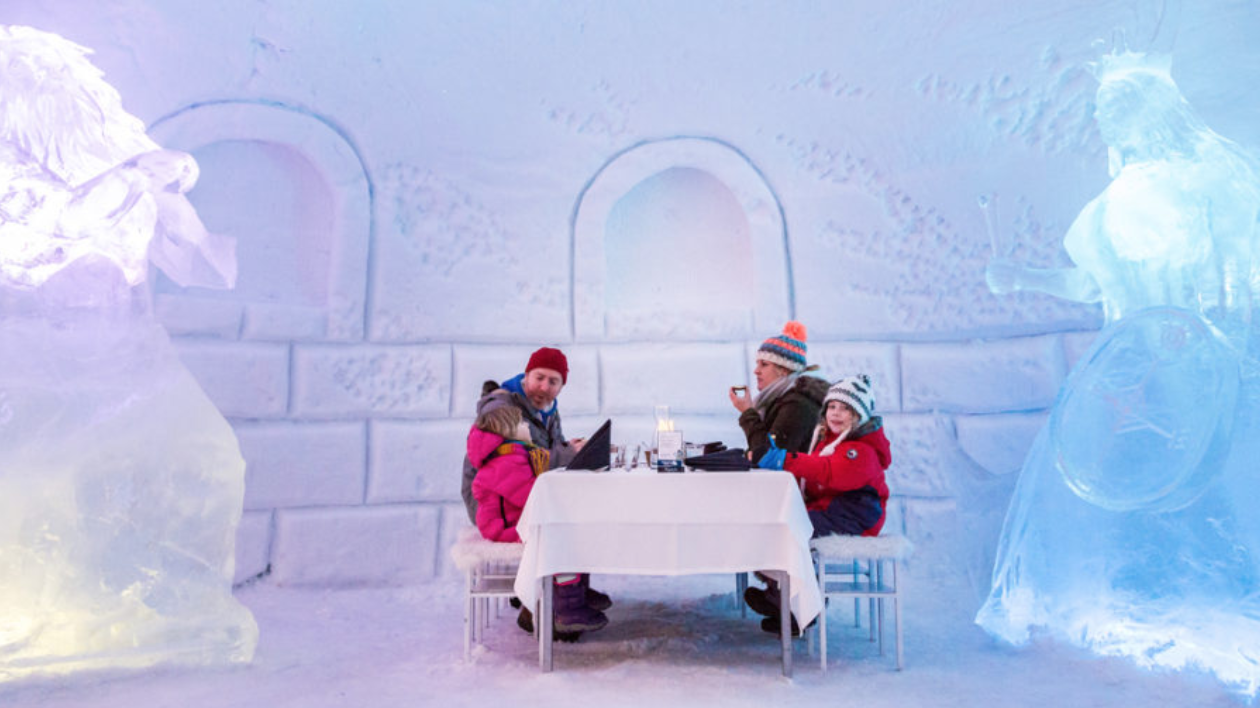
The photo below shows the moment ‘the Beast’ hit the city of London.

This blog will explore how different types of food and beverage business were affected over this freezing period. An important point to note is that the snow and freezing temperatures during this time were accompanied by very cold and strong winds battering the UK from the North-East, making the weather in this period far from pleasant. The business impact may have been very different without the wind.
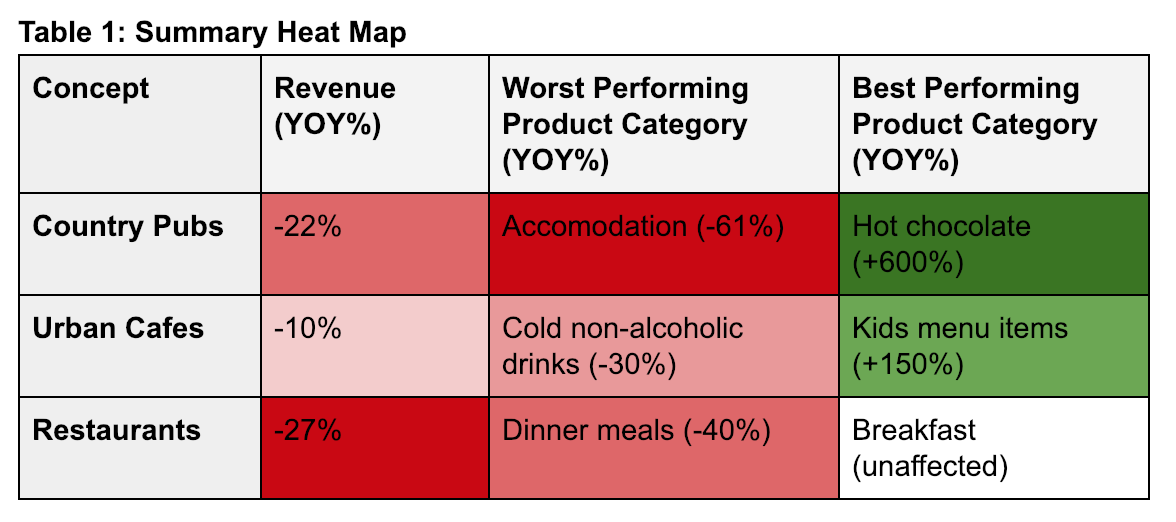
Table 1 outlines a heat map (or should we say COLD map?) of three major hospitality concepts on Tenzo’s books. Importantly, this data was taken on Friday March 2nd 2018 and compared to the closest Friday a year before across a statistically significant number of Pubs, Cafes and Restaurants across the UK. The results are discussed in the paragraphs below.
Country Pubs
The pubs which use Tenzo, mainly in countryside locations, were heavily affected by the snowy, windy conditions on Friday March 2nd. On average, their revenues were reduced by a massive 33% of what they expected to make at this time of the year. The very worst affected pubs made only a quarter of what they expected! Only one pub in the database did better than expected (it’s not clear why this exception occured).
A slightly different way to look at the numbers is to compare to what the pubs earned on the same day of the week a year earlier. This only makes the picture look slightly less bleak: the pubs on average saw a 22% drop in revenues.
Which product divisions were worst affected? Drinks were the least affected, down across all pubs by only 2% year-on-year. Food sales slumped a massive 30% compared to the previous year, and this change accounted for around 65% of the overall drop in sales. The most affected category, unsurprisingly, was accommodation. Only the foolhardy would choose this horrible weekend for a stay in a country inn, and sales were down a massive 61% year on year.
A few product categories actually saw slightly increased sales across this period in spite of the overall downturn. Draught beer and cider, red wine, port, sherry, rum and whisky all bucked the trend and did well, so publicans should stock up before January!
The two categories which did the best, however, were kids meals, up 400%, and hot chocolate, up an incredible 600%. This probably reflects the widespread closure of schools on that day, with many families opting to spend the snow day at their local.
The effect on mealtimes was different between lunch and dinner. Lunchtime was only slightly affected, but dinnertime business was severely affected, with sales down by a quarter year on year. Perhaps this was because while the snow might be appealing during daylight hours, the romance is considerably lessened after dark.
Urban Cafes

Cafes in city locations were also badly affected by Storm Emma and the Beast from the East, though not nearly as badly as the country pubs. On Friday the 2nd of March on average they saw a 10% decrease in sales compared to the same day a year earlier, and a 15% decrease compared to what they expected to make on this day.
The worst affected cafes saw sales slump 20% on this day. The only cafe on our system which actually saw a year on year sales increase on this day happened to be in one of the few cities in the UK which did not experience any snow over the period.
Of the major product categories, sales of drinks did worst, seeing a decrease of 30% year on year. Food did far better, seeing a modest 6% drop.
Getting more specific, the best selling items on this day were large breakfast meals including full English breakfasts. Unsurprisingly sales of takeaway food such as bacon rolls dropped off totally (-75%), whereas sales of takeaway hot drinks actually improved slightly. Among the worst affected categories were soft drinks, juices, and milkshakes (down around 30%), while sales of tea, coffee, wine and beer remained solid.
Some of the other best-performing food items were sweet treats, especially classic kid’s treats. This, coupled with an 150% increase in hot chocolate sales and a strong performance of kids menu items, would suggest that, just like for the pubs, the school closures on this day helped to temper the effects of the bad weather on cafes
.
Also similar to the pattern with pubs, as the bleak day wore on, sales got worse. Breakfast sales were not affected compared to the same day a year earlier, lunch sales were moderately reduced, while those cafes on our system which serve dinner were badly affected at this time of day, experiencing a 25% slump.
Restaurants
The restaurants on the Tenzo system also did very badly from the 28th February to the 2nd of March, on average seeing a decrease of 27% year on year. However, there was a lot of variation in how much they were affected, with many restaurants down more than 50%, and restaurants which did comparatively well seeing a modest decrease of around 10%.
In London, where the weather was slightly milder, the effects were also milder, whereas in the blizzard-like conditions across the west coast and the midlands, the impact on business was much stronger.
As with the other types of business, sales got worse as the day of the 2nd of March went on. Breakfast performed as usual, with some restaurants actually seeing improved sales: one particular chain seeing a 250% morning surge. Lunch on average saw decreases of around 10% year on year, while dinner was by far the worst affected, and accounted for the vast majority of the bad performance on this day. Dinner sales were typically reduced by 40%.
Due to the huge range of restaurants in the Tenzo database, it’s very difficult to draw lessons about specific product categories’ performance. However one clear pattern, perhaps obvious, was that sales of traditionally summery drinks such as sparkling wines, rose’s, juices, and fruity cocktails were all badly affected by the frosty weather.
Top 4 Insights
-
Snow storms are extremely bad for food and beverage businesses – expect sales to drop 10-40%, depending on the type of business.
-
If local schools close, you’re in luck. Expect boosts for cafes and pubs to lunchtime sales of kid’s meals, and stock up on hot chocolate!
-
On a cold, snowy day, expect business to get worse as the day wears on. Dinnertime business will be by far the worst affected.
-
Sales of warming drinks and alcohol will remain strong. Perhaps cash in on this by preparing a large supply of mulled wine or cider.
Tenzo’s Forecasting
As we can see, the weather can drastically affect business for restaurants, pubs, and cafes. Tenzo provides market-leading sales forecasting for food & beverage businesses and uses historic sales and weather forecasts, plus local events and holidays, in its forecasting algorithm. Tenzo’s Artificial Intelligence-driven forecasts have been shown to be far more accurate and reliable than typical forecasting strategies, and will help you to optimise labour scheduling, inventory ordering, and lower food waste.
The post Restaurants in Winter; the effects of snow on the hospitality industry appeared first on Tenzo.
]]>As you are no doubt aware, Coronavirus has had an enormous impact on the hospitality sector over the last couple of weeks. With fewer people venturing out due to fears of infection and social distancing being encouraged; restaurants, bars and cafes have been some of the worst-hit businesses. In light of this, we decided to […]
The post Coronavirus impact: An analysis of the last few weeks in hospitality appeared first on Tenzo.
]]>As you are no doubt aware, Coronavirus has had an enormous impact on the hospitality sector over the last couple of weeks. With fewer people venturing out due to fears of infection and social distancing being encouraged; restaurants, bars and cafes have been some of the worst-hit businesses. In light of this, we decided to deep dive into the numbers and see exactly how this new pandemic is affecting the industry.
Pre-Corona
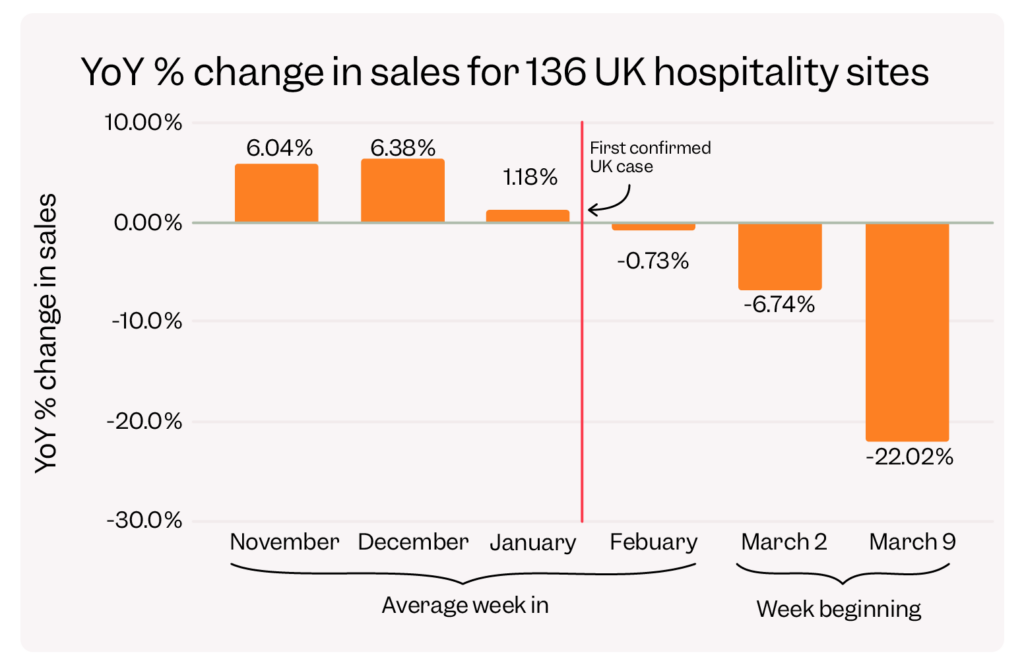
We looked at a sample of 136 restaurants in and around London and Southern England, including multi-site and single-site quick service, fine dining, and casual dining restaurants, pubs, and cafes. Tenzo customers tend to be fast-growing businesses and their numbers for an average week in November and December reflect this. On average these locations saw year-on-year sales grow by 6.04% for an average week in November, and 6.4% in December.
January was definitely considered a tough month with flooding and extreme rainfall deterring people from going out; yet these locations still saw growth of 1.18% on average for the month.
However, come January 31st, when the first UK case of the virus was reported, restaurants saw their growth teeter. February’s year-on-year growth was down 0.73% on average as people began to feel more wary about surrounding themselves with strangers and their potential germs. But as the first week of March rolled around, many offices had imposed work-from-home policies and the time for social distancing had arrived.
Corona arrives
After the arrival of the virus, average YoY sales for the first week in March dropped 6.74%, which translates to an average reduction in sales of £1,883 per location. The second week of March saw sales drop even more significantly, with year-on-year sales down 22%. Unfortunately, cafes look to have been hit hardest with their growth dropping 25%, likely due to the amount of people working from home and foregoing their morning caffeine fix en route to work.
Restaurant budgets also took a big hit. While budgets are admittedly usually more aspirational than attainable, many restaurants saw the first and second week of March close with sales numbers way below what was hoped for with the average location ending up 11.29% under what they had wanted in the first week of March and 25.85% in the second.
Delivery vs Eat in
As you might expect, we have seen an uptick of diners choosing delivery and takeaway options over eating-in. However, while sales for delivery were up 21.7% year-on-year in the first week of March, we saw a drop in the second week with delivery only up 10.84% compared to last year. While this growth is still a good thing, it is worrying that it seems to be dropping off and might mean that customers are more wary of consuming food that they haven’t prepared themselves.
It is nevertheless comforting to know that delivery services are attempting to stay as safe as possible. Deliveroo, for example, have taken precautions to avoid spreading the virus, including introducing a ‘no-contact drop-off’ option to eliminate unnecessary contact between delivery drivers and customers.
Needless to say, if your restaurant hasn’t traditionally offered delivery, it might be time to consider it. Changing your core-concept might seem like a drastic move but in these drastic conditions, it may help you to survive and continue paying your employees.. Food is the ultimate comfort in times like these and your diners are sure to be craving their favourites even if they can’t leave the house.
Conclusion
This is undoubtedly a very uncertain time for the hospitality sector as a whole and unfortunately, it is unlikely to end very soon. As such, the most important thing at the moment is to ensure that everyone stays as healthy as possible. In terms of business, our tip is to focus on delivery and takeaway business, and minimising costs, to help with cash flow while the situation is brought under control.
It’s important to remember that this industry is extremely resilient and once this virus has been contained we’re sure it will bounce back stronger than ever. In the meantime, take whatever actions available to you that will increase your chances of staying afloat. We have published our current advice here.
The post Coronavirus impact: An analysis of the last few weeks in hospitality appeared first on Tenzo.
]]>Two weeks ago, we had the pleasure of attending Restaurant and Bar Tech Live. The two days were a blur of demoing, meeting with partners and scrambling from talk to talk. It was hectic, busy, and everything we could have hoped for from the biggest event for restaurant tech of the year. Plus, with so […]
The post Restaurant Tech | 2020 Tech Trends Revolutionising the Industry appeared first on Tenzo.
]]>Two weeks ago, we had the pleasure of attending Restaurant and Bar Tech Live. The two days were a blur of demoing, meeting with partners and scrambling from talk to talk. It was hectic, busy, and everything we could have hoped for from the biggest event for restaurant tech of the year. Plus, with so many industry big-wigs and influencers in attendance, we had an opportunity to learn all about the upcoming trends in the industry.

Here’s our breakdown of everything we learnt over the two days about the direction tech is heading in the industry.
People over tech
Ironically, the first talk that we went to – a keynote by Cain Savazzi, Operations Director at TGI Fridays – promoted the idea that tech should come in second-place in your business. What should come first, you ask? According to Cain, it’s your people – TGI Fridays has a people-led strategy, with tech being an enhancement, not a replacement, for those people.
According to Daniel Davis of Honest Burgers, this is the worst labour market since World War 2. Retaining staff by investing in them and making them feel appreciated may be the answer to this problem. Tech solutions built with staff-empowerment in mind – dedicated training apps ,for example – are a way to integrate the efficiency of technology, while still putting your people first.
Tenzo is an example of staff-empowerment tech. A few examples: our real-time analytics allow GMs to be better decision-makers, and our forecasting can make shift schedules more reliable – a big factor in retaining staff.
Alternatively, training apps that incorporate gaming like those created by Attensi encourage employees to engage with both the company and each other. We’ve seen successful case studies of this from both Itsu and Starbucks. In fact, Itsu found that their onboarding time was halved thanks to the new gaming concept. Gamifying training encourages people to keep using the app to get higher scores while simultaneously repeating simulations that will make them more confident and effective workers.
Robots
It’s happened: the robots are here. Marius Robles, co-founder of Food by Robots, showed us how far robotics has come along in the food industry over the last few years. Now, robots can not only be programmed to perform one task but can easily be reprogrammed for the next one. This allows the same robotic device to be used for several different tasks, revolutionary when you think of all the tasks required in a kitchen! The takeaway here is that we have got to the point where a robotic arm is actually a sensible investment for many commercial Kitchens and not just a novelty.
We’ve already seen their implementation in new concepts such as Spyce in Boston, a fully automated quick-service restaurant. Robots run the show there, from taking orders, preparing the food, and delivering it to the consumer.
In Asia, they’re way ahead of the curve. Alibaba has rolled out Robots.He in their Hema supermarkets in China, a robot-powered eatery that allows you to select items from the supermarket to be prepared for you. Their competitor, JD.com, has also embraced robotics in the food industry and plans to have 1,000 robotic restaurants in China by 2020. These restaurants are fully automated, from food preparation to service. They incorporate AI and self-driving technology to safely manoeuvre within the space. The restaurant has a VR immersive eating area to provide diners with an even more futuristic experience.
Gen Z and digital engagement
We now live in the kind of hyper-connected world that means that the average twenty-year-old gets distracted every twenty-eight seconds by a new notification, according to Paul Wickers, founder and CEO, at Huggg. This means that to stand out from the crowd, any kind of advertisement must compel the consumer to convert as quickly as possible.
Olive Garden is one restaurant chain who have managed to do just this. They send their most engaged customers text messages, sometimes up to three times a week! They only contact customers who have signed up to receive text messages from the brand, meaning that they are already fans of Olive Garden. By capturing this audience, and sending out news or offers in this medium, they are able to incite repeat visits from loyal customers and reward them.
With a whole new generation of consumers coming of age, it’s important to know what makes them different from their predecessors. Gen Z, according to several industry insiders, will be far less loyal to one restaurant than the millennials that came before them. They are much more open and prefer to try new things each time they go out. Finding a way to keep them loyal is therefore imperative.
Harnessing the power of search
In 2019, whenever we want the answer to pretty much any question, Google is our first port-of-call. Same thing goes for restaurant recommendations. If we’re in the mood for something to eat, we don’t search for branded terms like ‘Five Guys’ but instead for unbranded terms like, ‘good burgers near me’. One key to increasing footfall is to be the first result for that unbranded search term.
Lee Zucker, from Yext, showed us how Five Guys did just that. And it was no simple task. We don’t realise how many separate terms need to be analysed to give us the answer we want on Google. Searching ‘good burger place near me with free wifi’ may seem pretty straightforward, but it actually requires Google to trawl through millions of data points, from menu information, reviews, and location information, to information on specific restaurants, and bring it all together for the customer.
For restaurants to achieve that elusive top search result, all of their information needs to be within easy reach for Google. According to Lee, it is seemingly important to lay bare all of the things that you offer. (The official name for this is a knowledge graph). Say you have activities for kids and great children’s menu, shout it loud and clear on the web. So next time someone searches for ‘best kid-friendly restaurant’, you’ll be on the radar.
Sustainability
Last, but absolutely by no means least, we saw a serious upsurge in interest in sustainability. Just walking around the stands at all the expos involved in the wider Food Entrepreneur Show, anyone could see that sustainability was at the forefront of everyone’s minds, whether it was eco-takeaway boxes, straws made of actual straw, more eco-friendly waste disposal, or brands targeting food waste such as Too Good To Go.
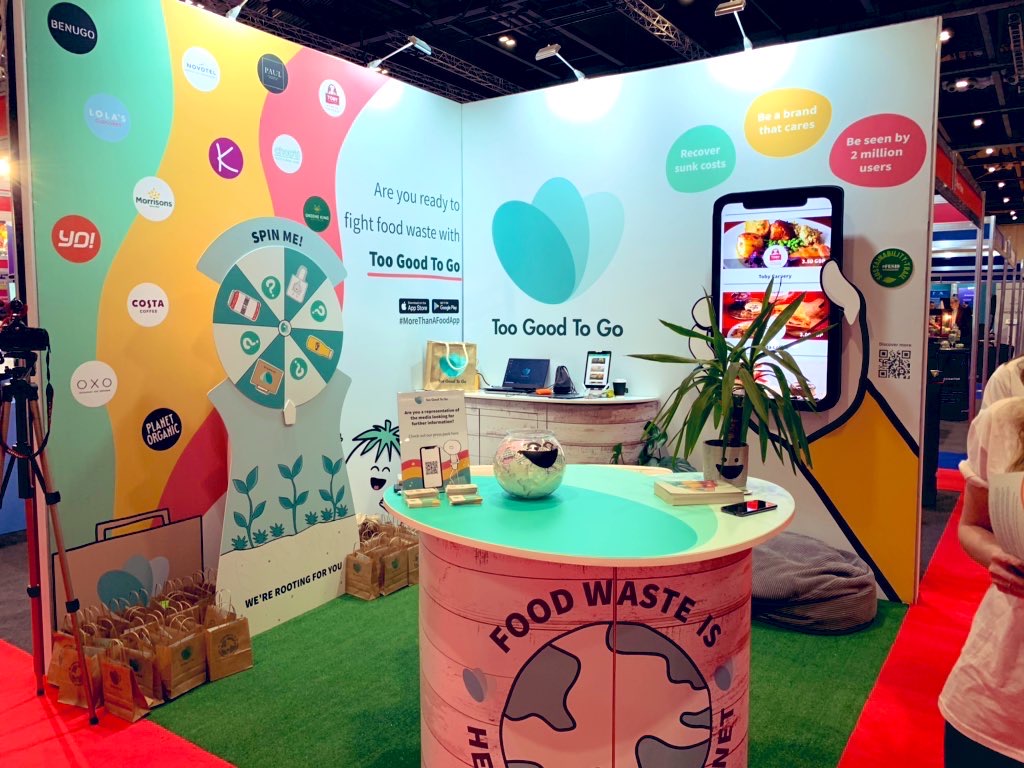
From a technology perspective, our own CEO and co-founder, Christian Mouysset, pointed out the huge issue of food waste in the restaurant industry during a panel discussion about “leveraging technology to streamline operations”. Using Tenzo’s AI forecasting allows restaurateurs to know, with much greater accuracy, how much food will be needed in order to reduce over-ordering and more waste.
Conclusion
Trends like these prove that the next era of hospitality has begun – the technological revolution. Things that might have seemed like science-fiction just five years ago, are now becoming reality.
Furthermore, in this internet-age, the reach that restaurant brands can now have is unprecedented. Using these next-generation tools to appeal to as many people as possible has become crucial.
These trends are here to stay and are bound to take the whole industry by storm.
We had such a great time at Restaurant & Bar Tech Live and we definitely learnt a ton. We can’t wait to be back next year!
The post Restaurant Tech | 2020 Tech Trends Revolutionising the Industry appeared first on Tenzo.
]]>To say that the coronavirus pandemic accelerated digital adoption across industries would be an understatement. Trying times like these breed innovation, and the restaurant industry alone has incurred arguably the most drastic changes to avoid permanent shutdown. We look into the future of restaurants, and how the pandemic has altered their business operations. McKinsey projects […]
The post The Future of Restaurants: Innovation Born of a Pandemic appeared first on Tenzo.
]]>To say that the coronavirus pandemic accelerated digital adoption across industries would be an understatement. Trying times like these breed innovation, and the restaurant industry alone has incurred arguably the most drastic changes to avoid permanent shutdown. We look into the future of restaurants, and how the pandemic has altered their business operations.
McKinsey projects that the restaurant industry could expect full recovery not sooner than 2025 with Technomic consultancy reporting that 20-25% independently-run restaurants will never reopen. Granted that government schemes like Eat Out to Help Out and the extended rent moratorium did give some breathing room to the industry, full recovery can only be achieved if businesses start rethinking their channels and operating models to reflect this new normal.
We’ve put together a list of ways restaurants are doing just that to increase margins, generate new revenue streams and generally stay afloat amidst these trying times.
Training/masterclasses over zoom
As the virus continues to make some people uncomfortable going out, many have turned to learning new skills with the help of dedicated webinars. That’s why restaurants are turning to online revenue by tapping into the virtual classes market. F&B businesses can take advantage of this trend by sharing their knowledge and skills with a new audience.

(Pic source: The Gentlemen Baristas)
One notable example is The Gentlemen Baristas launching their Online Coffee School. The Gentlemen Baristas offer scheduled classes where they teach everything you need to know about coffee, from brewing, to making a fragrant cup of espresso, the proper way.
Kerbside pickups
Kerbside pickups gained a lot of traction during lockdown as customers looked for low-contact and convenient services when obtaining essential goods. During times when everyone is trying to exercise caution, kerbside pickups not only improve the experience by providing a convenient alternative to going indoors, but also cut down on delivery cost and boost brand loyalty.
In fact, big juggernauts like Burger King and Nando’s have designed future locations to make the most of kerbside pickup’s newfound popularity. Burger King’s plans for their new Miami branch has a dedicated parking area for kerbside pickup customers as well as pickup lockers to reduce human interaction as much as possible.
Order & Pay
The pandemic has meant that the traditional menu is no more. Honestly, it’s strange to think that all menus were communal pre-March 2020. Now our choices are wasteful one-time-use paper menus or the newly popular order and pay apps. Platforms like Storekit allow customers to order and pay straight from their own devices without needing to download an app. They make ordering a breeze and keep customers feeling safe and comfortable.
Automats
(Pic Source: Brooklyn Dumpling Shop)
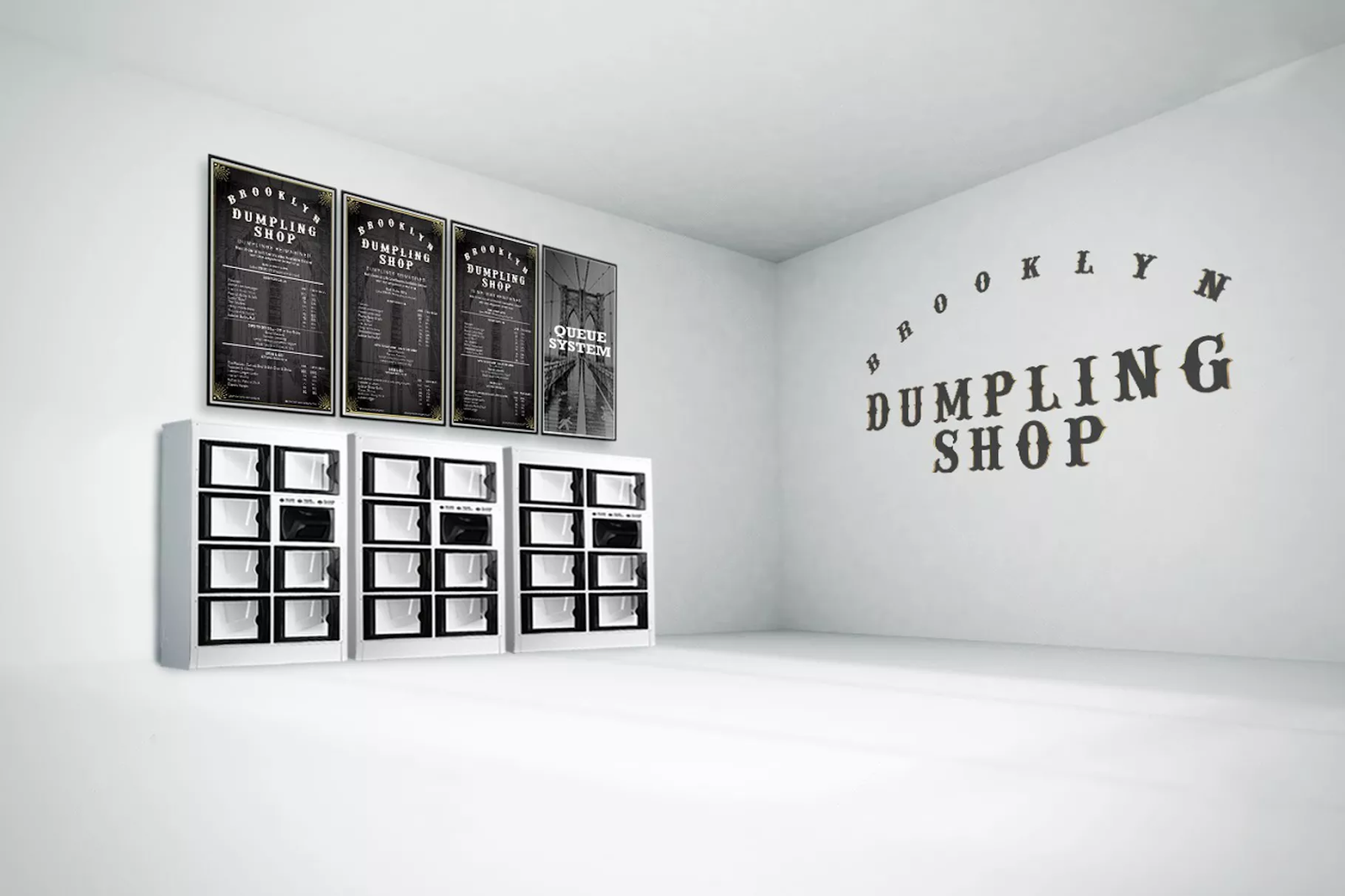
Not a new concept in any way, but one that is seeing an increase in popularity since the start of the pandemic. Popular in the 1920s, automats are seeing a resurgence as people don’t want to spend too much time indoors. Restaurants like Boston Dumpling Shop have since taken this technology and enhanced it by incorporating different temperature settings in its pickup lockers for the most optimal storage. To further avoid unnecessary contact, customers continuously receive text updates about their order and scan their phone to access their food.
Influencer collaborations
Dunkin Donuts have tapped into social media virality and enlisted the TikTok influencer, Charli D’Amelio, as a partner and added her custom iced beverage to their nationwide menu for a limited time. As well as a custom beverage, Charli D’Amelio is launching a TikTok dance contest for best choreography performed to an original song produced by Dunkin Donuts.
(Pic Source: Jerritt Clark / Courtesy of McDonald’s Corporation)
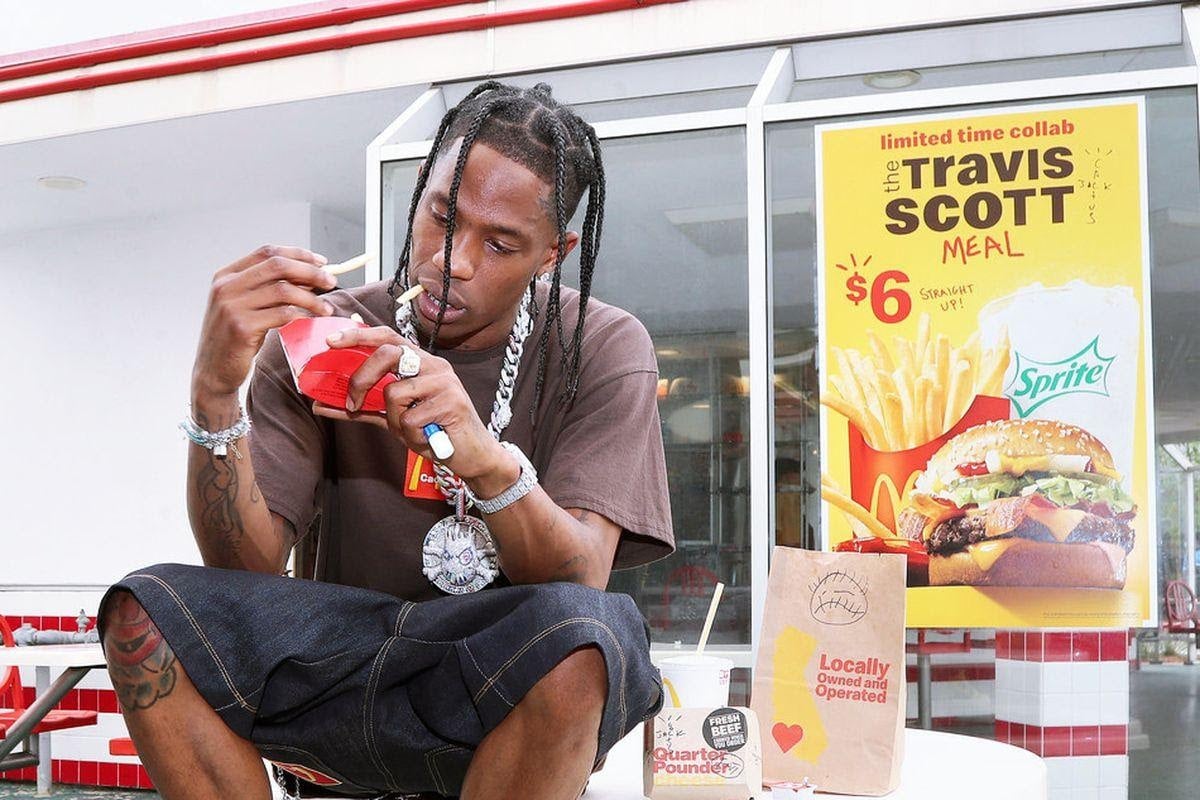
Perhaps the biggest news in fast food recently is McDonald’s first celebrity collaboration in almost 30 years. Fully embracing the hype, like they did with Michael Jordan and Chicago Bulls back in 1992, McDonald’s have partnered up with Travis Scott in a new marketing ploy to release the “Travis Scott Meal”. Despite only including a Quarter Pounder, fries, BBQ sauce and a Sprite, the fast food titan is running out of ingredients in locations where the popular meal is currently being sold.
McDonald’s clearly demonstrates that scoring the right collaboration can soar your sales without altering your operations in any substantial way.
DIY kits
Perhaps one of the largest changes within the industry is restaurants doubling down on delivery services. With eat-in being completely off the table, or vastly limited, a new kind of experience has emerged, which entails recreating your favourite dishes in the comfort of your home.
A popular example is the Pizza Pilgrims Frying Pan Pizza DIY kit that basically flies off the shelf. All you need is a frying pan and an oven and you’ll whip up fresh, delicious pizza in no time.
Red Velvet NYC offers subscription-based deliveries for those who want to make beautiful, Pinterest-worthy desserts at home. Delivery boxes are sent bimonthly and come with a wide range of allergy-sensitive recipes, ingredients and all the necessary tools you need to bake them.
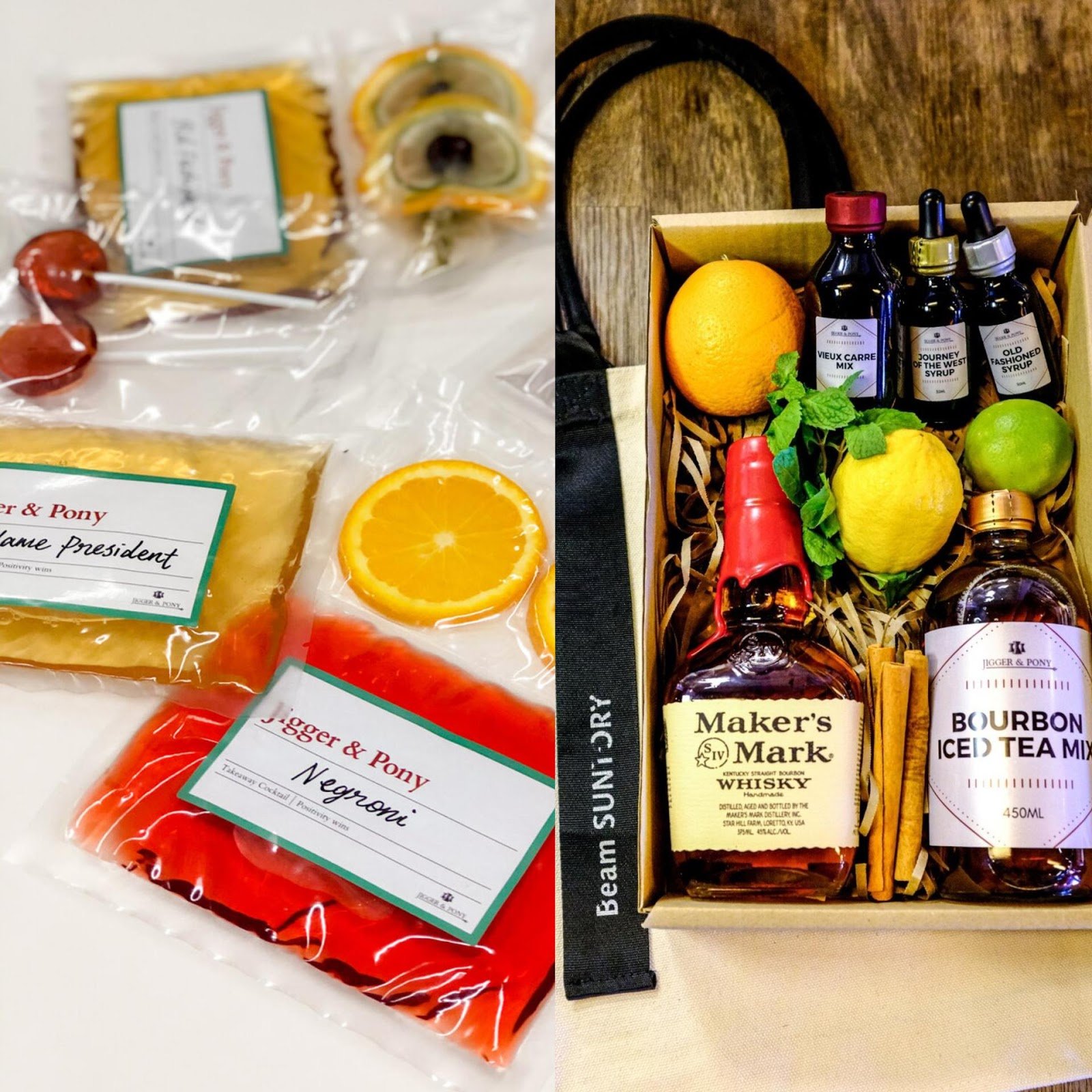
(Pic source: Jigger & Pony)
DIY cocktail delivery service offered by the #1 voted bar in Asia, Jigger & Pony, caters to everyone. From classics with a modern twist, to their signature, award-winning cocktails, Jigger & Pony menu features 24 cocktails and is exactly what you need to spice up a house or a dinner party. You can hear all about how founder Indra Kantono set up and grew the service on our podcast In the soup.
Creative social distancing measures
Even though most innovations allow businesses to continue their operation and ensure safe consumption, they sadly take away from the dine-in experience as they keep the human interaction to a bare minimum. However, some innovations have emerged that manage to adapt the eat-in experience to adhere with social distancing requirements, all while keeping enjoyment of dining out.
A Dutch plant-based restaurant, ETEN, offers a more intimate solution to social distancing by creating private greenhouses where guests can enjoy a 4-course, corona-proof meal. Guests are able to choose between a two- or four-person greenhouse with their dinner being served using long wooden boards to eliminate the possibility of contracting the virus.
Some restaurants definitely saw the new norm as an opportunity to elevate the guest experience amid the social distancing restrictions. Not only did Bar B Q Plaza in Bangkok use their mascot as a social distancing barrier, but also to defuse the tension surrounding the pandemic and keep their guests entertained.
A similar approach was taken by a cafe in Izu Shaboten zoo in Japan by strategically placing stuffed capybaras to keep guests entertained while ensuring they are at a safe distance from each other. Not only does this make the regulations seem less strict and reduce the risk of spread, but this genuinely became a highlight for people that stepped out to eat for the first time in months.
Ghost kitchens
One trend that has been supercharged by the pandemic is the emergence of ghost kitchens. While eat-in restaurants have had to reduce their number of employees, ghost kitchens have had to hire by the thousands as the demand for virtual eateries and delivery restaurants surged. This trend has given a boost to companies like TiffinLabs, which specialise in converting underused real estate into efficient, delivery-enabled kitchens. Needing only 19-28 m2 of space, ghost kitchens are probably the most sought after revenue stream, the value of which is set to become a $1 trillion global market by 2030, Euromonitor reports.
Conclusion
It’s been great to see so many restaurant businesses hustling during these past six months. Clearly, this hasn’t been an easy or simple time for anyone, but this innovation certainly shows that restaurants aren’t going anywhere, but the way we interact with them has definitely changed and perhaps for the better.
If you’d like some additional insight on what restaurants should be prioritising when surviving in the new normal, we recommend you to read the expert recommendations in our new restaurant playbook blog here.
We’d also like to hear your thoughts on how you think the restaurant industry will be further developing. Feel free to message us on any one of our social media accounts:
The post The Future of Restaurants: Innovation Born of a Pandemic appeared first on Tenzo.
]]>By now we all know that the hospitality industry was one of the hardest hit sectors by Covid-19. Over 80% of restaurants had to close their doors in March when the national lockdown was put in place. They were eventually allowed to reopen on July 4th with safety measures in place, including a ‘one-metre plus’ […]
The post Eat Out to Help Out: A Summary of the Last Month in Restaurants appeared first on Tenzo.
]]>By now we all know that the hospitality industry was one of the hardest hit sectors by Covid-19. Over 80% of restaurants had to close their doors in March when the national lockdown was put in place. They were eventually allowed to reopen on July 4th with safety measures in place, including a ‘one-metre plus’ rule for social distancing, but after three and a half months in lockdown, a new problem had arisen. Customers no longer felt confident heading out to eat. To try to kickstart the third largest industry in the UK after months of closure the ‘Eat Out to Help Out’ scheme was put forward by the chancellor. The government would pay 50% of the price of food and soft drinks up to £10 per customer. The scheme would encourage Brits to feel safe going back to restaurants and give a much-needed boost to the industry.
As we look back at the month, we can now say: it was a definite success. According to the government website, 100 million meals had been claimed in throughout the scheme. Bookings in cities became near impossible to get Monday through Wednesday, with more and more people wanting to take advantage of the discount. But just how much did the scheme affect sales numbers after months of negative year-on-year sales growth? Below we break down Tenzo data for the duration of the scheme.
Like-for-like sales soar Monday through Wednesday, but regress at the weekend
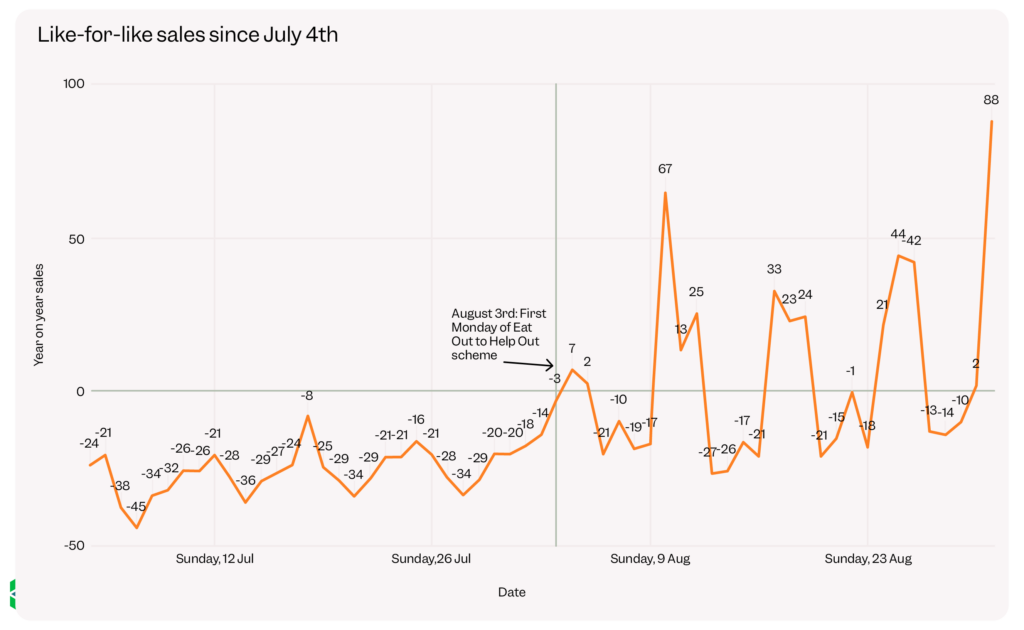
The graph above shows daily like-for-like sales since July 4th, the first day restaurants in England were allowed to reopen for dine-in customers. Throughout the month of July restaurants are operating at an average of -20% year-on-year. However, as the scheme comes into effect in August, sales numbers begin to shoot up Monday through Wednesday. The first week begins gradually with sales showing positive growth for the first time since reopening, but it’s really in week 2 that it all takes off.
The hot weather and a lack of increasing virus cases clearly gave people the confidence to go take advantage of restaurants and newly constructed outdoor seating areas. While sales were still not back to last year’s highs Thursday through Sunday, it’s clear that people got their taste for restaurants back as sales have steadily been increasing over the weekends as well.
Interestingly, sales appear to be up no matter what part of the day you look at, meaning that people working from home have perhaps ventured to have lunch out midweek using the scheme. If we see this trend continue through September this could actually be a replacement for all the business lost in city centres due to continued working from home.
Finally, the last day of the scheme being the Bank Holiday also meant that it ended with a big bang. On average, Tenzo businesses were up 88% as compared to last year, a monumental way to bring everything to a close.
Only 70% of businesses open compared to pre-pandemic times
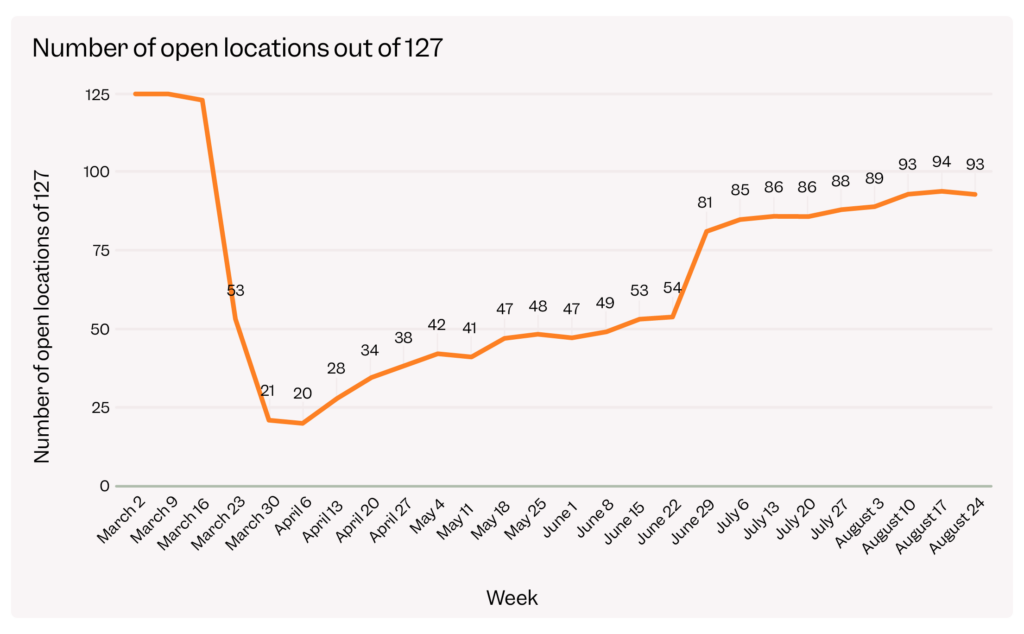
Despite restaurants being allowed to reopen 2 months ago, only 70% of locations have begun trading again since July 4th. While it’s true that some of these outlets have closed permanently, the majority of closed locations belong to groups who are operating most of their restaurants, but who are leaving a select few restaurants closed for the time being. This could be due to severely reduced foot traffic in business centres such as The City in London and a lack of commuters and after work food and drink. It remains to be seen whether these locations open this year or close permanently.
Good news for weekly like-for-like sales
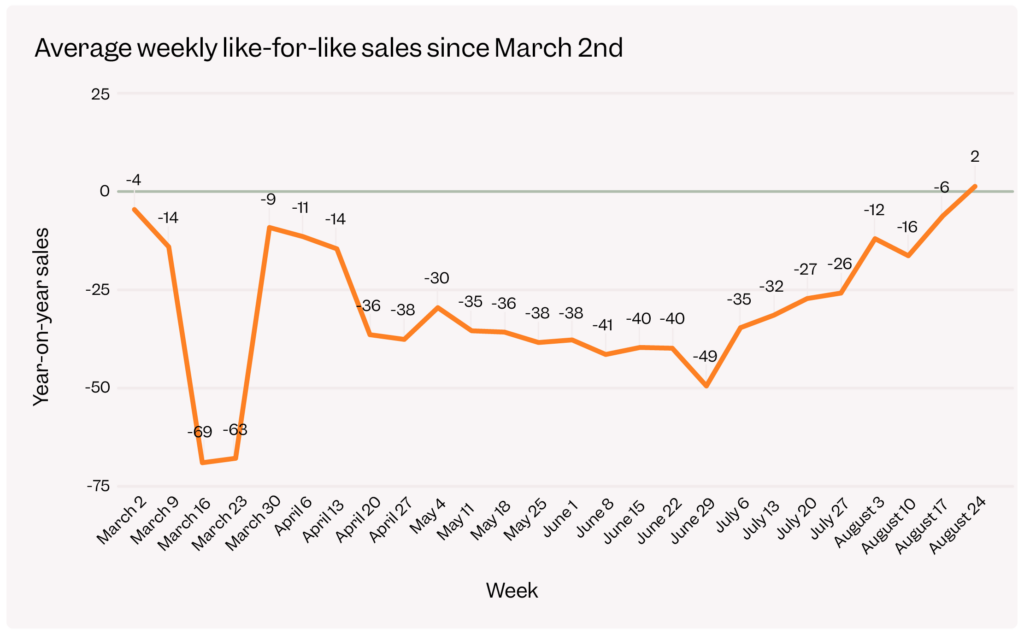
The good news is that the Eat Out to Help Out scheme has pushed weekly industry sales into positive growth for the first time since February, a true mark of success. The numbers for the week of August 24th hover at around 2% year-on-year growth, and hopefully this shows that there is hope yet for the industry to land back on its feet after months of uncertainty.
With the scheme now officially ended, it will be interesting to see how sales continue into September. Will sales fall back to July levels? And how will the businesses who are continuing the scheme on their own dime fare? Needless to say we’re in for a very intriguing September with rent moratoriums up and furlough coming to an end. Check back as we continue to report on data coming in over the next few months.
How have you found the last two months? If you’d like to discuss future plans and your tech stack, feel free to reach out to [email protected].
The post Eat Out to Help Out: A Summary of the Last Month in Restaurants appeared first on Tenzo.
]]>Restaurants, bars, pubs and cafes in the UK were given the official go-ahead to reopen for dine-in business on July 4th. Since then, Tenzo has been tracking restaurant reopening data as well as like-for-like sales of the industry as a whole. Below we break down our findings so far. 69% of restaurants have reopened We’ve […]
The post Restaurant Reopening Data: The First Four Weeks Back appeared first on Tenzo.
]]>Restaurants, bars, pubs and cafes in the UK were given the official go-ahead to reopen for dine-in business on July 4th. Since then, Tenzo has been tracking restaurant reopening data as well as like-for-like sales of the industry as a whole. Below we break down our findings so far.
69% of restaurants have reopened
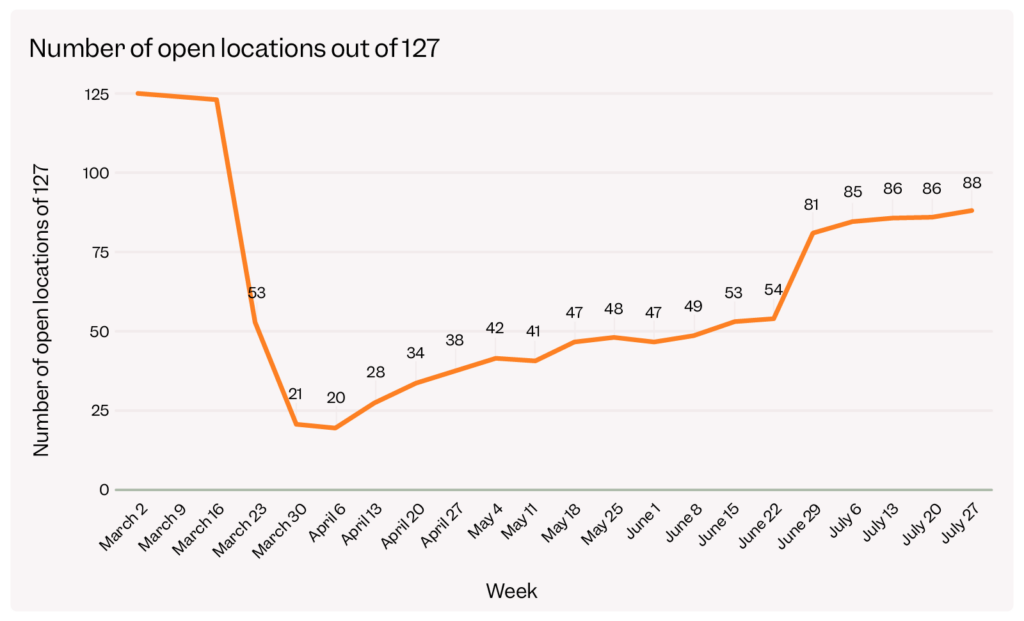
We’ve been tracking 127 restaurant locations that represent the broader industry since March 2nd. At its lowest, only 20 of the locations had their doors open but the number has been steadily increasing throughout the lockdown period. There was of course a big jump the week of June 29th, which included the first Saturday back. This shows that approximately 69% of locations have now reopened – consistent with reopening patterns all over the world.
Like-for-like sales hover around -30%
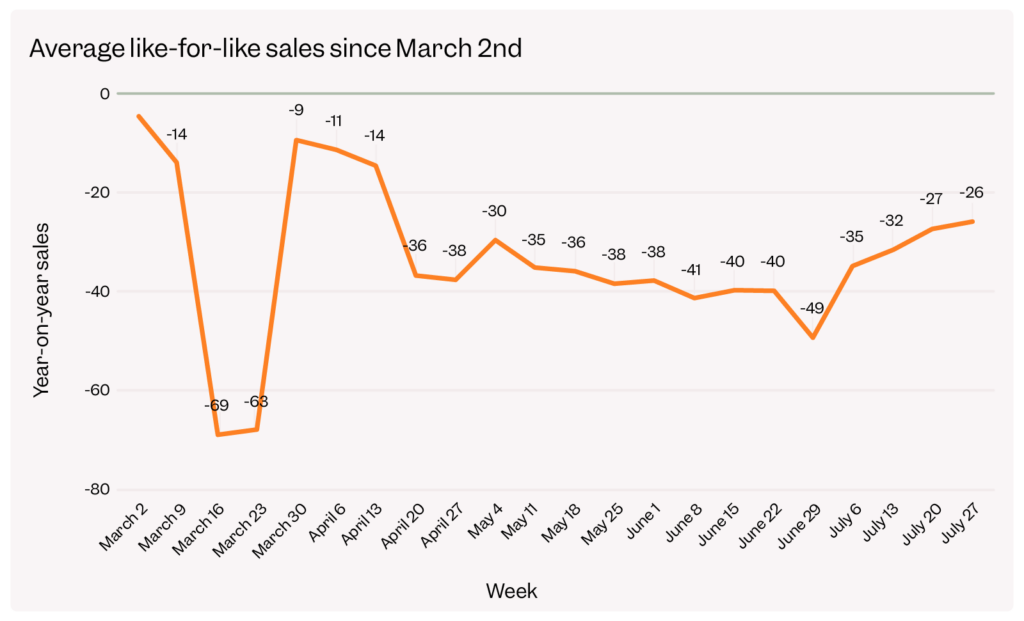
When it comes to like-for-like sales, we saw sales drop down to almost -70% year-on-year when the lockdown first came into effect. However, those that were able to remain open actually didn’t take too much of a hit to begin with as their omni-channel strategies were already in place. We see those like-for-likes fall again as more restaurants reopened and tested out a delivery and takeaway driven business model for the first time. Since reopening, we’ve seen sales hover around the -30% mark, with gradual improvement week-to-week.
We’ve also seen that around 20% of reopened restaurants have chosen not to open at the beginning of the week, and instead are only getting staff in during the traditionally busier end-of-week/weekend opening hours. It will be very interesting to see how the Eat Out to Help Out scheme changes this. Just one day in, and we’re already seeing successes across multiple businesses with more tables booked and more customers coming in to eat.
Conclusions
Numbers are looking promising as more and more people find the confidence to go out and eat again. Hopefully the Eat Out to Help Out scheme encourages more people to take part in hospitality and support as many businesses as possible.
If you would like to find out even more information about reopening, make sure to tune in to Planday’s webinar on August 11th at 3pm BST. Register here!
The post Restaurant Reopening Data: The First Four Weeks Back appeared first on Tenzo.
]]>