This post will run you through everything you need to know in order to forecast your sales more accurately than 90% of other restaurants. The guide includes: Let’s jump in with the reasons to care… Why improve your restaurant sales forecasting methods? When it comes to predicting sales, restaurateurs may be tempted to rely on […]
The post Sales Forecasting Methods: A Comprehensive Guide For Restaurants appeared first on Tenzo.
]]>This post will run you through everything you need to know in order to forecast your sales more accurately than 90% of other restaurants.
The guide includes:
- The reasons you should improve your forecasting accuracy.
- Sales forecasting techniques including a four-week rolling average.
- How to adjust that forecast and improve accuracy.
- How to create a forecasting model in your business: when, where, and who?
- How Tenzo creates hyper-accurate forecasts using machine-learning to give you the best restaurant sales forecasting tool.
Let’s jump in with the reasons to care…
Why improve your restaurant sales forecasting methods?
When it comes to predicting sales, restaurateurs may be tempted to rely on a crystal ball to tell them what’s what. But when scrying doesn’t work and you end up with an inaccurate forecast, the results can be extremely damaging in an industry of very narrow-margins.
Inaccurate forecasts can lead to:
- Understaffing resulting in negative reviews (understaffing is the #1 cause of negative reviews)
- Overstaffing, and wasting money on staff who don’t need to be there.
- Staff being sent home early or called in on their day off
- Increased employee turnover
- Over-ordering stock creating increased food waste
- Over-prepping, a waste of both food and time.
- Running out of key menu items, making customers unhappy
Forecasting is invaluable for restaurants. Without a good estimate of sales to be made, stocking and prepping inventory and scheduling staff becomes a real nightmare. Adequate staffing levels usually equals happy customers who write good reviews and leave excellent ratings – the returning customers, great reviews, and word of mouth are the foundations of a successful business.
Of course, talented and experienced GMs who know their restaurant like the back of their hand are able to forecast to a certain degree of accuracy.
However, extremely accurate restaurant sales forecasting is often assumed to be near-impossible and the inability to foresee sales in advance can occasionally unravel the most buttoned-up general manager. But have no fear! There is a way to predict your sales without resorting to fortune-telling, and we’re here to tell you how.
What is restaurant forecasting?
Traditional restaurant sales forecasting involves looking at past sales and predicting future sales based on the information collected. Once you have an idea of a sales forecast for a certain day of the week, you are able to plan all of your variable costs around it. These include inventory ordering, food prep and staff scheduling.
Tenzo automatically creates these sales forecasts for our customers using machine learning. However, there is an analogue method of creating a restaurant forecast if the AI version sounds too Black Mirror. The most common way of doing this is referred to as a rolling four-week average.
Rolling four-week-average sales forecasting technique
What is a rolling four-week average?
By taking data from the last four weeks (or three or five weeks, but four is most common), you are able to create a 4-week average that can give you an idea of sales for the upcoming week. Your forecast for Monday, for example, would be the average sales for the past 4 Mondays. Simple as that.
Adjusting your basic four-week average

Of course, it is important to take into account any abnormalities in the data, such as events or holidays that might skew your sales forecast, and adjust your projections accordingly. Bank holidays, for example, may increase your sales on certain Mondays or half-term may result in an amazing week for sales.
Be careful to remove any bank holidays or other exceptional days from your 4-week average when forecasting ahead. If these inflated sales figures are included when calculating the next forecast, you will overestimate your next week’s sales and over-order inventory or schedule too many staff. Your four-week average should be an average of the last four “ordinary” weeks to ensure an accurate baseline.
Taking weather and the seasons into account
Weather can also have a huge effect on restaurant forecasts. Many restaurants, for example, report that when snow is on the horizon, the number of cancelled reservations seriously increases, and vice versa when fair weather is expected. So knowing how certain weather conditions affect your restaurant can be invaluable when creating your forecast, and something to definitely keep in mind.
Bear in mind that weather forecasts are only accurate in the short term, so keep an eye on the forecast to see if your staff schedule needs any last-minute amendments.
Additionally, seasonal changes can also affect how accurate your sales predictions are. The rollover into winter, for example, may see more evening visits and hot drink sales that could bump up overall revenue. If this is the case for your restaurant, it can be helpful to look at past sales patterns for that time of the year so you can apply that knowledge to your forecasts.
Other factors to consider
Furthermore, events going on nearby can also increase footfall to restaurants, whether that’s a concert, a sporting event or even a pop-up shop that has generated more interest in your area. Food is always a high priority whenever large groups of people congregate, so knowing to expect more traffic is key to capitalising on the rise in customers.
Another important thing to consider is your own promotions. When you run a promotional campaign your footfall will hopefully rise. You’ll need more staff and inventory to keep up with higher customer demand but you’ll need to make sure that higher labour and food costs don’t eat into profits. These aspects of the promotion need to be considered carefully beforehand so that you’re sure not to run out of stock or have too few people working.

Most importantly, you know your restaurant best – if you know that certain occurrences affect sales, then there should be an allowance for these in your forecast. This is where gut-feeling comes most into play and experience is key. A seasoned GM should be able to make adjustments almost instinctively to a rolling-average baseline.
When is the best time for your restaurant to implement forecasting?
Where should forecasting be implemented?
Every restaurant should have some idea of the sales they will make on any given day. When first starting off, this may have to be ‘gut’ driven but as soon as you have reliable historical data built up, you can somewhat accurately start predicting sales manually.
When should forecasting be implemented?
When you’ve just opened your first restaurant, forecasting is extremely difficult as you haven’t got a data store to pull from. This is a time of trial and error, but as soon as you’ve gathered enough data, you should be forecasting.
Tenzo’s AI engine can start forecasting reasonably accurately with a mere ninety days of data, but is most accurate with access to two year’s worth of data, as key factors such as seasonality and annual event trends can be identified and applied.
Who should have access to forecasting data?
For larger operations, head office should have access to restaurant forecasts to ensure that GMs are accurately scheduling labour and ordering/prepping ingredients.They will also want to know what the overall sales forecast is for the entire business to make sure it aligns with financial plans.
But it’s the GMs who need the information most so they can successfully staff their locations and order in the right amount of inventory. Having access to an accurate forecast allows them to make last minute changes that increase profitability overall, such as sending a staff member home early or creating a special to offload stock that would go off before being ordered.
The GMs are the people on the ground and most likely to know if some kind of disruption to service will be caused – whether by an event, unforeseen weather or building work on the road outside. A key feature of Tenzo’s AI sales forecasts is the capability for GMs to make adjustments to our extremely accurate baseline based on their own knowledge and expertise.
So how does Tenzo’s AI sales forecasting work?
Machine-learning allows Tenzo to take into account many more factors and millions of more data points when building a forecast than a human forecaster could.
- Step 1: Tenzo amasses your entire historical sales data and with that is able to build a fairly accurate baseline, far better than a four week average (and we’re only at step 1!). This baseline incorporates your overall growth trend, as well as daily, weekly, monthly, and seasonal patterns.
- Step 2: Secondly, Tenzo uses our AI forecasting engine to understand how historical weather and events such as Christmas, Valentine’s day, and other holidays, have impacted your business.
- Step 3: Armed with a full understanding of how past events have affected sales performance, the algorithm can forecast future sales based on what it has learnt. The final layer of data needed is the weather forecast and a detailed schedule of forthcoming events.
- Step 4: Our forecasts are delivered to GMs 1-2 weeks before the date, giving them plenty of time to prepare. They are updated in real-time if the weather forecasts change. GMs can also make adjustments to the forecasts based on things that only they know – this combination of human intuition and machine baseline is by far the most accurate approach available today.
Exactly how accurate are Tenzo’s forecasts?
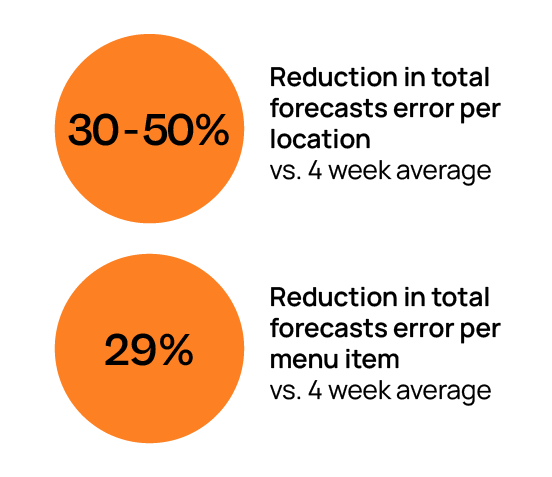
Tenzo’s forecasts typically reduce forecasting error by 30-50% as compared to traditional four-week averages.
With the ability to process so much data, Tenzo can also achieve the holy-grail of forecasting: item-level forecasts. This means forecasts of how many of a specific menu-item a store will sell.
When it comes to individual item forecasting, Tenzo reduces forecasting errors by 29%. Used well, this can mean a huge reduction in overall food waste.
Moreover, Tenzo doesn’t just give you a general forecast for the day like a four-week average would, but instead forecasts each hour-long interval. This allows restaurateurs to schedule the right amount of staff for the exact shift-times that they are most needed for.
Using machine learning and an accurate baseline, Tenzo can give you an accurate forecast up to 21 days in advance, taking into account historical data, weather patterns, holidays and custom events.
Benefits of a Tenzo forecast
Better labour schedules
Tenzo’s accurate forecasting allows restaurateurs to make decisions that are backed up by data. This means that when they schedule in staff for the coming week, they are much more likely to have the right amount of people working.
And when staff numbers are right, many benefits to your business follow. Staff can put all of their efforts into pleasing customers, generating good reviews for your business. Plus, having a well-oiled staff plan reduces workplace stress, therefore increasing staff retention levels. In an industry where turnover is so high, this can be a major competitive advantage.
When you’re able to match your labour force to predicted sales with an AI forecasting tool like Tenzo, you can reduce your overall labour bills. In fact, Tenzo users have seen a 5-10% reduction in labour costs.
Efficient inventory ordering and prepping
Beyond labour, an accurate forecast means more accurate inventory ordering. Many restaurants rely on the previous week’s sales when reordering inventory without considering external forces that may change demand. For example, is the sun coming out after weeks of rain? Your lighter meals and drinks may be more popular than the heavier comfort foods that people gravitate to when it’s grey outside.
When you have an AI forecast that warns you about changing conditions, less inventory will be thrown away. And with food waste contributing so negatively to the environment, this is something we should all be thinking about. Plus, less waste means a reduction in cost of goods sold. A Tenzo customer can expect their COGS to be reduced by anywhere from 2 to 8%.
General Managers will find that Tenzo takes the guesswork out of their job, allowing them to solve problems before they even come to fruition. They are better equipped to handle their budgets in the most efficient manner, saving money in the short and long term. And fewer surprises day to day means that everything can be planned in advance and checked over, leaving less room for costly human error.
Conclusion
Implementing a solid forecasting process in your business will give you a major competitive advantage – in our professional experience, very few restaurant business have good forecasting processes (even the big boys).
Forecasting itself makes the life of the restaurateur a little less frenetic, but using a tool like Tenzo? Life is positively peachy. Tenzo takes the stress out of decision-making because you know that all recommendations are backed up by cold hard data. Still not convinced? Request a demo now!
The post Sales Forecasting Methods: A Comprehensive Guide For Restaurants appeared first on Tenzo.
]]>This is the first of what is intended to be a 3 part series on how to get quality forecasts. We’d love your feedback; have a read on the impact of weather and restaurant sales below! At Tenzo we’ve spent a lot of time thinking about how to forecast accurately and wanted to share a couple […]
The post Weather and Restaurant Sales | What is the impact? appeared first on Tenzo.
]]>This is the first of what is intended to be a 3 part series on how to get quality forecasts. We’d love your feedback; have a read on the impact of weather and restaurant sales below!
At Tenzo we’ve spent a lot of time thinking about how to forecast accurately and wanted to share a couple of the key insights. Typically we have found:
- A smart forecasting algorithm can out-perform a store manager in the long run by 25–50%, but it might miss short term events (e.g., roadworks, staff shortage) that only a manager may know about
- Weather and events are a critical element in improving a typical forecast
- Rain affects sales, but after a certain amount of rain the impact diminishes. Extreme temperatures (vs. normal for the season) are what cause significant deviations in sales.
How do we think about the impact of machine learning?
The below chart compares a 4-week rolling average (e.g., the last 4 Mondays) to a machine learning generated forecast. We typically find a 4-week average this is the best a good manager can do given their memory for events.
MAPE, for a 4-week average forecast vs. a machine learning generated forecast
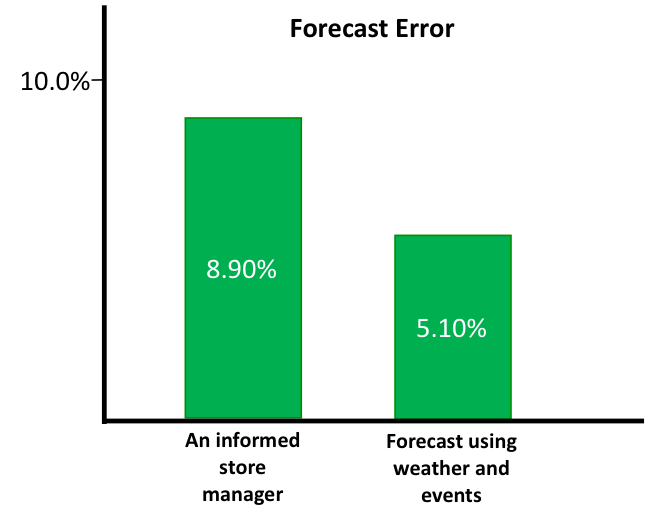
As you can see — the computer wins overall. There may be days when a manager knows something the computer does not, but overall results tend to this.
Now, let’s look at a chart showing how rain impacts sales for a given location.:
Daily sales variance per mm of rain
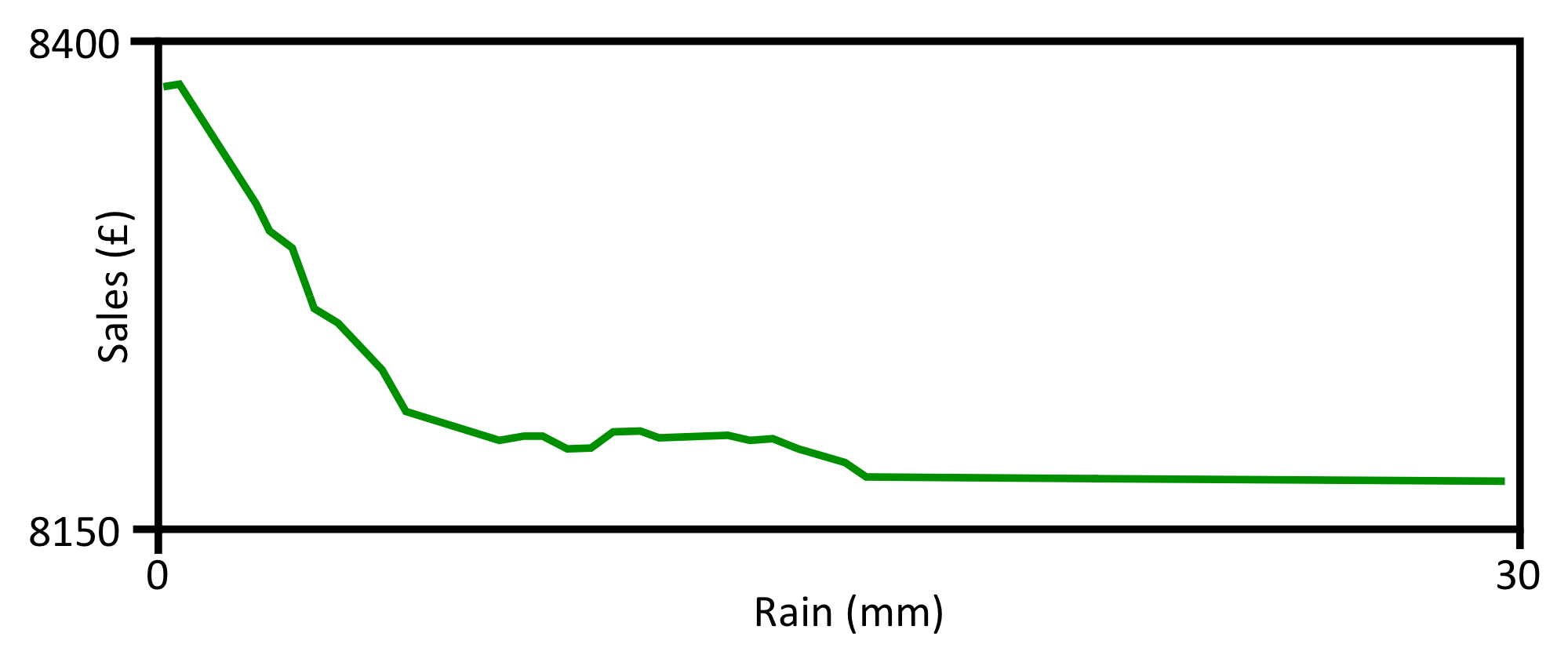
The result is clear — when it start to rain, sales drop-off, but beyond a certain point — people are no longer driven by the rain.
Now, let’s look at temperature:
Daily sales variance per degree of temperature (celsius)
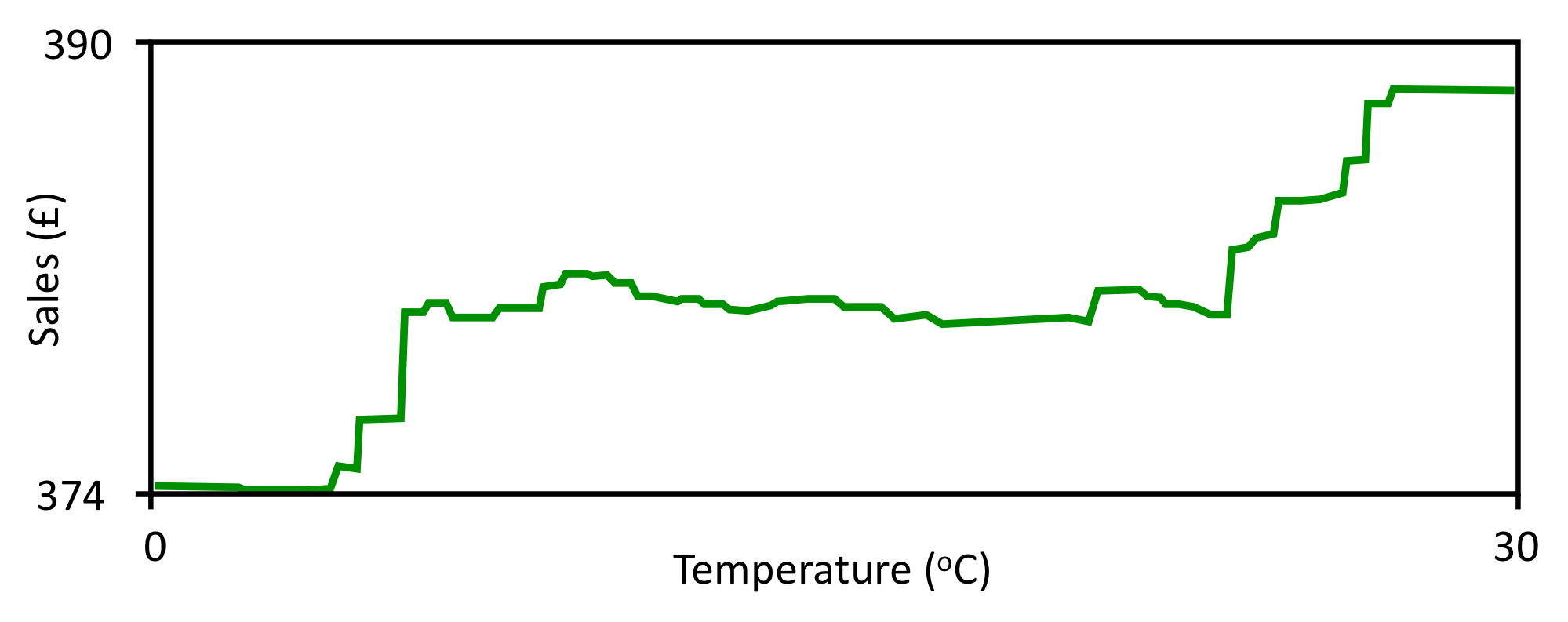
Interestingly — this chart is looking at a day in July. A big portion of temperature will be captured in the normal seasonality (which any computer based forecasting system should capture). However, what becomes apparent is how it’s all about extremes — if the day is unseasonably warm or cold it will dramatically affect sales up to a point.
Note: importantly all of these results will be dependent on the specific location, brand and type of business. That’s why you need a machine!
Thanks for reading, we hope we’ve shown:
- How weather can be an important factor for your business
- The kind of dramatic improvement you can get by looking at it
- How a computer can outperform a typical location manager
The post Weather and Restaurant Sales | What is the impact? appeared first on Tenzo.
]]>Automation, and technology as a whole, has not always been readily accepted in the restaurant industry. The reason for this is pretty clear, successful restaurateurs have long relied on their own intuition to make decisions, a method that has worked well in the past. However, technological tools can build on this intuition making for much […]
The post Automation in the restaurant industry: the ultimate playbook appeared first on Tenzo.
]]>Automation, and technology as a whole, has not always been readily accepted in the restaurant industry. The reason for this is pretty clear, successful restaurateurs have long relied on their own intuition to make decisions, a method that has worked well in the past. However, technological tools can build on this intuition making for much faster decision-making. In turn, automating these processes frees up brain space and, most importantly, time that restaurateurs can use to focus on actually running their restaurants.
The term automation might bring up thoughts of robots and human-free environments, but those ideas belong in the world of science-fiction, not in restaurants. Automating your processes is simply a way of making everyone in the business more efficient; tools that enable you and your staff to do their jobs better. Plus, the reality is you most likely already have the systems you need to automate in place, meaning no need for huge infrastructure overhauls. Additionally, now that reopening in the UK is just days away, automating these processes will allow you to make essential business decisions quickly as we learn more about demand in a post-Covid world.
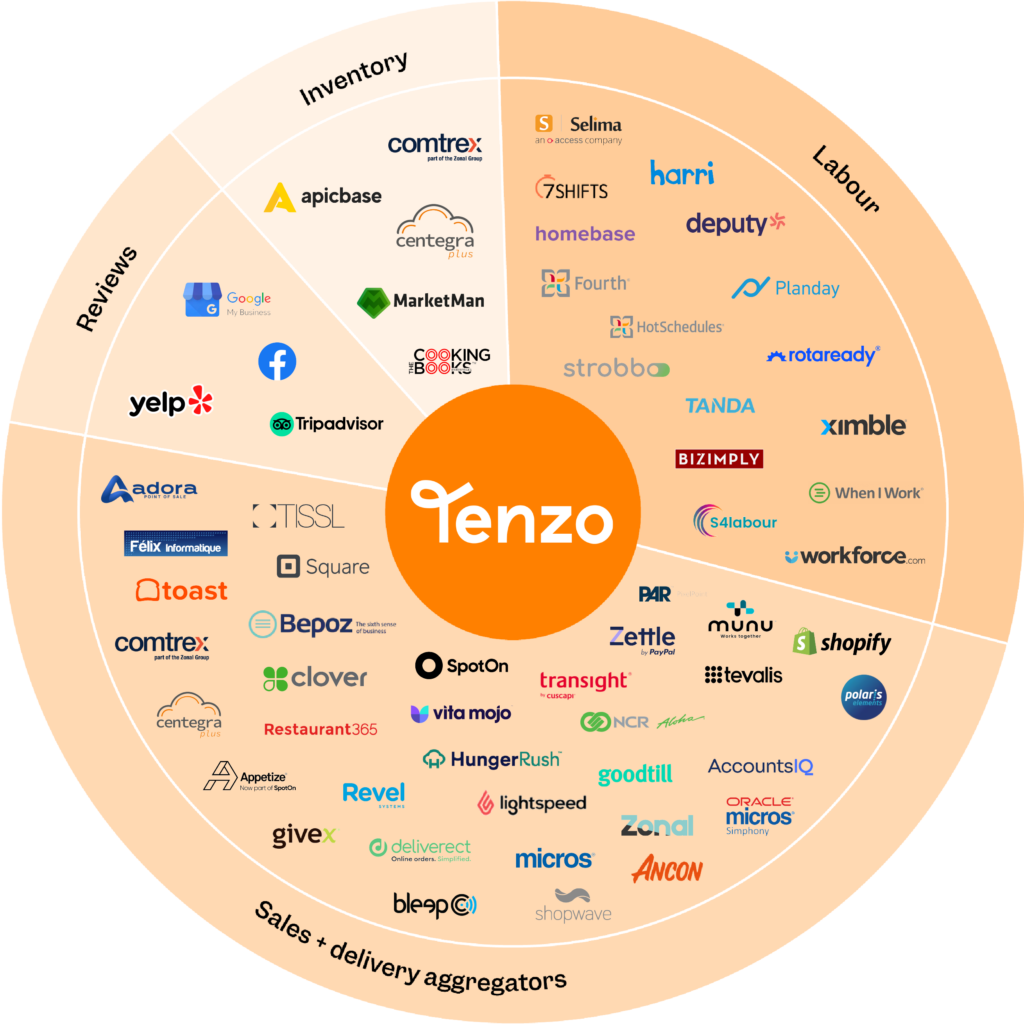
Just a few examples of the systems we integrate with. Our full list of integrations can be found here.
Sales
POS
The last three months have seen a fundamental shift in the way that people consume food. Delivery has obviously been a growing trend throughout the last few years, but pre-Covid, restaurants could still heavily rely on dine-in customers if delivery wasn’t something they wanted to look into. This is no longer the case. Consumers now rely on multiple different channels to get their food, whether it’s delivery from a delivery marketplace (e.g. Deliveroo), delivery from a restaurant’s own app, click and collect, or orders from an online store. With so many different channels, keeping track of sales manually can be a total nightmare with an abundance of iPads, not to mention that one wrong entry can throw off your data for a whole day.
This is where using programmes that integrate with your POS is life saving. Firstly, setting yourself up with an online ordering aggregator that funnels all delivery orders automatically into your POS will relieve a lot of that stress. Companies like Itsacheckmate and Deliverect will take your orders from Deliveroo, Just Eat, UberEats, etc and put them all in one place so you can easily track which marketplace is sending you the most orders and seeing where the highest spends some from. However, likelihood is that you also want a company-branded web page or app that allows you to circumvent the huge fees these delivery platforms charge. Slerp, Loke and Flipdish are the answer here and a big plus is that they also integrate with POSs.
As restaurants start to reopen you might also be considering new ways of taking orders to limit human contact. That could be through using a mobile ordering platform like Wi-5 that allows customers to peruse the menu and order directly from their mobile phones, limiting the need for communal menus and enabling social distancing between customers and waiters and also sends the order straight to your point of sale. We’ve also seen an increase in kiosks that allow for contact-free ordering. In quick service, kiosks may actually be the ultimate answer: no need for contact, easily disinfected, and studies show that people spend more on average at kiosks because there’s less embarrassment than when ordering from a person.
Another big trend we’ve seen come out of the lockdown period is sending out DIY kits and branded items from an online store. As this is also revenue for your restaurant it would make sense to see it as part of your overall sales data, so that you’re able to analyse and compare it. Using a programme such as Shopify will make these online transactions easy and simple for both you and your customers so all you need to worry about is producing the goods.
Accountancy
Gone are the days of manually inputting your sales into accounting software. You can automate your Point of Sale accounting using platforms such as SHOGO. This means that your sales get inputted into your accounting system (eg Xero) daily. You can map the data from your POS into Xero so that it is a fully automated process, removing the need for manual data entry.
A common name you’ll see throughout this blog will be Zapier. What Zapier allows you to do is to push any data from one of its integrated apps to any of the other (over a thousand) integration partners. In terms of accounting, this could mean sending all the data in a reporting platform that aggregates all your sales (e.g. Tenzo) into any of the accounting apps it has in its arsenal, allowing you to choose whichever system works best for you.
Labour
When it comes to staff, schedules can often be based on whatever they were the previous week. What this inevitably leads to is under- or overstaffing due to changing circumstances week to week. What schedules should really be based off is your predicted sales for any given day. Tenzo uses AI to forecast your sales up to three weeks in advance and then uses this information to create the optimum staff schedule. This reduces employee stress as they are never run off their feet from an unexpected rush and management are happy as the cost of labour never exceeds acceptable levels.
Once you have this automated schedule, you can use Zapier to push it through to any of its labour planner apps including Deputy, WhenIWork and Tanda. This means everything is in one place, no switching between apps to make sure you’ve got the right amount of hours scheduled and you know that your schedule is based on cold hard data.
Automation in the staff scheduler world can actually go as far as auto-scheduling individual staff members. Planday has this very option. This is an amazing tool if you know that your staff all work well together, but just remember that human intuition isn’t something that can be replicated by computers so it’s always worth having a quick look over your schedules if you know that certain team members work best together to make sure they’re scheduled at the same time.
And don’t forget to take advantage of the integrations your staff scheduler may have. The likelihood is that they integrate with your payroll provider – see Deputy’s integrations here – meaning that shifts and hours worked automatically get sent to your payroll system to make payday a far easier and less manually demanding experience.
Inventory
Managing your inventory is something I’m sure many restaurateurs wished was a lot faster, and while there are no real ways to cut corners when it comes to stock takes and the like, there are ways to speed up certain processes. One such way is Marketman’s genius Snap Expense Tracking. Instead of manually inputting all items and prices into the platform, simply take a picture of your invoice on your smartphone and it will automatically be uploaded, taking out a lot of the grunt work.
Another way of making your inventory management more efficient is by optimising what you buy in the first place reducing waste and the cost of uneaten food. This can be done using dynamic par levels for ordering as opposed to static ones. Static par ordering is when ordering is done to make up a fixed number of items, this would mean that you decide to always have, say, 60 chickens on hand and you reorder each week based on how many you need to make up that number. Dynamic par levels, on the other hand, take future demand into account. If you can forecast your sales at an item-level, you know that while last week you needed 60 chickens, this week you only need 20 because the demand will be different based on other factors such as weather or specific events. This means that you’ll always have the right amount in stock and reduce your waste.
If you can forecast at an item-level, you should also be able to forecast at hourly, half-hourly or even quarter-hourly intervals. This means that you know what to cook and when. Taking the chicken example further, it could tell you how many to put on the grill at 11am, 11:30 or at noon. Even having an idea of demand for the day as a whole can be hugely beneficial when it comes to prepping the right amount of food to get you through service, but not over-prepping so you don’t end up throwing away what you haven’t sold. Being able to send all of this information to the kitchen on a tablet can be the difference between a stressed kitchen and one that operates smoothly with everyone knowing what’s going on.
Finance
The great divide between restaurant finance teams and restaurant operations teams seems to be Excel. In short, the finance teams love it, the ops teams hate it. The question is how to bridge the two. Using a platform like Tenzo satisfies both. We make it easy for ops teams to see the data and reports that they want without needing to do any manual Excel work. Finance teams can always download CSVs of reports that they want to do further comparison on, but they don’t have to.
Tenzo sends automated flash P&Ls on a monthly or weekly basis. Because we connect your POS, labour scheduler and inventory tool, we can send you the gross profit numbers easily and regularly without the manual work that using different systems used to require. Using Tenzo also allows you to have personalised reports sent straight to you, to give you a 360 degree view of your business. We can send you these P&Ls based on brand (if you’re running multiple brands), area, or location based on role and responsibility.
Amazingly, yearly budgeting can also be automated. Using AI forecasting algorithms, we can take the total revenue a restaurant is hoping to make for the year and break it down by day based on past performance to have a realistic idea of the amount they need to take in to hit that target. This helps take out a lot of the guesswork that traditional budgeting methods have necessitated and gives a reasonable goal to work towards.
Conclusion
Automation clearly saves you time and allows you to use that time improving your business. It also saves you money. While all these solutions do have a cost, the likelihood is that you already have a lot of the infrastructure already in place, and though this is an exhaustive list of all the things you can do, simply implementing a few of these ideas can save you money in the long run. When you’ve got reliable data coming through, you can make faster and more informed decisions for your business which stops you overspending on things that don’t work.
It’s also important to remember that automation doesn’t mean the end of a people-based industry. Hospitality will always have a need for warm and inviting people by its very definition. Automating some of these practices will only mean that the people at the centre of the industry will have more time to do what they do best.
If you’d like to discuss anything mentioned in this blog in more detail, please feel free to email [email protected], we’re always happy to discuss your tech stack whether it currently involves Tenzo or not.
The post Automation in the restaurant industry: the ultimate playbook appeared first on Tenzo.
]]>We spend a lot of time thinking about forecasting. At Tenzo, we want to help restaurants predict their sales as accurately as possible and use those insights to make their business as efficient as possible. But, over the years, we’ve seen the same problems crop up time and time again: It’s a shame because every […]
The post The restaurant sales forecasting tech stack and ecosystem appeared first on Tenzo.
]]>We spend a lot of time thinking about forecasting. At Tenzo, we want to help restaurants predict their sales as accurately as possible and use those insights to make their business as efficient as possible. But, over the years, we’ve seen the same problems crop up time and time again:
-
Managers are given operational tools to deploy their team and order stock.
-
These tools typically use a 4-week average to forecast sales, but are often ignored by the team as accuracy isn’t high enough (especially on days like Mothers’ Day or Valentine’s Day)
-
The data needed to make more accurate forecasts is siloed in different systems and there is a lack of communication between them.
-
This means that they receive poor forecasts which are different in each system, contributing to lots of confusion and stress and either over or under spending
It’s a shame because every restaurant has the building blocks to get 30-50% more accurate sales forecasts, but, in the past, the process to get to these was not easy. We’re changing that.
The current sales forecasting pitfalls
On a day-to-day basis, restaurateurs are constantly trying to balance their revenue (sales) with their variable outgoings (cost of labour and cost of goods sold). It’s a constant balancing act to hit the sweet spot that maximises sales but doesn’t underestimate team and inventory needs.
Every restaurateur’s nightmare is to have unhappy customers because there’s a rush and you don’t have enough of certain ingredients or the service is too slow leading to negative reviews. On the flip side, however, having too many people scheduled and ingredients that go off before they’ve been used is a colossal waste of money – far from ideal in such a slim-margined business.
Unfortunately, this sort of situation happens far too often. The problem is that restaurant managers are asked to schedule staff and order stock for days and weeks to come, but they aren’t given the tools they need to do this as efficiently as possible.
Traditional methods
At the moment, most General Managers are given a 4-week average to help guide their decision-making. However, this average doesn’t take into account changes in seasonality, weather, holidays or events which can heavily affect sales. Further, the headache of having to redo rotas every week means that many will just copy the same as the week before without considering efficiencies or where they can maximise sales.
When it comes to inventory orders, most restaurants used fixed par levels to order ingredients. This means that they have a predetermined amount that they should have in and they just top up their levels to match that number. This also doesn’t take into account any seasonal changes or events which can change the popularity of certain items (think more salads in summer and more pies in the winter).
What therefore ends up happening is that when there is a one-off busy day e.g. Valentine’s Day, a Bank Holiday or even a football match, they end up under-staffed and under-stocked. This is also the case if you’re ordering and staffing the same amount for a week in the middle of July vs the middle of November.
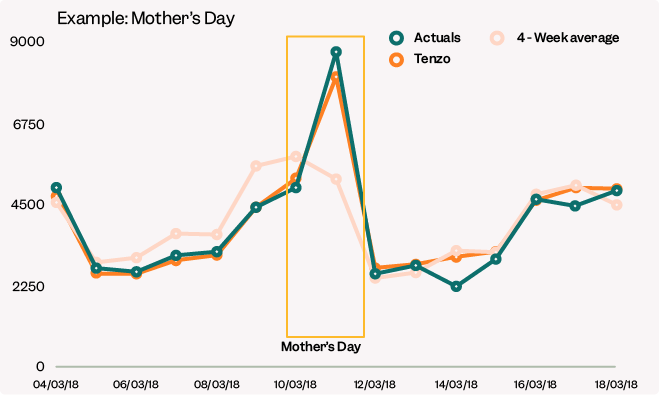
These methods end up generating a huge amount of waste (a third of all food waste comes from hospitality amounting to 1 million tonnes of wasted food per year or £3 billion wasted) and unhappy teams as they are asked to turn up at the last minute or sent home early if the demand is not there.
Why haven’t these forecasting problems been solved yet?
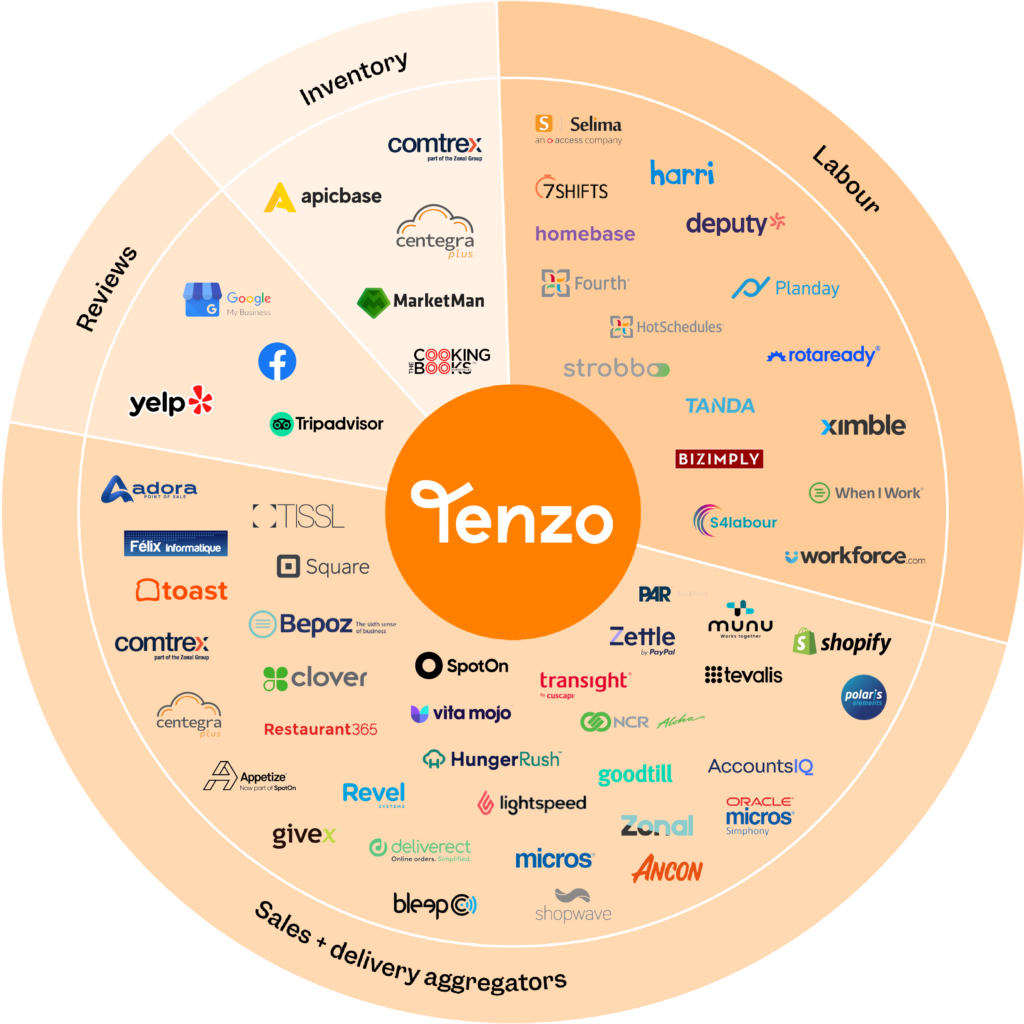
This has always been a problem in the industry so you may ask why it hasn’t been solved yet. The issue is that the restaurant tech stack has siloed data in individual systems up until now. You’ll have your POS (such as Lightspeed, Toast, Square, etc) which deals with all your sales data and (hopefully) integrates with your delivery partners so that all your sales are stored within that system.
Then you will have a separate labour scheduler where you’ll be able to schedule your team and keep track of time sheets to enable easier payroll. Some examples of these are Planday, Deputy, or Workforce.com. Some of these systems may integrate with your POS but might only show historical sales (not helpful for big swings in sales led by holidays and the like) or they will have forecasting capabilities but only show a 4-week average not taking into account events or weather.
Inventory tools which enable you to keep track of purchases and usage based on recipes (like MarketMan or Apicbase) may also have these sales integrations, but again only in the most basic sense. Neither labour nor inventory tools pull in the transactional data necessary to be able to forecast at the granularity needed (i.e. sales per hour to schedule hourly rotas or sales per item per day part to accurately forecast item-level needs).
There are few tools available that do use AI or machine learning to give more accurate predictions, however the risk is that your labour tool and your inventory tool come up with different predictions. This leads to issues like too much labour but too little stock or vice versa. Plus, it confuses your team as they don’t know which numbers to trust and end up suspicious of both systems.
The thing is, these forecasts are not the main priority of these tools. Their main priority is to be excellent labour and inventory tools – which they are. Forecasting is an add-on for them so obviously the vast majority of their development time isn’t spent improving it. Further, it’s actually incredibly difficult to get the information needed from all of their customers’ POS systems to make it work well.
Are all-in-one restaurant management systems the answer then?
There are several platforms that claim to be able to service all of your tech needs from POS, to labour, to inventory, to forecasting. The issue here is that even more so than individual systems, they have to spread themselves too thin which unfortunately gives you mediocre functionality across all their products.
Using best-in-breed technology will ensure you have the best possible functionality for each tool, but that still leaves the question of forecasting. You want to have a system that brings data from all your systems into one place that can then give you the most granular possible forecasts.
Tenzo’s approach
By pulling granular transactional data from your POS and combining it with weather, events and machine learning algorithms, Tenzo is 30-50% more accurate than traditional approaches.
The truth of the matter is that we are specialists when it comes to restaurant data, so we have the infrastructure to give you the most accurate results for your business. All of our focus is on analysing that data so we put in the time and effort to make our outputs as good as possible.
-2.png)
Most importantly, we want to involve the GMs so that they are confident in the forecasts. We know that their local knowledge can make our forecasts even better, so we like to say that we give them a better starting point, but in most cases a GM can further improve Tenzo’s forecast by 5-10%.
We recognise that we don’t know everything – there could be construction outside the restaurant for a week or two that will reduce footfall and see a decrease in sales, but the only person to know that will be the GM who can then adjust the forecast accordingly.
By giving the GM the freedom to adjust forecasts, there is far more buy-in from the team than if they were simply given a number that is seemingly pulled out of thin air. Tenzo shows sales from the equivalent day a year before, last week’s sales and then our forecast to show that our predictions are based on fact.
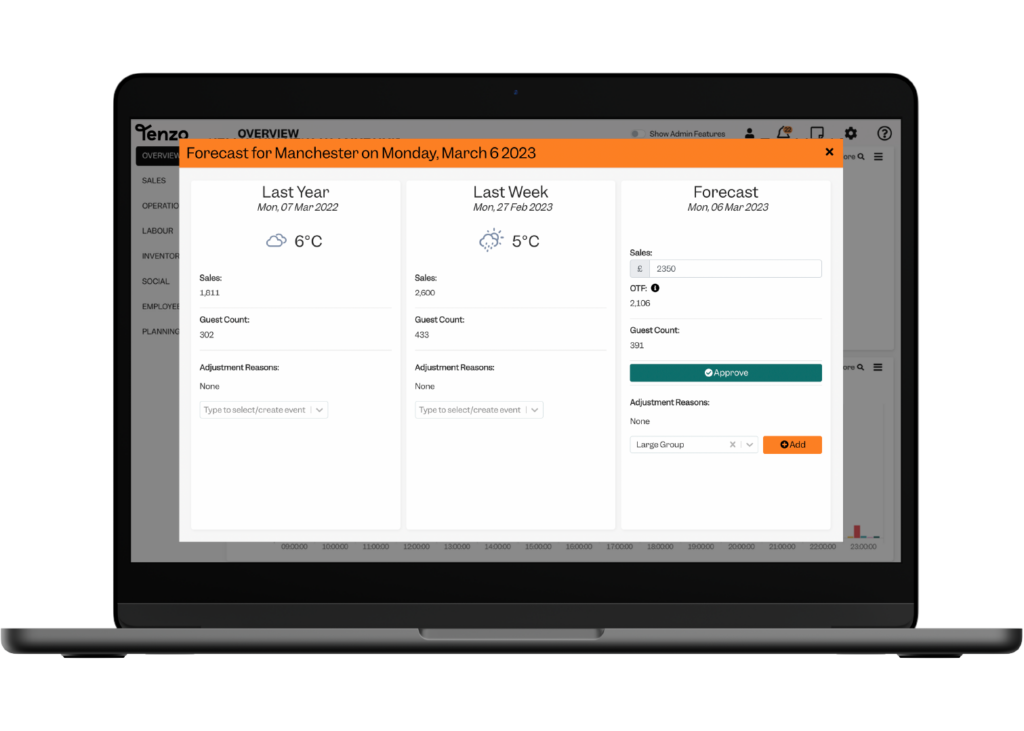
Once the GM has approved the forecasts, we break down the forecast by hour and by item. This allows the team to staff for the busiest times and order the items that will be most popular given all the variables.
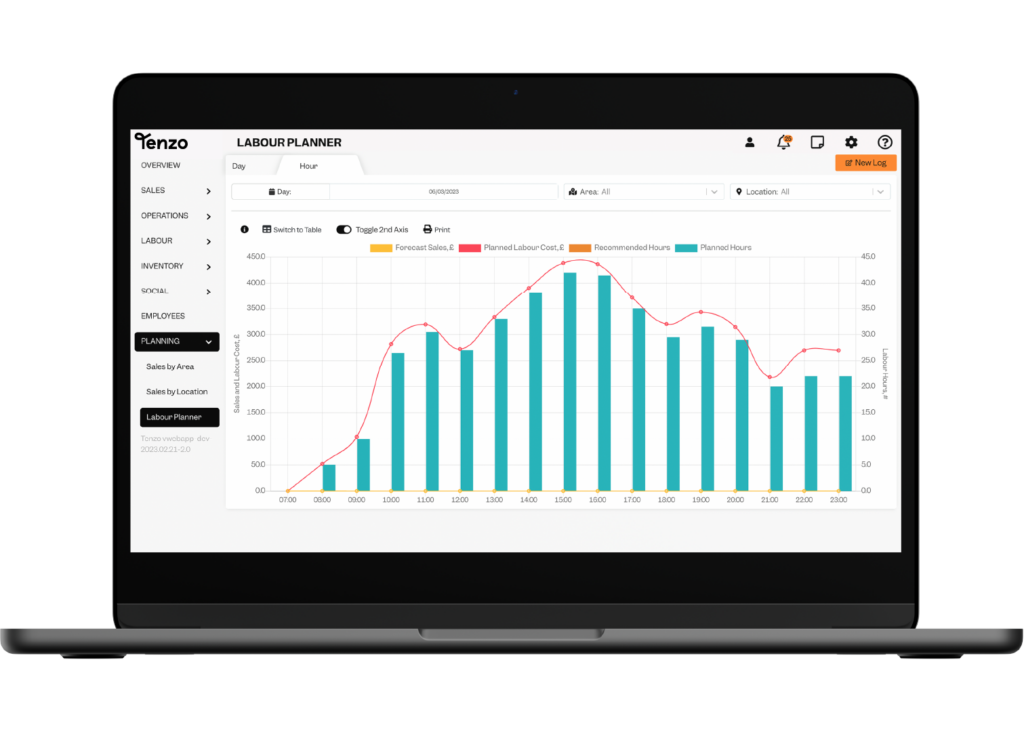
We also make that granular forecast available on our API, which means that labour and inventory tools can pull this from the API (or from Zapier) to make it available in their own tool. This stops the need to switch back and forth between multiple systems when planning and allows for a single source of truth to influence all of the plans eliminating the “too much stock/too little staff” situation and allows these tools to give their customers more accurate forecasts.
Always striving for better
We’re always trying to make Tenzo even better for our users. There are a lot of features in the pipeline which will make forecasting even more intuitive and easy.
First up, we’ll be expanding our alerts to include changes in forecasts due to outside factors like weather or events (e.g. if the English football team were to make it through to a semi-final in the Euros, forecasts at pubs would jump significantly). We run our forecasts every day so we can alert GMs if there are any significant changes.
Alerts can also be helpful reminders if the team hasn’t ordered enough food or if more staff need to be scheduled based on forecast sales. The lack of communication between your different systems can make it easy to forget to update the schedule when you update your forecast, so Tenzo will be able to alert you if that’s the case.
Work on hourly and item accuracy also continues thanks to our Innovate UK grant. Our goal is to be able to tell you exactly what you need to prep for the lunch rush before the queue is out the door to make restaurants as efficient as possible.
Finally, we’ll be adding even more data sources that will affect our AI algorithm to give us even more accurate forecasts such as reservation data and footfall counters, so keep an eye out for them.
We couldn’t be more excited about the direction we’re heading and to continue helping restaurants save on food waste and increase efficiency in any way we can.
Cover Photo by Raychel Sanner on Unsplash
The post The restaurant sales forecasting tech stack and ecosystem appeared first on Tenzo.
]]>2020 has certainly been unprecedented, but the Tenzo team has been hard at work perfecting the tools that make running restaurants more efficient in these trying times. The pandemic has accelerated corporate digital transformation and enhanced the importance of analytics tools in the hospitality sector. More than ever, restaurants need to be able to access their […]
The post Sales forecasting for restaurants: how Tenzo is shaping the future appeared first on Tenzo.
]]>2020 has certainly been unprecedented, but the Tenzo team has been hard at work perfecting the tools that make running restaurants more efficient in these trying times. The pandemic has accelerated corporate digital transformation and enhanced the importance of analytics tools in the hospitality sector. More than ever, restaurants need to be able to access their data and insights, as sales become more volatile. Sales forecasting for restaurants is another dimension on top of this helping to supercharge their performance.
On the flipside, in a recent report, Bain & Company listed technologies that work towards zero food waste as one of the key trends for 2021. “Using technology to reduce waste could put a significant dent in the food discarded by retailers and businesses, increase food security, and alleviate the suffering of the hundreds of millions of people who go to bed on an empty stomach”.
In the UK alone, food waste contributes to £3.2 billion in lost revenue for restaurants and 4.5 million tonnes of CO2 emitted. Our new project is set to change that.
We’re very excited at the prospect of partnering with Innovate UK to help the hospitality industry save over £100m in food waste by 2025. As a business, Tenzo is committed to helping restaurateurs survive this challenging period with the help of accessible data and accurate forecasts. In this post, we will share some of our initial findings and also invite you to become part in our food waste reduction journey.
The project
Through effective food waste reduction, restaurants can boost their profitability, while drastically reducing the environmental impact of their operations.
The key to reducing food waste lies in accurate sales forecasting. Restaurants order their perishable inventory days and weeks before selling dishes to their customers. Given that most restaurants rely on rigid 4-week demand averages and gut instinct to make their procurement decisions, food orders are routinely in excess of real demand – creating food waste.
Our project will focus on finding the most accurate forecasting algorithms and combining them with a user-friendly software interface to ensure frontline workers are empowered to reduce food waste in their day-to-day operations.
Variables for demand forecasting
With the understanding of how critical demand forecasting is for efficient restaurant operations, we started to investigate the different variables that can be used as predictors for forecasts.
Customer demand can vary by time of the year, weekday, weather conditions, promotions, etc. In our research, we identified 12 different categories that are useful in predicting that demand.
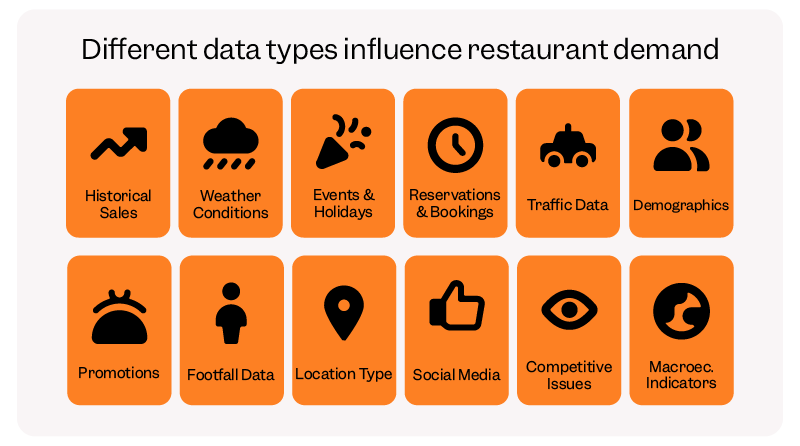
A time series is a sequence of numerical data points in a successive order associated with a time mark. Forecasting, at its core, is a time series problem where given a set of data in time we want to predict the dynamics of the same dataset in the future. For example, if we consider the revenues of a restaurant, we need historical observed revenues to “train” the forecasting algorithm.
Today, businesses try different processes to predict demand: from simple spreadsheets to complex forecasting software and models. But an accurate output could still be out of reach for two reasons.
A major challenge is incorporating large volumes of historical data. Missing relevant data from the past can lead to significant mistakes. An extensive historical dataset is particularly important to prepare for the new normal due to the COVID-19 pandemic. Understanding how the pandemic is affecting your sales and comparing it to the pre-COVID-19 period to predict the new normal will be essential.
The second challenge in forecasting is incorporating other contextual factors and relating it to the patterns observed in the time series datasets. When the forecasting output is too high, it may lead to over-staffing, excessive inventory purchasing and food waste. On the other hand, if the forecasting is too low, restaurants lose sales opportunities and customers are left unsatisfied.
The other inputs included in the figure above are external factors that could be beneficial for the forecasting process:
-
Weather conditions: Temperature, rainfall level, snowfall level, hours of sunshine. Extreme weather can have huge effects on restaurant forecasts and longer days of sunshine might increase demand;
-
Events and holidays: Public, school and religious holidays. They can also have a positive or a negative impact on your demand. If your restaurant is in a business area, you might see your demand drop on a bank holiday;
-
Reservations and bookings: checking the influence of bookings can help you align your inventory and staff with the number of reservations;
-
Traffic data: traffic congestions and public transportation data (e.g. TfL in London). A planned road closure could drive less footfall for that period of time, particularly in bakeries/restaurants on motorways;
-
Demographics: customers’ age for example, can be useful for predictions by time of the day;
-
Promotions: it is expected that footfall will rise when you run promotions in your restaurants;
-
Footfall data: these can be collected by WiFi, bluetooth or computer vision and be used as a proxy for real time customer demand along with sales;
-
Location type: restaurants located on streets and on shopping malls might have different demand profiles;
-
Social Media: can impact positively or negatively the demand, given the restaurant star rating and recent reviews;
-
Competition: competitive promotions or the number of restaurants in the surrounding area affect your demand;
-
Macroeconomic indicators: unemployment rate, inflation and other factors from the local population can also influence the forecasted outcome.
In this blog post, we have discussed how some of these factors play a role in forecasting and some tips for improving your sales forecasting process.
What’s next?
With the disruption caused by COVID-19, restaurants need to rethink their internal processes. “Data-obsession” allows restaurants to become more efficient in resource allocation and brings in more automation to their operations.
Want to get involved?
We’re looking to put together a Customer Research Panel in 2021 to bring together Tenzo customers who use our existing planning module, along with restaurants who don’t use it, to help us better understand first hand the challenges customers face when forecasting sales. If you are interested in joining, send an email to [email protected] by January 22nd 2021 so we can include you in the next exploratory session.
Cover photo by Jakub Kapusnak on Unsplash
The post Sales forecasting for restaurants: how Tenzo is shaping the future appeared first on Tenzo.
]]>London, November 13, Food waste is a huge issue in the UK hospitality industry. The sector wastes over 1 million tonnes of food every year, amounting to over 4.5 million tonnes in CO2 emissions and costing the industry over £3.2 billion in lost revenue. Tenzo and Innovate UK ‘s newest project is set to change […]
The post Innovate UK and Tenzo announce project to save UK restaurants £100m appeared first on Tenzo.
]]>London, November 13, Food waste is a huge issue in the UK hospitality industry. The sector wastes over 1 million tonnes of food every year, amounting to over 4.5 million tonnes in CO2 emissions and costing the industry over £3.2 billion in lost revenue. Tenzo and Innovate UK ‘s newest project is set to change that.
- Food waste contributes to £3.2 billion in lost revenue & 4.5 million tonnes of CO2 emitted in the UK restaurant industry
- £220,000 in funding from Innovate UK will kickstart Tenzo’s AI forecasting project
- New forecasting solution will be used by current Tenzo customers such as Nando’s, Pizza Pilgrims, The Fat Duck and 10,000 more locations by 2025
- Platform will reduce CO2 emissions by 800,000 tonnes by 2025 and save restaurant industry £100 million in costs
Co-funded by the UK’s innovation agency, Innovate UK, Tenzo is embarking on a £500,000 mission to create the most accurate sales forecasting platform for restaurants using artificial intelligence and machine learning. This will improve on Tenzo’s existing forecasting software which already increases forecast accuracy by 30-50% compared to traditional methods.
This new platform will forecast sales at an hourly and item level allowing operators to both order and prepare accurate amounts of food and significantly reduce the amount of waste generated.
We already know that 2020 has been a catastrophic year for the restaurant industry as a whole. Hospitality has always been a tight margin business, with successful restaurants operating on a 3-5% profit margin, but Covid-19 has made these already slim margins even slimmer. Just yesterday, Young’s Pubs announced that the last six months have been one of the toughest periods in their 189-year history. The situation is grave: if restaurants want to survive, operators simply cannot afford to throw away food.
“Reducing the amount of food wasted has always been a priority for me. This funding from Innovate UK will allow us to provide the tools for restaurants to get one step closer to carbon neutrality and significantly reduce the effect our industry has on the planet. Additionally, our accurate forecasting will save millions in costs in a sector that has been severely economically impacted by Covid-19.” – Christian Mouysset, Tenzo CEO
and Co-founder.
Tenzo is committed to helping restaurateurs survive this unprecedented period with the help of accurate data and forecasts. This new solution should therefore save the industry £100 million in wasted food by 2025.
Customers testing out the prototype have already been impressed. Moji Neshat, CEO of Nando’s Singapore has stated, “Tenzo’s forecasting solution combines machine learning with an easy-to-use mobile app for restaurant managers. This has helped us increase our labour productivity by 15% and has continued to perform well since the Covid-19 outbreak.”
But beyond saving cost, what people don’t realise is how much food waste contributes to global warming in the form of carbon emissions. In fact, if food waste were a country, it would be the third largest emitter of CO2 after China and the US and 30% of that waste comes from the restaurant industry. But thanks to this latest innovation, we hope to reduce carbon emissions by 800,000 tonnes by 2025.
The coming months and years may be tough for the restaurant sector both financially and environmentally, but Tenzo is now poised to give restaurateurs the tools they need to be as successful as possible.
The post Innovate UK and Tenzo announce project to save UK restaurants £100m appeared first on Tenzo.
]]>This week Tenzo’s chief of staff Maury Ueta breaks down the project with Innovate UK we’ve been working on for the last 2 years. In this blog post, we will: a) highlight how critical demand forecasting is for efficient restaurant operations, b) share some insights and c) reflect on our learnings from the forecasting project […]
The post Innovate UK – A.I. forecasting to reduce food waste appeared first on Tenzo.
]]>This week Tenzo’s chief of staff Maury Ueta breaks down the project with Innovate UK we’ve been working on for the last 2 years.
In this blog post, we will: a) highlight how critical demand forecasting is for efficient restaurant operations, b) share some insights and c) reflect on our learnings from the forecasting project we collaborated on with Innovate UK.
Context
In the UK alone, food waste contributes to £3.2 billion in lost revenue for restaurants, and 4.5 million tonnes of CO2 emitted. That’s a huge impact both on the environment and on a restaurant’s bottom line.
One of our main goals at Tenzo has been reducing that number. We’ve always prioritised accurate forecasting to help restaurants run more efficiently as well as reduce the amount of waste they generate.
In late 2019 we saw firsthand how we could help when we gave Nando’s Singapore 30% more accurate forecasts. Thanks to those numbers, we were able to help the team there increase their labour productivity by 15%. The logical next step was how we could make our forecasts even better and make them available to many more businesses.
That’s why we set out to partner with Innovate UK, the UK’s innovation agency, to help the hospitality industry save over £100m in food waste by 2025 by creating the most accurate sales forecasting platform for restaurants using artificial intelligence and machine learning.
A lot has happened since we embarked on the project in November 2020, not least that the key to resiliency for restaurants lies in accurate demand forecasting.
Currently, most restaurants rely on last week’s demand, rigid 4-week demand averages or gut instinct for operational decisions like shift scheduling, food ordering and preparation. These routinely exceed real demand – indicating demand for staff they cannot attract and creating costs for excess food they cannot afford.

Our approach
We kicked off the project by investigating the different variables that can be used as predictors for forecasts. Along with historical sales data, some external factors can be beneficial for the forecasting process: weather, events and footfall, for example.
After interviewing academic and industry forecasting experts, we experimented with new machine learning methods. In this research, we not only tested new algorithms but also explored new tools and new processes.
To make this really successful though, just having high forecast accuracy is not enough. Operators also need to be able to fit this process into their current operations. This is why, in early 2021, we created a select group of customers to investigate how the forecasting processes were performed inside restaurants. We then started drafting the user journey for the new tool and started a pilot.
On the product side, we revisited the entire infrastructure supporting our forecasting engine to ensure we had a reliable and scalable tool for the new methods.
We’ve now added ‘write integrations’ which means that we provide the forecasts in our own API that other software businesses can ‘read’, or we write our forecasts to our partner’s API.
This means that Tenzo forecasts are now available directly in our customers’ labour schedulers (eg Planday, Deputy, Workforce.com, and more) so they don’t have to switch platforms to schedule as efficiently as possible.
Plus, we’re working on integrating these forecasts into inventory platforms as well so that businesses can order ingredients according to demand and further reduce waste.
We’ve also created a new whole new internal function for quality assurance (hi Kieran ) that means we can test these more complicated integrations.

The new hybrid working style
COVID-19
We submitted our application just before COVID, so there were obviously aspects within the project that needed to be addressed.
For example, unstable datasets with periods without sales made us explore new machine learning methods. In this new context, we received the resilience fund grant for this project.
“During the Pandemic, one of the hardest-hit industries was hospitality. Many restaurants struggled to manage the unpredictable demand for freshly prepared food and getting the resources right to meet fluctuating needs, resulting in food waste and lost income.
The Tenzo team found a way to capture and share insights data, so that purchasing decisions and staffing levels can be optimised. Their software has had a really positive impact on its users, the economy and the environment at a time when it’s been needed the most.
Being able to provide Resilience funding to an innovative project such as this and observing the impact this work has had on a struggling industry gives me huge job satisfaction!” Lisa Gould-Davies – Programme Manager at Innovate-UK.
Due to the pandemic, we switched between fully remote and hybrid working in the UK.
We established more regular status updates among different functions in the project to increase information sharing. The cross-collaboration and visibility were critical to leverage the iteration feedback of the product considering the customer.
The experience in working with innovate-UK went beyond the financial support. Risk monitoring and project management skills developed in the project helped us identify new issues and bottlenecks ahead of time.
During the project, we hired one project manager, a dedicated data scientist, and a quality assurance analyst. The value from these functions can (and will) be exploited by other features at Tenzo.
What’s Next?
Our team is now better equipped to keep improving our current forecasting features while developing new tools and functionalities. In the near future, we want to build more detailed forecasting capabilities so users can get deeper insights by being able to drill down into different parts of the forecast.
This will make ordering and prepping food all the more accurate, reducing the tons of waste currently produced by F&B businesses and will give operators the ability to schedule as efficiently as possible – a huge impact given the current staff shortages.
Keep an eye out for what’s coming, we promise it’s very exciting!
The post Innovate UK – A.I. forecasting to reduce food waste appeared first on Tenzo.
]]>If you’ve spoken to anyone on the Tenzo team recently, you’ve probably heard us bandy around the term ‘write integrations’. No, we’re not speaking in code, we’re just referring to our latest foray into giving restaurateurs the tools they need to make their operations run as smoothly as possible. However, we’re not always the best […]
The post Tenzo Write Integrations: what are they and why we built them. appeared first on Tenzo.
]]>If you’ve spoken to anyone on the Tenzo team recently, you’ve probably heard us bandy around the term ‘write integrations’.
No, we’re not speaking in code, we’re just referring to our latest foray into giving restaurateurs the tools they need to make their operations run as smoothly as possible.
However, we’re not always the best at stopping to explain what we are actually talking about. So, I’m here to break down what these ‘write integrations’ actually are and why we think they’re so important in the evolving restaurant tech stack.
First thing’s first, what does a ‘write integration’ even mean?
As you may know, Tenzo integrates with your POS, labour scheduler and inventory management system to bring all your data into one easy to use platform.
When you see your sales numbers in Tenzo, for example, this is the result of a ‘read integration’ because we are ‘reading’ the information provided to us by an API. That’s to say we take the data they provide and transform it into the information available in Tenzo (this is very complicated in and of itself, give our Airflow blog a read if you would like to find out more about our ETL process).
Now we’ve expanded to ‘write integrations’ which means that we provide the data and information in our own API that other businesses can ‘read’, or we write our forecasts to our partner’s API. For the most part, the information that we’re providing is our AI forecasts, but we also provide actual sales numbers.
Why did we decide to build these write integrations?
Issue 1: Forecasting
We knew that there was a disconnect in the way General Managers were receiving forecasts and how they were being enacted.
In the old way of doing things, GMs may have received up to 3 separate forecasts:
- The finance team in Head Office comes up with a forecast to give some guidance when it comes to staffing and ordering stock. This can be as basic as a 4-week average or it can be something more complex taking into account differing factors.
- A forecast is generated by their labour scheduler to help with their rotas. The problem is these platforms are usually only able to give a daily forecast, not an hourly one. This forecast will be created using another method so will be different from the first forecast.
- Inventory tools also show forecasts to help with ordering. As above, it’s usually only on a daily level and will also give another totally different forecast.
So what happens then? According to Christian Mouysset, Tenzo CEO, ‘the GMs don’t trust any of these because firstly, they’re all giving different numbers, and secondly, there’s no context around the numbers.’
Quite understandably, this often leads to GMs ignoring all of the forecasts and going off of gut instinct or simply using the same schedule or inventory order as they did the previous week. The problem with this method is that if that week is half-term or if there’s an event going on, the schedule and order will be completely off.
How are Tenzo’s forecasts different?
Our forecasting methods go above and beyond what restaurants usually have access to. We not only take into account historical sales but seasonality, events, weather and more. Our algorithms are also trained on hundreds of different restaurants so benefit from the collective knowledge of all those businesses.
Not only do we provide daily forecasts, but we can give you an accurate forecast for every hour of the day, as well as at an item level. Plus, we give context as to how we got to that number so the GMs can see that we didn’t just pluck a number out of thin air.
Finally, we are fully aware that we can’t know everything. For example, if there are roadworks outside the restaurant and footfall is going to suffer because of them, Tenzo can’t possibly know that. That’s why we encourage the GM to change the forecast if need be. In fact, we’ve shown that Tenzo on its own improves a business’s forecast by 25%, but when the GM engages with it, that number goes up to 30%!
Tenzo’s forecasting module
Issue 2: Engagement
That all sounds great, but with these forecasts living within the Tenzo platform, everything becomes a bit clunky. You need to have the Tenzo app open, then in another tab have your labour scheduler open and so on and so forth. Then you need to keep switching back and forth between these platforms to make sure you’re scheduling or ordering correctly. It’s a bit too much friction, as we say in tech, for the process to feel simple and seamless.
That’s where the write integrations come in.
Now, a customer can access their Tenzo forecasts in their rota tools while they’re creating their schedule. No more switching back and forth, it’s all right there. You can actually see what your planned cost of labour will be as a percentage of your sales forecast per hour.
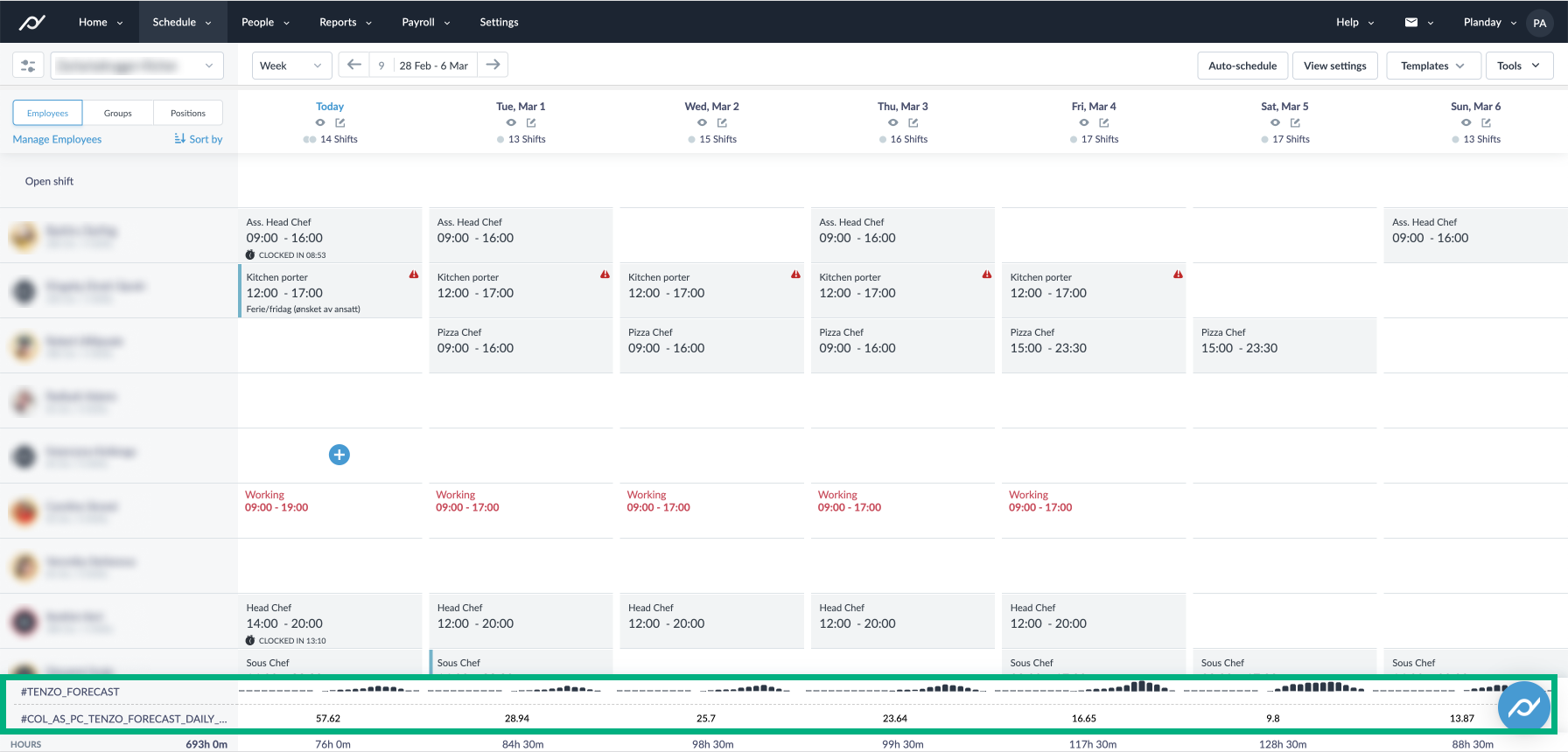
Planned cost of labour as a percentage of future sales as shown in Planday’s platform
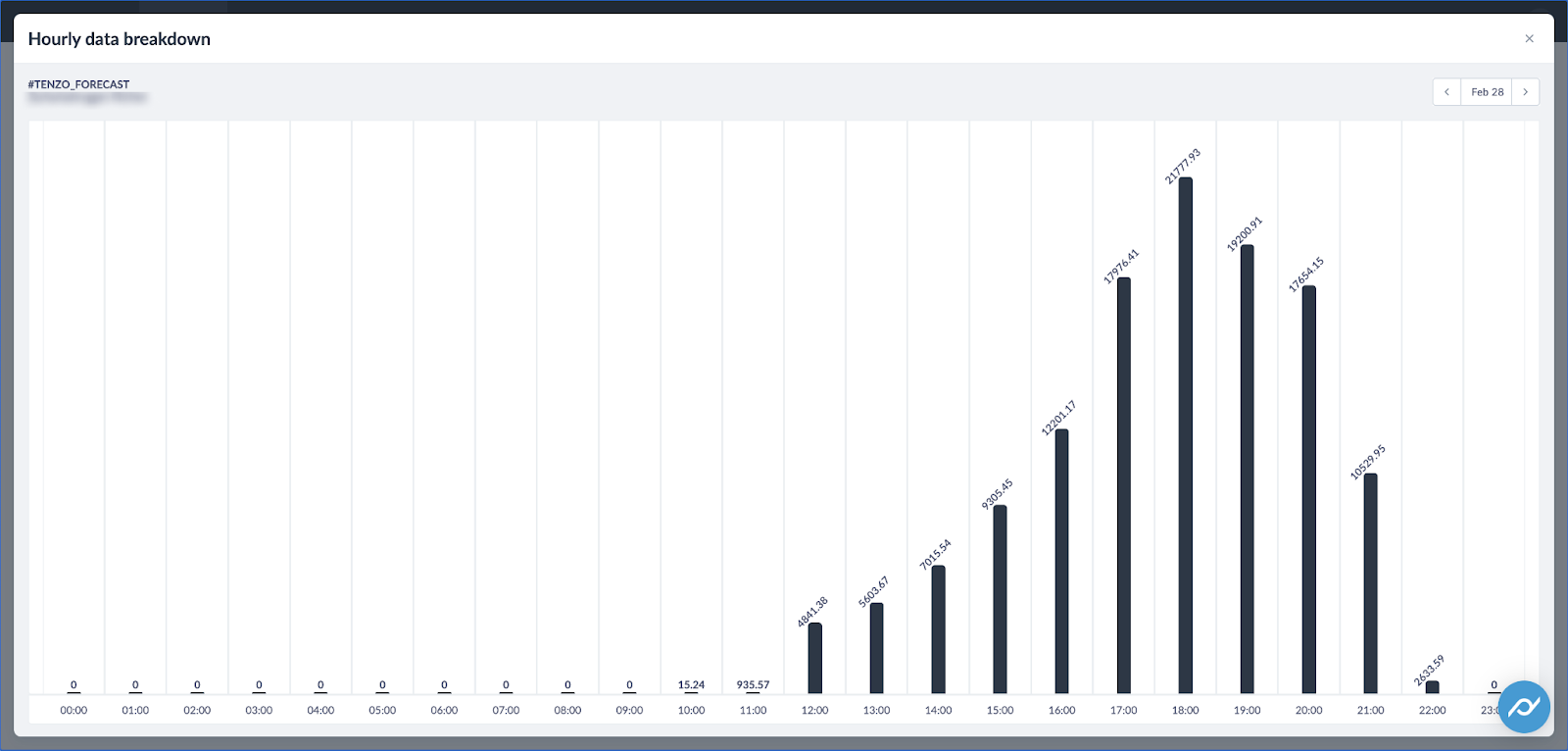 Tenzo’s hourly forecast as shown in Planday’s platform
When we tested out this way of scheduling, we found that it increased labour productivity (that’s sales per labour hour spent) by 15%. Not too shabby.
Why would partners want to include our forecasts in their tooling?
As we’ve covered, generating these forecasts is no easy feat. For the partner to get to the same level of detail as Tenzo does, they would need to pull in sales at an hourly level (something that we’ve shown to be *very* difficult), they would need to invest in their forecasting algorithm which takes AI expertise, and then they would need to build out the infrastructure to get GM engagement.
That’s a lot of work on something that’s not your core offering, because labour tools, for example, don’t just need to provide scheduling software, they also need to integrate with your accounting software to deal with payroll, with your clock-in/clock-out system, with your training software and much more that we at Tenzo don’t need to focus on.
Using Tenzo’s forecasts allows them to focus on the things that make them amazing platforms to work with without having to spare the resources to create these very complicated forecast delivery systems. This is what we call ‘best-in-breed’ – when everyone can focus on the things they do best.
But don’t just trust our word – our write integrations are currently supported by Planday, Rotaready, and Deputy for forecast sales, while Worforce.com and Tanda pull actual sales from Tenzo with Bizimply and Harri both building out this feature at the moment.
This is just the beginning…
We’ve started building these write integrations for labour schedulers, but that’s just the first step. We will soon be seeing Tenzo forecasts in inventory management platforms with item-level forecasts being used to order in the right quantities and cut back on food waste.
If you’d like to see Tenzo forecasts in your tooling, get in touch! We’d love to hear from you.
Cover photo by WrongTog on Unsplash
The post Tenzo Write Integrations: what are they and why we built them. appeared first on Tenzo.
]]>