2023 has been one hell of a year at Tenzo! From completely changing the look and feel of Tenzo to growing the team and adding some epic customers, 2023 might have been the best year yet. Introducing Restaurant PerformanceOps The biggest launch of the year (in our world at least). After years of work, we […]
The post Tenzo Wrapped: A 2023 to Remember! appeared first on Tenzo.
]]>2023 has been one hell of a year at Tenzo! From completely changing the look and feel of Tenzo to growing the team and adding some epic customers, 2023 might have been the best year yet.
Introducing Restaurant PerformanceOps
The biggest launch of the year (in our world at least). After years of work, we finally launched our brand new category: Restaurant PerformanceOps together with a full rebrand of our platform.
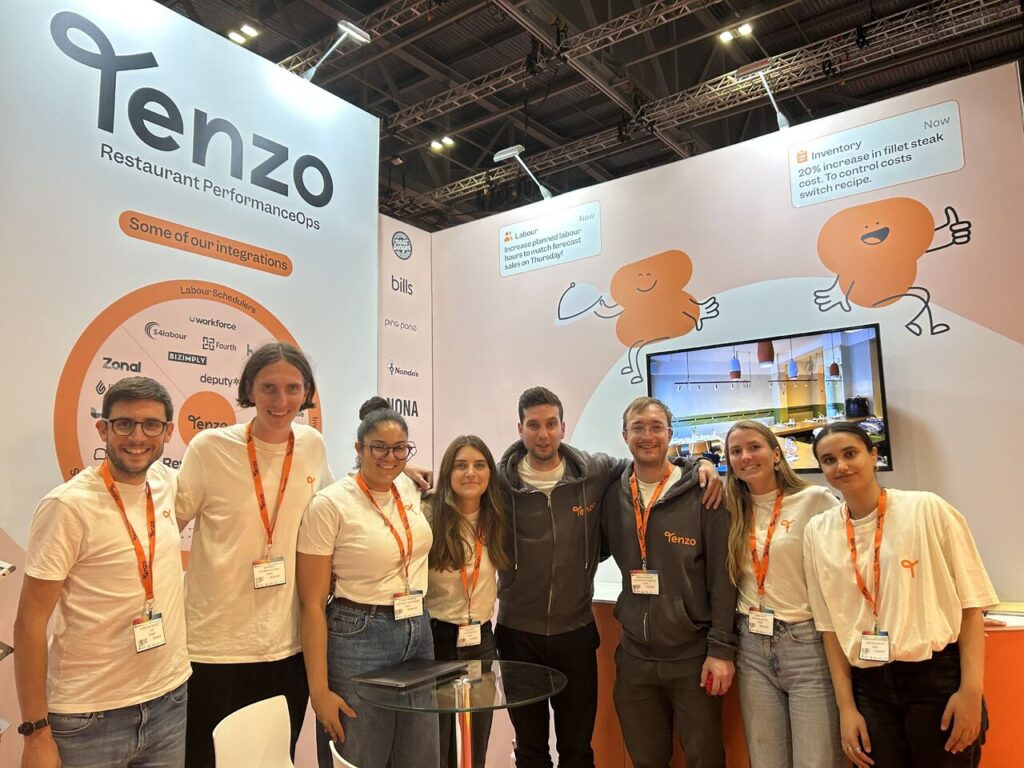
When Tenzo started in 2016, our goal was simply to bring a restaurant’s data into one place. But as we’ve grown and the industry has become more and more tech-forward, Tenzo’s capabilities have developed to a point where we’re now not only aggregating the data but providing a platform to analyse trends and predict what’s happening next in order to act with confidence and make data-backed decisions, so needed to find the right way to express that.
To hear more about the process of creating our category as well as how we hope to impact the hospitality industry, have a listen to Christian’s interviews on the B Word and Tech on Toast podcasts!
Our goal now is to keep supporting the hospitality industry to shift from surviving to thriving with access to the insights businesses need to keep growing!
An ever-improving product
Tenzo users will have noticed quite a lot of change in the last year. Firstly, when we launched Restaurant PerformanceOps, we also split our offering into three categories: Aggregate, Analyse & Predict, and Act.
Our Aggregate Product is now available as an independent offering. This means that if a business wants to use Tenzo as a data warehouse where we take care of maintaining integrations to your operational tools but push the data into another BI tool, we can make it happen.
This works particularly well in businesses where head office users are well versed in data manipulation and visualisation and who want very customised ways of looking at their data. A positive is that they can also have access to the Tenzo platform to give their frontline teams a simple, mobile-first way to engage with their data.
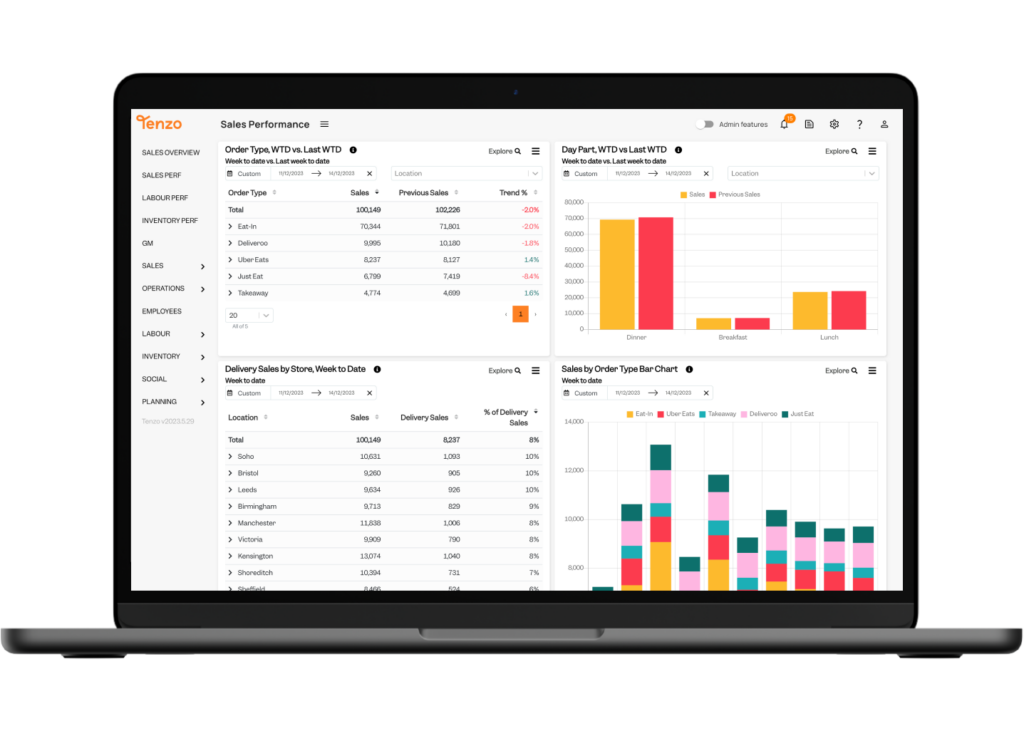
On the Analyse & Predict side, we’ve improved our forecasting algorithm and added the option for customers to upload custom calendars to pull in events that are most impactful to their revenue. For example, we now have sports bar customers who pull in all the important matches to help forecast the amount of staff they’ll need so no customers have to miss important moments while queuing for a beer.
We’ve also completely rethought our admin structure and continue to give users more freedom to create their own subscription emails and set up personalised log book templates.
Continuing to be a trusted partner
This year we increased the number of systems we integrate with to over 80 and deepened our partnerships with the companies behind them.
We had over 60 partner events whether that was training, sales enablement, drinks, networking or even the odd football match! Every time we meet with partners, we realise how integral our collaboration is to making sure every shared customer is supported in the best possible way.
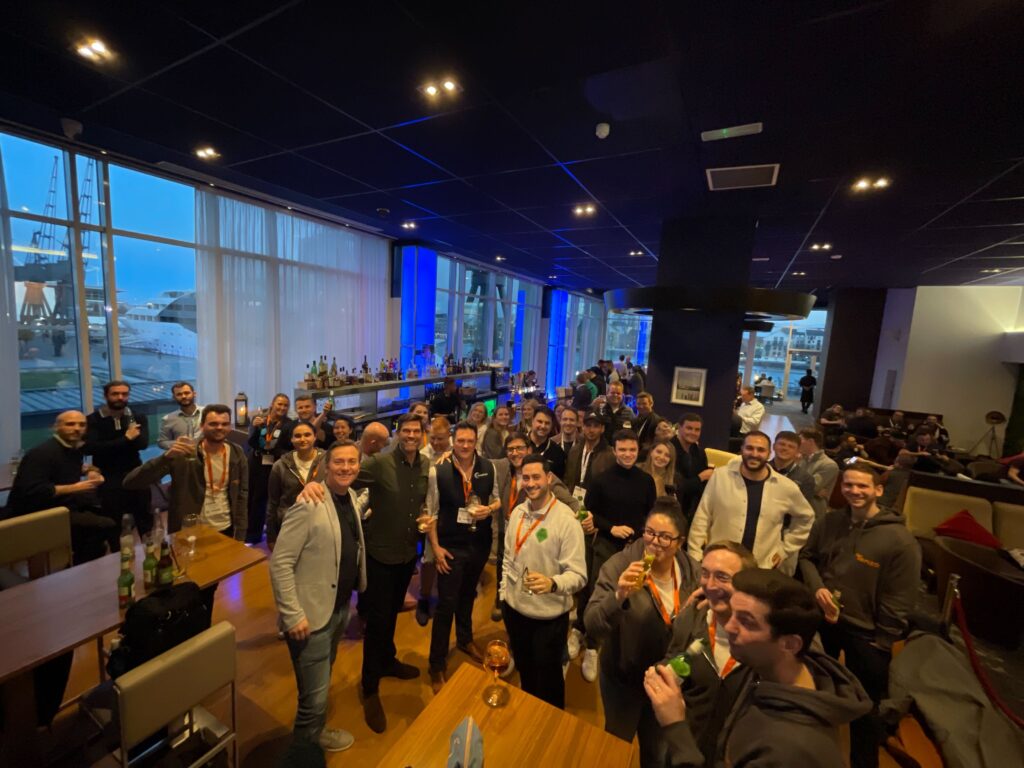
We were also delighted to attend the Lightspeed Partner Summit in Montreal this year where we were nominated for the Most Innovative Hospitality Partner Award.
We added a few more integrations to the wheel in 2023 including:
- Oracle Simphony
- Oracle Opera
- Procure Wizard
- OpenTable
- HR Duo
Adding some awesome new customers
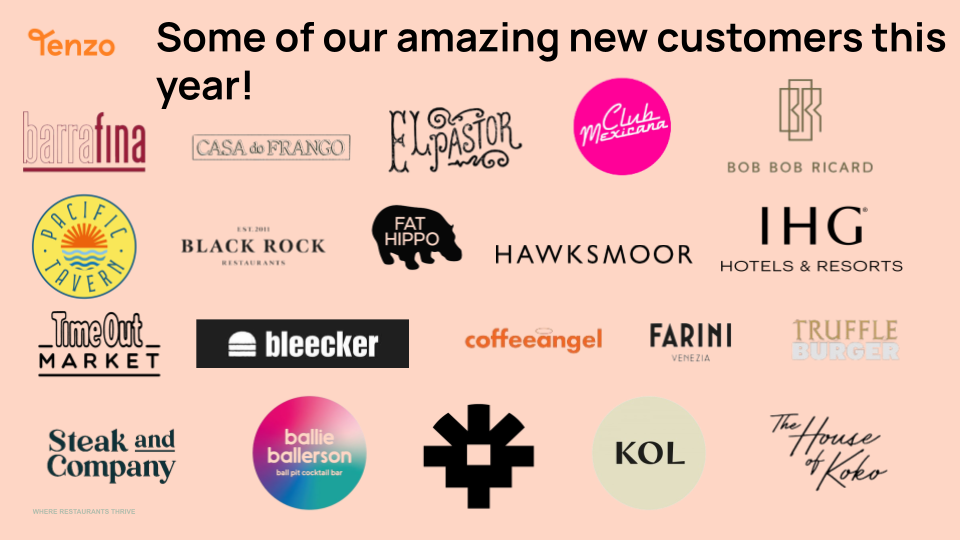
Thank you to every single one of our customers who used Tenzo this year! We’re extremely proud to have maintained our 100% 5-star review rate on Trustpilot. A quick shout-out to all the new customers who joined this year! We added three new countries: Germany, Indonesia and South Africa. That brings the number of countries Tenzo is present in to 24!
Here’s just a selection of some of the incredible brands we get to work with on a daily basis!
What’s next?
2024 is going to be epic! We have some amazing features in the pipeline. Keep an eye out for a dashboard creator which will allow users to create their own Tenzo dashboards as well as a card wizard that will help you find the reports you need to add to those dashboards.
We’re revamping emails and alerts so get ready for some awesome new notifications!
There’s even more coming, but you’ll have to wait for 2024 to find out about those secret initiatives. We’re super excited about how we can supercharge Tenzo even further.
The post Tenzo Wrapped: A 2023 to Remember! appeared first on Tenzo.
]]>In September 2022, Tenzo held its first-ever offsite! We spent two days in Pembroke College, Cambridge, a fitting place as it’s where our Founders, Adam and Christian, met as university students. Thanks to our fantastic team, we celebrated the incredible work and milestones Tenzo has achieved since 2016. Our offsite focused on three key areas. […]
The post Tenzo’s First Offsite appeared first on Tenzo.
]]>In September 2022, Tenzo held its first-ever offsite!
We spent two days in Pembroke College, Cambridge, a fitting place as it’s where our Founders, Adam and Christian, met as university students. Thanks to our fantastic team, we celebrated the incredible work and milestones Tenzo has achieved since 2016.
Our offsite focused on three key areas.
- Our departmental heads communicated their strategies to the whole company to ensure we align on what we are all working towards.
- It was also a chance to formulate initiatives on what we want to see on the road map at Tenzo
- and finally, an opportunity for team bonding away in a relaxed environment.
We had lots of learnings … and we mean a lot, so keep reading to learn more.
All in all, it was a success, and we can’t wait for next year!
What Tenzo learnt at our first company offsite
Growth Plans
It was a rare opportunity to have the whole team under one roof, from our leadership to overseas team members. We took this chance for every department head, with our founders, to discuss the year’s achievements alongside their strategic plans for the upcoming quarters.
Each department’s objectives inevitably impact the broader company, so it was a great time to communicate those targets and gather feedback so the whole company can feel they are working towards the same purpose. We want to hold departmental heads accountable for their strategic goals, taking out the time to roughly think out their plans and explain why they think this will be valuable.

Brainstorming Initiatives as a Team
We had 1-hour ideation sessions scheduled, divided into two days.
Our first ideation session was cross-departmental collaboration, having groups with members of different departments. We then discussed how those specific departments work together currently, how we could improve our collaboration, and how we could work in the future.
Cross-departmental collaboration can have its frictions, and it’s difficult to align on responsibilities and have clear communication channels. It is important to re-evaluate departmental relationships, with the input of all the teams.
A common theme was the limitation of our knowledge management system, which was often outdated or difficult to navigate. We have since implemented Notion, with departments updating their pages on a scheduled basis. Colleagues from other departments can gain valuable clarity with a simple search rather than having to constantly go back and forth.
We then moved on to our ‘Dragon’s Den’ ideation session, where each team had to pitch a product feature for Tenzo. It was interesting to formulate these ideas with the Product and Growth teams together, who were able to bring different perspectives. 34% of employees shared that they have had their most creative ideas on company or executive retreats. This figure increases to 53% for the ages of 16 and 24. Creating an environment where everyone feels they can propose what they would want Tenzo to look like is essential for our team to feel they have ownership and are working towards a purpose they believe in.
In our ideation sessions, we realised we were correct in not scheduling back-to-back sessions. It was important to have breaks in between and spread out our sessions two days to ensure the team always felt refreshed and came up with lots of interesting ideas, which you might see soon ….

Team-bonding
It’s not all work and no play! The second half of day two was solely focused on social events.
Work socials, while fun, can tread the fine line of feeling too corporate and unable to let loose completely.
Offsites work around this loophole, with 82 % of individuals feeling that the relaxed environment that corporate offsite provides is the main reason behind the success of these outdoor events. You haven’t just got off a tough call from a customer or trying to meet an important deadline. As a result of the calmness of a company retreat, employees perform better in terms of their contributions and learning.

So what did we do for fun during our offsite?
We were lucky enough to stay in Pembroke College, which was fully catered and able to host our indoor activities. As students were still on holiday, we had the whole building and shared space to ourselves. It made a difference as it gave us the space to get to know each other better in a more relaxed setting … probably wouldn’t be ideal to have our offsite during freshers week. Being able to go to the hall for our meals removed all the hassle of logistics, and not to brag, but the food was delicious .. you can’t go wrong with bangers and mash.
We were in Cambridge, so we had to do some punting … with all Tenzonians being expert punters and definitely not bumping into each other. We had a treasure hunt across Cambridge, apologies to all the Cantabrigians who we bombarded with questions; we are very competitive.
To end our trip, we celebrated in style at The Cambridge Brew House with our in-house DJ and some top-tier playlists. We ended our night with a questionable kebab … in true student fashion, with our founders telling us stories about what they got up to during their nights out.
Why was team bonding such an essential part of our offsite objective?
What do you look for in your job? Probably having a great team that you can enjoy a drink with after work is probably up there, right? In a recent survey, the top reason that talent doesn’t seek out other opportunities after pay is their work relationships. It’s vital to create opportunities for colleagues to socialise outside work hours, with retention rates increasing for the following reasons:
When you feel comfortable with your teams, giving honest feedback about improving work, culture, or strategy is always easier. Every employee wants to feel valued, and their views are taken into the decision-making process. A two-day trip outside the office helps consolidate relationships as you can disconnect from your hectic work life. There are memories from our offsite that we still laugh about today, namely about our Partnership Lead, Sebastian, being an awful punter … and we mean awful.
Teams in different countries or who work entirely remotely can sometimes feel isolated from the rest of the team, unable to go to monthly socials or other face-to-face interactions. Three-quarters of employees view work trips as a benefit, and 65% consider corporate travel proof of their significance within their organisation. Remote workers then benefit from flexible working while simultaneously enjoying creating more personable relationships when meeting their peers.

Learnings from our offsite.
When you do anything for the first time, you always discover what you did well and what you should have done differently.
Here are our top 5 learnings!
- Offsites are a great way to energise the team for what’s coming next, cross-collaboration with other groups and, most importantly, connect with other team members.
- Make sure to document all discussions and schedule a time to follow up after the offsite.
- Only book one thing at a time! We had headshots happening alongside one of the ideation sessions – It can be very distracting.
- Leave lots of free time and breaks between activities to ensure you are not rushing or running behind schedule.
- Treasure punting was the highlight of our offsite! We recommend doing a fun activity tailored to your location that will create many memories.
Conclusion:
Our 2022 offsite was one of the highlights of such an incredible year! We had the opportunity to look at the bigger picture of Tenzo’s development with the insights and contributions of the whole team. We had many priceless laughs along the way, making us chuckle today. All in all, if you have the budget for an offsite, from our perspective, it was one of the best investments of 2022, and we can’t wait for our 2023 offsite!
The post Tenzo’s First Offsite appeared first on Tenzo.
]]>That’s right, we’ve started a podcast – In The Soup! In the soup is a podcast by restaurateurs for restaurateurs. Hosted by former-restaurateur and current Tenzo CEO, Christian Mouysset, every episode will feature a different role in the industry. Focused on the business-side of running F&B enterprises, the podcast takes a deep dive into the […]
The post Announcing Tenzo’s new podcast: In the soup! appeared first on Tenzo.
]]>That’s right, we’ve started a podcast – In The Soup!
In the soup is a podcast by restaurateurs for restaurateurs. Hosted by former-restaurateur and current Tenzo CEO, Christian Mouysset, every episode will feature a different role in the industry. Focused on the business-side of running F&B enterprises, the podcast takes a deep dive into the nitty-gritty of the grind.
Christian and his guests will discuss the challenges and highlights of working within the restaurant industry. They look back on their careers, examine the business as a whole, and debate what it will look like in the future. Coronavirus’s impact will also be front and centre in these episodes, as the guests analyse the virus’s lasting effects on the industry.
Highly experienced in their field, each guest gives advice and solutions for real-world problems, and divulges the reality of surviving and prospering in the dog-eat-dog world of restaurants.
Series 1 features Tenzo customers who have emerged from the Covid-19 lockdown relatively unscathed thanks to innovative ways of doing business and an ability to pivot at a moment’s notice.
Series 2 (out now!) centres around guests in countries that are further ahead in the recovery period than the UK and the US. Christian chats to restaurateurs and operators in Hong Kong, Singapore and Thailand to find out how these guys are operating in the ‘new normal’, as well as any tips and advice they have for other hospitality businesses.
Get excited for series 3, coming soon! If you have any questions relating to In the soup production or about any of the episodes, please feel free to get in touch!
Please follow us on Spotify or Soundcloud and leave a comment!
The post Announcing Tenzo’s new podcast: In the soup! appeared first on Tenzo.
]]>Tenzo’s co-founders Christian Mouysset and Adam Taylor reflect on a truly unprecedented year. This chart shows how things were looking in the middle of April, a couple of months into the pandemic – this is the story of what we did about it: Daily sales of London based restaurants, GBP No one can say that […]
The post Navigating a pandemic: how we lost 80% of revenue before gaining more appeared first on Tenzo.
]]>Tenzo’s co-founders Christian Mouysset and Adam Taylor reflect on a truly unprecedented year.
This chart shows how things were looking in the middle of April, a couple of months into the pandemic – this is the story of what we did about it:
Daily sales of London based restaurants, GBP
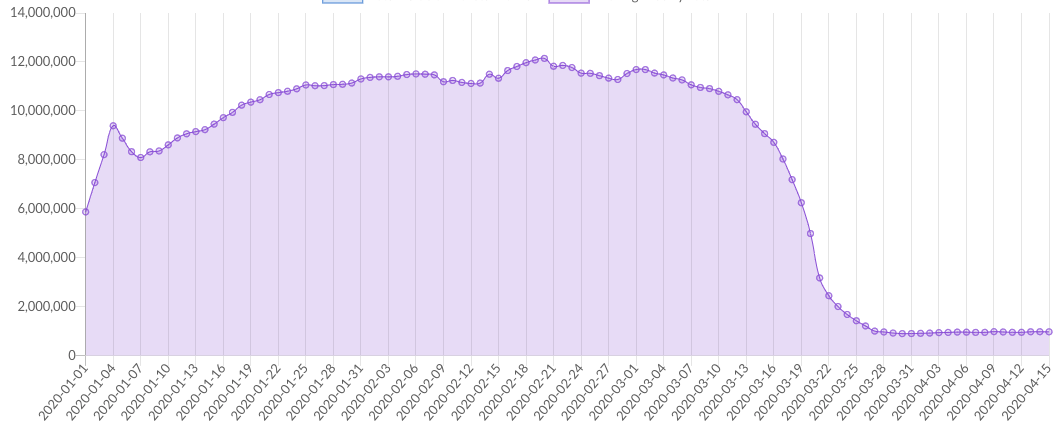
No one can say that 2020 was uneventful, that’s for sure. Way back in January, Tenzo was growing 10% month-on-month, and we were gearing up to expand. Coronavirus was on our radar – but felt like something overseas that wouldn’t impact us. Then the UK announced its first case – and as we all know, the rest is history.
As you can see above – restaurant sales were in rapid decline and we lost ~80% of our revenue in the matter of a few weeks. It required some serious soul searching to figure out what we should do. We found that we learned a lot and wanted to share and reflect on some key lessons from the pandemic.
Lesson 1 – People: If you don’t look after your people – you can’t recover
Our first reaction was to protect our most valuable asset – our people. We moved quickly to allow our teams to work from home to minimise their contact with others. Soon this meant we had a team that spanned the world as people wanted to be close to loved ones – from Thailand to Wales, North Carolina to Cambridge, Dorset to Ukraine. Critically, we’ve found 3 things to be important to our success in this new remote world:
-
Have the right tools and processes: Clearly, this new world requires new ways of working – we had to park our beliefs that teams are more effective in person, and find ways to make remote teams work. Obvious tools like Slack and Zoom have been coupled with operational process changes – a shorter dev sprint cycle, more regular daily check-ins and creating space for “brainstorming”.
-
Find new mechanisms for “social connectedness”: Every week now at Tenzo you’re assigned a cross-functional coffee group – the idea is to try and enable more “water cooler” conversation and build social groups. We’ve also played virtual escape rooms, adopted virtual lunch ‘n’ learns, and who doesn’t enjoy some team Among Us?
-
Reinforce your values: we’ve spun up a “values squad” who continue to evolve our values and make sure we’re living them daily. At its core – a group with a common value set will continue to stay together and function effectively – we believe this is core to our success.
We’ve worked hard to make sure that the team felt supported and remained productive during this time – 2020 has proven to be a tricky balance of health, family and work commitments – and we’ve had to reinforce that throughout.
Lesson 2 – Customer: The customer is always right (duh!)
Our main message: “If you’re closed – Tenzo is FREE”
Our second reaction was to do everything we could to support the industry. Given that we have first-hand experience of running restaurants, we knew that bills would be impossible to pay with no revenue coming in. We didn’t want to add to the increasing pressure, so we quickly communicated to our customers that we would pause their billing if they were closed. Our key learnings from a customer success point of view were:
-
Proactive is best: We were one of the few vendors to proactively tell our customers they didn’t need to pay. Even before the second UK lockdown was finalised, we had a communication plan in place, and customers couldn’t have been more grateful.
-
Empathy wins – and can go both ways: Our customer success team knew they had to put themselves in the shoes of the customer – but also with a realisation that we all have businesses to run. Helping understand each others’ pain helped us get more customers back to billing faster.
-
Have a regular communication strategy: We launched a weekly newsletter for our customers with our latest tips on how to get their products & services to their customers. A theme throughout this was “we’re here for you”. We wanted to stay front of mind for all our customers.
-
Build trust: We also wanted to help our clients adapt to this new situation as we felt that it was going to change habits for good. Offering the right advice might not always be the best for Tenzo – there are many examples where we’ve had discussions about how we can move customers to smaller paid plans until they’re ready to dive into other operational topics – our Artificial Intelligence (A.I.) forecasting module for instance.
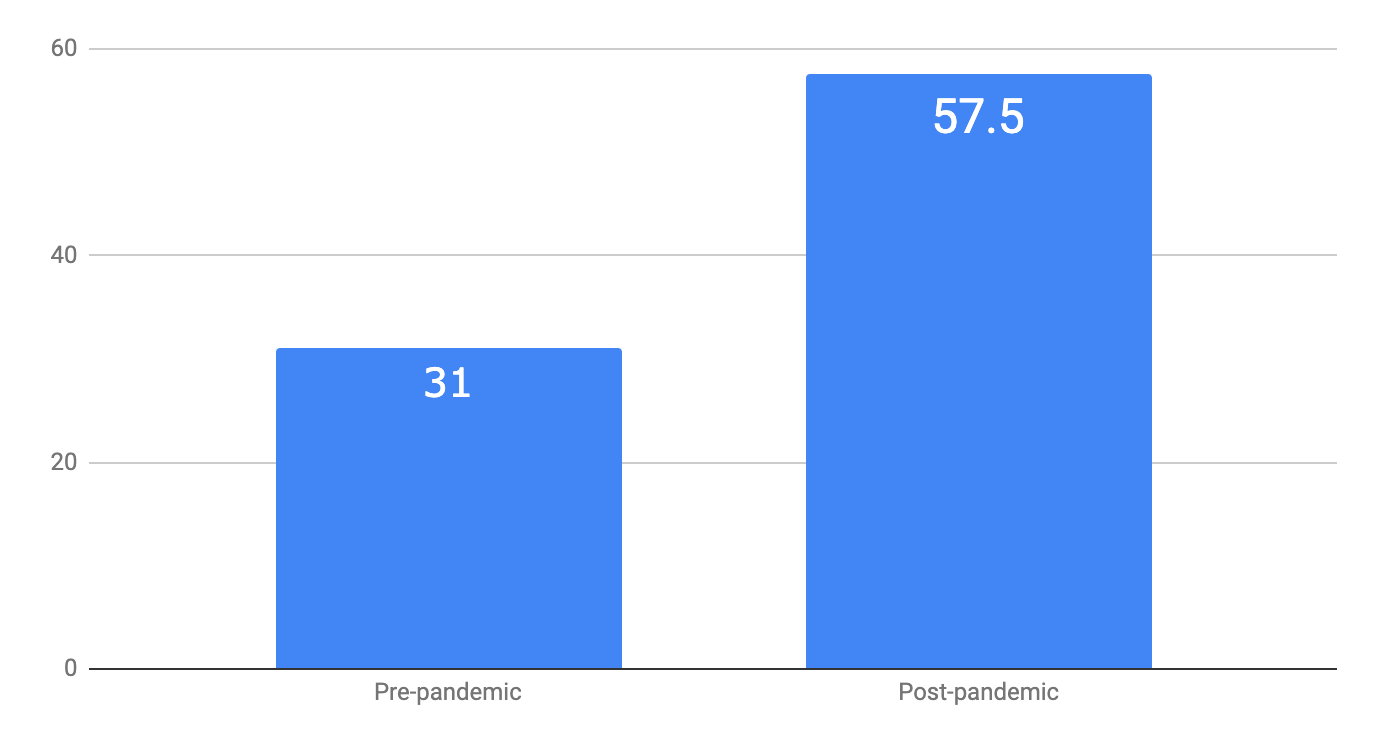
One of our core values is that we are customer obsessed – by making sure that we did the right thing for the customer our NPS (Net Promoter Score) went from 31 to 57.5!
It validated what was instilled in us at Techstars where the motto is “Give First”.
Tenzo Net Promoter Score
Lesson 3 – Sales: Never stop selling!
We didn’t believe that we would close any sales during the lockdown as all our potential customers would be focused on navigating the biggest crisis our industry has ever faced. That turned out not to be the case. Many potential customers felt they needed Tenzo more than ever to reopen even stronger! We even ran a marketing campaign on that theme.
We developed a new strategy in order to generate leads which relied on two key components:
-
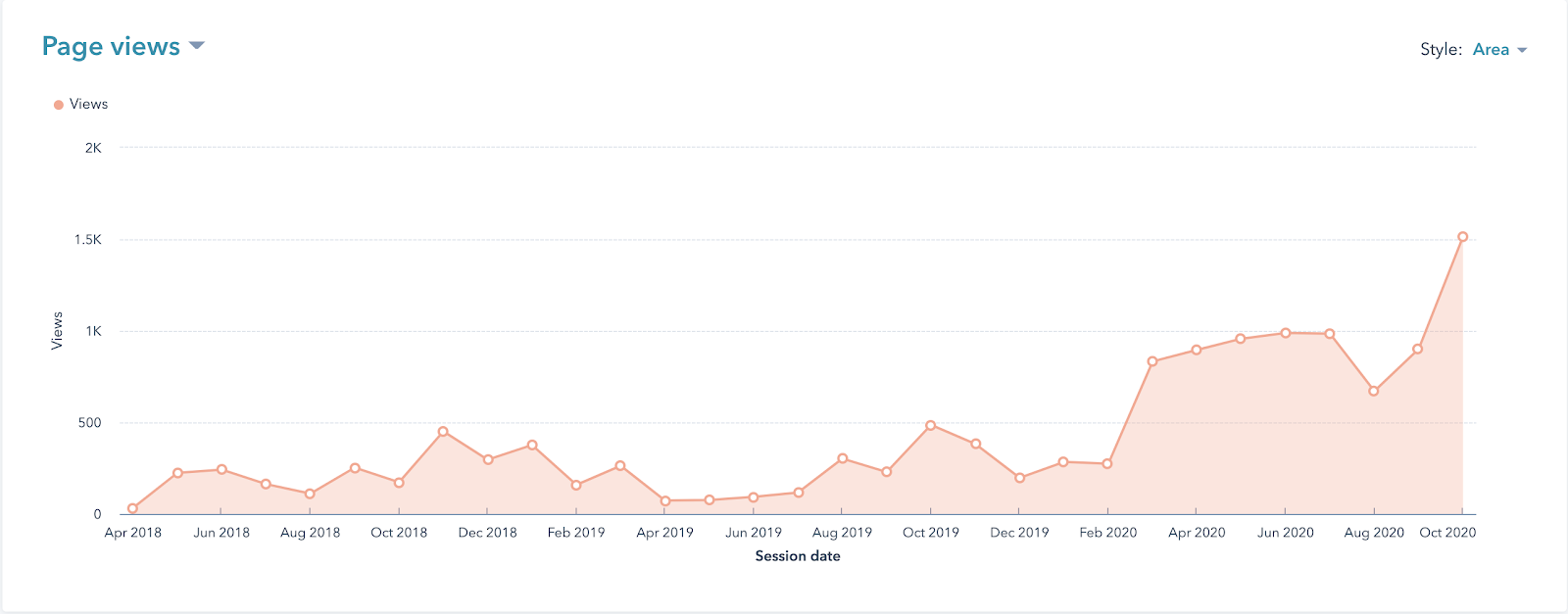
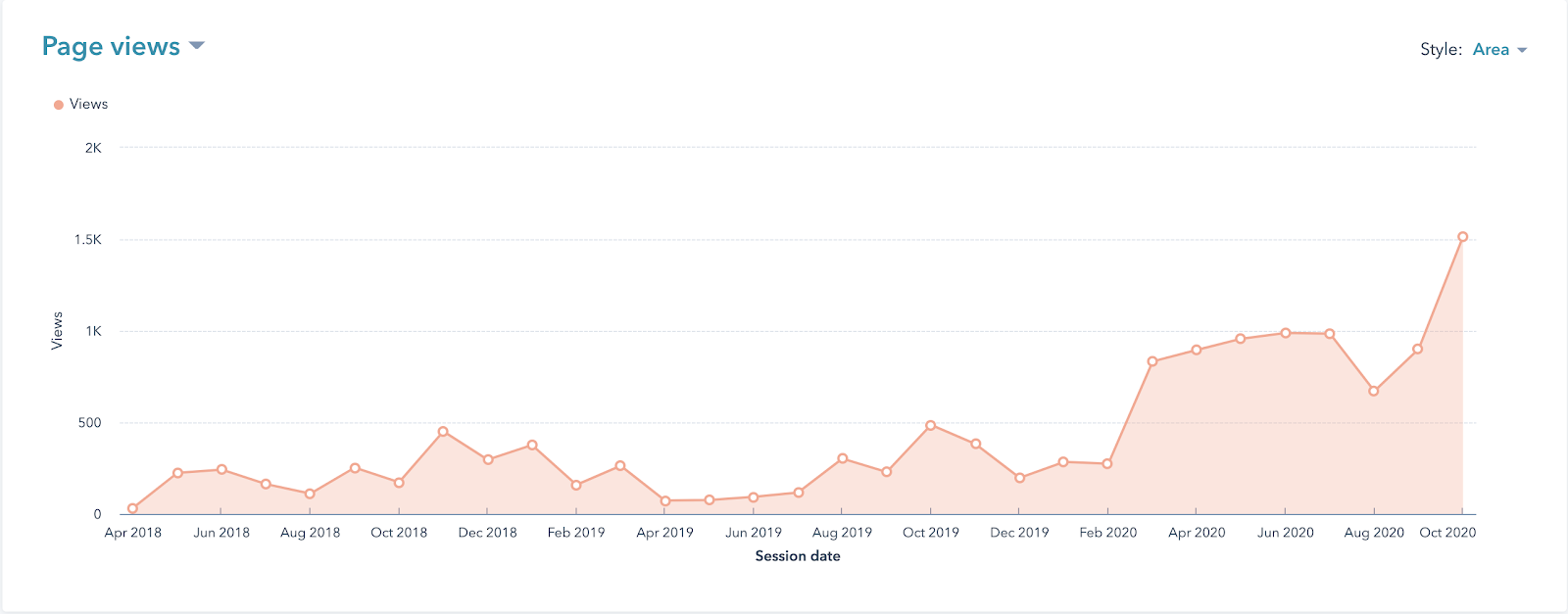
Adapt to changing customer behaviours: For the first time in their lives, restaurateurs weren’t on the floor of a restaurant – they were all at home on their phones and computers. This led to a huge focus on content – we invested time to write guides and share insights to help our customers adapt to this new reality. This came in the form of our blog as well as our podcast. Some of our most read pieces include how to optimise your restaurant’s online presence, tips on starting dark kitchens, and how your Tenzo toolkit can support you. Our readership grew 8x over this period generating an incredible amount of high-quality leads (see graph below).
Find new sources of pain that you can help address: Partners are at the heart of what Tenzo does: we pull data from a number of partners, whether that’s the Point-Of-Sale (POS), the labour scheduler or the inventory tool, to bring together these sets of data in one unified view for our customers. What’s more, our partners were all hurting too – from POS companies laying off over 50% of their workforces, to inventory systems furloughing most of their staff – our friends were also in trouble. What this also meant was that they couldn’t solve all problems themselves anymore – they needed to partner to help fill gaps in their customers’ data needs (in analytics, or A.I.). We’ve capitalised on this by:
-
Working with a number of our close partners in various formats – webinars, podcasts, blogs, small campaigns, case studies, etc.
-
Launching a partner Slack to help ease communication amongst our partners –– again all working remotely. Partnership referrals is now our top lead source and we will be doubling down on this in 2021.
-
Follow the market as it evolves: In terms of customers, we have been focusing on three main targets where we’re seeing real growth:
-
Asia – although the explanations for why vary, it is clear from our customers that they are not feeling the impact of COVID as badly as Western nations. We now have a number of prospects, paid pilots and customers in Australia, Malaysia, Singapore & Hong Kong.
-
Dark or cloud kitchens – we’ve had a number of conversations with large cloud kitchen operators across the world and have been helping lots grow in the UK.
-
Enterprises – data that is coming out of China suggests that many mom & pop restaurants have closed down permanently but recognisable brands are thriving.
-
With a lot of people now working remotely, having customers jump on video calls for demos was no longer a hurdle meaning that we have continued to sign big deals including TGI Fridays in Australia, Nando’s in Malaysia, Bavet in Belgium, Taglia in Texas and Bujo Burger in Ireland.
Lesson 4 – Product: Look at where the ball is going
Turning to product, our advice would be twofold:
Create leverage for your teams: Product was increasingly becoming a bottleneck for us, and we wanted to make sure we could uncap our growth. Our sales and customer success teams need to be able to delight customers without worrying about whether the product could deliver. Specifically, we focused in two key areas:
-
Enable a self-signup flow: We want to make it possible for a customer to sign up to Tenzo without ever needing to talk to a sales person, reducing the burden on our Customer Success team, and driving revenue activation.
-
Develop a set of self serve tools: Our Customer Success team spend too long helping customers get set up, or completing simple administrative tasks. We’ve set out on a journey to ensure that customers can be completely self-sufficient – they shouldn’t need to talk to our success or support teams at all! We built tools including an admin portal, budget loader, report discovery tool and many others.
-
Build for the customers you want, not the customers you have: Here we had to ask ourselves how would we respond in this new world. Connected to the above customer trends this meant:
-
A product that worked in Asia – thankfully enabled by already being localised, but also pushed us for a greater focus on Asia focused integrations – GiveX, Bepoz, Micros, Deputy, etc.
-
Dark or cloud kitchen support – here we’ve worked with partners like Deliverect who are helping customers launch in a delivery world.
-
Get ready for Enterprise – specifically, we’ve been focused on:
-
-
-
OAuth / Single Sign-on (the ability for customers to use recognised sign-in services such as Google or Microsoft to avoid their users having multiple logins that they need to remember).
-
Sharding (the ability to break up one’s data into two or more smaller chunks, called logical shards, allowing us to scale infinitely).
-
Micro-services (to enable a more scalable approach).
-
Understanding that our biggest problem was getting data into Tenzo in a scalable way allowed us to focus on building our “data manager”, a tool that will enable us to load data into Tenzo more quickly, easily and accurately. Over the past 6 months we have spent a lot of time building out the ETL (Extract, Transform, Load) infrastructure that supports “data manager”.
Lesson 5 – Engineering: Scalability is key
Here we’ve focused on ensuring we are set to scale – but broadly this has revolved around 3 key areas:
Move everything to microservices: The old monolithic architecture has to die and we used the opportunity of fewer customers online to move to a completely new architecture. Our main services – which we will cover in future tech blogs are now:
-
Authentication service: responsible for managing authentication across all our microservices and providing single-sign-on, etc.
-
ETL (Extract, Transform, Load) service: enabling us to load data faster and more seamlessly than before.
-
Cards / Insight service: the heart of our analytics engine – showing whatever data you want!
-
Forecasting service: using A.I. to predict sales.
-
-
Embracing serverless: In an attempt to both make our cost structure more variable (needed in a volatile world!) and also enable us to super scale, we’ve migrated a decent portion of our workloads to serverless technologies – specifically AWS Lambda, and AWS Fargate.
-
Remove legacy code: As with any company, we have acquired technical debt over time that has hampered our ability to be nimble. Having some breathing room during lockdown enabled us to focus on some housekeeping.
The net of all of this is our engineering team now has created significantly more capacity – rather than spending days debugging legacy code, or solving requirements issues across services in a monolith – they’re now freed up to build the next great feature at Tenzo.
Lesson 6: Funding – Cash is King
We’re a venture-backed, loss making startup – as such, our bank balance is a critical dimension to our success. It’s the second most common reason startups fail.
In our relentless pursuit of more cash, we learned a few key lessons:
-
Good ideas still attract funding: We were successful in our application to Innovate UK to help restaurants minimise on food waste. We’re very excited at the prospect of partnering with Innovate UK to help the hospitality industry save over £100m in food waste by 2025, and a grant is clearly an attractive form of funding for Tenzo.
-
Look for cheap sources of capital: Whether it’s grants or loans, we found a lot of attractive opportunities for fundraising. Clearly governments in both the US and the UK had schemes available, and both helped – but we continue to look beyond just equity funding as a way to enable our growth.
-
Negotiate, negotiate, negotiate: It was also an opportunity to talk to our own vendors – through many supportive partners (that we won’t forget!) we were probably able to take 10-20% of our total cost base out without needing to impact our people.
-
Keep communicating: We’ve found that communicating regularly with existing investors has been hugely helpful – both in terms of assessing the landscape, but also knowing they had our backs if we needed help. Shout out in particular to Kent and S28 for their help.
Where did we end up?
So far — so good: we’ve come back in a big way:
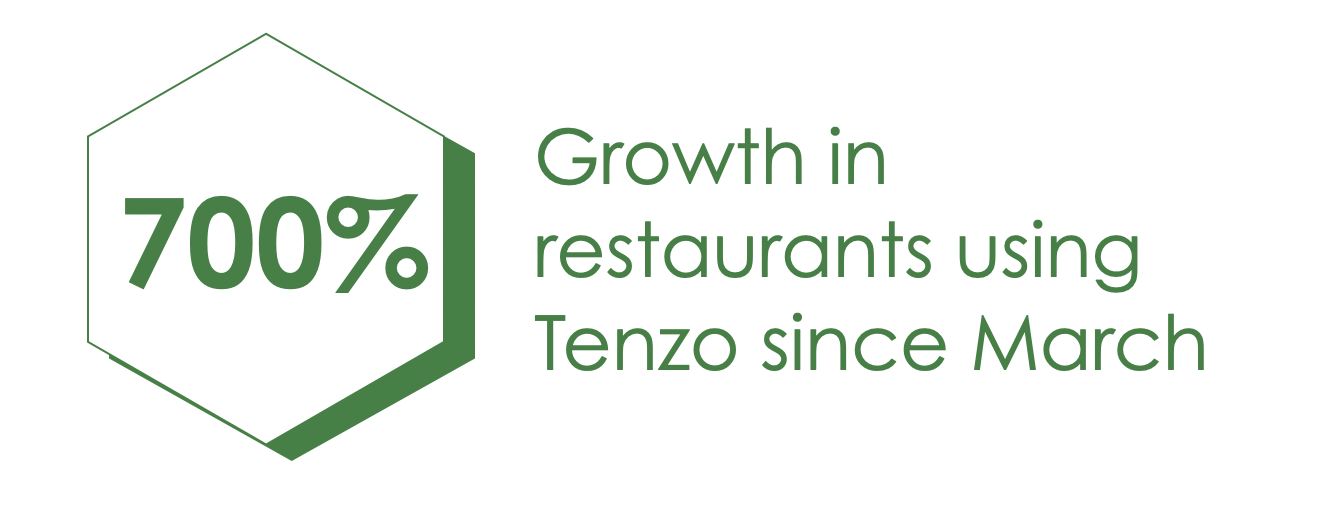
Beyond that, we’ve had a number of other big wins in 2020 which you can read about here.
What’s next?
Looking forward to 2021, we are more excited than ever about Tenzo’s prospects! We will finish the year with higher revenue than we started the year, we have secured funding from Innovate UK for our product, we’ve had great feedback from our customers, we have a number of ongoing conversations with global food brands as well as small & medium chains of restaurants and, most importantly, a wonderful team that works tirelessly to achieve these incredible results.

Cover Photo by Ethan Sykes on Unsplash
The post Navigating a pandemic: how we lost 80% of revenue before gaining more appeared first on Tenzo.
]]>What a year it’s been, we’re having a look at Tenzo’s 2020 results. We started 2020 growing 10% month-on-month and gearing up to expand the team to take full advantage of the numerous enterprise pilots we were running and to serve our ever-expanding SME customers in 10 different countries. Though we were hearing about a […]
The post Tenzo’s 2020 Results: A year like no other appeared first on Tenzo.
]]>What a year it’s been, we’re having a look at Tenzo’s 2020 results. We started 2020 growing 10% month-on-month and gearing up to expand the team to take full advantage of the numerous enterprise pilots we were running and to serve our ever-expanding SME customers in 10 different countries.
Though we were hearing about a novel virus in Wuhan, like most did not think much of it. That is until the UK announced its first case at the end of January – it all started moving very quickly from that point on, with Italy and France announcing lockdowns and the UK following shortly after.
The year has certainly been unprecedented (our new favourite word) and things are far from normal, but we wanted to take a moment to look back on 2020 and celebrate some of the wins that have made this year the best in Tenzo’s history so far!
1) We will end the year with more customers than at the start
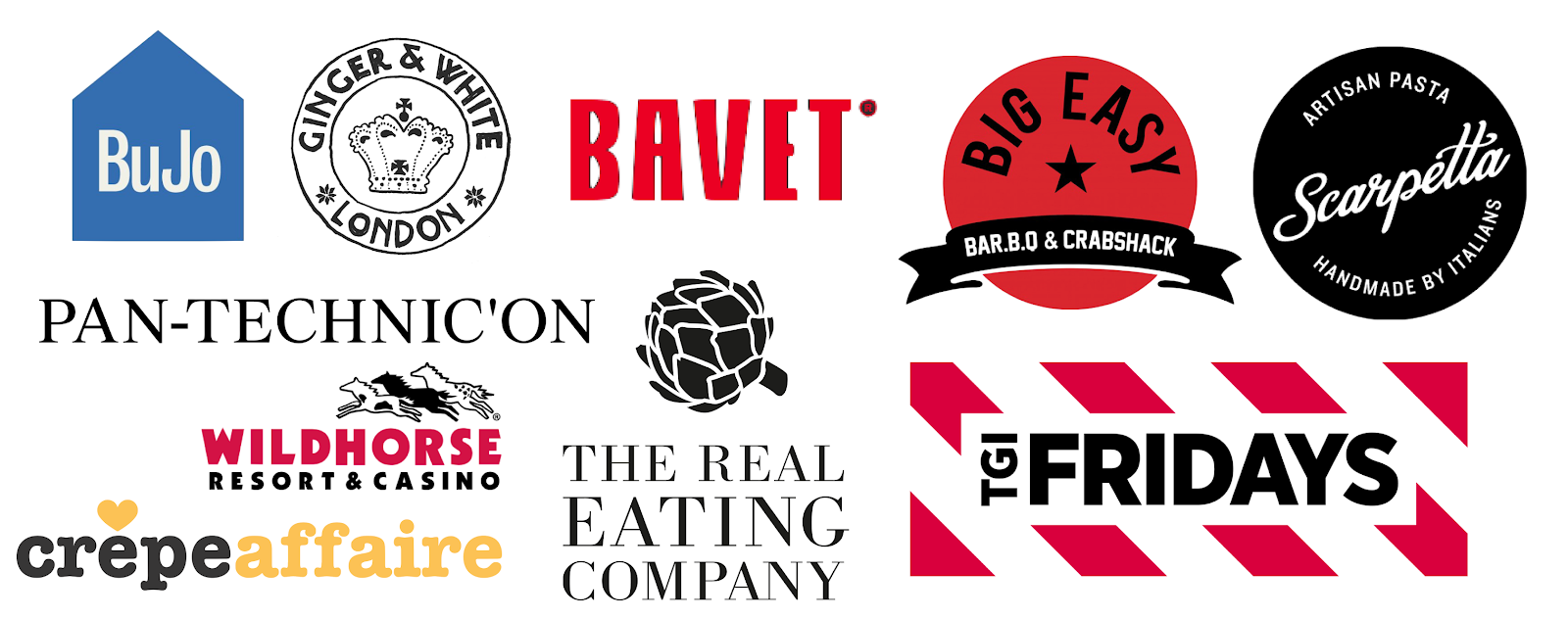
This has to be the biggest win of the year. Despite Covid and subsequent lockdowns heavily affecting the restaurant industry, our customer base still increased by 15%. Even in the depth of the first lockdown, we were signing new customers! We have focused our customer acquisition strategy on three main targets:
1. Asia – although the explanations for why vary, it is clear from our customers that they are not feeling the impact of COVID as badly as those in Europe or in North America. We now have a number of paid pilots and customers in Malaysia, Singapore & Hong Kong.
2. Dark or cloud kitchens – the biggest trend to come out of lockdown, dark and cloud kitchens need analytics and good forecasting just as much as traditional restaurants. We are having conversations with large cloud kitchen operators across the world and have been helping a number grow in the UK.
3. Enterprise businesses – data that is coming out of China suggests that unfortunately many mom & pop restaurants have closed down permanently but that recognisable brands are thriving.
2) We helped increase Nando’s labour productivity by 15%
Our work with our enterprise clients has shown some great results especially in the realm of more accurate sales forecasts.
By reducing their forecast error by 25% and putting a mobile-enabled labour planning process in place, we have improved the labour productivity (i.e. sales per hour of labour paid) for Nando’s in Singapore and Malaysia by 15%.
3) We supported Qoot in making an additional £365,000 of revenue
Not only were we able to help Scot Turner, VP of Operations at Qoot save 15% in labour costs, we helped them identify opportunities to add revenue from his existing estate – Tenzo’s BI tool has helped Qoot clock up £365,000 in additional revenue. Read more about this case study here.
4) Our partnership program increased by 100%
.png)
Partners are at the heart of what Tenzo does: we pull data from a large selection of partners, whether that’s POS, labour schedulers or inventory tools, to bring together these sets of data in one unified view for our customers.
We’ve focused on improving relationships with our close partners this year – doing webinars, podcasts, blogs, email campaigns, case studies, and more together with them. We also launched a partner Slack to help ease communication between Tenzo and all of our fantastic partners.
We realised that our product can help them to solve the pain that they were feeling when trying to help their customers get access to their data. Partnership referrals are now our top lead source and we will be doubling down on this in 2021.
New partners this year include Square, Toast, Zapier, Shopify, RotaReady and many more.
5) We’re helping the restaurant industry save £100m by 2025 with the help of Innovate UK funding
We were successful in our application to Innovate UK to help restaurants minimise on food waste. We’re very excited at the prospect of partnering with Innovate UK to help the hospitality industry save over £100m in food waste by 2025.
6) We grew our blog readership by 8x
We wanted to do all we could to help our customers navigate this new reality and as part of that wrote guides and shared insights about how to adapt. This came in the form of our blog as well as our podcast. Some of our most read pieces include how to optimise your restaurant’s online presence, tips on starting dark kitchens, and how your Tenzo toolkit can support you. Our readership grew 8x over this period generating an incredible amount of high-quality leads.
7) Our NPS score nearly doubled this year!
In 2020 we did everything we could to support the industry. Given that we have first-hand experience in running restaurants, we knew that bills would be impossible to pay with no revenue coming in.
We didn’t want to add to this pressure, so we quickly told our customers that we would pause their billing if they were closed. We also wanted to help our customers adapt to this new situation as we felt that it was going to change habits for good, so we launched a weekly newsletter just for them with our latest tips on how to get their products and services to their customers.
One of our core values is that we are customer obsessed – by making sure that we did the right thing for the customer our NPS score went from 31 to 57.5!
8) We released loads of new features
Turning to product, our strategy was twofold:
1. Making it as easy as possible to get Tenzo users set up
2. Making sure we are enterprise ready.
Understanding that our biggest problem was getting data into Tenzo in a scalable way allowed us to focus on building the ‘data manager’, a tool that will load data into Tenzo more quickly, easily and accurately than ever before. Over the past 6 months we have spent a good deal of time building out the ETL infrastructure that supports this new ‘data manager’.
To further reduce the time it takes to onboard new customers, we built new tools for customer success including an admin portal, budget loader, report card discovery tool and many more.
In order to be enterprise ready, we have built out a number of components:
-
OAuth / Single Sign-on (the ability for customers to use recognised sign in services such as Google or Microsoft to avoid their users having multiple logins that they need to remember)
-
Sharding (the ability to break up one’s data into two or more smaller chunks, called logical shards, which will allow us to scale infinitely)
-
Micro-services (to enable a more scalable approach)
9) Every single one of our TrustPilot reviews were a full 5 stars
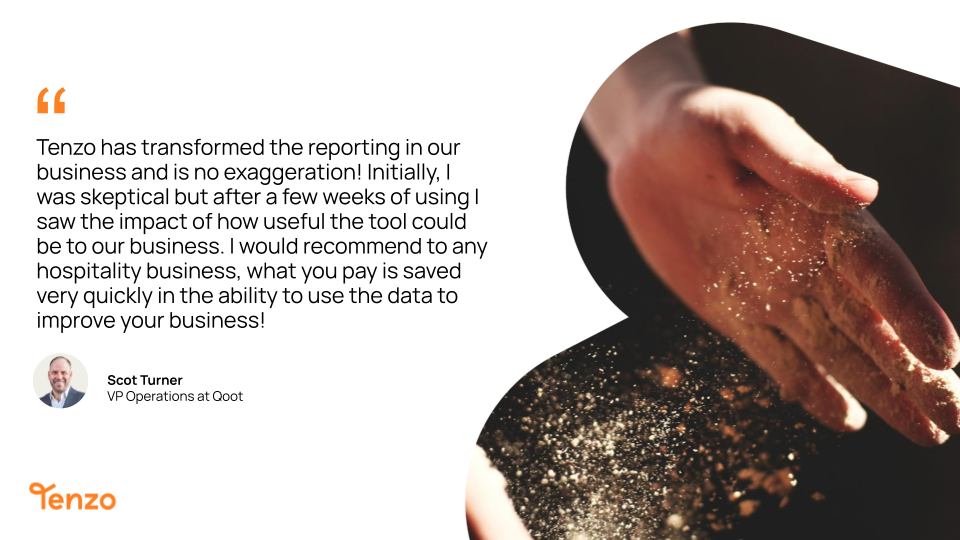
We have had a number of lovely reviews from our customers on TrustPilot this year including from Robb at Upham Group, Thom at Pizza Pilgrims and Scot at Qoot. We’d like to thank all our customers for their continued support!
10) Our wonderful team has started growing again
None of this would have been possible without our wonderful team! They have been incredibly resilient this year. They have helped us set the tone for what Tenzo will be like going forward by refining our core values and making sure we are the best we possibly can be. We’re so excited to be adding new members to the team to help us grow in Asia, deliver more savings for our customers and bring on new restaurant chains into the Tenzo family!
Looking forward to 2021, we are more excited than ever about Tenzo’s prospects. We will finish the year with higher revenue than at the start, we have secured funding from Innovate UK for our product, we’ve had great feedback from our customers, we have a number of ongoing conversations with global food brands as well as small & medium chain restaurants and, most importantly, a wonderful team that works tirelessly to achieve these incredible results.
The post Tenzo’s 2020 Results: A year like no other appeared first on Tenzo.
]]>Renewing our Values as a living document We believe that our values are Tenzo’s beating heart. We strive to ensure that these align with our mission to help food and beverage businesses become less wasteful, reduce the impact that humanity is having on the planet and create more efficient fast-growing businesses. But after a lot […]
The post How renewing our values became a full team effort appeared first on Tenzo.
]]>Renewing our Values as a living document
We believe that our values are Tenzo’s beating heart. We strive to ensure that these align with our mission to help food and beverage businesses become less wasteful, reduce the impact that humanity is having on the planet and create more efficient fast-growing businesses. But after a lot of growth over the last couple of years, we realised that our initial values needed some revisiting to make them feel more authentic, less generic and reflect what working at Tenzo is really all about. So we’ve looking at renewing our values so they align with how we see ourselves now.
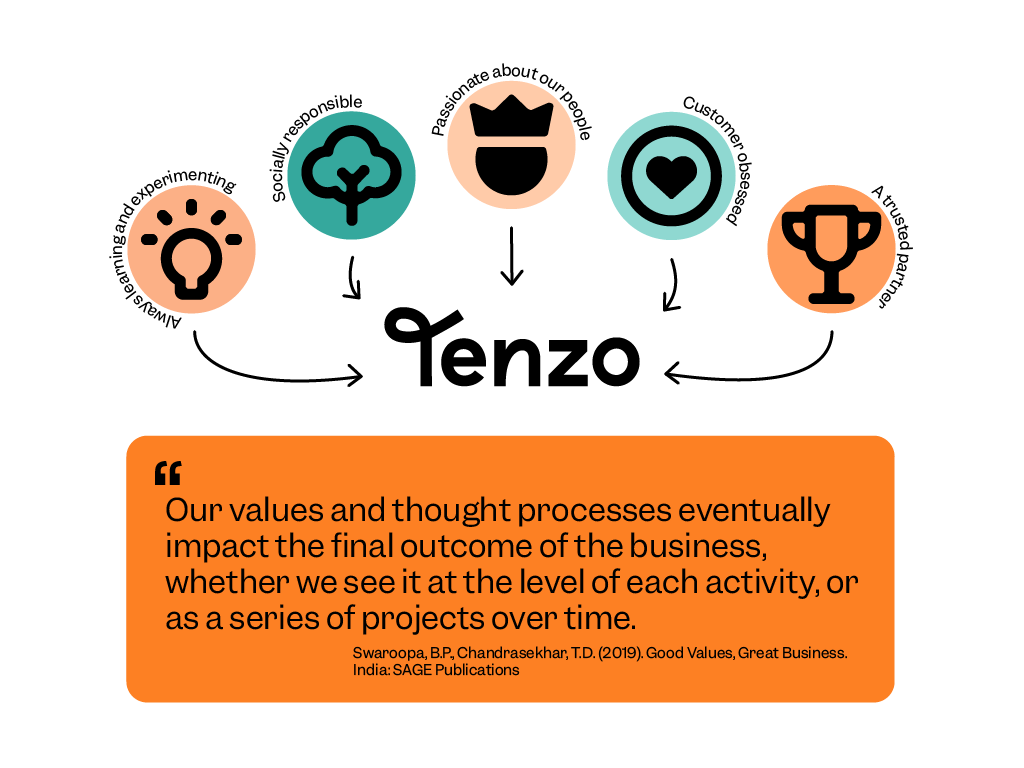
Team effort
To achieve this, last November we got every team member, regardless of their job title, type of contract, or location, to take part in our “Values Workshop”. Having the whole team involved ensured that everyone had a voice in this process.
During the workshop, we asked the team to think about their individual experiences as well as discussing the current values in small groups. Everyone filled out this worksheet so that we were then able to come together and debate everyone’s ideas.
What was interesting to witness during the process was how the refreshed values began to form organically from the different opinions and priorities each person had. This was a clear reflection of the fact that although we all come from diverse backgrounds, we are aiming for the same mutual goal.
That said, we definitely had moments where we didn’t agree, but we listened to what others had to say, respected each other’s opinions and had constructive conversations about challenges we were having as a business.
At the end of the session, each group nominated a spokesperson from their group to support the next phase of the value refresh journey. We closed the day with celebratory pizza and beers – there was definitely a vibe of excitement and pride in the air as we knew this was the beginning of something big.
Values Squad
Having gathered all the workshop feedback, we asked each group spokesperson to join Christian and Adam to represent their workshop group – the Values Squad was born.
The squad’s job was to consolidate, prioritise and challenge the ideas gathered to find out how we should reshape our values.
We wanted to make sure that the new set of values would:
-
Build on Tenzo’s mission and vision;
-
Set the morale compass for the team and strengthen our company culture; and
-
Align with the values of our customers and partners within the F&B ecosystem.
The new values
After two months, countless drafts and many meetings, we were ready to unveil the refreshed values to the Tenzo team.
Our founders had taken everything we put forward in the Values Squad and gone away to come up with the best wording to embody what Tenzo would strive to be and presented the final values to us all in a company-wide meeting.
Without further ado, introducing Tenzo’s Company Values. We are:

Passionate about our people
Create a supportive and diverse environment for our people to grow
 Customer obsessed
Ensure our customers succeed and helping them drive efficient and sustainable growth
 Always experimenting and learning
Move fast to create elegant and innovative solutions
 A trusted partner
Build trusted and secure services that put the customer’s needs first
 Socially responsible
Strive for greatness as a company while improving the society and environment we live in
What has changed:
We have now:
-
Streamlined our values from 7 to 5, which has made them more memorable;
-
Included the use of verbs when describing the values to give a sense of momentum (create, ensure, move, build, and strive);
-
Tailored our values to be more relevant to the team so they can better identify with them.
Living our values
We completed our values refresh at the beginning of 2020, before any of us could predict what would happen this year. Whilst we have begun to put our values into action through a range of initiatives, we, like other businesses, are continuing to adapt to our new working-from-home environment.
A few ways we’ve brought our new values to life so far include:
-
Setting up a pulse-check survey about the values and asking the team to contribute any ideas on how we can keep bringing them to life on a daily basis;
-
Creating sub-teams focusing on initiatives associated with each value, including our Diversity and Inclusion Squad, for example; and
-
Adding our value icons as emojis in Slack so that they can be celebrated on a day-to-day basis.
There is even more room to grow and much more we would like to do. We are certain, now more than ever, that even though we don’t see our values framed and hanging on the walls of our office every day, we can keep them present in our actions and decision-making at Tenzo.
What’s Next…
Watch our for our next blog post on culture to find out how we’re continuing to operationalise our values, and to understand more about the values themselves.
The post How renewing our values became a full team effort appeared first on Tenzo.
]]>London, November 13, Food waste is a huge issue in the UK hospitality industry. The sector wastes over 1 million tonnes of food every year, amounting to over 4.5 million tonnes in CO2 emissions and costing the industry over £3.2 billion in lost revenue. Tenzo and Innovate UK ‘s newest project is set to change […]
The post Innovate UK and Tenzo announce project to save UK restaurants £100m appeared first on Tenzo.
]]>London, November 13, Food waste is a huge issue in the UK hospitality industry. The sector wastes over 1 million tonnes of food every year, amounting to over 4.5 million tonnes in CO2 emissions and costing the industry over £3.2 billion in lost revenue. Tenzo and Innovate UK ‘s newest project is set to change that.
- Food waste contributes to £3.2 billion in lost revenue & 4.5 million tonnes of CO2 emitted in the UK restaurant industry
- £220,000 in funding from Innovate UK will kickstart Tenzo’s AI forecasting project
- New forecasting solution will be used by current Tenzo customers such as Nando’s, Pizza Pilgrims, The Fat Duck and 10,000 more locations by 2025
- Platform will reduce CO2 emissions by 800,000 tonnes by 2025 and save restaurant industry £100 million in costs
Co-funded by the UK’s innovation agency, Innovate UK, Tenzo is embarking on a £500,000 mission to create the most accurate sales forecasting platform for restaurants using artificial intelligence and machine learning. This will improve on Tenzo’s existing forecasting software which already increases forecast accuracy by 30-50% compared to traditional methods.
This new platform will forecast sales at an hourly and item level allowing operators to both order and prepare accurate amounts of food and significantly reduce the amount of waste generated.
We already know that 2020 has been a catastrophic year for the restaurant industry as a whole. Hospitality has always been a tight margin business, with successful restaurants operating on a 3-5% profit margin, but Covid-19 has made these already slim margins even slimmer. Just yesterday, Young’s Pubs announced that the last six months have been one of the toughest periods in their 189-year history. The situation is grave: if restaurants want to survive, operators simply cannot afford to throw away food.
“Reducing the amount of food wasted has always been a priority for me. This funding from Innovate UK will allow us to provide the tools for restaurants to get one step closer to carbon neutrality and significantly reduce the effect our industry has on the planet. Additionally, our accurate forecasting will save millions in costs in a sector that has been severely economically impacted by Covid-19.” – Christian Mouysset, Tenzo CEO
and Co-founder.
Tenzo is committed to helping restaurateurs survive this unprecedented period with the help of accurate data and forecasts. This new solution should therefore save the industry £100 million in wasted food by 2025.
Customers testing out the prototype have already been impressed. Moji Neshat, CEO of Nando’s Singapore has stated, “Tenzo’s forecasting solution combines machine learning with an easy-to-use mobile app for restaurant managers. This has helped us increase our labour productivity by 15% and has continued to perform well since the Covid-19 outbreak.”

But beyond saving cost, what people don’t realise is how much food waste contributes to global warming in the form of carbon emissions. In fact, if food waste were a country, it would be the third largest emitter of CO2 after China and the US and 30% of that waste comes from the restaurant industry. But thanks to this latest innovation, we hope to reduce carbon emissions by 800,000 tonnes by 2025.
The coming months and years may be tough for the restaurant sector both financially and environmentally, but Tenzo is now poised to give restaurateurs the tools they need to be as successful as possible.
The post Innovate UK and Tenzo announce project to save UK restaurants £100m appeared first on Tenzo.
]]>During one of our monthly Lunch & Learns, Ben, our Full Stack Developer, showed us how to use Blender to create a 3D rendering. We were all trying to reproduce the first picture on the left top corner—and these were some of the results! There is huge diversity within Tenzo — not just in nationalities […]
The post “The whole is greater than the sum of its parts”—The Tenzo Gestalt philosophy! appeared first on Tenzo.
]]>During one of our monthly Lunch & Learns, Ben, our Full Stack Developer, showed us how to use Blender to create a 3D rendering. We were all trying to reproduce the first picture on the left top corner—and these were some of the results! There is huge diversity within Tenzo — not just in nationalities (we have 14 and growing!), but in our personalities and ways of thinking as well. ️
What is Diversity?
Diversity refers to what makes each of us unique.
It can range from gender, age and ethnicity to religion, sexual orientation, physical abilities and ideologies. It also includes a person’s life experiences, how they solve issues and contribute to the company’s overall culture.
Why is it important in the workplace?
When people have different life experiences and see the world in different ways, creativity comes naturally, and new approaches to problem solving emerge.
As an example, our Customer Success Managers all speak different languages in addition to English — from Malay to Ukrainian, from French to Spanish and Italian! Thanks to this, we have found that we are able to connect on a much deeper and personal level with the customers we interact with every day; they feel better understood and free to share their thoughts, and in turn we are able to better shape our support to their specific needs, thus creating a long-lasting, healthy relationship.
Moreover, by being part of a diverse team each individual can grow professionally in multiple ways, as they are constantly exposed to new ideas and skills, different approaches to work and interpersonal relationships. On a personal level, learning about different cultures is something that opens your mind and makes you see the world in a new way.
Not only is diversity great from a personal growth point of view — it also prevents stagnation and leads to higher staff retention!
When you find the right harmony within a diverse team, you enhance each other’s abilities and achieve the best results!
How we value Diversity at Tenzo
We believe that an actual diverse environment comes not only from the different backgrounds of your team members, but from their mindset as well. If there can be complete open-mindedness about ideas and opinions, the result is a workplace where you finally know you can be who you are in all your uniqueness!
What do we do at Tenzo to ensure diversity?
Unbiased Recruitment Process
We want not only to hire diverse new candidates and enhance the company’s performance—at the heart of our efforts is the desire to create a safe place for all our team.
Some processes we’ve implemented to reduce unconscious biases to the minimum:
- Blind Hiring: our application tracking system masks all personal information related to candidates when they are in screening stages — additionally, we ask them a set of work-related questions even before seeing their CV. We give more importance to a person’s way of thinking than their University diploma.
- Equal opportunities survey: this helps us keep monitored the diversity dimensions among candidates.
- People Squad: we have a squad of Tenzonians (which includes members of HR, Product and Growth Teams) which anyone can join and where we have multiple initiatives, structured in bimonthly meetings to brainstorm new ideas and progress on ongoing projects! This allows employees to actively mould the diversity policies and feel like they truly own these initiatives.
We have multiple initiatives in place that allow our employees to work according to their needs:
- Flexible working: our hybrid in person/remote working options really get to the core of meeting the needs of each of us by letting us organise our time as better suits our agenda; this way we can better handle:
- Family care;
- Taking a pause when needed then working outside of hours;
- Spending more time with our pets (at Tenzo we love pets! )
- Working comfortably from our couch, a cup of tea in hand , on a Friday evening!
-
Summer remote working initiative: each of us can work 90 days during the summer abroad. This plan is designed to give more flexibility and an opportunity to travel and see family, which becomes particularly important as the Tenzo team is pretty international!
- Personal & professional development plans: we have PDPs that will allow you the chances and the time to help grow as you like, shaping it as you go and periodically reviewing it with your Manager.
- We ask “How are you?”, and we do care about the answer!
In order for us all to feel safe and to express our opinion, we ensure that people have the appropriate communication channels to say what’s on their mind.
From chats with members of our HR Team to weekly check-ins with your Line Manager and chats with our Founders or other colleagues, where the first question they ask will always be, How are you? And they will be ready to listen to your thoughts, both on your professional and personal life, hear of any challenges and help you grow and feel comfortable.
We all put time and effort into building relationships, so that when any person in our staff needs assistance, they feel comfortable asking for it.
Here are a few of the tips we use and which can really help with hearing about another person’s needs.
- It’s helpful to start with a data point — for instance, if the individual in question usually talks about their weekend plans and recently does not, one could start the conversation as “haven’t heard much on your weekend plans lately…”
- It is also really important to leave a pause, as at times, an instant reaction to the question is to say ‘I’m fine’ and move on. That pause gives the individual that space to go more in-depth into their mental state.
Anything that emerges from these conversations is heard and we try to help as much as possible; be it being close to a colleague if they need some support or suggesting they take a few days off to rest, we make sure to make everyone’s life better as much as we can!
What Next?
In the past six years of growing as a company we have accomplished multiple goals, from increasing gender balance, flexible working policies and more; however we never stop there! We are always looking at what step to take next and how we can do better.
If you’d like to join the awesome Tenzo Team, check out our Careers Page for open positions. And remember — always be your awesome self!
The post “The whole is greater than the sum of its parts”—The Tenzo Gestalt philosophy! appeared first on Tenzo.
]]>As part of our new values revamp, ‘values squads’ were formed for each of our five values to focus on how we can better live Tenzo values. We’ve already covered our first value ‘Always experimenting and learning’ in our previous blog, and today we’re spotlighting our second squad – ‘Socially Responsible’. When we originally renewed our […]
The post Socially Responsible: Tenzo Values appeared first on Tenzo.
]]>As part of our new values revamp, ‘values squads’ were formed for each of our five values to focus on how we can better live Tenzo values. We’ve already covered our first value ‘Always experimenting and learning’ in our previous blog, and today we’re spotlighting our second squad – ‘Socially Responsible’.
When we originally renewed our values last year, many on the team were keen to include a value that would keep us ecologically accountable – after all one of Tenzo’s main goals is to reduce the huge amount of food waste in the restaurant industry. We soon realised, however, that we weren’t just passionate about the environment but about many different social causes and wanted our value to encompass all these passions. Our ‘Socially Responsible’ value was born.
What is ‘Socially Responsible’?

As we assembled this new squad, we first wanted to define what we understood by ‘socially responsible’. We knew that we wanted to include environmental issues as this was something that Tenzo was built on, but we also wanted to make sure that we devoted time to other social issues.
We work with restaurants and as such, thought it would be more powerful to address issues faced in the wider f&b industry. We considered business interests, like actively working with businesses that pay living wages, treat their employees fairly, and that we are proud to be associated with. The restaurant industry also traditionally employs immigrants who are facing increased xenophobic and racist attitudes, so we wanted to discuss what we could do as a company to help.
We also looked at what we could do for the planet. Food waste is a huge carbon emitter, in fact, if it were a country, food waste would be the third largest emitter of greenhouse gases after the US and China. Tenzo is in a unique position to stop the generation of some of that waste, in fact we recently got funding from Innovate UK to further develop our forecasting solution which will eventually save 4.5 million tonnes of carbon dioxide from being emitted.
What we were already doing
So once we had defined our value more concretely, we looked at what we already did that lived that value. Recently, we switched all of our employees’ pension provider to an ESG (environmental, social and governance) fund that only invests when the investments meet these high standards. This change alone is apparently 21 times more effective at reducing your carbon footprint than giving up flying, going veggie and switching energy provider combined, according to Make My Money Matter.
In terms of Tenzo’s carbon footprint, our servers are what contribute most to it. We use AWS data centres to host our database however, we can choose which data centre to run the majority of our data through. We specifically use the AWS data centre in Ireland where they plan to be powered exclusively by renewable energy by 2025.
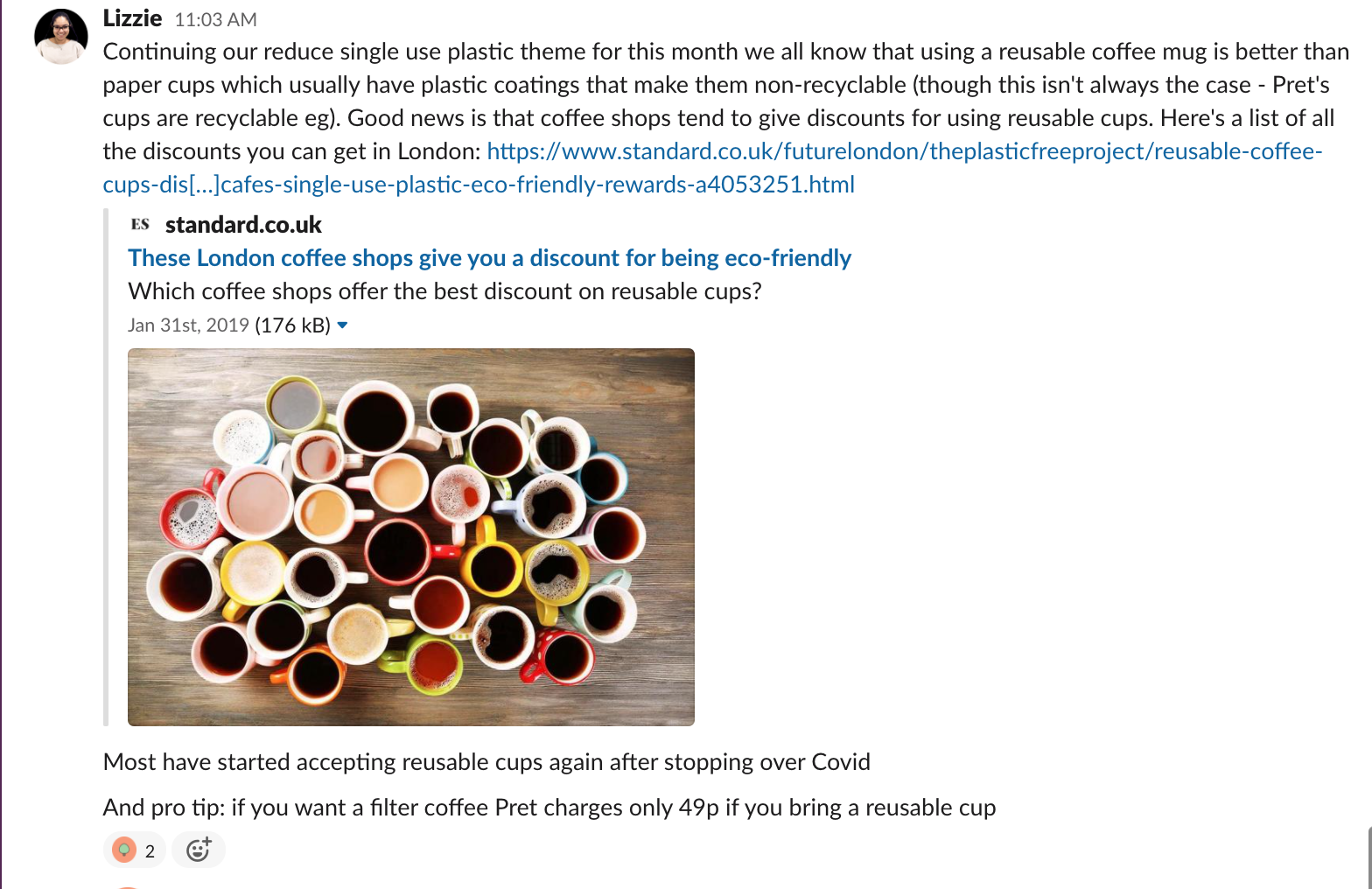 Tips and tricks shared with the team
But beyond these somewhat passive actions – we don’t have to make active decisions about our pension contributions each month or think about the data warehouses we use on a daily basis – we weren’t actively seeking out ways to live more responsibly.
The squad saw this as an opportunity, there was space to expand the team’s thoughts and activities by bringing the types of issues we wanted to address to the fore.
Next steps
The challenge was actually trying to narrow the scope of what we could do. There are so many issues that we are passionate about as a team, but we felt we could have the biggest impact on problems facing restaurants (like food waste or Brexit as examples) than other social issues. Further, since we are all currently working from home, we felt like this could be a good opportunity to introduce new habits not just at work but in our personal lives as well.
When it came to deciding how we should approach this value, we realised that we needed to separate our goals into big and small ones. As an example, significantly reducing food waste in the industry is a big goal and takes a lot of work on a long term basis. We discussed the possibilities of building solutions into the Tenzo platform by incorporating food waste eliminating features or food bank donation goals, for example. These are things we want to include eventually but will need to be developed from the ground up, taking a lot of time and not something we could do in the near term.
However, we also had small goals that we could achieve to make our difference as a company now. We devised a list of monthly themes that we could all participate in as a team. Not only would this be a great way of living our values, but also give the team a common goal to work toward while we’re not seeing each other as often as we might like – a bonding type activity if you will.
Our monthly themes
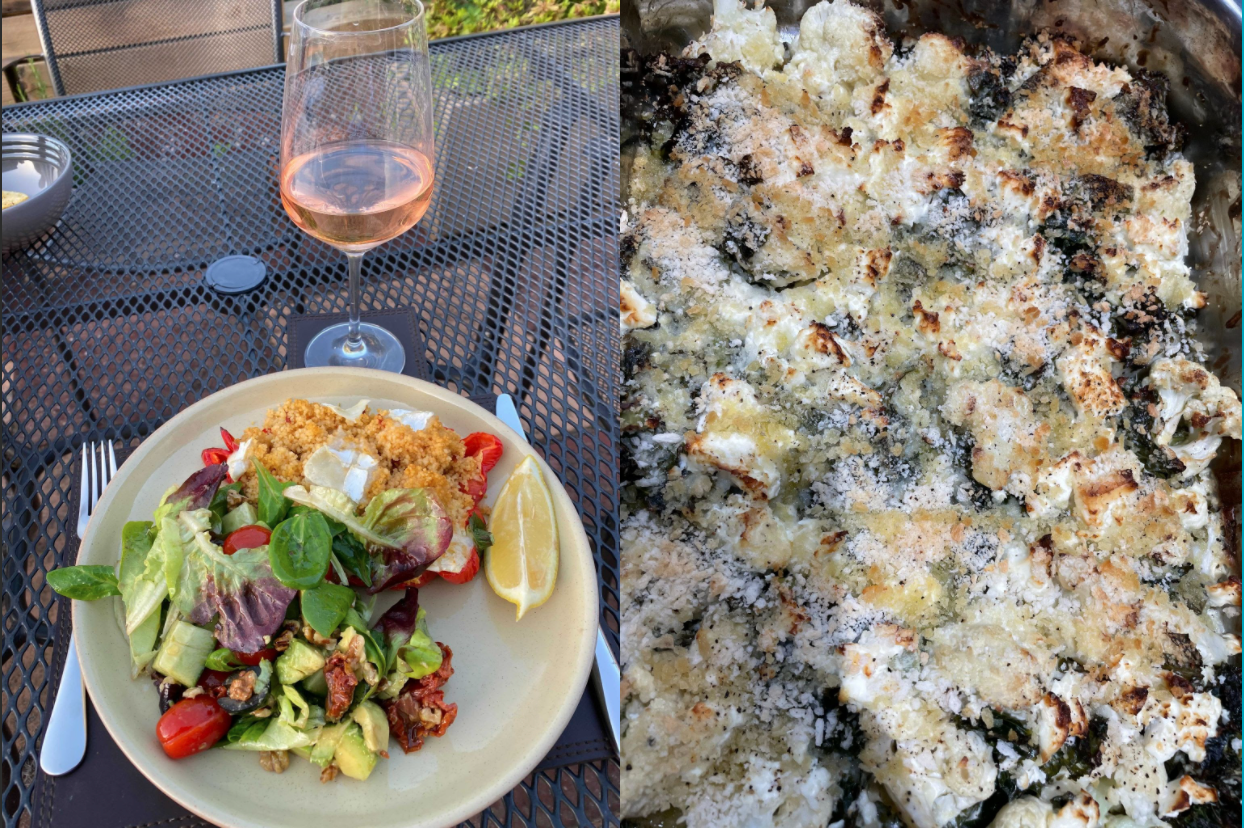 Some deliciously veggie meals made by the Tenzo team
So far we’ve had a vegetarian awareness month to encourage more veggie forward meals and reduce our meat consumption. We’re currently in the middle of single-use plastic reduction month, where we try to reduce the amount of plastic waste we generate. And we’ve planned a zero food waste month next, where we’ll attempt to reduce the amount of food thrown away.
We share tips and tricks, recipes, photos and more with each other as the month goes on. It’s been both a fun and rewarding experience so far.
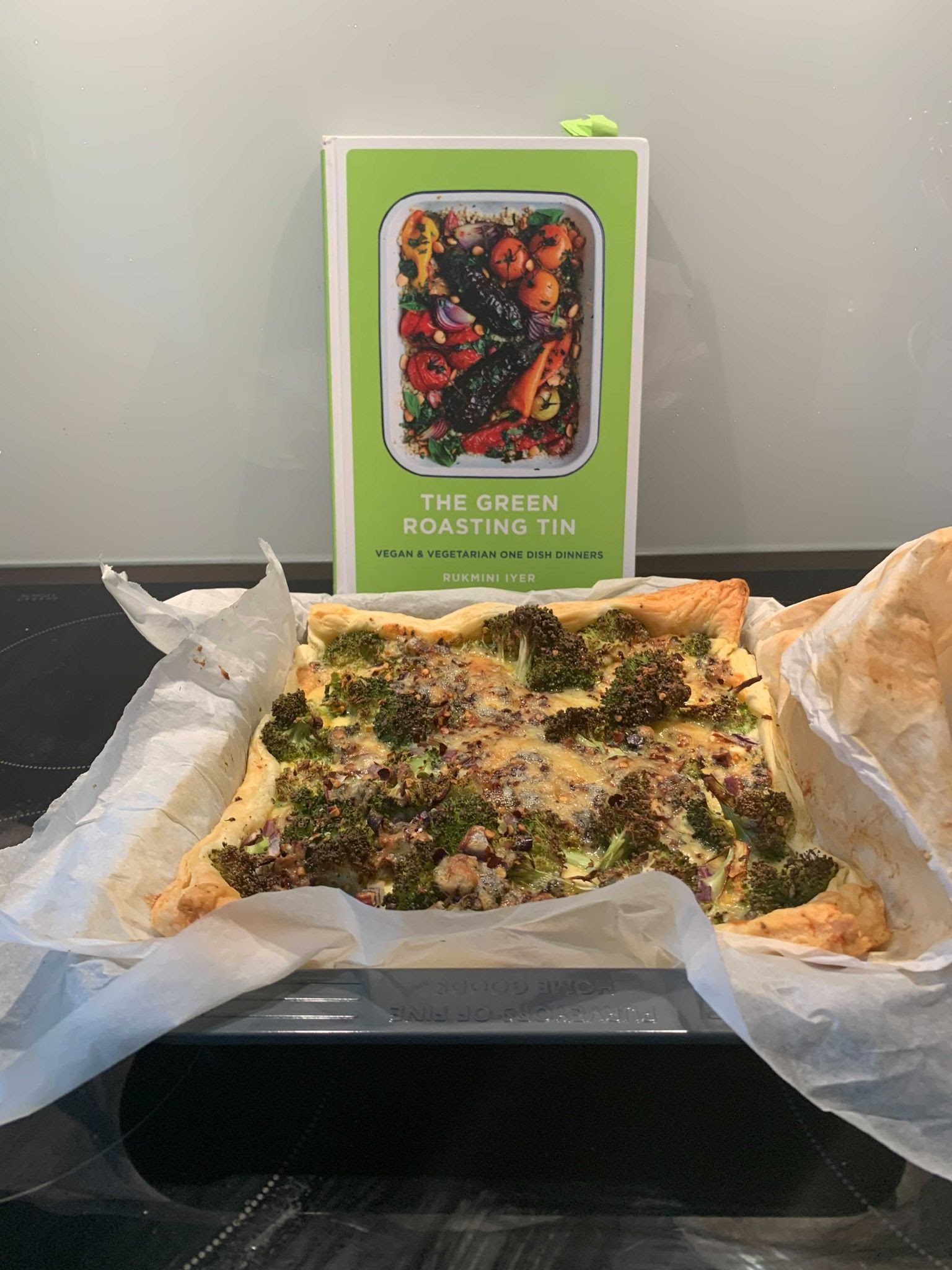 More veggie meals from the Green Roasting Tin
Future plans
In terms of the future, we plan to continue our monthly themes, but as we move back into a hybrid working model, we’ll be making sure that our office enables our socially responsible value. That will include having dedicated recycling bins for things like plastic bags and other difficult to recycle items like shampoo bottles that the team can bring in from home, finding a carbon neutral space, and having dedicated conference rooms for remote customer meetings rather than constantly traveling to meetings.
Once it’s safe to do so Covid-wise, we’ll also be encouraging group volunteering where members of the team will get together to volunteer their time to causes which are important to us.
We’re also keen to work with customers and partners with like-minded values, helping them with publicising their efforts on our platforms as well. We already work with the likes of The Vurger Co, and Angelina who are all dedicated to sustainability in their own ways, but we’d like to expand that list.
That’s it so far, but we are committed to keeping this conversation open, always looking for new ways to be socially responsible and getting the squad back together every quarter to keep us accountable. Check back in soon for our next value spotlight: Passionate about our people.
Cover photo by Tyler Casey on Unsplash
The post Socially Responsible: Tenzo Values appeared first on Tenzo.
]]>Part of our company-wide goals for 2021 is actively promoting and living our core values. To hold ourselves accountable and make sure the entire team gets involved, we’ve instituted squads for all of our values. Here, the leader of our first value squad, Dr Matt Brewer, Senior Software Developer at Tenzo, breaks down how we’re […]
The post Always Experimenting & Learning: Tenzo Values appeared first on Tenzo.
]]>
Part of our company-wide goals for 2021 is actively promoting and living our core values. To hold ourselves accountable and make sure the entire team gets involved, we’ve instituted squads for all of our values. Here, the leader of our first value squad, Dr Matt Brewer, Senior Software Developer at Tenzo, breaks down how we’re approaching this initiative and what’s on the cards for our first value: ‘Always experimenting and learning’.
When we renewed our values at the beginning of 2020, we thought that upholding them would be simple – we saw each other every day, we’d be able to encourage and steer each other in the right direction. But then of course the pandemic hit and we quickly realised that upholding our values when we were all at home and spread across the world would not be as simple as we thought.
As a response to this, we decided to set up ‘squads’ for each value with nominated leaders. These value squads would be responsible for a) critically assessing how we live each value today and b) producing initiatives and targets for the whole team on how we can improve. These squads are also responsible for holding everyone accountable on the targets set.
Since these squads are a new initiative and we’re still experimenting with how they will practically work and integrate with our team’s processes, it seemed like a good idea to start with the ‘Always Experimenting and Learning’ value. This is a value close to my own heart given I come from a research science background and this value was core to the ethos of myself and those I worked with back then.
Getting the lay of the land
Our first task was to take an in-depth look at how we are currently living this value, asking ourselves whether everyone feels they have the opportunity to learn and experiment in their roles, how many experiments are being done, and how we are communicating the results if so.
The main themes emerging from this research were around knowledge-sharing and lowering opportunity costs for more blue sky experimentation. The Tenzo team is a collection of highly intelligent people; where we are lacking is when it comes to sharing that knowledge with one another.
This ‘knowledge-sharing’ is particularly important as we know it can lead to inefficiencies when a member of the team can’t find resources from previous research for a specific task or if they repeat research already carried out by another colleague. Additionally, it can make it harder for new-starts to get up to speed without well-defined source material to use as a first port of call.
The second area we highlighted that could be improved is that we don’t have a process when it comes to conducting research or experiments. I think back to my school days where you would be forced to write exactly how you came up with a result: Introduction, Hypothesis, Methods, Results, and Discussion.
It’s not that we need to be as formal as say, a scientific paper would, but more so to make it clear what we did, why, and what the outcomes were, so that we aren’t repeating anything.
Initiatives
After looking at how we’re currently living our ‘Experimenting & Learning’ value, we came up with several straightforward goals and initiatives to help us better connect with this value. The first step is simple, we are encouraging the team to jot down any research or experiments they plan to (and do) conduct, be it bullet points or an in-depth presentation.
The idea here is that simply writing out what you plan to do often gives us more clarity and can lead us to the answer more quickly than if we don’t set out a plan. In order to keep a record of every bit of research anyone has done we are creating one location to put these reports so they can be referred to later if someone else has a similar idea or is looking for inspiration for new ones.
Growth
Some of the targets we are setting are specific for our two different teams: Growth and Product. For our Growth team we are setting the goal of conducting a set number of experiments within the first half of 2021. This could include A/B testing on the website, tracking best performing landing pages and advertising, sales funnel experimentation, hiring processes and more.

Photo by Scott Graham on Unsplash
To keep a record of this progress we have created an experiment tracker to lower the opportunity cost and allow the team to feel that they can experiment in their role by incorporating it into their daily work. It also gives the team a base to see all the different experiments the various departments are conducting.
Product
Same as on the Growth team, we are encouraging everyone on the Product team to report what they’re experimenting with or researching. Since developers make up the majority of this team micro-experimentation happens on a daily basis as part of solving problems. The focus here is more on the higher level topics where there may be several different solutions and create a more formal process of decision making.
An important part of deciding where experimentation is needed is gathering empirical data to inform us what we could try and to track the success, or failures, of any resulting experiments. For example, we are striving to increase our speed when it comes to deployments. There are many things that impact this, such as build time and frequency, and time reviewing, updating and merging proposed changes. These are all measurable variables and if we want to devise experiments to reduce them, we first need to know what the averages of each of these metrics are.
Learning

Photo by Jude Beck on Unsplash
To increase knowledge-sharing within our team as a whole we are putting a few new initiatives in place. Firstly, we are dedicating time each month for everyone to set aside to learn something. We left this purposefully vague to allow research into areas we might not normally venture. The important thing is that people report back anything insightful they have learnt, in the form a short document or a presentation if it’s worth discussing or debating.
Secondly, somewhat tying into the previous point, is that we are organising ‘Show & Tell’ sessions for people to present a topic of their choice to either their main team or to other departments if relevant. These sessions are also there to encourage discussion and debate within the teams to help keep the creative juices flowing.
Lastly unifying all this knowledge in a central location is essential for anyone to be able to see and read what others have been doing. There’s not much point having an unlinked document floating somewhere in the ether of the cloud. To resolve this, we are sprucing up our internal site (intranet) to have everything correctly grouped together and also, like a dictionary, indexed where you can simply search through a list of all the documents/ presentations/ memos/ meeting notes etc. to find what you’re looking for.
In this, our first major experiment, we’re hoping these relatively small changes will be reflected in our team’s overall ability to move faster, have more freedom to learn, try and fail, boost our creativity, and most importantly, learn new things. Our squad will certainly be tracking the progress of each initiative. It is likely that not all the initiatives will succeed, or turn out in the way we’re anticipating at least, but the point is that we will learn something irrespective of the outcomes.
Find out more about how we reshaped our values to better represent the team in the first blog of this series.
Cover Photo by Lysander Yuen on Unsplash
The post Always Experimenting & Learning: Tenzo Values appeared first on Tenzo.
]]>