2020 has certainly been unprecedented, but the Tenzo team has been hard at work perfecting the tools that make running restaurants more efficient in these trying times. The pandemic has accelerated corporate digital transformation and enhanced the importance of analytics tools in the hospitality sector. More than ever, restaurants need to be able to access their […]
The post Sales forecasting for restaurants: how Tenzo is shaping the future appeared first on Tenzo.
]]>2020 has certainly been unprecedented, but the Tenzo team has been hard at work perfecting the tools that make running restaurants more efficient in these trying times. The pandemic has accelerated corporate digital transformation and enhanced the importance of analytics tools in the hospitality sector. More than ever, restaurants need to be able to access their data and insights, as sales become more volatile. Sales forecasting for restaurants is another dimension on top of this helping to supercharge their performance.
On the flipside, in a recent report, Bain & Company listed technologies that work towards zero food waste as one of the key trends for 2021. “Using technology to reduce waste could put a significant dent in the food discarded by retailers and businesses, increase food security, and alleviate the suffering of the hundreds of millions of people who go to bed on an empty stomach”.
In the UK alone, food waste contributes to £3.2 billion in lost revenue for restaurants and 4.5 million tonnes of CO2 emitted. Our new project is set to change that.
We’re very excited at the prospect of partnering with Innovate UK to help the hospitality industry save over £100m in food waste by 2025. As a business, Tenzo is committed to helping restaurateurs survive this challenging period with the help of accessible data and accurate forecasts. In this post, we will share some of our initial findings and also invite you to become part in our food waste reduction journey.
The project
Through effective food waste reduction, restaurants can boost their profitability, while drastically reducing the environmental impact of their operations.
The key to reducing food waste lies in accurate sales forecasting. Restaurants order their perishable inventory days and weeks before selling dishes to their customers. Given that most restaurants rely on rigid 4-week demand averages and gut instinct to make their procurement decisions, food orders are routinely in excess of real demand – creating food waste.
Our project will focus on finding the most accurate forecasting algorithms and combining them with a user-friendly software interface to ensure frontline workers are empowered to reduce food waste in their day-to-day operations.
Variables for demand forecasting
With the understanding of how critical demand forecasting is for efficient restaurant operations, we started to investigate the different variables that can be used as predictors for forecasts.
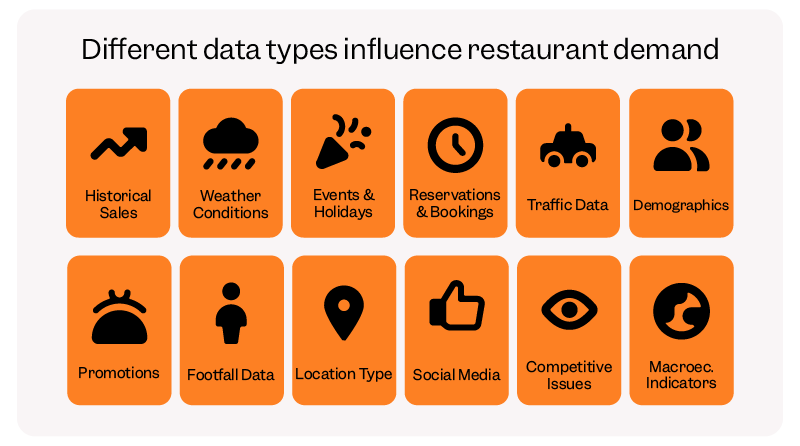
Customer demand can vary by time of the year, weekday, weather conditions, promotions, etc. In our research, we identified 12 different categories that are useful in predicting that demand.
A time series is a sequence of numerical data points in a successive order associated with a time mark. Forecasting, at its core, is a time series problem where given a set of data in time we want to predict the dynamics of the same dataset in the future. For example, if we consider the revenues of a restaurant, we need historical observed revenues to “train” the forecasting algorithm.
Today, businesses try different processes to predict demand: from simple spreadsheets to complex forecasting software and models. But an accurate output could still be out of reach for two reasons.
A major challenge is incorporating large volumes of historical data. Missing relevant data from the past can lead to significant mistakes. An extensive historical dataset is particularly important to prepare for the new normal due to the COVID-19 pandemic. Understanding how the pandemic is affecting your sales and comparing it to the pre-COVID-19 period to predict the new normal will be essential.
The second challenge in forecasting is incorporating other contextual factors and relating it to the patterns observed in the time series datasets. When the forecasting output is too high, it may lead to over-staffing, excessive inventory purchasing and food waste. On the other hand, if the forecasting is too low, restaurants lose sales opportunities and customers are left unsatisfied.
The other inputs included in the figure above are external factors that could be beneficial for the forecasting process:
-
Weather conditions: Temperature, rainfall level, snowfall level, hours of sunshine. Extreme weather can have huge effects on restaurant forecasts and longer days of sunshine might increase demand;
-
Events and holidays: Public, school and religious holidays. They can also have a positive or a negative impact on your demand. If your restaurant is in a business area, you might see your demand drop on a bank holiday;
-
Reservations and bookings: checking the influence of bookings can help you align your inventory and staff with the number of reservations;
-
Traffic data: traffic congestions and public transportation data (e.g. TfL in London). A planned road closure could drive less footfall for that period of time, particularly in bakeries/restaurants on motorways;
-
Demographics: customers’ age for example, can be useful for predictions by time of the day;
-
Promotions: it is expected that footfall will rise when you run promotions in your restaurants;
-
Footfall data: these can be collected by WiFi, bluetooth or computer vision and be used as a proxy for real time customer demand along with sales;
-
Location type: restaurants located on streets and on shopping malls might have different demand profiles;
-
Social Media: can impact positively or negatively the demand, given the restaurant star rating and recent reviews;
-
Competition: competitive promotions or the number of restaurants in the surrounding area affect your demand;
-
Macroeconomic indicators: unemployment rate, inflation and other factors from the local population can also influence the forecasted outcome.
In this blog post, we have discussed how some of these factors play a role in forecasting and some tips for improving your sales forecasting process.
What’s next?
With the disruption caused by COVID-19, restaurants need to rethink their internal processes. “Data-obsession” allows restaurants to become more efficient in resource allocation and brings in more automation to their operations.
Want to get involved?
We’re looking to put together a Customer Research Panel in 2021 to bring together Tenzo customers who use our existing planning module, along with restaurants who don’t use it, to help us better understand first hand the challenges customers face when forecasting sales. If you are interested in joining, send an email to [email protected] by January 22nd 2021 so we can include you in the next exploratory session.
Cover photo by Jakub Kapusnak on Unsplash
The post Sales forecasting for restaurants: how Tenzo is shaping the future appeared first on Tenzo.
]]>This week Tenzo’s chief of staff Maury Ueta breaks down the project with Innovate UK we’ve been working on for the last 2 years. In this blog post, we will: a) highlight how critical demand forecasting is for efficient restaurant operations, b) share some insights and c) reflect on our learnings from the forecasting project […]
The post Innovate UK – A.I. forecasting to reduce food waste appeared first on Tenzo.
]]>This week Tenzo’s chief of staff Maury Ueta breaks down the project with Innovate UK we’ve been working on for the last 2 years.
In this blog post, we will: a) highlight how critical demand forecasting is for efficient restaurant operations, b) share some insights and c) reflect on our learnings from the forecasting project we collaborated on with Innovate UK.
Context
In the UK alone, food waste contributes to £3.2 billion in lost revenue for restaurants, and 4.5 million tonnes of CO2 emitted. That’s a huge impact both on the environment and on a restaurant’s bottom line.
One of our main goals at Tenzo has been reducing that number. We’ve always prioritised accurate forecasting to help restaurants run more efficiently as well as reduce the amount of waste they generate.
In late 2019 we saw firsthand how we could help when we gave Nando’s Singapore 30% more accurate forecasts. Thanks to those numbers, we were able to help the team there increase their labour productivity by 15%. The logical next step was how we could make our forecasts even better and make them available to many more businesses.
That’s why we set out to partner with Innovate UK, the UK’s innovation agency, to help the hospitality industry save over £100m in food waste by 2025 by creating the most accurate sales forecasting platform for restaurants using artificial intelligence and machine learning.
A lot has happened since we embarked on the project in November 2020, not least that the key to resiliency for restaurants lies in accurate demand forecasting.
Currently, most restaurants rely on last week’s demand, rigid 4-week demand averages or gut instinct for operational decisions like shift scheduling, food ordering and preparation. These routinely exceed real demand – indicating demand for staff they cannot attract and creating costs for excess food they cannot afford.
Our approach
We kicked off the project by investigating the different variables that can be used as predictors for forecasts. Along with historical sales data, some external factors can be beneficial for the forecasting process: weather, events and footfall, for example.
After interviewing academic and industry forecasting experts, we experimented with new machine learning methods. In this research, we not only tested new algorithms but also explored new tools and new processes.
To make this really successful though, just having high forecast accuracy is not enough. Operators also need to be able to fit this process into their current operations. This is why, in early 2021, we created a select group of customers to investigate how the forecasting processes were performed inside restaurants. We then started drafting the user journey for the new tool and started a pilot.
On the product side, we revisited the entire infrastructure supporting our forecasting engine to ensure we had a reliable and scalable tool for the new methods.
We’ve now added ‘write integrations’ which means that we provide the forecasts in our own API that other software businesses can ‘read’, or we write our forecasts to our partner’s API.
This means that Tenzo forecasts are now available directly in our customers’ labour schedulers (eg Planday, Deputy, Workforce.com, and more) so they don’t have to switch platforms to schedule as efficiently as possible.
Plus, we’re working on integrating these forecasts into inventory platforms as well so that businesses can order ingredients according to demand and further reduce waste.
We’ve also created a new whole new internal function for quality assurance (hi Kieran ) that means we can test these more complicated integrations.

The new hybrid working style
COVID-19
We submitted our application just before COVID, so there were obviously aspects within the project that needed to be addressed.
For example, unstable datasets with periods without sales made us explore new machine learning methods. In this new context, we received the resilience fund grant for this project.
“During the Pandemic, one of the hardest-hit industries was hospitality. Many restaurants struggled to manage the unpredictable demand for freshly prepared food and getting the resources right to meet fluctuating needs, resulting in food waste and lost income.
The Tenzo team found a way to capture and share insights data, so that purchasing decisions and staffing levels can be optimised. Their software has had a really positive impact on its users, the economy and the environment at a time when it’s been needed the most.
Being able to provide Resilience funding to an innovative project such as this and observing the impact this work has had on a struggling industry gives me huge job satisfaction!” Lisa Gould-Davies – Programme Manager at Innovate-UK.
Due to the pandemic, we switched between fully remote and hybrid working in the UK.
We established more regular status updates among different functions in the project to increase information sharing. The cross-collaboration and visibility were critical to leverage the iteration feedback of the product considering the customer.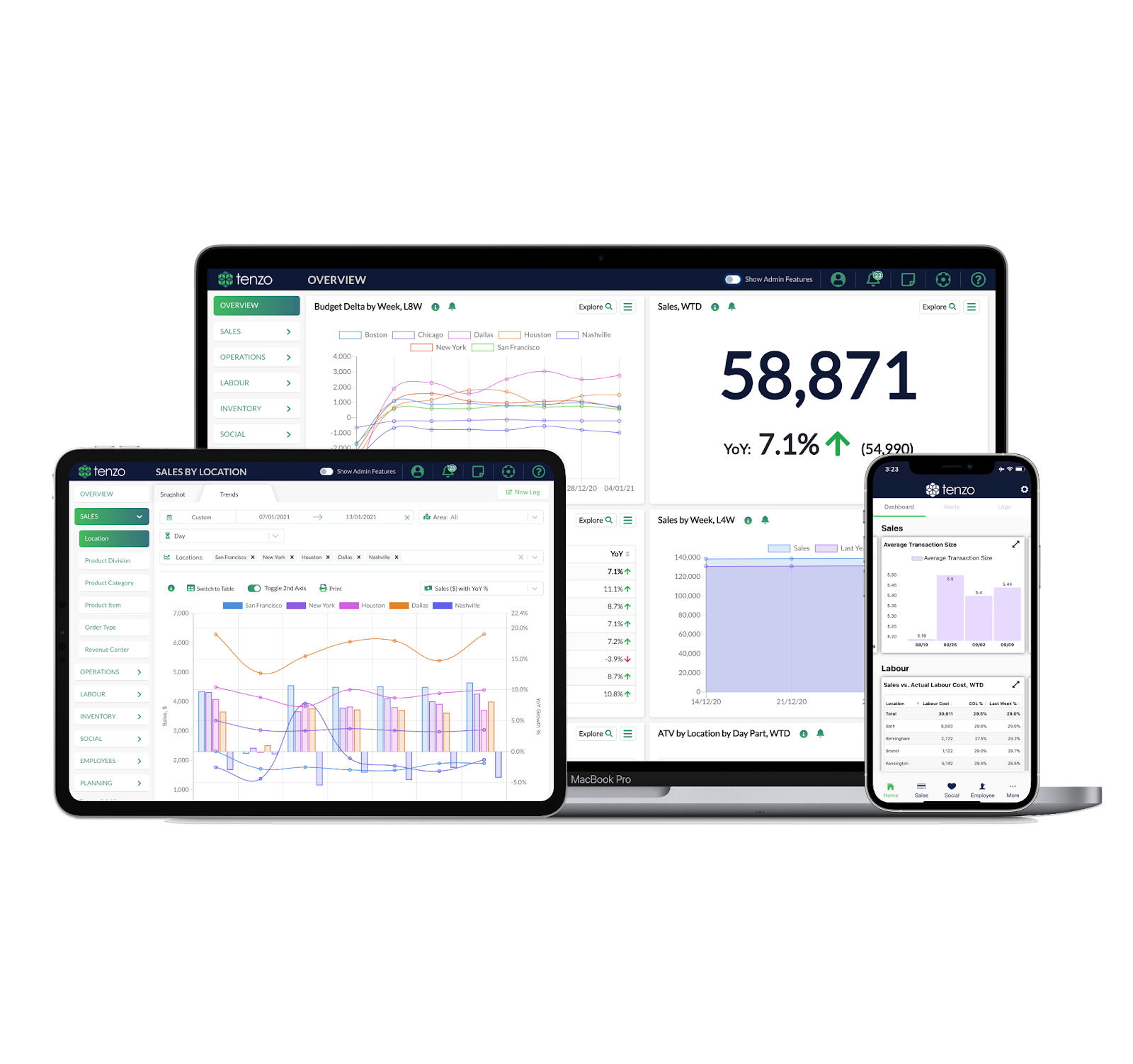
The experience in working with innovate-UK went beyond the financial support. Risk monitoring and project management skills developed in the project helped us identify new issues and bottlenecks ahead of time.
During the project, we hired one project manager, a dedicated data scientist, and a quality assurance analyst. The value from these functions can (and will) be exploited by other features at Tenzo.
What’s Next?
Our team is now better equipped to keep improving our current forecasting features while developing new tools and functionalities. In the near future, we want to build more detailed forecasting capabilities so users can get deeper insights by being able to drill down into different parts of the forecast.
This will make ordering and prepping food all the more accurate, reducing the tons of waste currently produced by F&B businesses and will give operators the ability to schedule as efficiently as possible – a huge impact given the current staff shortages.
Keep an eye out for what’s coming, we promise it’s very exciting!
The post Innovate UK – A.I. forecasting to reduce food waste appeared first on Tenzo.
]]>