Are you looking to reduce costs and streamline your restaurant’s operations? To achieve these goals, consider supplier consolidation. This is the process of reducing the number of suppliers you work with to simplify your inventory management and operational processes. In this article, we will explore the benefits of supplier consolidation for restaurants and how to […]
The post Consolidating Suppliers | What are the benefits for my restaurant? appeared first on Tenzo.
]]>Are you looking to reduce costs and streamline your restaurant’s operations?
To achieve these goals, consider supplier consolidation. This is the process of reducing the number of suppliers you work with to simplify your inventory management and operational processes.
In this article, we will explore the benefits of supplier consolidation for restaurants and how to effectively manage this process.
Consolidating suppliers has always got to be the best thing; you’re increasing your purchasing power and building better relationships. Buy as much as possible from as little as possible. – Scot Turner, Founder and MD at Auden Hospitality

What is Supplier Consolidation?
Supplier consolidation is the process of reducing the number of suppliers that a restaurant uses to streamline operations and improve efficiency.
This can be achieved by selecting a few – or even one – key suppliers that can meet your restaurant’s needs, from food and beverage to equipment and supplies. By consolidating suppliers, you can simplify your ordering process, reduce costs, and build stronger relationships with your suppliers.
Consolidating suppliers must be a strategic process, and the number that restaurants can reduce to depends on the type of restaurant and the nature of the business. For example, some restaurants will get fish from one supplier, and meat from another, so in this case, consolidating suppliers could be based on reducing the suppliers for each inventory group.
How to Manage Consolidating Suppliers
Assessing your current situation is vital to developing a strategy for consolidating suppliers. It’s important to focus on the quantity and quality your restaurant requires and any contracts with your current suppliers.
For multi-site locations, it’s also important to consider that supplier consolidation may have to happen regionally, with individual locations consolidating their supplier as opposed to the overall business.
To successfully manage supplier consolidation, it is important to build good relationships with your chosen suppliers. This includes open communication, regular meetings, and providing feedback on their products and services.

Benefits of Supplier Consolidation for Restaurants
Consolidating suppliers can bring several benefits to restaurants. Improving the relationships and communication between businesses working together opens up new opportunities to grow both businesses and control costs in the process.
Reduces Costs
Consolidating suppliers can help reduce the cost of goods sold for your restaurant in various ways. By working with fewer suppliers, you can benefit from cheaper delivery costs as you can consolidate orders and reduce the number of deliveries.
It also increases buying power and allows you to negotiate better prices or pricing deals and longer payment plans with your suppliers. Minimising price volatility is another benefit, as you have more security with your suppliers, which reduces the risk of sudden price increases.
Increasing the order quantity of specific items and buying in bulk can also help to further reduce overall costs. Buying one 5kg box of tomatoes often works out as cheaper than buying four 1kg boxes of tomatoes due to the reduced labour and packaging costs. If you’re a multi-site restaurant business that can benefit from sharing suppliers, ordering a pallet would be significantly cheaper again. Altering the menu to increase usage of excess items, or adding specials is another way to keep the cost of goods sold down.
Increased Negotiating Power
Consolidating suppliers gives your restaurant more buying power, which in turn increases your negotiating power.
Negotiating powers work to improve the quality and delivery of orders, as well as influence prices. The more leverage you have allows you to request higher quality items and ensure that you’re one of the first on the delivery list to allow for maximum prep time.
Increased mutual dependence also allows restaurants to be able to request specific goods, and develop an agreed level of quality that you expect. It is easier to ensure that suppliers are compliant with the values you live by in your restaurant.
More Efficient Account Management
Consolidating suppliers can lead to more efficient account management for your restaurant. With fewer suppliers to manage, your accounting department will have less to deal with in terms of invoices, payments, and reconciliations.
A smaller chain of suppliers means that you can have more of an impact on each supplier and ensure that they align closely with your restaurant’s values and standards. Managing this can be crucial for some restaurants, but with too many suppliers it’s almost impossible. Consolidating your suppliers allows you to spend more time with them, and learn from each other.
Development of the menu can also benefit from a good relationship with suppliers. Being the first to know about the newest and most popular cuts of meat, or the best quality seasonal vegetables can help restaurants create the best menu for their customers, and therefore boost sales.

Risks of Consolidating Suppliers for Restaurants
It’s important to note that whilst consolidating your suppliers can lead to many benefits, reducing it too much, to a single supplier, can bring some risks from over-dependency.
Mutual Dependence
Reliance on one supplier can be risky during slow periods, for both restaurants and suppliers, with the risk of one becoming insolvent.
If your restaurant relies on just one supplier for all of its ingredients, equipment, or other essential items, you are putting all your eggs in one basket. If that supplier goes out of business or fails to deliver, it can leave your restaurant in a difficult position, negatively impacting business and reducing restaurant performance.
Also, if there are any compliance issues with that supplier, such as food safety violations or unethical business practices, it can damage your business’ reputation. Profitability can also be affected as looking for inventory on short notice will likely lead to increased costs, and therefore reduced profit margins.
Limited Flexibility
Relying on a single supplier can limit your options and flexibility. If you only have one supplier, you may not have access to a wide range of products or competitive pricing.
It can lead to a lack of innovation and creativity.
When you work with multiple suppliers, you have the opportunity to explore different options and try new products. This can help keep your menu fresh and exciting for your customers.
However, if you consolidate suppliers and limit yourself to just one, it may result in you missing out on the chance to discover new and unique ingredients that can set your restaurant apart from the competition.
Conclusion
In conclusion, consolidating suppliers for your restaurant can bring numerous benefits including:
- Reducing costs
- Increasing negotiating power
- Allowing for more efficient account management
By streamlining your supply chain, you can save time and money while ensuring high-quality products for your customers. To maximise these benefits, it is important to carefully consider the potential drawbacks and weigh them against the benefits before deciding on supplier consolidation.
Overall, supplier consolidation can be a strategic move that helps your restaurant thrive in a competitive industry.
The post Consolidating Suppliers | What are the benefits for my restaurant? appeared first on Tenzo.
]]>Labour productivity or labour cost as a percentage of sales are crucial metrics to monitor when considering restaurant performance. Understanding how effectively your employees are utilising their time means you can identify areas for improvement and make informed decisions to improve labour performance and optimise your operations. However, it can be challenging for restaurants to […]
The post A Guide to Measuring Labour Performance (with a free template) appeared first on Tenzo.
]]>Labour productivity or labour cost as a percentage of sales are crucial metrics to monitor when considering restaurant performance.
Understanding how effectively your employees are utilising their time means you can identify areas for improvement and make informed decisions to improve labour performance and optimise your operations.
However, it can be challenging for restaurants to measure this effectively. We’ve put together a guide on how to streamline labour performance, and how to measure it.
“Labour productivity is much more measurable than labour cost, as focusing on labour as a negative cost to revenue can have negative effects. Putting too much pressure on teams will have a bad impact on mental health, but the upside of an engaged team is much more important than cheaper labour”
– Scot Turner, Founder and MD at Auden Hospitality
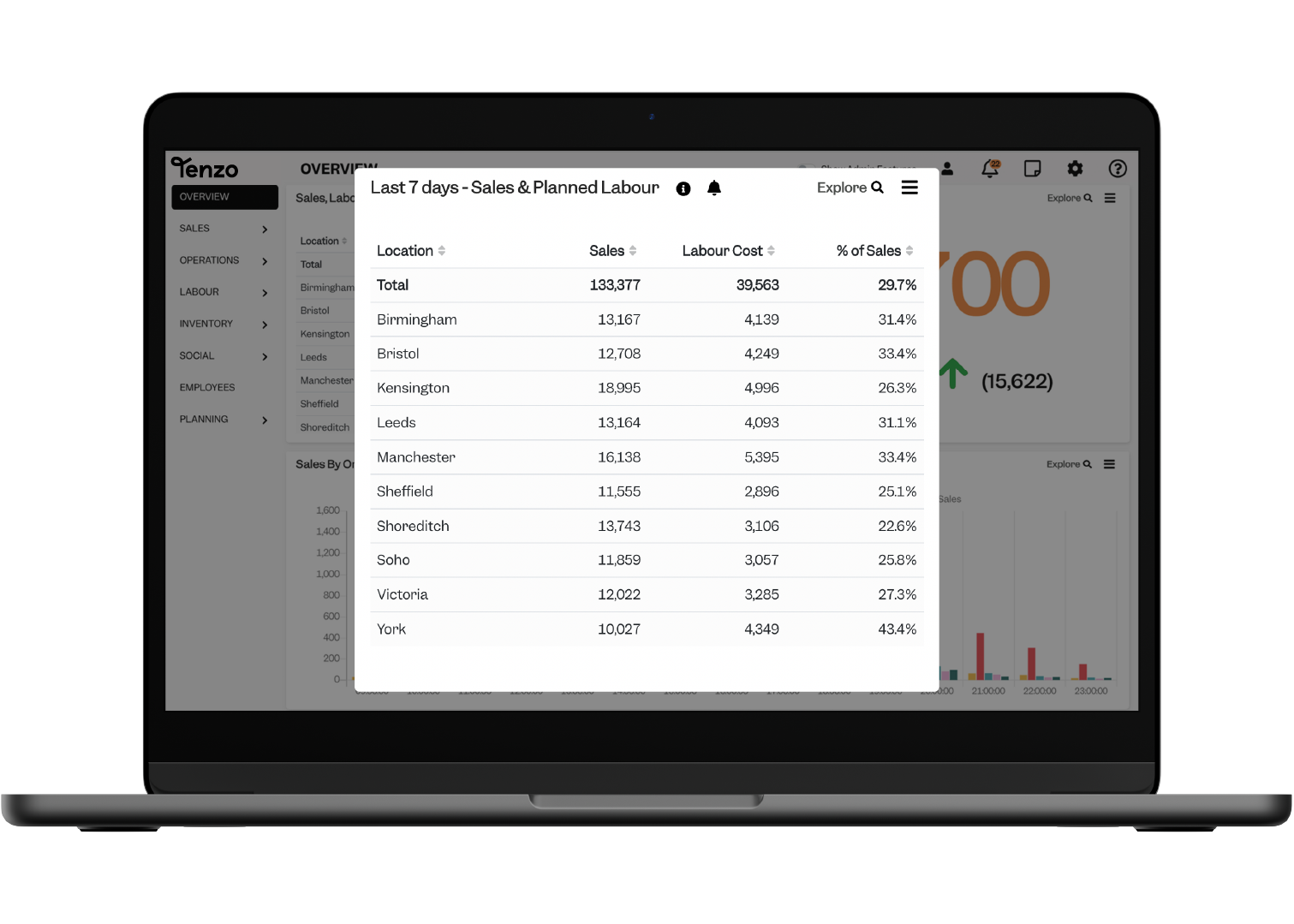
Measuring Labour Performance
Labour productivity and labour cost as a percentage of sales are methods of measuring the efficiency of a restaurant’s workforce. In the hospitality industry, labour cost and productivity are particularly important as they directly impact the profitability and success of the business.
By measuring and optimising labour performance restaurant owners can ensure that their teams are efficient and effective, leading to improved customer service and increased revenue.
Optimising labour performance can be challenging, it involves improving employee performance, alongside careful workforce management. Calculating labour performance is an efficient method to manage this and improve your bottom line.
Calculating Labour Performance
Effective methods of measuring labour performance are calculating labour cost as a percentage of sales or labour productivity. To do this, you must have access to your restaurant’s sales and labour costs by the hour, as well as the number of labour hours deployed per hour.
Labour Cost as a percentage of Sales = (Total fully loaded labour costs ÷ total net sales) × 100
Calculating labour cost as a percentage of sales can be measured for any period, however, it is most valuable to dive into this hourly. Measuring this as an average of sales and labour data over the last 4 weeks also allows you to get more accurate and reliable data. Understanding on an hourly basis which are your most profitable, or least productive hours allows you to make adjustments to the staffing schedule and opening hours on an accurate scale.
Labour productivity = Total Sales / Total Labour Hours
Calculating labour productivity involves using labour hours as opposed to labour cost, but, it is still most accurate to get averages of the hours over the last 4 weeks. Labour productivity gives you a measure of how efficient your team is being throughout the day, and enables you to focus on the least efficient times on a granular level.
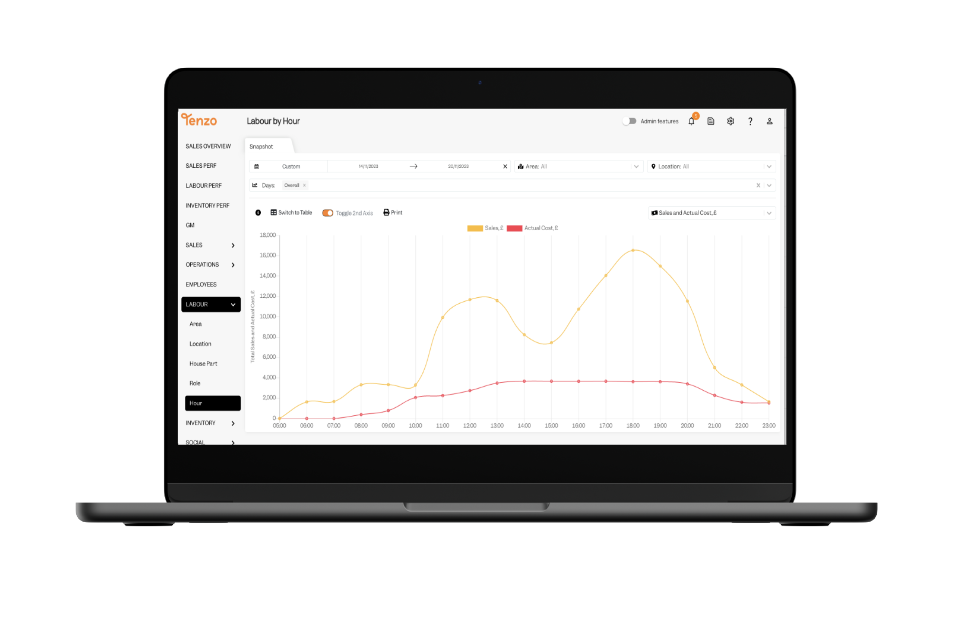
Making Changes to Optimise Labour
As we’ve mentioned, optimising labour performance can be challenging for restaurants: there are so many elements contributing to sales output – both internal and external.
When optimising labour performance, it’s important to focus on internal restaurant challenges and improving individual employees’ labour performance, alongside the management of your workforce. Optimising labour performance involves controlling costs as well as increasing sales.
Effective Labour Deployment
Effective labour deployment is key to controlling costs and optimising performance. By analysing your restaurant’s busy and slow periods, you can make adjustments to your workforce to ensure you have the right number of employees at all times. This helps you avoid overstaffing during slow periods and understaffing during busy periods.
Identifying when these slow periods are is vital to making actionable changes. When looking at sales by labour hour, or labour cost by hour, if there are certain hours and days where labour performance is down, focus on why.
Maybe there were not enough staff to deal with demand? Or, were there too many and as a result the labour costs were too high?
During busy periods, having the right number of employees ensures that you can meet customer demand efficiently and effectively. This prevents long wait times, reduces customer frustration, and improves overall customer satisfaction. By deploying your workforce to meet the demand, you can maximise performance and minimise costs.
However, during slow periods, having too many employees can lead to unnecessary labour costs. By streamlining your workforce and reducing the number of employees during these periods, you can control costs and avoid wasting resources. This allows you to allocate your budget more effectively and invest in areas that will generate higher returns.
Reducing Operating Hours
Although this is something no restaurant would take lightly, sometimes reducing operating hours is the best answer to reducing labour costs. Doing this during especially slow times can actually increase your profitability.
By analysing your data and identifying the periods of low customer demand, you can adjust your operating hours accordingly. When looking at your data, this may only be a case of opening a few hours later, however, if Mondays are consistently slow and a drain on revenue – it makes sense to close!
This not only improves employee morale and job satisfaction as your staff don’t have to work during slow periods, but it gives them more time off and flexibility. This, in turn, improves sales through improved customer interactions.
This can also benefit inventory management. Preparing in advance for slow days, or removing slow days altogether, reduces wastage and the costs that are associated with it, improving overall profitability.
Improving Sales During Slow Periods
Combating slow periods can also come from improving sales during these periods to boost performance.
If lunchtimes are consistently slow, use marketing strategies to boost sales. Offering special promotions, such as introducing lunch-time deals can entice customers to your restaurant and maximise sales opportunities, whilst keeping staff busy.
Another strategy to test out is altering opening hours to lend your business to your current customer’s spending habits. If labour performance is particularly high at the very beginning, or end, of the day consider opening earlier or later to test the overall impact. Then, monitor labour cost by hour, or sales by labour hour again after a few weeks to check the results.
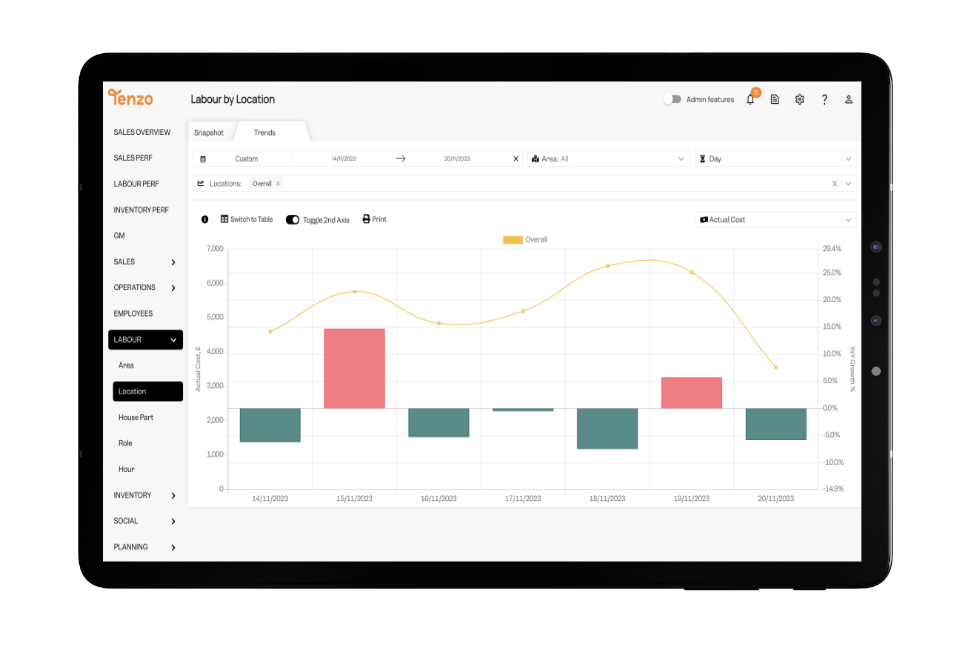
Using the Free Templates
To help restaurant owners measure and track their labour productivity, or labour cost percentage by hour, we have created a couple of free templates that you can use. These templates include areas to input your own sales and labour data, allowing you to track changes in performance throughout the day and week easily.
To use the templates, simply download one below and input your data into the designated sections. The template will automatically calculate the labour cost percentage per hour, or labour productivity by hour, based on the data you provide. You can then use this information to identify trends, make informed decisions, and take steps to optimise your restaurant’s labour performance.
Implementing Automated Reporting
Although this template is completely functional in identifying trends of labour performance in your restaurant during days and weeks, automated reporting tools can provide a lot more accuracy.
When calculating labour performance during the hours of the day using this template this should be done regularly, to ensure that results are up to date with the current trends in your restaurant. Tenzo automatically does all the steps in this sheet, aggregating data from your POS and labour tools providing you with a real-time, accurate view of your labour performance throughout the day.
Implementing automated reporting tools, such as Tenzo, can greatly simplify the process of measuring and tracking labour performance. These tools can integrate with your restaurant’s existing systems, such as POS (point-of-sale) and labour scheduling software, to automatically aggregate and analyse data, giving you the insights to act on.
Cost of Labour as a Percentage of Sales Template
Labour Productivity Template
The post A Guide to Measuring Labour Performance (with a free template) appeared first on Tenzo.
]]>Are you looking to streamline operations in your restaurant? To ensure smooth and efficient operations, it is crucial to have integrated tech solutions in place. These solutions can help automate processes, improve communication, and provide real-time insights into your restaurant’s performance. In this article, we will explore what integrated tech solutions are and how they, […]
The post How can integrated tech solutions help streamline the operations of my restaurant? appeared first on Tenzo.
]]>Are you looking to streamline operations in your restaurant?
To ensure smooth and efficient operations, it is crucial to have integrated tech solutions in place. These solutions can help automate processes, improve communication, and provide real-time insights into your restaurant’s performance.
In this article, we will explore what integrated tech solutions are and how they, as a combination of best-in-breed technologies, can boost restaurant performance.
“We believe an ecosystem strategy with partners on each operational challenge of the restaurant is the only way to keep focus, working as a team to help restaurateurs thrive.” – Sebastian Arrese, Senior Partnerships Manager, Tenzo

What is an Integrated Tech Solution?
Integrated tech solutions are best-in-breed software solutions that ‘communicate’ with each other to allow for data to be shared between the two tools. These integrations must be built into the back-end of software by the companies to allow for the data to be integrated between them.
The businesses behind the software work as partnerships, working together to provide specialised tools to address the complex challenges faced by restaurants. An example of this is when a restaurant’s POS (point-of-sale) system is integrated with its inventory management system. This allows the restaurant to view its sales data within its inventory management tool, and vice versa.
Building a Tech Stack
Integrated tech solutions are combined into tech stacks of multiple best-in-breed software to streamline the operations of your restaurant. These solutions can include point-of-sale systems, inventory management software, employee scheduling tools, and more. By implementing integrated tech solutions, you can automate processes, reduce manual errors, and improve efficiency in your restaurant.
To implement integrated tech solutions in your restaurant, start by identifying the specific areas where you need improvement. Then, research and choose the best software solutions that address those needs.
Build a tech stack that integrates well with each other, ensuring seamless data flow and efficient communication between different systems. Train your staff on how to effectively use the integrated tech solutions to maximise their benefits.
Combining Best-In-Breed Software to Boost Performance
Best-in-breed software refers to using top-performing software solutions in each specific area of your restaurant’s operations. Instead of relying on a single software provider for all your needs, you can choose the best software for you in each business category and integrate it to create a customised tech stack that caters specifically to your restaurant’s unique requirements.
By using best-in-breed software, you can leverage the expertise and specialisation of different providers to solve the complex challenges faced by restaurateurs. This approach allows you to have access to the systems which work best for your restaurant instead of trying to fit a square peg in a round hole with an all-in-one system.
Why Best-In-Breed Works Best
Best-in-breed software works best for restaurants because it offers solutions that are specifically designed to address the unique problems faced by your business. Whether it’s inventory management, employee scheduling, or customer relationship management, choosing software tailored to your restaurant’s needs ensures that you have the right tools to overcome challenges and achieve your goals.
When selecting best-in-breed software, it’s important to consider how well the different solutions can integrate. Integration is key to creating a seamless workflow and avoiding data silos. By choosing software that can easily share data and communicate with each other, you can ensure that all stakeholders in your restaurant have access to the same information, leading to improved communication, collaboration, and decision-making.
Improving Operations with Integrated Tech Solutions
When it comes to running a restaurant, there are many areas where integrated tech solutions can help streamline operations. They can have a positive impact in all areas of restaurant operations, from labour to inventory management.
For example, with an integrated POS system, you’re eliminating the need for manual data entry and reducing the risk of errors whilst easily being able to track sales, manage inventory, and process orders all in one place.
By implementing these solutions, you can streamline your operations, reduce manual work, and ultimately, provide a better experience for both your staff and customers.
Real-Time Operational Insights
Real-time operational insights are crucial for the smooth functioning of your restaurant. By integrating tech solutions like Tenzo with the rest of your tech stack, you can have access to real-time data on sales, inventory, and labour. This allows you to make informed decisions and act as fast as possible to combat any issues that may arise.
With real-time insights, you can identify trends and patterns in your sales data, allowing you to make better decisions about menu planning, pricing, and promotions. By combining sales data with inventory control, you can ensure that you have the right amount of ingredients on hand, reducing waste and improving efficiency.
Combining sales data with labour control costs can help you optimise staffing levels. By understanding how sales fluctuate throughout the day, week, or month, you can schedule your staff accordingly, ensuring that you have enough employees to handle busy periods and not overspend on labour during slower times.
One Source of Truth
Integrating tech solutions into your restaurant operations can help streamline your business by providing one source of truth for all your data. This reduces the risk of human error and ensures that everyone works from the same accurate data.
With an integrated tech stack, you can easily share data across all stakeholders, from front-of-house staff to back-of-house managers, and all the way to head office. This improves communication and allows for fast, actionable, data-led insights throughout the business.
Having one source of truth means that everyone is on the same page and can make informed decisions based on accurate and up-to-date information. This leads to more efficient operations and a smoother-running restaurant.
Increased Restaurant Performance
The increased communication and efficiency provided by integrated tech solutions can hugely improve the performance of restaurants and boost sales, through both new and returning customers.
Improved customer loyalty generally comes from good experiences, and the integration of POS systems with CRMs, labour, and inventory tools allows restaurants to increase data collection on their customers to provide them with a better experience through personalisation. Automatically sending personalised recommendations and discounts, based on previous visits, to customers improves satisfaction and loyalty.
POS systems can also be integrated with online delivery apps. These integrations help to improve order accuracy and speed; crucial aspects of performing well on delivery apps. With increasing competition, being able to be seen by more customers massively helps boost sales via alternate revenue centres.
Conclusion
In conclusion, integrated tech solutions can greatly streamline the operations of your restaurant. By combining best-in-breed software to build a tailored tech stack, you can boost performance and improve efficiency.
With real-time operational insights and a single source of truth, you can make better decisions and optimise your operations. Embracing integrated tech solutions is the key to streamlining your restaurant and achieving success in a competitive industry.
The post How can integrated tech solutions help streamline the operations of my restaurant? appeared first on Tenzo.
]]>Running a restaurant is no easy task, especially with the current market and tightening margins. However, in this article, we will explore mastering the recipe for success to create a thriving and profitable restaurant. Built for longevity and strength against the challenges the industry is facing. At Hummus Bros we were really focused on adding […]
The post Mastering the Recipe for Success: How to Run a High-Performing Restaurant appeared first on Tenzo.
]]>Running a restaurant is no easy task, especially with the current market and tightening margins.
However, in this article, we will explore mastering the recipe for success to create a thriving and profitable restaurant. Built for longevity and strength against the challenges the industry is facing.
At Hummus Bros we were really focused on adding extra drinks and adding what the customers’ favourite drinks were, and with 80-90% margins it has a huge impact on revenue. – Christian Mouysset, CEO and Co-Founder of Tenzo

Build a Loyal Customer Base
Building a loyal customer base is crucial for the success of a restaurant. By providing exceptional service and memorable dining experiences, you can create a strong bond with your customers that continues over many years.
Personalise the Guest Experience
To personalise the guest experience, restaurants should harness customer data to understand their preferences and dining habits. By collecting information on CRM systems such as their favourite dishes, and dietary restrictions restaurants can tailor their offerings to meet individual needs. This can include suggesting personalised menu recommendations and offering special promotions on their favourite items.
Tailoring deals and offers for customers can also encourage them to return to the restaurant. By analysing customer data, restaurants can identify patterns and trends in their dining habits. This allows you to create targeted promotions and discounts that are relevant to each customer’s preferences. For example, if a customer frequently orders a certain dish, the restaurant can offer a special discount on that item to entice them to return.
In addition to personalised deals and offers, restaurants can also provide a unique dining experience by personalising service. This can include greeting customers by name and offering personalised recommendations based on their previous orders. By going the extra mile to make each guest feel special and valued, restaurants can create a memorable experience that will keep customers coming back for more.
Provide Value for Money
When it comes to running a high-performing restaurant, it is essential to provide value for money to your customers. Dining out has become more expensive, but as a result customers now expect more when they go out to eat.
Going the extra mile for your customers can make all the difference in their dining experience. By providing quality meals and exceptional service, you can ensure that your customers feel like they are getting their money’s worth.
Customers are more likely to leave positive feedback and return to your restaurant if they feel that they received value for the price they paid. On the other hand, if they feel that they did not get their money’s worth, they may leave negative reviews and choose to dine elsewhere in the future.
Implement Effective Sales Strategies
Effective sales strategies are essential for driving growth in a restaurant. These can include upselling, implementing loyalty programmes, and providing customers with discounts. Incentivising customers to return and become regular repeat business is the best way to promote profitability.
Upselling
Effective upselling can significantly boost restaurant performance. By upselling, you can increase the average transaction value per customer, leading to higher revenue. It also helps to maximise the value of each customer interaction and increase overall profitability.
To successfully upsell, it is important to train your staff to make recommendations based on the customer’s preferences and needs. By providing personalised suggestions and highlighting the benefits of the additional items, you can enhance the dining experience and increase customer satisfaction.
Menu Optimisation
Menu optimisation is a crucial aspect of restaurant performance. By analysing menu data, you can identify the popular dishes and make strategic changes to maximise profitability.
To optimise your menu, start by analysing menu data to identify the dishes that are selling well and those that are not. This can help you make informed decisions about which dishes to keep, tweak, or remove from the menu. By regularly reviewing and updating your menu, you can keep it fresh and appealing to customers, ultimately improving restaurant performance and increasing profitability.
Menu Size
Having a smaller menu size can greatly optimise the customer experience at your restaurant. When customers are presented with a smaller menu, they can make decisions more quickly and easily; reducing the time they spend deciding on what to order and allowing them to enjoy their meal sooner.
Reducing the menu size also has benefits for back-end operations. You can streamline your inventory management and labour processes with a smaller menu.
You will need to stock fewer ingredients, which means less time and effort spent on ordering and receiving supplies. This can also help to reduce food waste, as you will have a better idea of how much of each ingredient you need to order.
Reduced labour costs also come from having a smaller menu. There will be fewer people required to be in the kitchen at any one time, reducing overhead costs and boosting profitability. More focus on fewer dishes is also likely to improve the quality and care for customers.

Ingredients Sourcing
Outsourcing the production of some ingredients can be a smart move for your restaurant. By doing so, you can make the most out of your labour and save costs.
For example, instead of making your bread in-house, you can source it from a local bakery. This not only saves you time and effort but also ensures that you are serving high-quality bread to your customers.
Another benefit of outsourcing ingredients is that it allows you to focus on your core competencies. Instead of spending time and resources on making every single ingredient from scratch, you can concentrate on perfecting your signature dishes and providing excellent customer service. By outsourcing certain ingredients, you can streamline your operations and improve overall efficiency.
Managing Outgoing Costs
Managing outgoing costs is crucial for the success of a restaurant. As we’ve already mentioned, the tight margin nature of a restaurant requires operators to be on top of their outgoing costs in real-time. Small changes in revenue can have a huge impact on the profitability of the business.
Energy
To maximise the current market, restaurants need to pay attention to changing energy prices. One way to do this is by investing in energy-efficient equipment and appliances. By using energy-efficient lighting, HVAC systems, and kitchen equipment, restaurants can significantly reduce their energy consumption and lower their energy bills.
Restaurants should consider implementing energy management systems that allow them to monitor and control their energy usage in real-time. This can help identify areas of energy waste and implement energy-saving measures.
Inventory
Consolidating your suppliers can lead to better deals and higher-quality ingredients. By working with fewer suppliers, you can negotiate better prices and discounts, as well as establish stronger relationships. This can result in cost savings for your restaurant and allow you to invest in higher-quality ingredients that will enhance the taste and presentation of your dishes.
When you consolidate your suppliers, you can also ensure consistency in the quality of your ingredients. By working with trusted suppliers who understand your needs and preferences, you can rely on them to consistently deliver high-quality products. This can help you maintain the standards and reputation of your restaurant, as customers will appreciate the consistency in the taste and presentation of your dishes.
This also helps to streamline your inventory management process. With fewer suppliers to coordinate with, you can simplify your ordering and delivery processes, reducing the chances of errors or delays. This can help you optimise your inventory levels, minimise waste, and ensure that you always have the necessary ingredients on hand to meet customer demand.

Restaurant PerformanceOps
A high performing restaurant is the key to long-term success. But, data is the key to a high-perfoming restaurant.
Restaurant PerformanceOps is about having all of your restaurant data in real-time, in one place, in the palm of your hand. It’s crucial for all restaurant operators to be empowered to use their data in order to supercharge restaurant performance.
It’s equally important for General Managers to use their data, as it is for head office roles. The head office needs to be using data for strategic decisions and ensuring that the restaurant is in strong financial health. Whereas, front-line restaurant employees can use their data to make daily improvements to the running of their restaurants.
Reporting is essential for this. It’s vital that the data is given to the specific roles in the appropriate way. Dashboards for each business role can help to optimise how each team member can use their data.
Conclusion
In conclusion, mastering the recipe for success in running a high-performing restaurant requires building a loyal customer base, implementing effective sales strategies, optimising the menu, and managing outgoing costs.
To achieve this;
- Focus on personalising the guest experience and providing value for money.
- Implement sales strategies like upselling and
- Use menu optimisation to increase revenue.
- Manage outgoing costs in real-time to stay on top of your margins
- Empower restaurant operators to use their data to maximise performance
By following these key points, you can create a thriving restaurant that attracts loyal customers, maximises revenue, and minimises costs.
The post Mastering the Recipe for Success: How to Run a High-Performing Restaurant appeared first on Tenzo.
]]>Are you looking to supercharge your restaurant’s success? To make data-driven decisions that can drive growth and profitability, it’s crucial to have access to the right information. In this article, we will explore the concept of a Restaurant KPI Dashboard and how it can help you track and analyse key performance indicators to make informed […]
The post Supercharge Restaurant Success with a Powerful KPI Dashboard appeared first on Tenzo.
]]>Are you looking to supercharge your restaurant’s success?
To make data-driven decisions that can drive growth and profitability, it’s crucial to have access to the right information.
In this article, we will explore the concept of a Restaurant KPI Dashboard and how it can help you track and analyse key performance indicators to make informed decisions.
To effectively boost restaurant performance, my customers have felt that the most important metrics to be monitoring are ATV, Guest Count and Sales Comparisons compared to last week or last year and so on. – Maria Gully, Customer Success Manager at Tenzo
– ATV or SPG (which one they use depends on each restaurant/POS) – Guest count or Transaction count (same as above) – Sales comparison (to last week, last year, etc)
What is meant by a Restaurant KPI Dashboard
A restaurant KPI dashboard is a tool that provides a visual representation of key performance indicators (KPIs) specific to your restaurant. It provides an opportunity to effectively communicate a business’s KPI progress to its stakeholders.
Unlike traditional reporting methods, a KPI dashboard allows restaurant owners and managers to easily track and monitor important metrics in real time. It provides a comprehensive view of the restaurant’s performance, allowing for data-driven decision-making and the ability to quickly identify areas of improvement.
Best KPIs to include in Restaurant Dashboards
When it comes to restaurant dashboards, there are several KPIs that are essential to monitor to boost restaurant success.
These KPIs can be in-line with sales, labour, or inventory aspects of restaurant businesses. By tracking these metrics, restaurant owners and managers can gain valuable insights into the financial health of the business, optimise labour costs, and ensure efficient inventory management.

Sales
Sales KPIs are crucial for measuring the financial performance of a restaurant. These are likely to be the most useful metrics for monitoring the success of the business and will impact how revenue is spent.
At Tenzo, we feel the most useful metrics to monitor on your dashboard when tracking sales performance are:
- Sales Week-To-Date compared with Last Week-to-Date
- Sales vs. Budget by Day
- Transactions Last four weeks compared with Last Year
- ATV Last four weeks compared with Last Year
- ATV by Employee
Tracking your sales compared to last week, and how sales compare to budget gives restaurants an immediate evaluation of whether the restaurant’s performance is improving. Ensuring the sales are hitting the budget allows operators to know that their costs are covered by revenue.
Monitoring ATV and Transactions over the last four weeks, and ATV per employee helps restaurants understand whether changes in sales are coming from more customers or more transactions. This helps target sales and marketing strategies.
Labour
To boost your restaurant’s performance, it’s crucial to monitor key performance indicators (KPIs) related to labour.
We believe that some of the most important KPIs to monitor on a restaurant’s dashboard for labour performance are:
- Cost of Labour as a percentage of sales by location and day of the week
- Planned vs. Actual labour Cost
- Labour Percentage by Day of the Week
- Average Sales vs Actual Labour Cost by day
- Sales vs. Labour Mix
- Sales & Forecast vs. Actual & Planned Labour
Monitoring the cost of labour as a percentage of sales allows restaurateurs to ensure that labour costs are in line with revenue and make adjustments accordingly. This, alongside the Sales vs. Labour Mix, helps to track labour productivity and ensure that labour processes are optimised. This also helps make sure staff aren’t overrun and at risk of burnout. Tracking this by the day of the week also ensures that productivity is maintained throughout the week and that profits can be maximised on fast and slow days.
Looking at planned hours and comparing these to actual hours worked, or the sales relating to those periods also helps to optimise labour costs. Planned hours are based on what restaurants have put into the labour tool, and this is likely from predicted sales for that period. Aiming to match the actual labour hours to these is likely to create stability for your team, and be able to predict revenue spend more accurately.

Inventory
Inventory KPIs are crucial for effective inventory management in a restaurant. By tracking these KPIs, restaurant owners and managers can minimise food spoilage and reduce inventory carrying costs; leading to a more sustainable industry.
The most effective metrics to track to optimise inventory management are:
- Theoretical Use, Actual Use, Wastage, and unaccounted for as a percentage of sales
- Sales, Cost of Labour, and Cost of Goods Sold after Transfers
- Wastage by Category
- Inventory Price Changes by Vendor
Waste is an incredibly important aspect of inventory for restaurants. Not only does it have environmental impacts but it can be a huge financial cost. Tracking wastage by location, and then by item, helps ensure everyone is using the correct processes and portioning as per the recipes.
Inventory price changes are important to monitor especially for restaurants that use multiple suppliers for the same items. With the current rates of inflation, prices are changing all the time, but at different rates for different suppliers. Tracking this helps restaurants get the best price for all their items, as well as leveraging quality.
Restaurant KPI Dashboards for Specific Roles
It is important to tailor the restaurant KPI dashboard to specific roles within the restaurant, such as business directors, general managers, and chefs. Each role has different goals and responsibilities, and their dashboard should reflect the metrics that are most relevant to their role so that they can maximise the insights gained.
Business Directors
Business directors in restaurants are responsible for the overall success of the business. Generally, there will be roles within the directors that are responsible for the overall financial performance of the business and expansion, as well as all operations and people within the business.
Their goals may include increasing revenue, improving profitability, and managing costs. The metrics they focus on provide insights into the financial health of the business as a whole and help guide strategic decision-making, whilst taking into account the front-line operations.
We believe that the most important KPIs for business directors to focus on are both high-level and more granular. It’s important to know what is going well in a zoomed-out view with a Flash P&L: incorporating all factors of COGS, labour and sales, to determine how much profit the restaurant is making.
Senior stakeholders need to be able to go more granular quite quickly to understand where the improvements, or mistakes, are being made. For example, labour spend could look positive over the month, but in reality, it equated to overspending at the beginning and having to reduce spend to remain within budget towards the end.
When diving further into their data, for COGS and inventory, labour productivity and wastage should be focused on. For multi-site operators, it’s important to have granular information on individual locations as well as overall contributing factors.

General Managers
General managers play a crucial role in overseeing the day-to-day operations of a restaurant. They are responsible for managing staff, ensuring customer satisfaction, and meeting financial targets.
The KPIs that would most help general managers will identify areas for improvement, optimise staffing levels, and ensure a positive dining experience for customers.
Empowering general managers to use their data is vital. Normally, time restraints mean that they don’t have time to be diving into spreadsheets throughout the day. However, creating a dashboard focused on information important to them and making it easily digestible allows them to use their data in real time.
Tenzo believes that quick data values for their specific locations such as ATV, Number of Transactions, Labour Cost Percentage, and Recent Social Reviews are the most important. It’s valuable to compare this weekly so that recent changes in operations or staffing can be evaluated easily.
Conclusion
In conclusion, using a restaurant KPI dashboard can supercharge performance. It allows you to track key metrics and make data-driven decisions.
Focusing on KPIs from all areas of the business; sales, labour, and inventory, is vital to create a sustainable business and maximise profitability.
A KPI dashboard provides valuable insights and empowers restaurant owners and managers to make informed data-driven decisions that promote success.
The post Supercharge Restaurant Success with a Powerful KPI Dashboard appeared first on Tenzo.
]]>Are you looking for ways to boost labour productivity in your hospitality business? To ensure the financial success of your restaurant, it is crucial to maximise labour productivity. In this article, we will discuss the changing landscape of labour in the industry, the impact of staff turnover and labour costs, methods to measure labour productivity, […]
The post How to Boost Labour Productivity by Tracking Team Performance appeared first on Tenzo.
]]>Are you looking for ways to boost labour productivity in your hospitality business?
To ensure the financial success of your restaurant, it is crucial to maximise labour productivity.
In this article, we will discuss the changing landscape of labour in the industry, the impact of staff turnover and labour costs, methods to measure labour productivity, and how tracking employee performance can lead to overall restaurant success.
Look strategically at who you’re rostering and when. You need the best people in places at the busiest times, it’s much easier than training people. Focus on rostering people who can make you the most money. – Scot Turner, MD and Founder at Auden Hospitality

How Labour in the Hospitality Industry Has Changed
The hospitality industry has seen significant changes in labour since the pandemic and the rising use of technology.
The transient nature of the industry has become more apparent, and the industry is increasingly less experienced with younger people viewing it as an in-between job. Especially as many small businesses can’t keep up with the increasing salary demands for experienced employees.
The introduction of technology has also changed the processes involved with operating restaurants: the expectations and goals for many restaurants are now more concrete. Technology has also become a key aspect of monitoring labour productivity.
Staff Turnover
Staff turnover is a major challenge for restaurants in the hospitality industry. It can be difficult to retain employees, especially in positions that require long hours and high levels of customer service. It can be difficult to find and retain staff members, which can lead to increased costs (for recruitment and training).
External factors can also impact the employment pool and how people view jobs in the hospitality industry. For example, the current job market may offer more opportunities for individuals outside of the hospitality industry, making it easier for them to find alternative employment. The impact of this is increased with some people viewing jobs in the hospitality industry as temporary or low-skilled, leading to higher turnover rates. Hospitality Rising and UK Hospitality are working together to change this perception and encourage more young people into the industry, but this will take time.
Businesses need to take charge of improving this by offering developmental opportunities for younger people joining the hospitality industry and allowing them to envision long-term careers. Good examples of this are the Pizza Pilgrims Training Academy or Otolo with their mentorship programme.
Labour Costs
Labour costs can have a significant impact on a company’s profitability. Generally, labour costs should be around 30% of a restaurant’s revenue, but this can change depending on the type of restaurant.
As inflation rises, the cost of wages and benefits expectation for employees also increases. This puts pressure on profit margins, as restaurants need to allocate more resources to cover these rising costs.
How to Track Labour Performance
To boost labour productivity, it is crucial to track labour performance. By monitoring and evaluating each employee’s performance, you can identify improvement areas and provide targeted training. This allows you to address specific weaknesses and help employees develop the necessary skills to excel in their roles.
The methods used to track employee performance may vary depending on where employees’ work is focused and their seniority within the organisation. For example, front-of-house may have their performance measured based on their sales targets, while managers may be evaluated on their ability to lead and motivate their teams. By tailoring the tracking methods to each employee’s specific role and responsibilities, you can gain a more accurate understanding of their performance and provide relevant feedback and support.
Qualitative Tracking
For senior stakeholders, observing junior staff members can be a valuable method for tracking their performance. By directly witnessing their actions and interactions with customers, you can gain a better understanding of their capabilities. This qualitative tracking allows you to see firsthand how they handle different situations and whether they meet the expectations of their role.
Customer feedback can also provide valuable insights into the performance of your employees. By listening to what customers have to say about their interactions with your staff, you can gain a better understanding of their strengths and weaknesses. This feedback can help you identify areas where your employees excel and areas where they may need further training or support.
In addition to observing and gathering feedback, engaging in regular conversations with your junior staff members can also provide valuable qualitative insights. By discussing their experiences, challenges, and goals, you can gain a deeper understanding of their performance and provide guidance and support where needed. These conversations can also help you identify any potential issues or areas for improvement before they become larger problems.

Quantitive Tracking
Quantitative tracking is a more data-driven approach to monitoring labour performance. By analysing specific metrics and numbers, you can gain a clearer understanding of how each employee is contributing to the overall productivity of your restaurant. This type of tracking can be especially useful in measuring sales abilities, as you can track the average transaction value (ATV) for each employee and identify areas for improvement.
By setting specific goals or key performance indicators (KPIs) for employees, you can use quantitative tracking to see how well they are meeting these targets. This provides a way to reward and recognise employees who consistently meet or exceed their goals.
Quantitative tracking provides a more objective and data-driven way to monitor employee performance. By analysing specific metrics and numbers, you can gain valuable insights into how each employee is contributing to the success of your restaurant and identify areas for improvement.
It is, however, important to note that data can only get you so far. Not all productivity can be measured with numbers as it’s not all quantifiable. Interactions between team members, and the customers, can have a huge impact on morale and productivity.
How Boosting Labour Performance Boosts Overall Restaurant Success
Improving labour performance directly contributes to the overall success of a restaurant. When employees perform at their best, customer satisfaction increases, leading to repeat business and positive word-of-mouth recommendations. This, in turn, can drive higher revenue for the restaurant.
Staff Experience
Boosting the staff experience is essential for creating a positive work environment. By tracking labour performance, you can identify areas where individuals excel and provide them with opportunities to further develop their skills. This not only boosts morale but also drives overall team development.
Tracking employee performance also allows you to recognise and reward high performers, which can help boost morale and motivation within the workforce. By acknowledging and celebrating the achievements of your team, you create a culture of excellence and encourage others to strive for similar success.
Tracking labour performance also allows you to identify areas where additional training or support may be needed. By providing targeted coaching and development opportunities, you can help employees grow and reach their full potential. This investment in staff experience not only benefits employees but also contributes to the overall success of the team and the business.
Controlling Costs and Boosting Performance
Tracking labour performance allows businesses to identify their top performers in real time and provide staff with incentives to upsell and increase sales. This can result in higher revenue and profitability for the company.
Improving labour productivity also means reducing the overall labour costs as a percentage of sales. By analysing employee performance data, businesses can identify areas where productivity can be improved and make necessary adjustments. This can lead to more efficient use of resources and employees’ time, ultimately improving the bottom line.
By tracking labour performance and improving labour productivity, businesses are getting more out of their data. This means they can make better-informed decisions and optimise their operations. This can result in increased efficiency, reduced costs, and ultimately, improved overall performance for the business.
Conclusion
In conclusion, tracking labour performance is crucial in boosting labour productivity in the hospitality industry.
Labour costs only allow restaurants to focus on one aspect of staff management, and can negatively impact the performance of the business. Focusing on productivity means restaurants can manage the performance of their staff, to boost overall restaurant performance whilst controlling costs.
By monitoring and evaluating labour performance, businesses can identify areas for improvement and implement strategies to enhance productivity. This not only improves overall restaurant success but also provides a better staff experience.

The post How to Boost Labour Productivity by Tracking Team Performance appeared first on Tenzo.
]]>Inflation is prevalent in everyone’s lives at the moment, but it’s having an especially large impact on the hospitality industry. Why? Well, it’s because food and drink inflation is the highest of all categories at 12.2% in September 2023. This has caused a significant increase in costs for restaurants, which already operate on tight profit […]
The post Rising Costs: The Impact of Inflation on Restaurants appeared first on Tenzo.
]]>Inflation is prevalent in everyone’s lives at the moment, but it’s having an especially large impact on the hospitality industry.
Why? Well, it’s because food and drink inflation is the highest of all categories at 12.2% in September 2023. This has caused a significant increase in costs for restaurants, which already operate on tight profit margins.
In this article, we will discuss the rising costs in the restaurant industry, how inflation has affected dining habits, and what restaurants can do to combat decreasing profit margins.
“Restaurants are affected by food, labour & energy inflation. This means they need to increase their prices to protect margins which in turn may reduce demand. It’s a tough balance to keep.” – Christian Mouysset, Tenzo’s Co-Founder
Rising Costs in the Restaurant Industry
Inflation’s impact on restaurants is clear when you consider all the rising costs and shrinking margins. As inflation affects customer habits, restaurants are facing challenges in cost control and profitability as well as generating revenue. The increasing costs in the restaurant industry are putting pressure on businesses to find ways to maintain their margins.
Rising labour costs and staffing challenges have also contributed to the shrinking margins in the restaurant industry. Minimum wage increases and the rising cost of living have led to higher labour costs for restaurants. This has created a labour shortage for some businesses that cannot afford to compete with larger establishments, further decreasing the labour pool in the hospitality industry. Labour costs have been increasing by 10% monthly since April 2021, adding to the financial strain on restaurants.
Increasing Cost of Goods Sold
The cost of goods sold in restaurants has been significantly affected by inflation. Food and drink inflation is at over 10%, as of September 2023, leading to higher expenses for restaurants.
In the past, the cost of goods as a percentage of revenue was much lower compared to now. This disruption to the normal COGS means restaurants are now spending a larger portion of their revenue on purchasing the ingredients and supplies needed to run their business. As a result, profit margins are shrinking and it is becoming more challenging for restaurants to maintain profitability.
Rising Labour Costs and Staffing Challenges
Rising labour costs and staffing challenges have become major challenges for restaurants.
Not only has the London Living Wage increasing put a strain on labour costs, making it more difficult for restaurants to maintain their profit margins, but the global rising cost of living has meant that labour cost demands are increasing, putting further pressure on restaurants.
Labour costs have been increasing since April 2021, adding to the financial burden for restaurants. With higher wages, restaurants are finding it harder to afford the necessary staff to run their operations smoothly. This has led to understaffing issues, which can impact the quality of service and overall customer experience. Restaurants having to allocate more of their budget towards labour costs leaves less room for other expenses such as food and equipment.
The labour shortage in the hospitality industry has made it even more challenging for restaurants to find and retain qualified staff. With limited options and competition from larger establishments, smaller restaurants are struggling to attract and keep employees. This can lead to increased turnover rates and a lack of consistency in staffing, which can negatively impact the overall efficiency and productivity of the restaurant.
As a result, restaurants are having to come up with creative solutions to address the staffing challenges, such as offering higher wages or implementing flexible scheduling options.

How Inflation Has Affected Dining Habits
Inflation has also had an impact on dining habits, with customers adjusting their spending patterns. Speculation suggests that while the average transaction value (ATV) has increased, the number of transactions has decreased.
How much are customers spending?
Over the last year, the average transaction value (ATV) for restaurants in the South East of England increased by 5.7% compared to the previous year. This likely means that, on average, customers are spending more money when they go out to eat.
The increase in ATV could be due to rising restaurant prices. As inflation pushes up the cost of ingredients and other expenses for restaurants, they pass on these costs to the customers by raising their prices. This would result in customers spending more money per transaction, but, due to the cost of goods sold increasing, businesses aren’t getting anymore out of each transaction. With tightening margins, it’s likely they’re getting less.
Despite the rising costs, customers may still be willing to pay higher prices for their favourite meals or for the convenience of eating out. This willingness to spend more could be driven by factors such as a desire for social experiences, and because people may be going out less regularly.
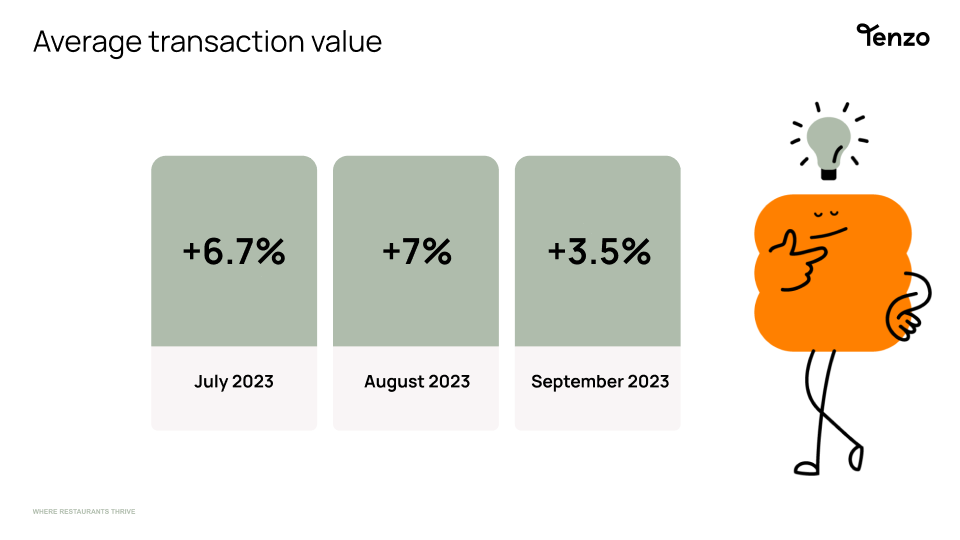
Changes in dining-out habits
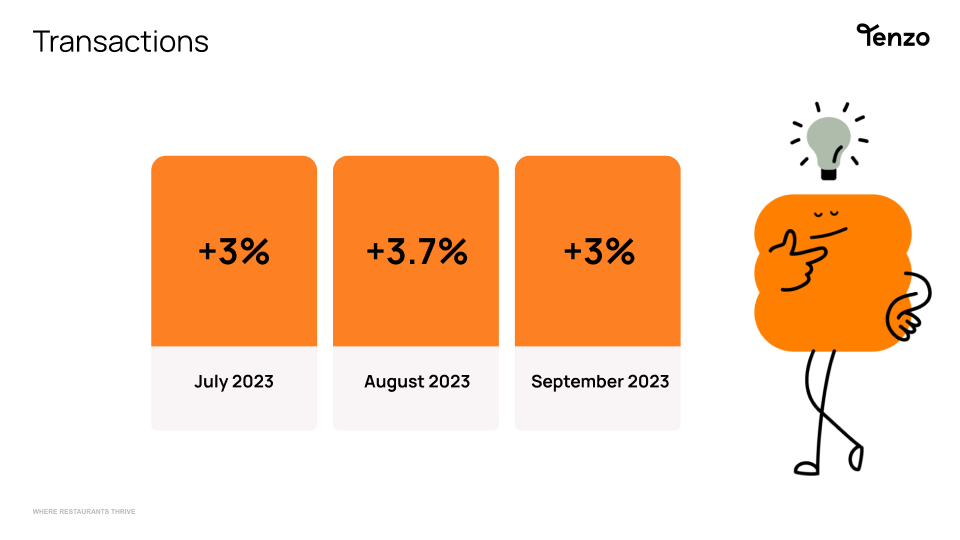
We have also looked into changes in the dining-out habits of diners in the South-East of England over the last year. Many believed that the number of transactions would decrease, with increasing ATV. However, the number of transactions has increased by 2% between September 2022 and September 2023.
This unexpected increase in the number of transactions, alongside rising costs, may mean that diners are choosing to eat in more affordable restaurants. Customers may be spreading their disposable income out and shifting from fine-dining restaurants to casual, or fast-casual, restaurants.
This could also mean that when customers are eating out they are splitting the bill more. The figure for the number of transactions does not tell us how this aligns with the number of covers.
What can restaurants do to combat decreasing profit margins?
To combat decreasing profit margins caused by inflation, restaurants can take several steps to boost their profitability. This can involve all aspects of the business; from menu engineering to labour efficiency, and improving the guests’ experience.
Personalising the guest experience is another strategy that restaurants can employ to improve profit margins. By creating a loyal customer base, restaurants can ensure repeat business and customer satisfaction. Personalising experiences using reservation and CRM systems to build a database on customers, such as their birthdays and favourite wines, allows restaurants to send personalised deals and offers to keep customers coming back.
Menu Engineering
Menu Engineering is an essential strategy for restaurants to use to combat decreasing profit margins. All aspects of menu engineering can lead to improved sales and decreasing costs: boosting profit margins, but we’re going to focus on pricing and menu size here.
Pricing can be a huge challenge for restaurants, but it’s essential that pricing is altered to align with inflation, taking into account the rising costs of ingredients and other expenses. However, it is important to strike a balance and not set prices too high, as this can push customers away and towards competitors. Small increases of 50p or £1 on best-selling dishes can have a huge overall impact on revenue.
Review the price of all menu items, both food and drink and see how the cost of each item compares to the sale price. It’s also important to understand each menu item’s impact on overall revenue. For example, increasing the price of a low-selling menu item by 5% might have a minimal impact on margins and revenue, so might not be worth doing.
Another menu engineering strategy to boost performance is reducing the menu to create a more efficient kitchen. By streamlining the menu and focusing on the most popular and profitable items, restaurants can reduce labour and inventory costs. This allows for better control over expenses and helps to maintain profit margins.
Reducing the menu can also lead to faster service and improved customer satisfaction. With a smaller menu, the kitchen staff can focus on perfecting the preparation of a limited number of dishes, resulting in quicker turnaround times and a more efficient operation overall. This can help to attract and retain customers, even in the face of rising costs and shrinking margins.
Labour Efficiency
Labour efficiency is another business area that restaurants should focus on to improve performance and profit margins. By using data to monitor labour productivity, restaurants can identify areas where optimisation is necessary and make adjustments accordingly.
Another way to improve labour efficiency is to get the most out of your current labour costs. This means not using time and resources to make something that can be better, and cheaper, sourced elsewhere. By outsourcing certain tasks or using pre-made ingredients, you can save time and money while still delivering high-quality food to your customers.
Improving labour productivity can also come from understanding best practices and learning from top employees. By observing and learning from your most efficient and skilled employees, you can implement their techniques and strategies across your entire staff. This can lead to faster and more efficient service, ultimately boosting your margins through increased sales.
Personalising Guest Experience
Personalising the guest experience is essential in the restaurant industry. By creating a loyal customer base, you can ensure repeat business and increase revenue – returning customers provide 67% more revenue in their lifetime than the equivalent of new customers.
To achieve this, it is important to give customers an experience that they believe is worth the money. This means going above and beyond to exceed their expectations and provide exceptional service. These changes in going-out habits are more about finding a balance between cost and quality, with customers seeking value for their money.
One way to personalise the guest experience is by using a CRM system to build a database of your customers. This allows you to gather information such as birthdays, favourite wines, and dietary preferences. With this knowledge, you can personalise deals and offers sent to them, making customers feel special and encouraging them to keep coming back.
Conclusion
In conclusion, the impact of inflation on the restaurant industry has led to rising costs and shrinking profit margins. With cost of goods sold and labour costs increasing, it makes it harder for restaurants to maintain their performance whilst being affordable to their customers.
To combat these challenges, restaurants can focus on menu engineering, optimising labour efficiency, and personalising the guest experience. It’s crucial to ensure that costumers feel they are getting value for their money, if you’re having to increase prices personalise experiences and make customers feel more special, and their experience more memorable.
Overall, navigating the effects of inflation requires strategic decision-making and adaptability in order to maintain profitability in the restaurant industry. Using restaurant data is vital in monitoring the success of business changes and tracking performance.
The post Rising Costs: The Impact of Inflation on Restaurants appeared first on Tenzo.
]]>Menu engineering is a crucial aspect of restaurant operations that shouldn’t be neglected. It’s an opportunity to solidify restaurant branding and supercharge restaurant performance. A great menu will result in increased sales and happier customers. It’s not only an operational tool to create a more profitable restaurant, but it is also an opportunity to use […]
The post Menu Engineering | How a great menu can improve restaurant performance appeared first on Tenzo.
]]>Menu engineering is a crucial aspect of restaurant operations that shouldn’t be neglected. It’s an opportunity to solidify restaurant branding and supercharge restaurant performance.
A great menu will result in increased sales and happier customers. It’s not only an operational tool to create a more profitable restaurant, but it is also an opportunity to use marketing techniques to drive sales at the final point.
Below, we break down how menu engineering can have an impact on your restaurant’s performance and tips you can implement when going through the menu engineering process.
Fine dining restaurants tend to have higher SPG and design their menu carefully, follow up on reviews . Whereas, QSRs might care more about boosting transactions, and increase SPG by upselling extra products. – Maria Gully, Customer Success Manager at Tenzo
Menu Engineering | Items on the menu
Arguably, the menu items are the most critical aspect of menu engineering – they are likely why customers will keep coming back.
Aligning the menu with customers’ favourites increases the likelihood of returning customers. Ideally, the best-selling dishes will all be those with the highest profit margins – stars! Adapting the ingredients or dishes to improve popularity and profitability is vital.
When thinking about items on the menu, they can generally be placed into one of four terms – stars, plow horses, dogs, and puzzles. These terms are used to describe the popularity and profitability of menu items simultaneously.
Stars are menu items that are highly profitable, and popular. Whereas plow horses are those that are popular with customers but have low profitability. The strategy for dealing with plowhorses is to use these to draw in customers, and then find a way to make them more profitable without weakening the value too much.

It can be hard to judge which dishes are actually the best-selling, often employees’ conversations with customers can influence the perception of this. Making an assessment of customer favourites can be done through human behaviour, but the most accurate way is through data.
Using data-based decision-making is more accurate and more likely to result in increased sales and profits. Many point-of-sale (POS) systems will already collate information on menu item popularity for you, making the data really easily accessible. However, this isn’t the full picture and restaurants can’t always identify the high sellers and good margin items.
Focus on time periods and assess what the attachment percentage of each menu item is. It’s important to understand that menu items will experience seasonality, and optimising for different items should be done accordingly throughout the seasons.
Calculating Profit-Margin of Menu Items
We’ve mentioned how important it is for a menu to be full of high-profit margin items, but how is this calculated?
Menu profit margin = (Menu Price – Raw Cost) / Menu Price
Profit margins on menu items need to be on a median at about 70%, the actual vs. theoretical usage should be taken into account when considering recipes. Outgoing costs for restaurants are more than just inventory costs: labour costs, taxes, and rent all need to be considered.
Menu Engineering | Menu Size
The length of the menu doesn’t only influence the customers’ experience, but it also has a huge impact on operations.
Traditionally, large menus were considered to positively impact sales due to a wide offering that would appeal to more potential customers, and keep them coming back for more.
However, smaller menus have now become more popular; allowing restaurants to cut costs, reduce wastage, and improve profits. This is known as creating a minimum viable menu. Using the same ingredients in multiple dishes also helps reduce costs by buying in bulk.
Operationally, having more simplified menus increases efficiency and quality. Labour costs will be lower as there is less to prepare and ticket times are likely to be shorter with less staff needed.
A simplified menu is more targeted. Not only does it streamline inventory management, but reduces COGS (cost of goods sold) by needing fewer ingredients.
Customers are able to make faster decisions with a smaller menu, decreasing the decision-making process and making it more straightforward for them. They’re more likely to be happy with a menu with no outliers, which in turn reduces wastage and allows for more ‘stars’ and less ‘dogs’.
Menu Engineering | Portion Sizes
Portion sizes can affect profits and wastage. This can come down to how the portions have been designed, as well as over-portioning.
Restaurants that serve large portions can lose money unnecessarily, especially if lots of food is coming back on the plates as waste. These large portions can affect customer experience too by compromising on quality and using low-cost ingredients to bulk up meals to justify large price tags.
Over-portioning can result in unaccounted-for losses for restaurants that will affect performance. This can be reduced by introducing small wares to help during busy services, or using scales to ensure expensive ingredients aren’t over-portioned. Thinking about takeaway portions is vital too, it needs to be easy for staff to give the correct size for both eat-in and takeaway.
Offering varying portion sizes can be an operational strategy to improve average transaction value, whilst reducing the likelihood of wastage. If normal and large portion options are given to the customers, their experience is improved by not being over or underwhelmed, and restaurants aren’t wasting inventory.
Menu Engineering | Menu Psychology
There is so much information that could be included on menus, but based on the type of restaurant, what’s included on the menu varies.
Calories on the menu
A good example of this is calories. This is only a legal requirement in the UK if the business has more than 200 employees and as a result generally only larger restaurant chains have included them.
Calories were introduced on menus to tackle obesity, with the aim to encourage customers to think more about their health. However, this was met with backlash with over 50% of young women between 18-29 not agreeing, with the change due to negative impacts on those with eating disorders.
It’s likely that calories also dictate customers’ choices whether they’re counting calories or not, bringing down ATV (Average Transaction Value) due to people ordering less. It adds another dimension to menu engineering: creating menu items with lower calories to appeal to a wider customer base.
Prices
Pricing is always included on menus, to ensure that customers know how much they’re spending.
There are techniques to increase sales by helping customers dissociate from the prices. Removing the currency helps to remove the association with money, and allows customers to assume the currency based on location.
The pricing of menu items is an essential aspect of menu engineering and should be decided when considering profit margins and the menu items included. However, how the price is shown is more psychological.
Exclusive establishments tend to use round numbers for their pricing, as it is already high, however, more affordable restaurants are likely to use .95 in their prices to let them appear more reasonably priced.
Adding more expensive menu items can make the high-profit, low-popularity (puzzles) menu items seem more appealing and therefore more likely to be sold.
Extra Information
Menus can have a range of information on them, for most restaurants the story behind their business and the food being served is really important. But how that information is displayed can affect sales.
The backstories behind restaurants help establish an emotional connection with customers and increase sales by making a more memorable dining experience. However, it can be too much information for customers, so using a QR code is a good way to provide this.
The wording surrounding food items can also have an influence on which items are chosen. Descriptive labels can slow down decision-making, but, they can also increase sales by 27% through creating an emotion surrounding the food and angling customers towards higher profit margin items.
Menu Engineering | Digital Menus
With the rise of QSRs, digital menus are becoming more popular. Digital menus can come in a couple of different forms, for some restaurants this is an electric board presented above the point-of-sale, and others use kiosks.
Digital menu boards allow for more control of the consumers’ decision-making. It is easy to advertise promotional menu items and test marketing strategies giving them the best chance of success.
Digitalisation allows for easy menu adaptation in real-time. This means restaurateurs can alter the price, adding discounts for items going to waste and pushing them above those that are almost at stock-outs – reducing disappointment and wastage.
This also allows for dynamic, or surge, pricing; when restaurants alter the price of menu items throughout the day to align with demand and supply. For example, if it’s a busy period with a known popular dish you can hike the price to increase profit margins.
Kiosks have been found to increase sales compared to counter sales, with them on average seeing a 10% increase in sales. This is due to increased customer comfort, not having to order from a person, but also increasing ATV through easy upselling.
Conclusion
Menu engineering is a powerful tool that helps balance the menu between popularity and profitability. Successful menu engineering can massively improve the performance of restaurants; with the potential to increase profits by 15%. But, it relies on deep customer knowledge to the optimise menu accordingly.
There are so many aspects to menu engineering, but the main aims to improve performance come from promoting high-profit margin items and improving or removing low-profit margin items.
If you want to find out more about how technology can help with menu engineering, request a free consultation today!
The post Menu Engineering | How a great menu can improve restaurant performance appeared first on Tenzo.
]]>Cost of Labour (COL) in restaurants is an important metric to be monitored at all times. It can be a huge part of overall costs with most restaurants averaging at about 35% labour cost as a percentage of sales. Following the pandemic, and the rising cost of living, high staff turnover has become a universal […]
The post Labour Productivity | Drive restaurant performance and staff retention appeared first on Tenzo.
]]>Cost of Labour (COL) in restaurants is an important metric to be monitored at all times. It can be a huge part of overall costs with most restaurants averaging at about 35% labour cost as a percentage of sales.
Following the pandemic, and the rising cost of living, high staff turnover has become a universal challenge for restaurants and the hospitality industry. Nearly 4 out of 5 restaurants are understaffed leading to a reduced capacity for sales, whilst increasing the risk of staff burnout due to them feeling overwhelmed. Hiring staff can also be expensive, so ensuring you have loyal, happy employees is vital in controlling costs by improving labour retention.
Labour productivity is another factor that should be taken into consideration when analysing labour costs; it’s how much revenue is taken in per labour hour spent. Encouraging employees to improve their productivity is a great way to control labour costs and create a more cost-effective business.
My customers that manage labour most efficiently have very strict labour budgets that flex with revenue. They create a culture that values sticking to labour budgets, as a way of maintaining consistent revenue within the business. – Maddie Pellico, Customer Success Team Lead at Tenzo
Improving performance with labour productivity and retention
Increased Staff Retention
High employee turnover is costing the hospitality industry £275 million a year, as each new hire can cost 1.5 to 2 times the amount of the existing employee’s salary, Not only does employee turnover cost money, but it’ll also lessen morale within the team and likely encourage more staff to leave.
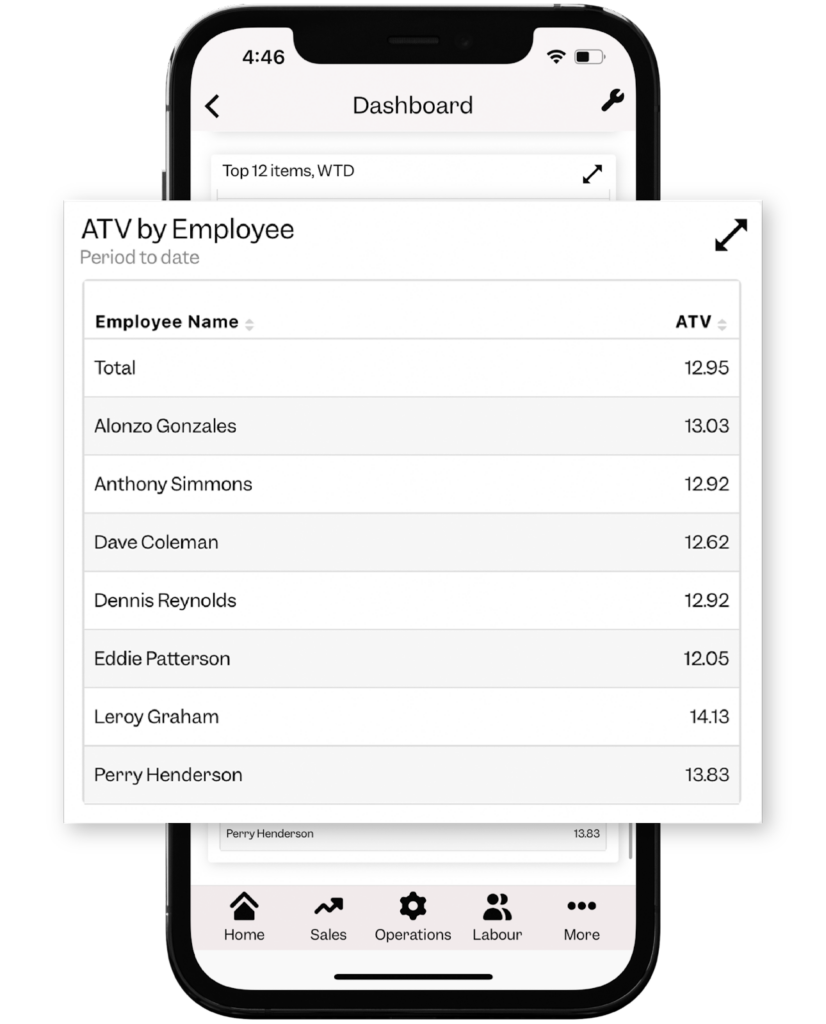
Champion your Team
Set goals and targets for your staff, and business, based on metrics and quantifiable values; these could be set for either general business sales or specific staff members’ performance.
Creating targets gives employees something to work towards, and an understanding of the level they should be performing at. Targets provide an opportunity for you to champion your employees, and really make them feel proud of the work that they’re doing.
78% of employees feel more engaged when they feel strong recognition from their employers decreasing the likelihood of staff turnover. But it’s important not to meet underperforming staff with any resentment and ensure they are given the support and feedback they need to aid their development.
Push for a great company culture
Employee satisfaction increases to 87% when they feel that they have a thriving workplace culture, so ensuring that your business does everything to create a happy working environment is important.
Company events that aren’t focused on work are a great way to improve employees’ relationships and create a positive working environment. Team building events such as bowling or after-work drinks can also help improve internal communications whilst outside of the workplace.
59% of people in hospitality experience mental health issues making it imperative that employees feel supported by their team members, and have good relationships with colleagues that they can rely on. Creating buddy schemes, or having a dedicated team member to check in is a useful way to ensure everyone is feeling heard.
Attracting top staff
There are currently many more open jobs in the hospitality industry than employees to fill them. Junior and senior positions alike are tricky to find the perfect candidate for. If you’re not able to fill all the available vacancies, then filling as many as possible with experienced candidates will put you above the rest.
Employer branding
Employer branding is vital in attracting both experienced and junior staff; it’s an outward message from the company about who they are and what makes them special. It not only helps to attract new potential prospects but also prospects that are likely to resonate with your company and its values.
Offering good company benefits and competitive salaries is one way to ensure that your company stands out above other restaurants. Benefits could include private healthcare, training budgets, and good holiday allowances.
Demonstrating company culture is another good way to be successful in employer branding. It shows that relationships within your company are fulfilling’ and that time and resources are spent ensuring your employees are happy and developing.
Progression Opportunities
Clear progression opportunities not only attract staff that are looking to succeed in their careers, but it also promotes productivity and encourages employee retention. Employees with long-term business knowledge are valuable and save money in hiring.
Providing professional development with clear progression paths also encourages hospitality to be seen as a long-term career, and not a stopover between jobs. Without the stability of a future, and growth within the industry many will leave in search of a ‘career’.
Improving labour productivity
Labour productivity is one of the most important metrics to monitor when it comes to restaurant performance. Managing sales by labour hour means controlling costs by optimising your labour spend; this can be based on either improving employees’ productivity or the restaurant as a whole through effective deployment.
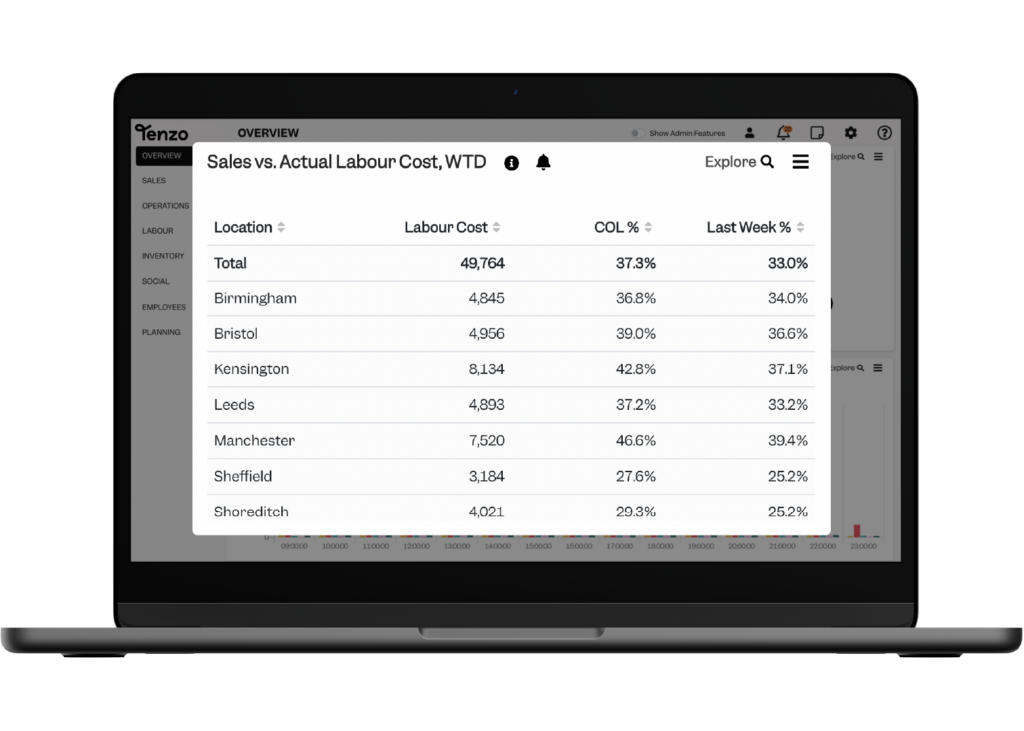
Effective deployment of staff
Staffing according to demand is really important so that staff neither feel overwhelmed nor bored, but that there are also enough people to deal with busy periods. Demand forecasting allows you to prepare for the number of covers during each service so that you can deploy staff appropriately and boost restaurant performance.
Shift patterns within restaurants can be rigid with everyone’s shifts ending or starting at the same time, this either leads to staff feeling unsure of the current restaurant’s customer needs or having both teams having to overlap for a long period. Implement a staggered handover time where one person from each team overlaps shifts with everyone else – leaving the restaurant running smoothly with high customer and employee satisfaction.
Trends and technology
Introducing technology within your business reduces the requirements for employees to do time-sapping administrative tasks; your team is more likely to enjoy their work if they feel it’s of value to the business.
Data collation is another task that has previously been a huge part of the general manager’s role. For example, Nona’s GMs used to spend 2 hours every week collating and understanding data, that time is now freed up to implement the changes that increase performance.
Using your own restaurants’ data to improve team productivity can be useful. Trends can help to identify which of your team are the highest performing. These team members can be an asset in training up the rest of the team: allow underperforming team members to shadow them so restaurant sales continue to improve.
Training
Staff training programmes are a great way to enhance labour productivity, helping to increase sales and profitability, while also helping staff gain more skills for their careers. Low training was cited as the main reason for leaving by 34% of staff.
Another benefit of good training schemes is that you’re able to employ less experienced staff, with the knowledge that they should be up to your restaurant’s standards very quickly. Saving the business more money, and expanding the potential talent pool.
Conclusion
High staff turnover is a prevalent issue within the hospitality industry at the moment with everyone feeling a pinch in applicants and the necessary resources to pull in the few there are. Working on improving your restaurant retention rate is a great way to avoid this problem, and save money on the hiring process.
Take advantage of the resources available to you to manage your staff efficiently, ensure that they don’t feel overwhelmed and help them improve their productivity so that your restaurant sees the benefits of improved performance.
The post Labour Productivity | Drive restaurant performance and staff retention appeared first on Tenzo.
]]>Business Intelligence (BI) tools are focused on transforming the operational data of businesses into valuable information that can be used to improve performance. They add strategic value and a data-forward approach to the decision-making process. If you’re thinking of implementing a restaurant Business Intelligence tool in your business, this article will explain all the aspects […]
The post Business Intelligence for Restaurants | Evaluating Your Options appeared first on Tenzo.
]]>Business Intelligence (BI) tools are focused on transforming the operational data of businesses into valuable information that can be used to improve performance. They add strategic value and a data-forward approach to the decision-making process.
If you’re thinking of implementing a restaurant Business Intelligence tool in your business, this article will explain all the aspects you need to think about.
|”People buy analytics to be able to act on their data and see an impact from it” – Christian Mouysset, CEO and Co-Founder at Tenzo
Why Is Business Intelligence Needed For Restaurants?
It’s no secret that Business Intelligence tools bring value to restaurants. Harnessing your restaurant data provides the roadmap and directions to controlling costs, driving growth, and as a result supercharging your profitability.
But, many Business Intelligence setups are more focused on providing accounting reconciliation and end-of-month reports rather than surfacing and delivering operational insights.
And this leaves a lot of opportunity on the table.
These limited opportunities can lead to missed chances for the business. A proper restaurant Business Intelligence setup enables front-line workers to engage with the data in order to make better daily decisions to hit targets and boost performance, while also giving back-office teams the required strategic and accounting visibility.
For example, Managers should know if next week’s staff schedules are aligned with forecasted sales and which items they’re typically over-ordering.
While Head Office should be able to measure the impact of the new happy hour and how to bring lower-performing sites up to the average.
Problems With The Current Restaurant Business Intelligence Tools
To make your organisation more data-driven, you need to (1) aggregate your data (2) analyse it and (3) engage the right decision-makers at the right time to action those insights.
Many non-restaurant-specific Business Intelligence tools, such as Power BI and Tableau tools really struggle to do (1) and (3).
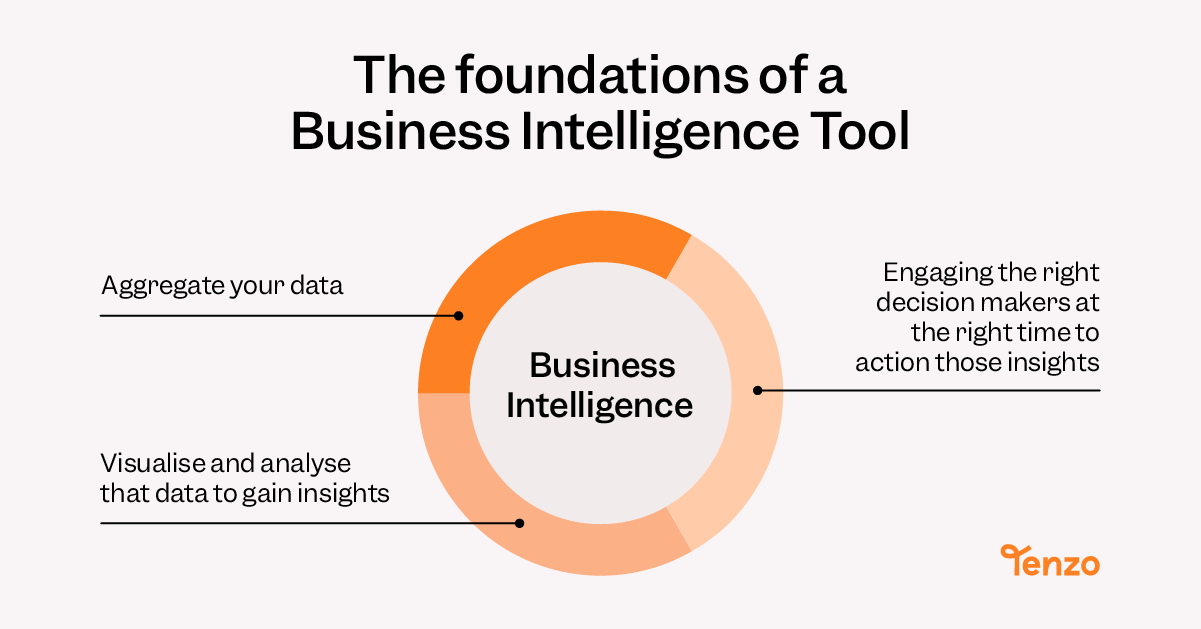
Power BI and Tableau can be great for other industries but restaurants are inherently different. I.e. restaurant businesses typically don’t have large in-house IT teams with developers.
This makes piping data into these BI tools difficult. And their lack of native integrations means data is often not real-time or requires constant maintenance. Plus, it’s quite difficult to get POS tools to expose their API (if they even have one).
Even if you solve the integrations piece, Business Intelligence tools’ fixed, static views (that generally aren’t mobile-friendly) have been designed with data analysts in mind, not restaurant operators.
They don’t lend themselves to GMs on the go, and the lack of manipulative ability and ‘so what’ makes it hard for them to understand how to action the insights without going through the chain of command.
On top of this, these tools’ complexity and sophistication can cause data paralysis for many restaurant operators leading to potential overwhelm for front-line workers who already have so many fires to fight without adding complex data analysis to the mix.
Missed Opportunities With Restaurant Business Intelligence Tools Not Engaging Operators
To really see improvement in business performance, both head office and front-line workers need to be able to access Business Intelligence data. By predominantly focusing on head office a lot of opportunities for improving performance are missed, for example:
- Reducing food waste and stock-outs
- Deploying the right number of labour hours
- Analysing menu performance
- Improving sales performance
General managers need to be able to understand their data and be shown where they are missing these opportunities in real time in order to maximise results. This not only allows them to hit the goals above, but it also helps them align closely with their targets.
Finding The Right Restaurant Business Intelligence Solution
Finding the right restaurant Business Intelligence tool for your business is just as important as the rest of your tech stack.
A good restaurant Business Intelligence tool is one that will grow with your business, providing you with the flexibility and scalability to grow.
It’s likely that restaurants looking to implement Business Intelligence software already have a tech stack in place with POS, labour and inventory tools, so looking for a Business Intelligence tool that integrates with multiple data sources is vital. The more sources the tool can connect to, the more visibility you’ll have over your entire business’s operations.
Aligning the data delivery capabilities of the solution with the use cases throughout your business is essential. Understanding how the tool will be used – strategically and operationally – will highlight the best options.
Operationally, finding a tool that allows those making everyday business decisions to understand insights garnered is essential in boosting performance. To provide operators with access to the correct information, ensure that it’s easily interpreted and offers real-time, fast and intuitive insights.
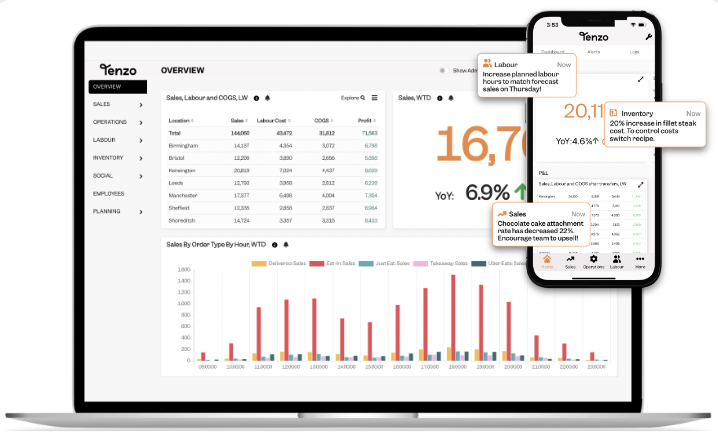
Tenzo vs. Traditional Business Intelligence Functionality
All business intelligence tools will provide useful information for businesses through access to data visualisation and many provide automated emails and allow for advanced data manipulation and report building.
However, as already mentioned, the real difference in boosting performance comes from engaging and empowering operators. Not only does Tenzo provide depth and complexity in the drill-down reporting and AI sales forecasts for head office, but it also lends itself to operators and General managers.
Tenzo’s mobile-first, real-time approach to reporting makes it easily accessible for GMs on the move.
Tenzo is intuitive and fast in providing insights, with tailored dashboards for individual users to allow for General Manager use as well as 95% of the strategic use cases needed by head office. It can also be used as a data warehouse to feed into Business Intelligence tools such as Power BI, should this be required.
Tenzo vs. Traditional Business Intelligence Implementations
When considering new software, it is important to not only think about functionality but implementation as well. Generally, from the moment you sign up for the software, you’ll be paying for it, but you might not get anything out of it.
Business Intelligence tools can take up to 12 months or more to implement with no guaranteed success – they have very high opportunity costs with expensive set-up fees and ongoing expenses.
Tenzo allows you to access and gain insights from your data within weeks. We already have integrations set up allowing for immediate data aggregation and reporting so that operators can utilise their data as soon as possible.
Not only does Tenzo empower General Managers to take charge of their restaurant’s success, but the AI predictions for sales alongside GM knowledge, allow for accurate demand forecasting.
“Tenzo’s exceptional support team went above and beyond to help us optimize our operations and achieve our goals. Thanks to their robust BI platform, we were able to extract valuable insights from our data and drive our business forward. I would highly recommend Tenzo to any hospitality business looking for an analytics tool with outstanding support.” – Nora Kanawati – Head of Technology & Digital Transformation, Sisban Holdi
Conclusion
Business Intelligence is an increasingly important tool for restaurateurs, especially for large, enterprise businesses with many locations. Choosing the right tool is challenging, but we advise considering the use cases before doing so.
The best way to improve performance is by empowering operators and front-line employees to take charge of their own success. Although most Business Intelligence tools will provide the head office with strategic data delivery, Tenzo differs by allowing operators to easily engage.
Engaging front-line restaurant workers and operators by providing useful insights and a dashboard suited to them creates more opportunities for restaurateurs to supercharge their performance.
If you would like to speak to an expert, don’t hesitate to reach out for a tech consultation with the Tenzo team.
The post Business Intelligence for Restaurants | Evaluating Your Options appeared first on Tenzo.
]]>