January is a relatively slow time for both the restaurant business and most people’s social calendar after the madness of December, but restaurateurs and managers should not rest on their laurels this month. January is a time for renewed vigour and purpose, and you should be using the lull in business to re-assess, refresh, and […]
The post The Ultimate January Checklist for Restaurateurs appeared first on Tenzo.
]]>January is a relatively slow time for both the restaurant business and most people’s social calendar after the madness of December, but restaurateurs and managers should not rest on their laurels this month. January is a time for renewed vigour and purpose, and you should be using the lull in business to re-assess, refresh, and put together your plan of attack for 2019. If this year is going to be more successful than the last, riding the wave of purpose that January can bring along is absolutely essential. We’ve put together the ultimate January checklist for restaurateurs;
On the other hand, knowing where to begin and keeping track of all your tasks is a challenge in itself, especially with a head still reeling from NYE revelry. With this in mind, Tenzo have put together the ultimate restaurateur’s January checklist to set you off in the right direction. Follow this to get off to a galloping start in 2019.
For those who like pen and paper, the checklist is also available as a PDF to print out.
Alternatively, if you like to use a task-management tool, the checklists can be found here as a Trello board template. Just follow the instructions by clicking on the Tenzo logo inside the Trello board to make your own copy.
1. Set goals for your managers (or yourself)
High-level goals can be to improve three key metrics:
1.Sales – Target perhaps a 6% increase year-on-year. Be more ambitious if you are new in town. Do this via two paths:
A) Increase footfall by 3%. Closely monitoring your social reviews on platforms such as Google Places is one key to this – it has been found that 33% of restaurant customers won’t dine below 4 stars. Respond quickly and politely to bad reviews to increase the likelihood they will be retracted. Also make sure your concept is clear and your menu is 2019-ready (see other checklist items)
B) Increase upsell by 3%. Average Transaction Size (ATS) should be monitored regularly by optimising menu item combinations – (see other checklist item)
2.Cost of labour as a percentage of sales (COL) – 27% is a healthy goal. Perhaps target a 1% improvement each year, or choose to keep stable at around 27%. Technology such as a good labour planner coupled with Tenzo, our business intelligence platform, is a great path to reducing COL. Click here to learn more about Tenzo’s labour forecasting.
3.Cost of goods sold as a percentage of sales (COGS) – aim for a goal of 25%. Keep this stable or reduce it by a small increment at a time by paying attention to your menu items, portion sizes and prices, your suppliers, and your ordering efficiency/wastage. Tenzo’s best-in-class sales forecasting can drastically reduce wastage and improve COGS. Read how here.
2. Give each waiter a spend per head target
Look at spend-per-head averages for each of your waiting staff and set them realistic targets for improvement over the next few months. January is the perfect time to do this, as your staff will be primed for positive change, and the relative lull in business will give them the space to experiment and spend more time with customers. Base your targets on a realistic convergence with the spend-per-head of your strongest performers. Also, set your star performers targets; there is always room for improvement. Schedule check-ins with each staff member at monthly intervals to check on progress and renew motivation. Promising a bonus for those who smash their targets can help with motivation, but not always. If you sense that your staff are already well motivated to improve, offering a financial incentive can “crowd out” their desire to perform well for its own sake and actually cause them to lose motivation. For many, genuine praise, appreciation and the satisfaction of a job well done is a much stronger motivator than money.
Make sure there are up-selling opportunities available to your waiters.
Waiters can’t do much to increase spend per head if your menu is too rigid. Make sure you are offering enough add-ons and sides. Good examples of add-ons are guacamole added onto a brunch, vegan cheese added to a veggie-burger, protein add-ons for salads such as sliced chicken breast or grilled tofu, and edamame beans or bread and olive oil as an appetiser. Offering the option to upgrade the size of drinks, especially on more expensive items such as smoothies and wines, is another beneficial idea.Once added to the menu, educate your staff on which add-ons should be offered with which meals.
3. Recognise and reward your staff.
You may wish to reward or give special recognition to your staff, and particularly your strong performers this January. Your gratitude may not have shown during the hectic Christmas period, but don’t forget to let your staff know how much you appreciate them while you have the chance. January is the time for change and if they don’t feel valued, key staff members may do their own new year appraisals and leave your business. Show them some love.
Use quantifiable metrics
Make sure that if you single out particular staff members for recognition or reward, you do not sow resentment with others. A good way to avoid bad feeling is to make your rewards based on tangible, quantifiable metrics. Spend-per-head is a good one, as is average tips. You may also choose to recognise a member of staff for working a particularly high number of hours in 2018.
Don’t miss out on training opportunities
If one of your waiters had a particularly outstanding spend-per-head this past year, don’t miss out on the opportunity to let your other waiters learn from her. During the January lull, while your staff are less busy, they can be encouraged to take a step back and appraise their performance. Getting staff to observe a strong performer doing their stuff is a great way to have this happen organically. Just make sure the observation is subtle so as not to disturb customers. Tenzo can help provide quantitative sales performance metrics with its employee leaderboard module. Read more here.
4. Make sure your menu is ready for 2019 trends
The big food trend for 2019, as in 2018, will be an increase in the number of customers eating a vegetarian or vegan diet. The proportion of strict vegans to more traditional ovo-lacto-vegetarians is massively increasing, so be sure to add another fully vegan option to your menu. The gluten-free and wheat-free trend is also set to continue in 2019, so make sure you offer enough suitable options here too.
Also look out for other industry trend predictions, for example the results of the American National Restaurant Association’s annual “What’s Hot” survey. This year, the Chef’s surveyed predict that “globally inspired breakfasts” e.g. Shakshouka, plant-based sausages and burgers, and locally-produced spirits will be some of the big trends.
5. Identify your sales trends
During your January refresh, it’s a great idea to deep-dive into your sales data for the year to identify trends and opportunities. Determine which menu items are selling the best at specific times (time of day/day of week/seasonal), which helps focus your efforts in terms of inventory management. You never want to run out of ingredients for your most popular dishes, but on the flip side over-ordering these ingredients is a common cause of wastage in restaurants. Correct, accurate sales forecasting is key to ensuring you maximise margins.
Using sales data to engineer a menu is a complex topic deserving of its own checklist, but here are a few ideas to think about, that can quickly increase sales:
-
If you have one or a few items which dominate sales, consider adding similar items to your menu, and ensure that this item is customisable for all dietary requirements.
-
Poorly selling items are bad for your bottom line, regardless of how tasty they may be or how long they’ve been on the menu. Rarely ordered items cause ingredient wastage, so take a look at your bottom 20% of items. If you see that sales are not sufficiently high to avoid wastage, removing the item might be the best option. However, there may be other reasons why the item is not selling well, such as a bad name or description, or cannibalisation by another similar but more appetising item, so be sure to explore all possibilities first.
6. Schedule a short weekly social review meeting
Scheduling a regular meeting to go over reviews is incredibly important for your staff so they see all the latest feedback from guests. This provides both accountability and transparency of business performance, while also providing a platform to give credit to your staff when reviews are good. Tenzo’s social module allows staff to see all the latest reviews in real time as well as how each location is trending over any given time. Read more.
7. Build a calendar of local events and public holidays
Grab a few creative staff members to brainstorm whether promotions or special products can be planned for each calendared event. Festivals on your street are a huge opportunity to get a grill out and cook some unique takeaway food. Public holiday promotions are a great way to lure in passing foot traffic. The only limit here is your imagination. Build a detailed plan for 2019 events and schedule when you will start preparing for each.
8. Do an annual tech review
Make sure the tools and software you are using are still fit for purpose and best-in-class. The world of restaurant-tech has never moved so fast and solutions that were cutting edge two years ago may now be old-hat. Get rid of any software that isn’t being used or work out how to ensure that it will be used properly this coming year. Identify key problems with the solutions you are currently using that are causing staff a lot of headaches and see if you can find new, better solutions.
Software companies usually offer free demo calls so make the most of this amazing service to get a personal walk-through of the new tech available in 2019. You’ll be an expert in no time, and with very little effort.This year inventory management platforms such as MarketMan, staff schedulers such as Planday, and Restaurant BI platforms such as our very own Tenzo have matured and will become more widely used. We would recommend scheduling demos of all three!
9. Do a restaurant lay-out review.
Can efficiency be improved? Talk to your floor and kitchen staff about their working space. Do they wish things could be moved around? Sometimes a small switch can do wonders for efficiency and stress-levels. They may not be aware of the issues causing them stress, so also be sure to spend time observing how staff move around your restaurant. Look for bottle-necks and inconvenient placement of frequently used items. Also, consider how you can reduce the ‘cognitive load’ of your staff members – a major cause of stress. Efficient layouts can reduce the number of things that each staff-member must keep in mind. The benefits of reducing cognitive load are many – lower stress, better communication, better staff relationships, and staff who are more relaxed and charming with customers. Small changes can make a big difference here.
10. Schedule your team building activities for the year.
Let your team know the dates as soon as you can. January will seem much less bleak with something fun to look forward to. This will also help make your staff feel rewarded for their hard work over the winter holidays. Team building activities don’t have to cost much either; here are some great ideas.
11. Schedule bi-monthly one on one meetings with your team members.
Scheduling regular meetings with your team members is highly important. Firstly, it gives you valuable knowledge as to what is and isn’t working in your restaurant both operationally and on the customer service side – your floor staff have a lot of useful insights. Secondly, it allows you to both receive and provide feedback on performance whether that be your management effectiveness or their sales metrics. Regularly meeting will ensure information transparency, accountability and respect for both parties, as well as help to keep morale high.
12. Do an annual review of your electricity and gas supplier.
Use a tool like Compare the Market in the UK, Power2Switch in the US, to see if you can save money on your electricity and gas bills in the coming year. It takes minutes and could save you thousands!
UK
https://energy.comparethemarket.com/energy/v2/ https://energy.gocompare.com/
US
Even better, save money and the environment in one fell swoop by going green with an 100% renewable energy provider such as Bulb in the UK, CleanChoice Energy in the US (limited states). Given their great prices, they are also likely to be
cheaper than your current energy provider.
US
https://cleanchoiceenergy.com/
The post The Ultimate January Checklist for Restaurateurs appeared first on Tenzo.
]]>Any restaurateur worth their Maldon salt will tell you that rain is generally bad for business. As people hide inside to stay dry and cozy, they cancel reservations and opt for comfort food and a Netflix binge instead. See our past analysis of rain effects here. Restaurants in winter are another story, so what about […]
The post Restaurants in Winter; the effects of snow on the hospitality industry appeared first on Tenzo.
]]>Any restaurateur worth their Maldon salt will tell you that rain is generally bad for business. As people hide inside to stay dry and cozy, they cancel reservations and opt for comfort food and a Netflix binge instead. See our past analysis of rain effects here. Restaurants in winter are another story, so what about snow?
With the Met office anticipating freezing weather this coming January, being aware of how your business might be affected by snow should be a top priority.
Does the winter romance of a blanket of white encourage people to bundle up and venture out to eat? Or does the hunkering-down instinct kick in here too? Should you expect to be snowed under, or left out in the cold? We looked into the vast Tenzo database to find out.
The impact of snow for restaurants in winter
The Cold Snap
The last time the UK had a widespread white Christmas was 2010, way before Tenzo started collecting data, so we will focus on the latest period of extreme cold weather which occured in 2018 between the 28th of February and the 3rd of March.
During this period, nicknamed ‘The Beast from the East’, strong winds brought air to the UK from the direction of Finland, and it got seriously cold. As ‘the Beast’ collided with warmer, wetter air from Storm Emma rising from the south, the UK was blanketed with a thick layer of snow on the 2nd of March.
On 28th February a man died after falling into a frozen lake in a London park. Glasgow airport was shut among major disruption to roads, rail, and air travel. Thousands of schools closed, and many areas experienced power cuts. Many isolated communities had to receive emergency supplies by helicopter.
The photo below shows the moment ‘the Beast’ hit the city of London.

This blog will explore how different types of food and beverage business were affected over this freezing period. An important point to note is that the snow and freezing temperatures during this time were accompanied by very cold and strong winds battering the UK from the North-East, making the weather in this period far from pleasant. The business impact may have been very different without the wind.
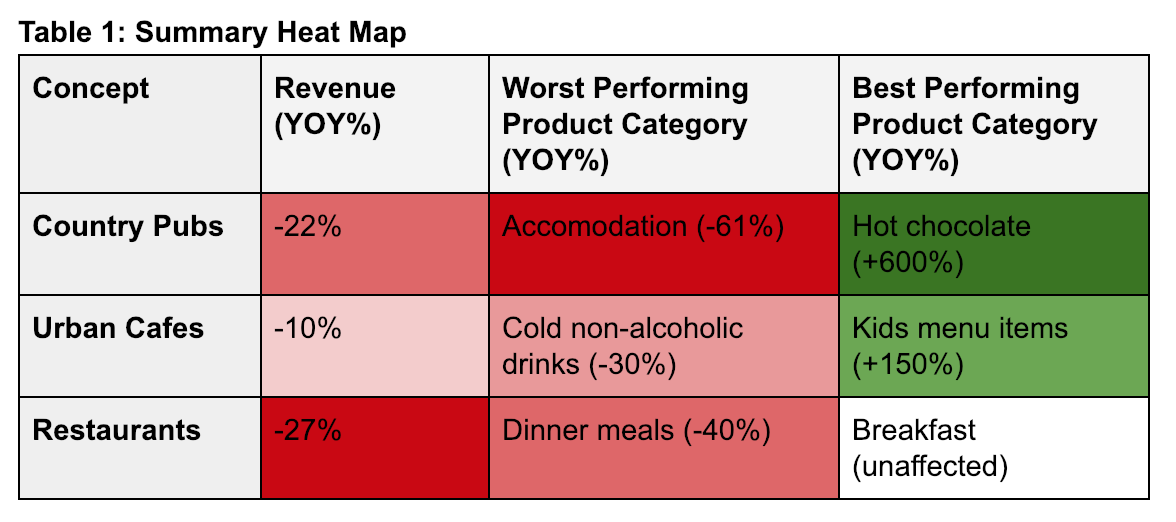
Table 1 outlines a heat map (or should we say COLD map?) of three major hospitality concepts on Tenzo’s books. Importantly, this data was taken on Friday March 2nd 2018 and compared to the closest Friday a year before across a statistically significant number of Pubs, Cafes and Restaurants across the UK. The results are discussed in the paragraphs below.
Country Pubs
The pubs which use Tenzo, mainly in countryside locations, were heavily affected by the snowy, windy conditions on Friday March 2nd. On average, their revenues were reduced by a massive 33% of what they expected to make at this time of the year. The very worst affected pubs made only a quarter of what they expected! Only one pub in the database did better than expected (it’s not clear why this exception occured).
A slightly different way to look at the numbers is to compare to what the pubs earned on the same day of the week a year earlier. This only makes the picture look slightly less bleak: the pubs on average saw a 22% drop in revenues.
Which product divisions were worst affected? Drinks were the least affected, down across all pubs by only 2% year-on-year. Food sales slumped a massive 30% compared to the previous year, and this change accounted for around 65% of the overall drop in sales. The most affected category, unsurprisingly, was accommodation. Only the foolhardy would choose this horrible weekend for a stay in a country inn, and sales were down a massive 61% year on year.
A few product categories actually saw slightly increased sales across this period in spite of the overall downturn. Draught beer and cider, red wine, port, sherry, rum and whisky all bucked the trend and did well, so publicans should stock up before January!
The two categories which did the best, however, were kids meals, up 400%, and hot chocolate, up an incredible 600%. This probably reflects the widespread closure of schools on that day, with many families opting to spend the snow day at their local.
The effect on mealtimes was different between lunch and dinner. Lunchtime was only slightly affected, but dinnertime business was severely affected, with sales down by a quarter year on year. Perhaps this was because while the snow might be appealing during daylight hours, the romance is considerably lessened after dark.
Urban Cafes

Cafes in city locations were also badly affected by Storm Emma and the Beast from the East, though not nearly as badly as the country pubs. On Friday the 2nd of March on average they saw a 10% decrease in sales compared to the same day a year earlier, and a 15% decrease compared to what they expected to make on this day.
The worst affected cafes saw sales slump 20% on this day. The only cafe on our system which actually saw a year on year sales increase on this day happened to be in one of the few cities in the UK which did not experience any snow over the period.
Of the major product categories, sales of drinks did worst, seeing a decrease of 30% year on year. Food did far better, seeing a modest 6% drop.
Getting more specific, the best selling items on this day were large breakfast meals including full English breakfasts. Unsurprisingly sales of takeaway food such as bacon rolls dropped off totally (-75%), whereas sales of takeaway hot drinks actually improved slightly. Among the worst affected categories were soft drinks, juices, and milkshakes (down around 30%), while sales of tea, coffee, wine and beer remained solid.
Some of the other best-performing food items were sweet treats, especially classic kid’s treats. This, coupled with an 150% increase in hot chocolate sales and a strong performance of kids menu items, would suggest that, just like for the pubs, the school closures on this day helped to temper the effects of the bad weather on cafes
.
Also similar to the pattern with pubs, as the bleak day wore on, sales got worse. Breakfast sales were not affected compared to the same day a year earlier, lunch sales were moderately reduced, while those cafes on our system which serve dinner were badly affected at this time of day, experiencing a 25% slump.
Restaurants

The restaurants on the Tenzo system also did very badly from the 28th February to the 2nd of March, on average seeing a decrease of 27% year on year. However, there was a lot of variation in how much they were affected, with many restaurants down more than 50%, and restaurants which did comparatively well seeing a modest decrease of around 10%.
In London, where the weather was slightly milder, the effects were also milder, whereas in the blizzard-like conditions across the west coast and the midlands, the impact on business was much stronger.
As with the other types of business, sales got worse as the day of the 2nd of March went on. Breakfast performed as usual, with some restaurants actually seeing improved sales: one particular chain seeing a 250% morning surge. Lunch on average saw decreases of around 10% year on year, while dinner was by far the worst affected, and accounted for the vast majority of the bad performance on this day. Dinner sales were typically reduced by 40%.
Due to the huge range of restaurants in the Tenzo database, it’s very difficult to draw lessons about specific product categories’ performance. However one clear pattern, perhaps obvious, was that sales of traditionally summery drinks such as sparkling wines, rose’s, juices, and fruity cocktails were all badly affected by the frosty weather.
Top 4 Insights
-
Snow storms are extremely bad for food and beverage businesses – expect sales to drop 10-40%, depending on the type of business.
-
If local schools close, you’re in luck. Expect boosts for cafes and pubs to lunchtime sales of kid’s meals, and stock up on hot chocolate!
-
On a cold, snowy day, expect business to get worse as the day wears on. Dinnertime business will be by far the worst affected.
-
Sales of warming drinks and alcohol will remain strong. Perhaps cash in on this by preparing a large supply of mulled wine or cider.
Tenzo’s Forecasting
As we can see, the weather can drastically affect business for restaurants, pubs, and cafes. Tenzo provides market-leading sales forecasting for food & beverage businesses and uses historic sales and weather forecasts, plus local events and holidays, in its forecasting algorithm. Tenzo’s Artificial Intelligence-driven forecasts have been shown to be far more accurate and reliable than typical forecasting strategies, and will help you to optimise labour scheduling, inventory ordering, and lower food waste.
The post Restaurants in Winter; the effects of snow on the hospitality industry appeared first on Tenzo.
]]>The post Restaurant Technology: Predicting the future in the year 2030 appeared first on Tenzo.
]]>
“79% of diners agree that restaurant technology improves their guest experience.” – Ellie Mirman, pos.toasttab.com
The modern consumers are distinct creatures to that of previous generations: from travel, shopping and communication; there has been an entirely different approach to life thanks to technology. From the previous century, the way food chains and restaurants have been run has roughly stayed the same. For example, customer experience in the past century has remained relatively consistent from the introduction of diners, to the slow evolution of fast-casual restaurants and take-out joints.
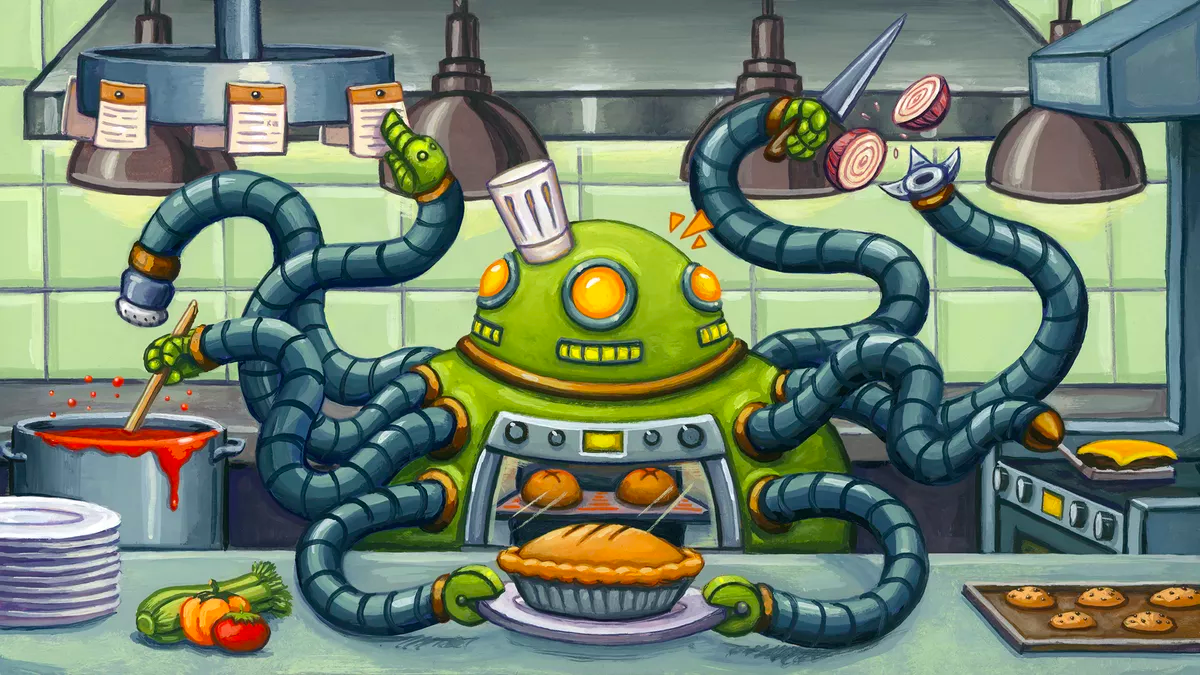
However, this trend looks to be taking a turn as technology is edging closer to disrupting this space. According to experts, future restaurants will be mainly operated by machines rather than humans due to their ability to:
- Lower operating costs
- Improve customer experience
- Reduce employee fraud and;
- Create automated and transparent business intelligence/reporting in real time.
Front-of-House
Customer Experience
“61% of adults say they would rather spend money on an experience, such as a restaurant or other activity, compared to purchasing an item from a store.” – Restaurant.org
The standard expectation of any consumer will be to provide good food at affordable prices, which are delivered quickly. To deliver on the above expectation takes tremendous effort and a highly efficient cohesive business operation plan. To increase the customer retention rate, the customer experience is imperative to your business. The younger generation consumers are always looking for newer, more unique experiences when it comes to dining and food. With new generations being more tech-savvy, it is a clear indication to involve technology as part of the dining experience in your business. Incorporating multi-channel marketing operations and store data from every visit made by a consumer to a restaurant, and additionally using that personal data for future consumer visits to ease their order and checkout process.

A huge future product is Project Nourished, which aims to change the restaurant customer experience by infusing AR, artificial sensory inputs, 3D printing, and computational gastronomy to create an artificial experience of eating any type of food the customer desires without its harmful dietary drawbacks.

Another front-of-house operation system is Eatsa which is completely automated. From ordering on kiosks to assembling the order to a self-service food pickup system which adds a more tech-savvy, futuristic experience to a fast-casual restaurant.
Self Serving Kiosks
The idea of ordering from a small open-fronted store gets the tech-savvy consumer excited about an experience that is convenient, hassle-free, and private. Reports say that customers are likely to order dessert 200% more from a kiosk, which shows more motivation towards using this type of ordering method to help boost sales. Kiosks also have the ability to store individual behavioral ordering data like the different age groups or genders and the ordering time per customer – this analytic data can be studied to provide business insights and prepare for future customer offerings.
“In the restaurant industry alone, employee theft totals between $3 and $6 billion dollars annually.”- Kendal Austin, pos.tasttab.com
Using Kiosks can increase restaurant operation mobility and reduce fraud activities.
Tall the above issues outlined below lead to a large amount of lost value, however, using Kiosks guarantees more security and eases management concern on loss prevention (i.e.theft). Kiosks from an investment perspective have the following benefits:
- Reduce labor costs
- Reduce human error due to miscommunication or language
- Increase average transaction value
- Increase complimentary food & drink orders
- Reusable receipts
- Decrease service theft

Switching to digital platforms for payments offers a more secure platform for money transactions and reduces customer anxiety around making inaccurate payments.
Wearable tech
Wearable technology can improve communication between front and back-of-house as well as customer satisfaction. In particular, wearable tech devices can help:
- Link front to back-of-house staff to send important customized details like order preferences & real-time changes.
- Managers get real-time data around the restaurant to make instant decisions.
- Maximize customer service by completing guest requests instantly and informing responsible staff to take action.
- Complete fast and simple payment procedures directly from the table.
Smart Tables
Smart Tables are a powerful prospect which will could change the front-of-house scenario and eliminate the idea of going up to a counter or even a kiosk. By completely transforming the table from an out-dated, boring piece of furniture to a device that can take a customer’s entire order, remember menu preferences and recommend new dishes. Additionally, Smart Tables can take payments, remember payment accounts and complete service requests.

Also, there are different visual features that can be integrated into the tables, such as a hologram showing every item on the menu.
Back-of-House
Kitchen Automation
“59% of restaurant operators name staffing as a top challenge to success, 63% of QSR managers name staffing a challenge to success – more than in any other concept.” – Allie Tetreault and AJ Beltis, pos.toasttab.com
Most of what you read above was focused on how the front-of-house space can transform with technology, but there is another area that has the most direct impact on the customer experience. The kitchen has new tools and technologies coming through every year where chefs and operators can create new types of food techniques and dishes. Back-of-house operation will be going mechanical at some point in the future in most restaurants, and definitely fast food joints where high frequency and consistent quality are a prime requirement. Automated machines have the capability to perpetually produce sustained quality food in terms of shape, taste, and texture with a higher success rate than chefs. For example, Roostersbot is a portable food technology stand creating high-quality burgers at only $5; or, another example being the complete robot kitchen at Spyce in Boston where customizable high nutrition dishes are cooked for prices as low as $7.50.
.png)
Using these automated kitchen machines means lower prices, with consistent food quality.
Digital Inventory & Purchasing Tracking
Storing data on paper is a thing of the past, with new digital and cloud formats where you can track your inventory and automate purchasing operations. Switching to digital inventory systems help manage assets in a more organized fashion and increases operational transparency. Features like customized schedules for inventory purchasing and creating theoretical inventory levels and situations to simulate various situations can help management plan months ahead and cut costs at higher rates.
.png)
Conclusion
The potential gains from introducing these technological solutions are significant and likely to be inevitable in certain segments (quick service, quick casual restaurants) as the consumer continues to demand lower prices and a smoother customer experience. These demands can be met by implementing automated systems and devices to assist in restaurant operations, specifically robotics and kiosks.
The post Restaurant Technology: Predicting the future in the year 2030 appeared first on Tenzo.
]]>The Covid 19 pandemic is a real onion of a problem for the hospitality industry. As the most urgent issue of the moment is peeled away, more potential issues are already there to face us. We look at how COVID-19 threatens the restaurant supply chain. Last week, as many businesses were just beginning to get […]
The post How COVID-19 threatens the restaurant supply chain at every link appeared first on Tenzo.
]]>The Covid 19 pandemic is a real onion of a problem for the hospitality industry. As the most urgent issue of the moment is peeled away, more potential issues are already there to face us. We look at how COVID-19 threatens the restaurant supply chain.
Last week, as many businesses were just beginning to get their heads around loans, delivery, safety, and the government’s worker retention scheme, eyes turned to a fresh crisis: the restaurant supply chain is at breaking-point at almost every link – meaning that the hoped-for “bounce-back” after the virus is finally defeated might not be easy.
How COVID-19 threatens the restaurant supply chain
11 billion meals are prepared by the UK hospitality industry each year. With the government closing these businesses down on the 20th of March, almost all of them immediately stopped sending orders to their suppliers, or massively reduced their orders to service the trickle of takeaway orders they are receiving.
This abrupt change has sent shockwaves down the supply-chain, hitting wholesalers, importers, farmers, and fisheries in turn.
Wholesalers
Many wholesalers and restaurant suppliers have been scrambling to pivot to a straight-to-consumer home-delivery model over the past week or so. However, the infrastructure, demand, and labour force required to sell food in this way all take time to build, and a large portion of the food currently in warehouses cannot be distributed directly to consumers.
Trade body The Federation of Wholesale Distributors, which has 600 members including Booker, Bestway, Brakes, and Costco says that £20m of food with less than three months shelf life is now lying in warehouses unwanted. It cannot be sold to consumers because it is in large packs without the correct labelling of country of origin, nutritional and allergen information.
As well as the issue of unsold stock, wholesalers are dealing with customers who are unable, or unwilling, to pay their bills. JD Wetherspoons, for example, initially announced that it would not pay outstanding amounts to any of its suppliers until their pubs re-open, but backtracked today after receiving criticism. However, many other businesses are holding back on payments until government help with wages arrives, leaving suppliers in the lurch.
Most wholesalers without significant cash reserves will be faced with a choice:
Either take advantage of the government’s Business Interruption Loan Scheme
Or pass their troubles on to those further down the line, by refusing to pay importers and producers.
The first option, government loans, is troublesome. Even if businesses are eligible for the scheme, they probably don’t want to take on much debt under the current situation of uncertainty. Indeed, some small business owners have reacted angrily to the scheme – calling it a “trap” and accusing the government of designing it to prop up the economy, rather than to actually help businesses.
The second option, refusing to pay importers and producers, only passes the buck down the chain to industries facing their own unique set of challenges.
Importers
Half of the UK’s food comes from overseas. Generally, importers are having little trouble getting food over the channel, with the trade in goods continuing to operate over otherwise sealed borders. The government has also classed logistics workers as essential, putting them in the same category as NHS workers and giving them preferential access to coronavirus testing kits and childcare. Importers will generally find it easier than other businesses in the supply chain to switch to supplying the overrun supermarkets.
However, there are some issues to be seriously concerned about.
Andrew Jackson, managing director of Marrfish, a seafood wholesaler based in Hertfordshire, says that certain trade routes are being disrupted: “We’ve had lorry drivers stopped at borders, given temperature checks, and blocked from crossing,” He said. “The fish in the back of the truck has had to sit there for days, going rotten.”
Marrfish is particularly badly hit by the pandemic: “Over a period of three days, we lost all of our customers,” said Jackson, “But we had chillers full of fresh fish, fish coming in from Iceland, Norway and Turkey still. All perishable. We made a decision to cut fish off the bone and freeze all of it in vacuum packs to offer for home delivery.”
Most of Marrfish’s customers have refused to pay money owed to them for the time being, but Marrfish have already paid for the fish – they buy it directly from markets and vessels.
Quick thinking means Marrfish are now selling fish boxes for home delivery, but the learning curve is steep – they set up their online shop on Thursday 19th, and started selling on Friday 20th. Getting out the message through their customer network and Facebook ads allowed them to shift up to 70 boxes a day a week later. Impressive, but Jackson says they will still be losing thousands of pounds a week even if the delivery business really takes off, and that they are in real danger of going under.
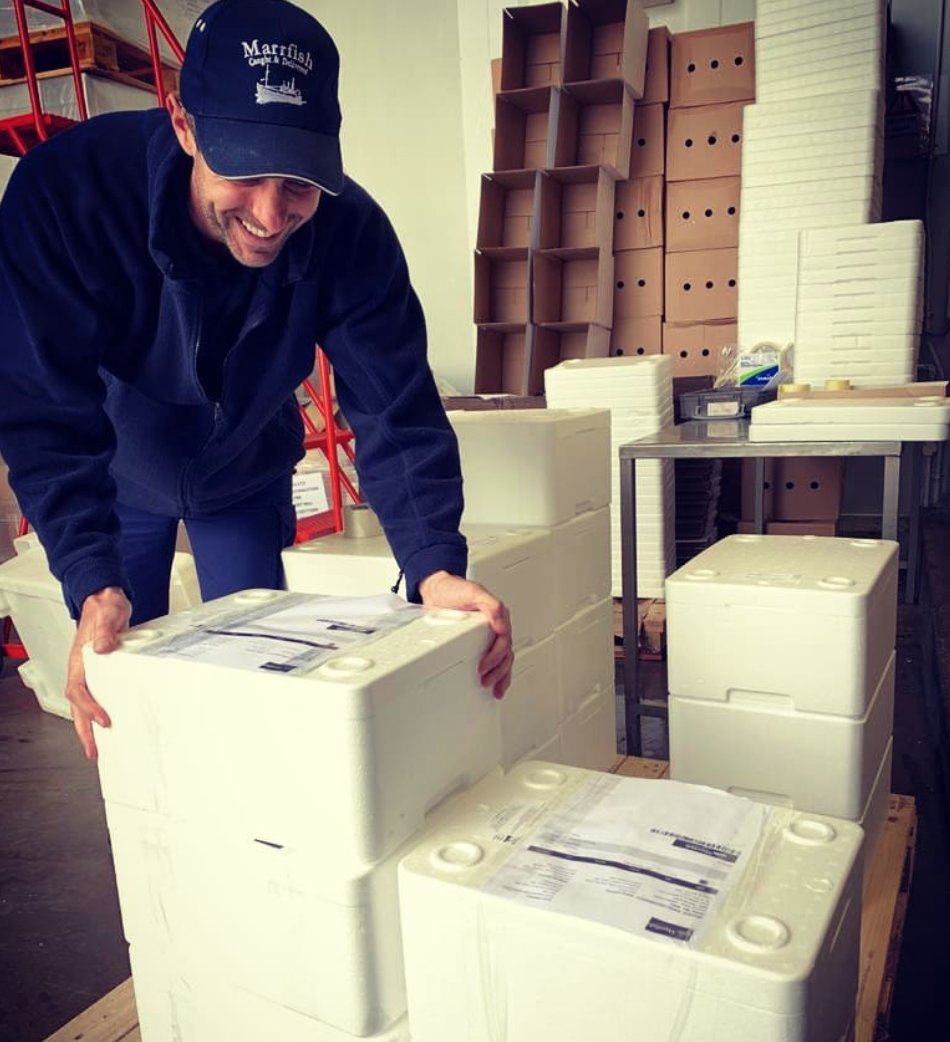
A Marrfish employee packing boxes for home delivery
Fish is a food that most Brits very rarely cook at home: “A lot of people don’t know what to do with fish,” says Jackson. “It’s slimy and in the supermarket they are only accustomed to a few farmed species. We are trying to sell a product and also trying to educate. It’s not like a pork sausage.” Right now the boxes that Marrfish are selling to consumers consist of familiar species: salmon, seabass, and bream. But most of the fish in the freezers are less familiar species: stonebass, swordfish, turbot, john dory, whiting, and halibut. They expect these to be much harder to sell.
Other importers also specialise in supplying foods that are not usually stocked in supermarkets. For example, importers of international ingredients such as Asian food importers. These businesses are especially vulnerable, and with demand gone, many simply won’t be there when restaurants and wholesalers start ordering again. Chinese restaurants were the earliest in the UK to be hit by Covid-19, and may, unfortunately, also be affected long after the outbreak has subsided, this time by lack of supply.
Producers
Farms face a very different problem to most other businesses – a lack of labour. At around this time of year, almost a million seasonal workers usually arrive in the UK, France, and Germany from abroad to bring in harvests of fruit and vegetables, many from Eastern Europe. With most borders closed, these essential workers simply cannot arrive. Reports are already surfacing of French farmers discarding fields of ripe asparagus because of a lack of labour to harvest it.
Without a land army responding to calls to “dig for victory”, crops may rot in fields, affecting supplies of food, and pushing farm businesses over the edge. No wonder then, that farms have begun chartering planes to rush in workers from Bulgaria – the only country where workers can be found which hasn’t yet closed its borders. Industry bodies are calling on the government to urgently charter more planes to fill the 90,000 vacancies.
David Herdman, farmer and chairman of Muller Milk Group Farmer Board, the body which represents farmers to Muller (Britain’s largest producer of dairy products), says that the government needs to do more to help farms to feed the nation; in a similar way to how it has asked the public to help the NHS. “It would be criminal to let crops rot in the fields.” He says, “There are a lot of people now out of work – the government should be encouraging those people to fill the shortfall on farms.”
However, he also warns that those workers would have big shoes to fill: “It’s a cliche, but Eastern Europeans have got a great work ethic – they’re keen to get on and do as much as they can.”
Herdman also warns that some farms in the dairy sector will be pushed over the edge by the pandemic. Demand for milk from foodservice businesses has dropped off a cliff, meaning those farms which usually supply them have seen prices drop. Logistics issues have also led to price increases on animal feed. “Due to a pre-existing oversupply,” he says, “Most dairy farmers have already been losing money on every litre of milk for over 12 months: they are already saddled with as much debt as they can get, and this latest drop in price will mean many will be forced to throw in the towel by Autumn.”
More globally, the UN’s Food and Agriculture Organisation says that labour movement restrictions may lead to food shortages and price increases, as they did during the African Ebola outbreak in 2014. Beyond labour issues, the FAO says: “Restrictions on movement are curbing farmers’ access to markets to buy inputs and sell products. Fresh produce is accumulating at farms, resulting in food loss”.
The fishing industry also faces a struggle – as already mentioned, many British consumers are unaccustomed to cooking fish at home and have little desire to start – preferring to leave the slimy bits to chefs. Fishermen are still fishing, but prices have dropped. “Because the volume is so small, many logistics companies have stopped transporting fish as it’s not worth their time.” said Andrew Jackson, of Marrfish.
According to Jackson, the British public will have to change their tastes if international supply lines suffer further disruptions, something he thinks is very likely. “If everyone cooked fish, and was familiar with all the British species on offer, we could feed ourselves without imports,” He says, “But it’s not our culture to do that. The people of this country do not eat the species of fish we produce. 70% of what we eat is imported and 70% of what we produce is exported. People are going to have to eat root vegetables and meat and fish grown and slaughtered in this country.”
Conclusion
If businesses in the supply chain go under, restaurants will find sourcing ingredients much more difficult when they are eventually allowed to continue trading. Some changes might be permanent – if producers are forced to shut down or switch to producing other crops. Some other supply chains may take a long time to get going again.
Given that the industry is relying on a surge of pent-up demand to bring it out of dire straits when the virus is gone, it would be disastrous for many restaurants, cafes, and pubs if they couldn’t source food to sell.
The government needs to take swift action to prevent farm labour shortages and to keep all businesses in the supply chain alive.
The restaurant industry can do its part by helping to promote the new home-delivery offerings started by erstwhile suppliers – the email lists and Instagram followings you’ve built up over the years could be a lifeline. They might also need advice on promoting their offerings through Facebook ads – it’s a great time to get in touch and offer expertise in this area if you have it – the gesture won’t be forgotten.
As individuals, we can also do our bit to keep these businesses going. Rather than further crowding the overstretched supermarkets, we can order from the new delivery businesses popping up, run by restaurant suppliers, farmers, and fishermen. We can also try to support our local businesses by buying beautiful locally grown seasonal ingredients for the next few months.
If you know of any great new home delivery services please post a link in the comments and let’s get sharing!
Subscribe here.
The post How COVID-19 threatens the restaurant supply chain at every link appeared first on Tenzo.
]]>This post contains everything you need to know about how to reduce food waste in your restaurant business. Why you should reduce food waste. How to reduce food waste from your kitchen. And even how to stop your customers from wasting your food. Let’s get started then, with the why. Why you should reduce food […]
The post Reduce Food Costs And Eliminate Food Waste: The Ultimate Guide for Restaurants appeared first on Tenzo.
]]>This post contains everything you need to know about how to reduce food waste in your restaurant business.
Why you should reduce food waste.
How to reduce food waste from your kitchen.
And even how to stop your customers from wasting your food.
Let’s get started then, with the why.
Why you should reduce food waste
Food waste costs UK restaurants £682 million each year.
In the US, the scale of the problem is far worse, costing restaurants $25.1 billion annually. Restaurant owners and managers are acutely aware of the problem, with 52% of restaurant professionals naming high operating and food costs as a top challenge.
This waste takes a huge bite out of many restaurant’s profits, and it is also incredibly damaging to the planet.
Food waste as a whole is a huge waste of basic resources that could be used for nature, or for feeding hungry people. Take land as an example: the land used to grow food that is subsequently wasted makes up an area 58 times the size of the UK, or almost 3 times the size of the Amazon Rainforest.
The land that is used to grow food that is subsequently wasted makes up area 58 times the size of the UK
Food waste is also warming the planet: if food waste was a nation, it would rank as the third largest national emitter of greenhouse gases, after China and the US.
But, food waste also ranks among the easiest and biggest environmental opportunities available to us, probably because it’s a total win-win: not many solutions to climate change immediately save us money.
On average, businesses save 7 times what they invest in reducing their food waste! This means that pretty much any food waste reduction strategy you try will be a financial success.
We’ve put together a comprehensive list of all the things you can do to reduce your waste and save money on food. Find an approach that works for you, implement it, and you and the planet will soon be reaping the benefits.
This post focuses on kitchen waste, but we’ve recently posted blogs on plate waste and forecasting techniques for a complete view of everything you can do to reduce COGS.
How to measure your restaurant waste
What gets measured, gets managed, and the first step to a successful kitchen waste reduction plan should be to measure how much you are wasting, the cost of that waste, and what the sources of the waste are. If you measure your waste for a trial period as short as a week, you will get a pretty accurate idea of the current state of your food waste.
The simplest way to measure your food waste is by using separate bins / trash cans for different types of waste:
- Bin 1: Preparation waste – the waste generated while prepping food e.g. broccoli stems.
- Bin 2: Spoilage – Food that has gone off while sitting in your fridge or other storage.
- Bin 3: Plate waste – Served food that customers didn’t eat.
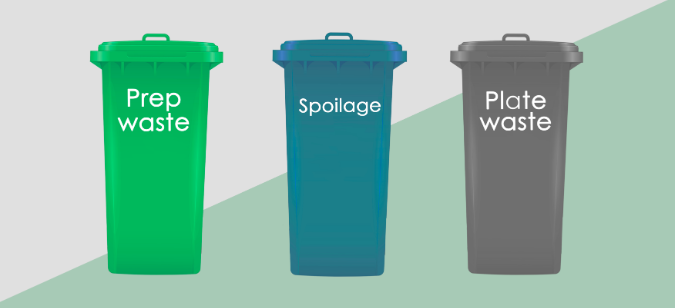
Weigh each bin at the end of each day, or even better at the end of each service. If you don’t currently own a set of bin / industrial scales and don’t want to spend the money for a short-term project – a good set of parcel scales can be strong enough to do the job.
From your week’s data, calculate how much waste you are producing each year. Then multiply this by the cost per tonne; the average figure in the UK is £3,500.
You will then know roughly how much wasting food is costing your business each year. It’s likely to be a surprisingly large number, but don’t be alarmed! Lot’s of practical advice for making improvements incoming…
Tech alternative: If you are running a large operation and really want to get to grips on your food waste, Winnow’s smart bins have an inbuilt scale and identify food items as they are thrown in, using AI.
How to get employee buy-in
Any successful food waste reduction program will rely on committed staff members. Without the buy-in of your employees, it will be an uphill struggle. Here are some tips on how to get them on board.
- Make sure there is no fear attached to tracking waste. The carrot is definitely better than the stick here, as waste can easily be covered up by popping it in the wrong bin and thereby ruining the accuracy of your waste tracking. Make sure that an open environment is created, where wasted food is not viewed as a result of poor performance on the part of staff. Communicate this clearly before you begin measuring waste.
- Hear and implement suggestions of employees. If staff feel that they are heard, they will take ownership of the project themselves, ensuring consistency and accuracy. Kicking off the project with a quick brainstorming meeting including all staff is a good approach.
- Go armed with data. It’s a good idea to complete your initial measurements before scheduling your kick-off brainstorming meeting. Staff will take the project much more seriously if they understand the huge losses associated with waste. They will also come up with better ideas if they can see where the waste is coming from.
- Make the ingredients sacred. Most people who work in kitchens have a huge love and respect for food – they all agree that good ingredients are sacred, and shouldn’t be wasted. Without being too preachy, stress this point, emphasizing the farms, farmers, animals, land and natural resources that have produced the food. Also emphasize the environmental issues involved with food waste. Stay tuned to this blog for our hard-hitting upcoming post on the environmental impact of food waste – print it out and pass it around the kitchen!
- Give them what they need. Make sure your staff have suitable equipment that will make the task of waste reduction as easy as possible. If staff see you investing cash and time in the project, they will recognise the importance of it.
How to set reasonable targets for waste reduction
Setting realistic targets for waste reduction will motivate your team and give everyone a great sense of satisfaction when you totally smash through them.
In Champions123’s research, which involved 114 restaurant sites across 12 countries all undertaking a waste-reduction program, the average result after 12 months was a 26 percent reduction of food waste by weight. After three years, the average result was a 58 per cent reduction by weight.
The best-performing sites achieved a reduction of over 95% of food waste weight. This is an inspiring achievement that shows what is possible, but to avoid disappointment, it may be best to shoot for the average.
Once you have measured your major sources of waste, compare your numbers to the average proportions – see the pie chart below. This will show you where you are falling short compared to the rest of the industry. Set more aggressive targets for the areas where you are doing badly, and more relaxed ones where you already do well.
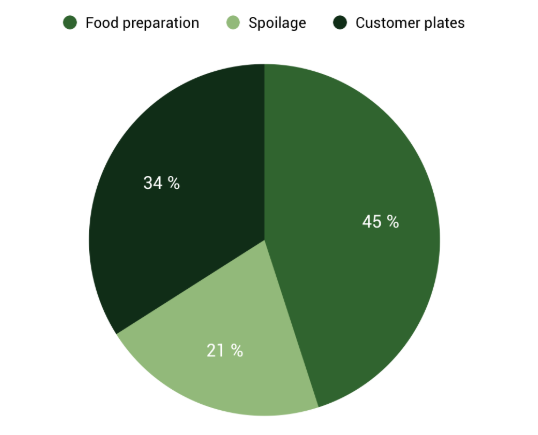 Where restaurant food waste comes from. Data from wrap.org
Part 1: How to reduce spoilage waste
Of the three major types of waste shown in the chart above, spoilage waste may be the smallest but is also the easiest to prevent, and in many ways, the most inexcusable. A careful commercial kitchen will have very little spoilage waste, and a very careful kitchen will eliminate it altogether. To state the blindingly obvious, letting expensive ingredients rot makes little business sense!
1. Avoid over-stocking ingredients
Forecast better
What are your expected sales on Wednesday? If the answer is “the same as last Wednesday”, chances are you’re going to miss the mark.
In a highly competitive industry with tight margins such as restaurants / F&B, accurate demand forecasts are often the difference between a business that is profit-making and one that’s destined to fail. The sales forecast determines not only your stocking levels for ingredients but also your labour schedule – in other words, all of your variable costs.
As forecasting specialists, we are constantly surprised by how primitive our clients’ and prospects’ forecasting methods are before they start using Tenzo’s automated AI forecasts. It’s very rare that there is a process defined. Konrad Edwards, one of the data scientists who built our restaurant forecasting software , likes to say that the general approach taken by most of the industry is to “hire a psychic”.
If you don’t currently have the budget for Tenzo’s automated forecasts (it’s great value!), that’s fine, there are probably a few things you can do to improve the accuracy of your current sales estimates, though it might not be easy.
Here’s some basic advice from Jiaxin Chen, one of our other data scientists at Tenzo, who focuses on creating ever more accurate sales forecasts.
- Consider corresponding past sales – Look at sales on the same day for the last 4 weeks. The most basic approach is then to average these numbers to get a four-week-moving-average, a decent forecast base. Even better, create a “weighted average” which favours the more recent sales figures.
- There is no forecast for all seasons – Seasonality is generally the most powerful predictor of sales volume. When it’s necessary, consider different seasons of the year separately. For example, identify when your summer busy season tends to begin, and adjust your 4-week-rolling-average base according to how big of a jump in sales you usually see in the spring to summer transition. If you skip this step, you could be caught out badly when the seasons change.
- Take into account events – If there is a large local event or national holiday on the day you are trying to forecast, such as Mother’s Day, or Valentine’s Day, your forecast needs to be adjusted. Look at the percentage jump you saw on the day of the event last year. If it’s a one-off event, your best bet might be to have a guess but take some time to consider the likely impact carefully. Also, when you are generating a four-week-moving-average, make sure you never include any days when such events occurred.
- Understand your key factors – This is the bit that the above mentioned “psychics” do based on gut-instinct. Consider what the key factors are that affect your sales – a restaurant on the seafront in a holiday town will have wildly different key factors than a QSR in the City of London. Key factors can include seasons, weather, events, or week-day, and each restaurant will have a unique mix. We recommend trying a data-led approach, figuring out from your past sales how much these factors affect your business and creating some simple guidelines to use when creating forecasts. You might need a bit of data analysis skill here.
 Jiaxin Chen – Tenzo forecasting scientist.
Need more practical advice on forecasting better? We will post a deep-dive on forecasting techniques in the next few weeks, so subscribe to be alerted!
Push sales of items you are overstocked on
Pushing sales of overstocked food items is a technique as old as time, but given the environmental imperative to reduce waste, it’s now more appropriate than ever. Here are the basic approaches:
- Get floor staff to recommend dishes containing overstocked items – Diners often ask waiters to recommend dishes. Most waiters simply recommend their personal favourite because they get little direction from the kitchen on which dishes need to be pushed. Set up a meeting before each service that ensures floor staff are always informed when a dish needs pushing, then show them how to push that particular dish. Even better, set up a competition and reward the staff member who sells the most – Tenzo users can do this easily by using the “% attachment by product item metric in the “employees” module. For a master-class in pushing specific menu items, watch this.
- Specials – I used to work in a sustainable fish restaurant where the head chef was a master at using his specials board to drive great COGS. When vendor prices were low for skate wing, for example, he would very quickly create a delicious new skate wing dish for the specials board, even if we had skate wing on the menu already. This drove more sales of the ingredient and allowed us to shift more of this high-margin item. He also used the specials board in a similar way to shift overstocked or slow-moving items, keeping waste very low. One important principle to follow when doing this is to make sure that the dish you put on the specials board is sufficiently different from the dish that you already have on the menu which contains the same principle ingredient – without doing this, the special will cannibalise your menu item and you won’t increase sales overall by much.
- Staff meals – every restaurant should be using staff meals as a lever to reduce waste. If a meal is made in error – managers should be on the lookout for a staff member who is due for a meal break who is willing to eat it. If an item is heavily overstocked, make that the staff meal for the day. Far too many restaurants use an inflexible (or overly flexible) staff meals policy that doesn’t aim to reduce waste. Note – restaurant staff often view enjoying staff meals as an important perk of working in the industry – ensure your managers don’t force staff to eat dishes they don’t enjoy, or you risk causing a major upset.
2. Be strict with vendors
Resist being sold more than you need
Some vendors will sometimes deliver more than was ordered, then charge you for it. Make sure that all deliveries are checked to make sure that they conform strictly to the original order. Reject anything additional.
Vendors also tend to use the hard-sell on items that they have overstocked, with special offers and discounts for volume. These can be great items to build high-margin specials on, of course, but caution should also be taken to ensure you don’t end up with more than you can sell. Look at the popularity of similar specials you have tried in the past before putting in a big order. Note: this is quick and easy with Tenzo, meaning you can check your past specials while the vendor waits.
Reject food likely to spoil quickly
Reject anything with visible spoilage on delivery – it will soon be on the way to the bin either way, and better the vendor’s bin than yours. Note: Blemishes and discolourations on fruit and veg don’t necessarily mean that the produce is on its way out. Make sure that staff inspecting deliveries know the difference between actual spoilage and mere ugliness – absurd retail standards for aesthetic produce are a major cause of food waste. You might even be able to negotiate a knock-down price for the “ugly” produce.
Reject food stored at the wrong temperature – Another thing to look out for is food stored at the wrong temperature. Meat, poultry, dairy, seafood, eggs, and anything cooked or ready to eat should be delivered below 5 degrees celsius. Any temperature higher than this is the “danger zone” where bacteria will start growing, increasing the rate of spoilage and the risk of food poisoning. Consider this: bacteria populations double every six days when kept at 1℃ (34℉), and double every six minutes at 22℃ (72℉)!
Get deliveries during slow or off hours – Often the reason for badly checked deliveries, or slow refrigeration (see section 4) is that deliveries are made when staff are busy with prep or service. Arrange to have deliveries made when your employees have time to deal with them quickly and correctly. If this isn’t possible, schedule an extra employee for days when you expect a lot of deliveries. You will save a lot more money in prevented spoilage and also make sure your ingredients are always fresh – customers will notice the difference.
3. Avoid over-prepping
Over-prepping is a common scourge of unprofitable kitchens and it often comes down to simple culture – kitchen staff, like overzealous boy scouts, hold the mistaken view that more preparation is always good. When it comes to food, this is not the case. Over-preparation will lead to wasted ingredients and in many cases having pre-prepped ingredients sitting around for hours impacts the quality of dishes.
A simple culture-shift is relatively easy to achieve, and will naturally emerge out of your company-wide waste-busting project. However, creating the optimal prep-sheet is an art-form, balancing risk of waste against the risk of running out of dishes.
Forecast better
Creating more accurate forecasts, as detailed in section one, will help you to adjust your prep-sheets in line with expected sales. See that section for more information on how to do this.
However, there is a lot of variation in which dishes sell that depends on weather, day of the week, season, and local events. Taking all this into account and adjusting preps sheets according can be roughly eyeballed by a very experienced chef, but simply cannot be done accurately – there are just too many factors to take into account!
Accurate item-level forecasts are somewhat of a holy grail for restaurants – optimising both ingredient use and kitchen staff time, while minimising the likelihood of disappointing customers by running out of dishes.
Tenzo uses machine learning to create extremely accurate menu-item level forecasts and automate the creation of prep-sheets for every service. The AI allows us to take into account far more factors than a human planner could. For more information on how these forecasts work, get in touch!
 Tenzo’s AI forecasting take into account all relevant information, including weather forecasts and local events, to automatically create item-level forecasts.
Be prepared to run out
Running out of dishes is obviously not a good thing. Customers can be fairly disappointed if their favoured dish is not available. However, balancing this risk with the risk of over-prepping and wasting ingredients means you have to accept an occasional let-down customer.
Having said that, there are some dishes you should aim never to run out of. Any dish that is a house speciality, is extremely popular, or that you are known for, should always be available. Also, there should always be options for special diets available – if you have a single vegetarian or vegan item on your menu, running out is a big deal.
Delist or alter dishes which drive waste
Tracking your waste will help you to identify those dishes which drive your over-prepping waste. Once you’ve identified these problem dishes, find a solution for each.
- Unpopular dishes that drive waste should probably be removed from the menu.
- Is it really necessary to prep for these dishes? Can they be made to order instead?
- If not, can the recipe be changed to remove the need for prepping?
- Should the ingredients be prepped in vacuum bags, so that they can be safely stored in the fridge for several days?
There are many possible solutions. Treat each dish as a separate puzzle, and you will quickly find solutions.
If you still over-prep, donate or sell online
Lot’s of amazing tech startups have been founded in recent years to combat the waste problem in commercial kitchens.
Olio, Food Rescue, and Food Rescue US, are all apps that connect food businesses with non-profits that can redistribute surplus food. They will arrange for pick up your food and deliver it to those in need in your community.
If you want to make a bit of money out of your daily surpluses, Too Good To Go, and Karma are both apps that allow budget-conscious consumers to browse nearby surplus food available for pick-up at the end of each day.
4. Improve storage methods
One of the easiest ways you can reduce waste is by putting in place simple checks and processes to make sure that food is stored correctly. It’s surprising how many restaurant kitchens do not strictly adhere to best practice.
Ensure food is stored at the correct temperature – Many fridges and freezers are not set cold enough. Here is a reminder of the most important guidelines for food storage:
| Fresh meats, produce, and dairy. | 1 to 2℃ (34 to 36℉) |
| Fresh fish and seafood. | -1 to 1℃ (30 to 34℉) |
| Freezers |
-21 to -18℃ (-5.8 to 0℉) |
Other things to do to ensure correct temperatures are to set up a regular maintenance program for all your refrigerators, and to fit curtains on your walk-ins. Doing a monthly clean of your filters is the best way to ensure good fridge performance and reduce chances of break-down.
Refrigerate deliveries as quickly as possible – A head of lettuce will lose one day of shelf life for every hour that it is not refrigerated. As mentioned in section 2, make sure that staff are trained and available to put away deliveries as soon as they come in, and schedule deliveries for slow or down time.
Use tech to increase shelf-life – There are various cheap technologies available that will dramatically prolong freshness.
- Bluapple, for example is a (fittingly named) blue, apple-shaped ball which absorbs ethylene gas – the signal that prompts fruit and veg to rapidly ripen. Popping one in the fridge can make produce last up to three times longer.
- Vacuum sealing is another great waste-busting technology. Nowadays cheap, these suckers can pack your ingredients in plastic and remove all the air. You can then cook them in a vacuum, pasteurising them, meaning they will last much longer in the fridge. It’s a great method which allows you to batch-prep meats and veggies on the day you receive them, and store them safely throughout the week.
Organisation – Keeping storage areas neat and tidy and storing similar items in the same section not only saves your staff time and headaches, but also helps to cut down on waste. Great organisation will cut down errors in your stocktake, and also prevent items from being put back in the wrong place to be “lost” and subsequently spoiled.
For example, having one fridge to receive all goods and one for all prepped food is a good health and safety practice but also helps with organisation.
Involve various kitchen staff in the reorganisation of your kitchen storage – this will ensure that the optimisation helps everyone, that they remember where the changes were made, and that they will be fully on board with the changes.
5. Use stock rotation best-practice
The FIFO rule – A first-in first out (FIFO) policy is the gold standard for restaurant storage – it’s hard to find a professional kitchen these days that doesn’t use it. However, it’s more rare to find a kitchen that successfully adheres to the FIFO rule 100% of the time. Bad labels, rushed staff, and disorganised fridges and freezers are the common causes.
Labelling. Don’t be tempted to save money on labels and use cheap masking tape instead. Investing in proper sticky labels that are fit for their specific purpose, like the selection available from dot it, is a no-brainer. Masking tape = chaos.
Left to right – Keep your oldest perishable ingredients on the right-hand-side of your fridges and freezers. When new food of the same type is added, put it on the left. Make sure you keep moving the oldest stuff to the right, and stick to the rule of adding newer food to the left, and you will cut down on waste, as well as saving time during service. Ensuring staff stick to this policy is the hard part – implement proper training, regular checks, and put signs on fridge and freezer doors to remind staff of the policy.
Keep great inventory records. Doing an accurate and thorough stock-take at the end of each day is of course essential. Make sure to build in a tidying process, so that the member of staff doing the stock-take ensure that the fridges are set up to make FIFO easy during the next service. Use a modern inventory system to keep your inventory. Tenzo recommends Marketman, Kitchen Cut, Caternet, and Simple-order – these are all great inventory software options – the benefits go far beyond more efficient stock-takes.
6. Reduce your menu size
Perhaps the most powerful thing you can do to reduce food waste in your restaurant is to reduce the number of dishes on your menu.
Having fewer items to order, store, prep, and serve, helps with almost every other point covered in this guide:
- It’s easier to identify sources of waste with fewer dishes.
- It is easier to forecast item demand for fewer items bought in higher quantity.
- It’s easier to conscientiously store and adhere to good stock rotation practices with fewer items
- It’s easier to ensure good prep training with fewer ingredients.
- It’s easier to track & compare vendor prices, and negotiate good deals with fewer ingredients.
Aside from preventing food waste, there are many other advantages to a smaller menu, including helping to define your concept, having to deal with fewer suppliers, and making customisation of dishes easier.
Smaller menus are also preferred by customers. Research says that 10 mains is the optimum number for a modern menu. Any more, and diners will be overwhelmed by the amount of choice. But be careful of going too spartan – many diners still appreciate having a variety of choices.
Part 2: How to reduce restaurant preparation waste
According to the Wrap.org research cited in the introduction to this guide (see the pie chart), preparation waste accounts for a huge 45% of restaurant food waste. That’s more than twice the waste that generally comes from spoilage, so getting this part right is absolutely crucial to successful food cost and waste reductions.
Generally, preventing preparation waste comes down to three simple, but hard to master, factors:
- Training chefs to reduce waste. A well-trained chef knows how to prep every ingredient with minimal waste, and how to repurpose trimmings. However, you can’t expect chefs to have perfected this art before they start working for you, so a great training process for new chefs, and regular prepping masterclasses will be required.
- Ensuring chefs remain conscientious about reducing waste. If the importance of reducing waste is not regularly communicated, kitchen staff can get lax. Keeping standards high requires great processes and communication.
- Use your scraps. Many food “scraps” from preparation are perfectly edible, nutritious foods. Converting th
The post Reduce Food Costs And Eliminate Food Waste: The Ultimate Guide for Restaurants appeared first on Tenzo.
]]>