Managing a chain of restaurants is very challenging, and in order to get the best results the team in each restaurant needs to have access to the right information in order to make the right decisions. For large restaurants, the power of restaurant data can be unlocked by having it all in one place. This […]
The post Restaurant Data: All in one place for restaurant chains appeared first on Tenzo.
]]>Managing a chain of restaurants is very challenging, and in order to get the best results the team in each restaurant needs to have access to the right information in order to make the right decisions. For large restaurants, the power of restaurant data can be unlocked by having it all in one place.
This is becoming ever more complex as restaurants are collecting an increasingly large amount of data.
In this article we will set out how technologies that have been available to Google and Amazon are now set to revolutionize the restaurant industry.
We see the approach in 3 key steps:
1) Data collection
You must gather restaurant data from all facets of your business. We like to break it down as follows:
- “In-store” data e.g., POS, inventory, employee data
- “Near-store” data e.g., social media reviews and other 3rd party content
- “External data” e.g., weather, traffic etc.
2) Insight generation
then turning the data into actionable insights — here it’s important that the steps taken by each staff member must be clear, and ideally you can quantify the result
3) Insight delivery
finally , you must deliver them to the right person (e.g. a store manager) without having to wait for the insight to be passed down the management chain.
You need to ensure ease of access to relevant and reliable information, while decentralizing decision making ability away from the boardroom, or headquarters.
These insights will drive decision-making and help better manage restaurant chains. Actually, the faster and more accurately you can access and review information about your restaurant, the better you can manage, control and improve your operation.
The use of big data in your chain should increase your productivity and maximize your marketing ROI. For example, based on the analysis of your sales you could adjust staffing and procurement levels based on demand or you could reduce food costs by reducing wastage. With the collection of data from social media and review sites you are able to see how well your sites and staff are performing.
Here are five ways you can get value from your data:
- Raise customer satisfaction to drive additional traffic
Improve your overall customer reviews and get alerted of bad reviews immediately, so they can be actioned in real time. The store managers will receive alerts if something needs attention to engage your most valuable customers.
- Improve staff performance: increase speed and upsell
Increase your speed of service, your average check size and give staff real time feedback on their performance and incentivise to sell more. We’ve seen more than 150% variability in up-sell across staff members, and even up to 800% in speed of service!
- Optimize your menu
Analyze menus to find the most popular dish. Menu analytics can have far-reaching benefits, whether in identifying complementary menu pairings, creating discounts for winning combinations of such items, or identifying non-performing items and removing them.
- Reduce wastage of food and labour cost
Increase procurement efficiency with automated forecasting and find the right balance of delivery and in-store resources — more accurate ordering and staff scheduling.
- Test and learn: bring software development practices to your restaurant!
A restaurant can test a program in one location and then, depending on its success, choose to apply the program at other locations and across various levels. Having access to the restaurant data enables you to quantity an initiative’s success.
—
At Tenzo we can offer all these insights in one place, on mobile and web. All the insights are delivered in real time to the right person in order to improve decision making and your bottom line!
The post Restaurant Data: All in one place for restaurant chains appeared first on Tenzo.
]]>It is something every restaurateur knows: good reviews boost takings while terrible ones can close you down. And, in an age when everyone can be an online critic, ratings have never been more important. We’ve put together a blog on why monitoring your reviews online matters; Work by two economists at the University of California, […]
The post Why monitoring your reviews online matters! appeared first on Tenzo.
]]>It is something every restaurateur knows: good reviews boost takings while terrible ones can close you down. And, in an age when everyone can be an online critic, ratings have never been more important. We’ve put together a blog on why monitoring your reviews online matters;
Work by two economists at the University of California, Michael Anderson and Jeremy Magruder, aimed to measure the relationship between online star ratings and customers’ purchasing decisions.
They found that a restaurant with a rating improved by just half a star (on a scale of 1 to 5) was much more likely to be full at peak dining times.
This was further backed up by Michael Luca, who published research in 2016, and found that a one-star increase in Yelp rating leads to a 5–9 percent increase in revenue.
Importantly, the two economists found that the increase in trade happened without any change in prices or the quality of food and service, confirming that it was the reviews that brought in the new customers.
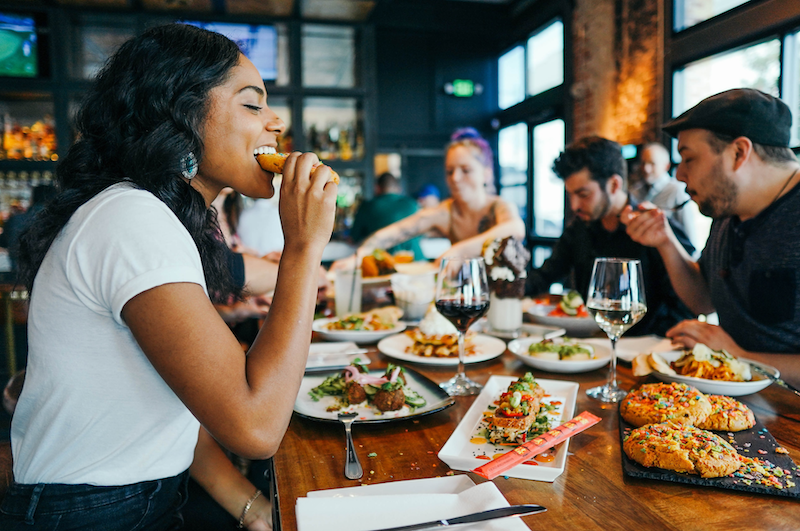
The economists conceded that, while restaurants with strong reviews on the site did better business than poorly reviewed restaurants, establishing cause and effect was difficult.
“After all, restaurants that get good reviews are those that appeal to consumers and they would probably do well even in the absence of any reviews,” the pair write. However, they are confident the research is robust. They note that, when Yelp computes a business’s average rating (which ranges from 1 to 5 stars), it rounds off to the nearest half-star.
So, two restaurants that have similar average ratings can actually appear to be of very different quality to online viewers. For example, a restaurant with an average rating of 3.74 displays a 3.5-star average rating, while a restaurant with an average rating of 3.76 displays a 4-star average rating.
This, the economists claim, allows them to make important comparisons between restaurants that have different ratings — for example, 4 stars versus 3.5 stars — but are of nearly identical quality (for example, a 3.76 average versus a 3.74 average). Their conclusion? That half a star makes all the difference.
Furthermore, they found that the effect was more profound when alternative information was hard to come by, opening up the possibility that invented reviews could boost fortunes.
The pair write: “These returns suggest that restaurateurs face incentives to leave fake reviews, but a rich set of robustness checks confirm that restaurants do not manipulate ratings in a confounding, discontinuous manner.”
So what can you do about it?
We believe that there are 4 key steps to turning around social media performance.
- Inspect the data
- Incentivise your staff
- Be proactive and respond
- Address root causes
Inspect the data
To quote Louis Gerstner, ex-CEO of IBM :
“You don’t get what you expect, you get what you inspect”
… and the same is definitely true of social media scores.
Can you answer the following questions:
- Which was my top performing store on social media this month?
- How many likes do I get for an average post on Facebook and how did this month compare?
- Do I have any critical reviews outstanding that I need to respond to?
If you can’t answer them within a minute or two — you need to work on your tools. Whether you invest in a solution to aggregate reviews for you, or have someone collate a regular report — you need to understand this data in some detail.
Incentivise your staff
Just making sure managers are aware of social media reviews will help — but there’s nothing quite like making social media scores part of an employee scorecard to help drive positive reviews. We’ve seen customers include an average review metric as 10% of a balanced scorecard impacting bonus at the end of each month. Of course, go to far and you could start seeing odd behaviours — an employee may push customers to make reviews — so use in moderation.
You can also run competitions, or have a “mention of the week” type award to rewards one-off performance.
Lastly, it’s important to role model the behaviors you want to see — make social media scores a topic at team meetings, and an important part of the day to day.
Be proactive and respond
Don’t just let negative reviews sit there — make sure you’re responding to them, and trying to remedy the situation. Customers are looking at the responses and well, and want to see an engaged restaurant.
Best in class restaurants can respond within a couple of hours — and it shows you’re thinking customer first. It’ll also help you get closer to the pulse of customer feedback.
Address root causes
Of course, you also need to listen to the content of customer feedback. Not all of it can be fixed with a staff incentive or by listening more closely.
Example of structural issues may be things like poor menu selection for vegetarians, or long wait times on certain days. Each of these comes with an obvious action that you can then decide to make if the reviews persist. Listening closely will help give you this feedback.
If you’d like to see how Tenzo can help you power all of the above — please get in touch for a demo.
The post Why monitoring your reviews online matters! appeared first on Tenzo.
]]>We’d like to share how we see the restaurant tech market map evolve over the next few years. Here at Tenzo, we see the industry moving from an integrated world where systems would span multiple verticals to one where a collection of specialised systems in each vertical work together. Below is our view of a […]
The post Restaurant Tech Market Map: Integrated vs. Best In Class appeared first on Tenzo.
]]>We’d like to share how we see the restaurant tech market map evolve over the next few years. Here at Tenzo, we see the industry moving from an integrated world where systems would span multiple verticals to one where a collection of specialised systems in each vertical work together.
Below is our view of a restaurant tech market map;
Integrated World
In the “integrated world” of restaurant tech, a small number of systems manage the restaurant. There would typically be a point-of-sale (POS), such as NCR, Positouch or Zonal where the data would sit on a computer in a back room, a back of house system such as Fourth Hospitality and an accounting system such as Sage. These systems would sometimes talk to each other. The tech lacked in depth functionality as they were stretched over many verticals. It would be difficult to get insights out as the data was fragmented and not readily available.
The Best In Class World
The “best in class world” that has now emerged is one in which many systems built by different entities communicate with each other to deliver more value to the restaurant. It also means that restaurants have more choice in each vertical and therefore have the opportunity to choose the best in class.
When choosing a technology in the best in class, you should make sure that the data they collect is available to other systems via an API.
We’ve explored the main verticals and some of the options available:
Tablet POS platforms
These companies offer tablet-based point-of-sale systems for restaurants, aiming to give team members faster and more mobile ways to process transactions. There are a number of options here. Revel and Lightspeed have both raised in excess of $100m. Most have robust systems with reliable APIs which can connect to your accounting software, loyalty systems, payment systems.
Staff Scheduling
When I Work (have raised $24m) and Nimble Schedule have a large installed base and offer APIs that will allow you to pull relevant data out of their system.
On-demand labour
There are several companies that are helping restaurants plug short term gaps in their staff by offering on-demand team members. Notable ones include Catapult and TotalJobs.
Internet-of-Things (IoT)
These include footfall sensors (like Hoxton Analytics), smart kitchen sensors (such as Casabot), guest wifi (like purple wifi), digital displays (Enplug) or phone charging stations (powermat).
Customer loyalty
The main players in the restaurant loyalty space include FiveStars ($90M in funding), LevelUp ($53M in funding), and Belly ($26M in funding). These companies reward systems, offer points and sometimes pay-by-phone options for customers, as well as limited analytics and marketing options for restaurants.
Purchasing and inventory
Companies like BlueCart ($4M in funding) or SimpleOrder help restaurants track inventory, improve supplier communications, aggregate supplier orders, and analyse costs.
Reservation platforms
There are several platforms here but one that is emerging from the crowd is Velocity.
Restaurant music
These startups provide smart music systems for restaurants and cafes. Ambie.fm matches the right music the store. TouchTunes ($65M in funding) offers a “digital jukebox” with a companion mobile app for guests, while Rockbot ($6M in funding) gives clients like McDonalds, Panera, and Buffalo Wild Wings a digital music dashboard with curated music stations.
Actionable Insights
Tenzo can bring all the data that these systems collect, apply machine learning and data science to them in order to deliver short actionable insights to the right person, at the right time on the right device.
The post Restaurant Tech Market Map: Integrated vs. Best In Class appeared first on Tenzo.
]]>Reputable business software directory FinancesOnline has recognized Tenzo as an exceptional business intelligence solution. The team called the software a “must-have for restaurant owners, store managers, and employees who want to fully comprehend their business and improve its performance through the maximum use and analysis of their data.” Impressed with the overall design of Tenzo […]
The post Tenzo: “The Gold Standard for Restaurant Intelligence Software” appeared first on Tenzo.
]]>Reputable business software directory FinancesOnline has recognized Tenzo as an exceptional business intelligence solution. The team called the software a “must-have for restaurant owners, store managers, and employees who want to fully comprehend their business and improve its performance through the maximum use and analysis of their data.” Impressed with the overall design of Tenzo in equipping businesses with actionable insights to drive their profitability, the review team honored us with its prestigious Great User Experience Award for 2018 under their top business intelligence software category.
FinancesOnline is one of the most trusted review platforms for B2B and SaaS solutions, having reviewed thousands of software solutions across various categories and visited by over 2 million users. It has a useful resource for all types of software solutions, making it the go-to place for those looking to answer their business intelligence software questions.
FinancesOnline’s qualifications for its Great User Experience Award, which includes ease of use, intuitive interface design and easy product implementation, perfectly match our core principles in designing the software. Tenzo was built to supply all essential data in an accessible platform and deliver insights in real-time to key personnel, allowing everyone to focus on their operations instead of wasting time wrestling with the software. The FinancesOnline team elaborated on this in their Tenzo overview, stating that it “simplifies and speeds up your access to data from multiple sources and systems, centralizing all your data in one place for easy and painless reporting.”
As seen in FinancesOnline’s review, other notable benefits of Tenzo include effortless sales forecasting thanks to smart AI and automation capabilities and real-time social media feedback monitoring for speedy resolution of issues. They also found Tenzo’s forecasts reliable for recalibrating one’s staffing strategies.
Complementing the positive remarks from FinancesOnline’s experts is a high 95% user satisfaction rating and inclusion in their business intelligence tools research. Additionally, we were conferred with the Rising Star Award for 2018 in recognition of our increasing presence on the market and positive client feedback.
Make better and faster decisions with Tenzo.

The post Tenzo: “The Gold Standard for Restaurant Intelligence Software” appeared first on Tenzo.
]]>Leaderboards: A Data Driven Approach to Increasing Restaurant Sales There are a number of strategies to increase your restaurant sales such as the use of loyalty programs, delivery, online ordering etc. However, this article focuses on one key lever that tends to get less attention: employee performance. Leaderboards, alongside competitions, bonuses and compensation plans, are an […]
The post How to Use Data to Increase Restaurant Sales appeared first on Tenzo.
]]>Leaderboards: A Data Driven Approach to Increasing Restaurant Sales
There are a number of strategies to increase your restaurant sales such as the use of loyalty programs, delivery, online ordering etc. However, this article focuses on one key lever that tends to get less attention: employee performance.
Leaderboards, alongside competitions, bonuses and compensation plans, are an effective way to drive sales. Typically, we find them used for:
- Increasing speed of service in Quick Service
- Driving up-sell and average check size
- Selling specific items (“attachment”) e.g., fries and a drink
- Improving social media performance (higher review ratings drive more revenue)
Furthermore, they also help reinforce positive behaviours, boost morale and increase transparency throughout the business.
Here are some example leaderboards you could consider using:
- Average Transaction Size
- Average Sales per Hour
- Individual Product Sales
- Social Media Reviews
- Individual Location Sales
1) Transaction Size Leaderboard
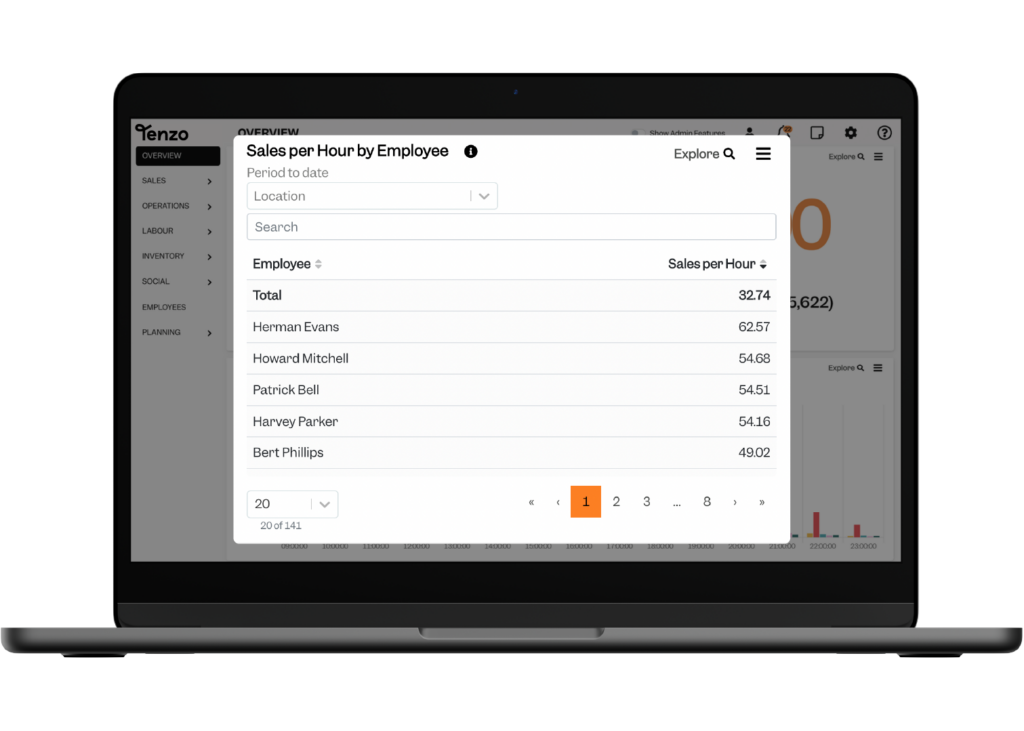
A transaction size leaderboard ranks employee performance by how far above or below the individual employee’s average transaction size is compared to the average transaction size of the whole team in the same period worked. For example, Patricia Johnson is the clear winner with an average transaction size of 540% above the average transaction size of her peers in the same time period. The reason this comparison is important is that you might have people who work specific days, or specific shifts, have a higher check size just because of the time of their shift (i.e. Saturday dinner may always win)
2) Average Sales per Hour Leaderboard
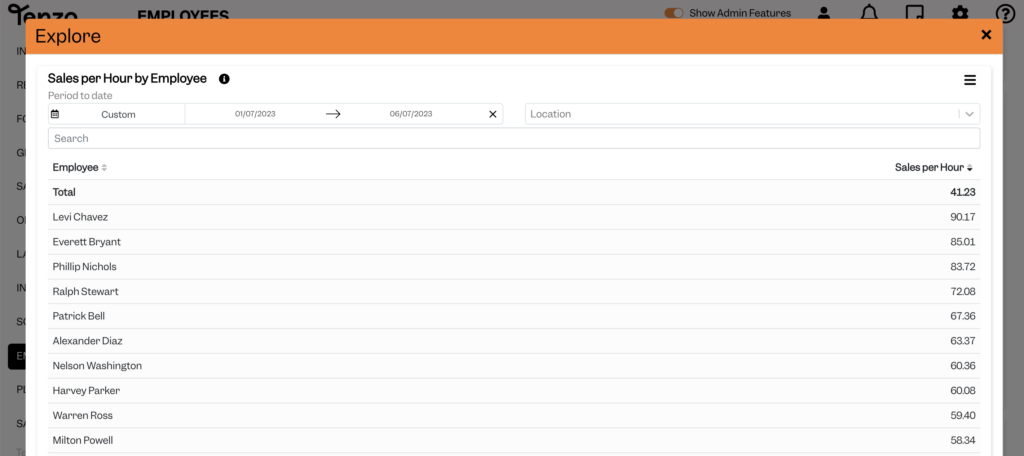
The average sale per hour leaderboard ranks employee performance by how far above or below the individual employee’s average sale per hour is compared to the average sale per hour of the whole team in the same period worked. For example, Patricia Jones is the clear winner with an average sale per hour of 218% above the average sale per hour of her peers in the same time period (Friday evenings with Friday evenings etc).
3) Product Sales Leaderboard
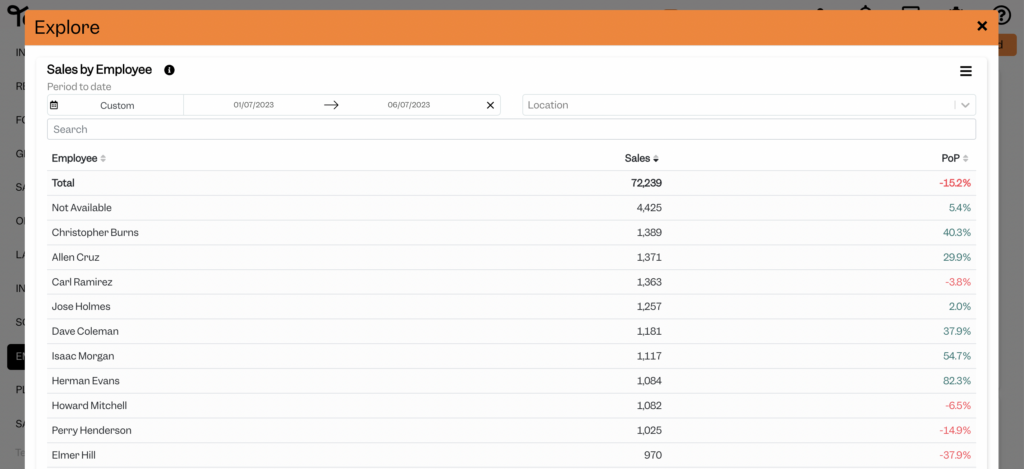
Ranking employees based off total sales of individual product items is particularly useful for selling off any food quickly (e.g. chicken) or encouraging promotional sales (e.g. specials/limited time only products). In our example, John Smith sold off the most chicken salad (126 sales) in the last three days of May.
You can imagine doing the same thing to up-sell a small item (e.g., breadsticks, cookies), or supersize a meal.
4) Reviews Leaderboard
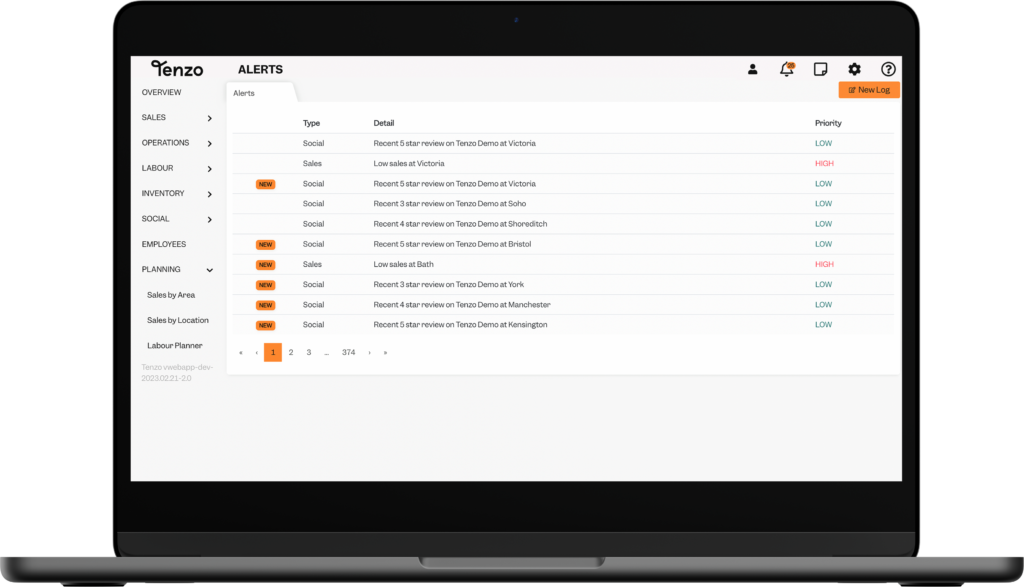
Reviews leaderboard promotes a sense of teamwork within the individual stores by ranking the locations by average social review rating over any given period. It can also be helpful to understand whether each location is trending up or down compared to the period prior. For example, the Kensington location has the highest rating for the month of May and is trending up compared to April.
5) Location Sales Leaderboard
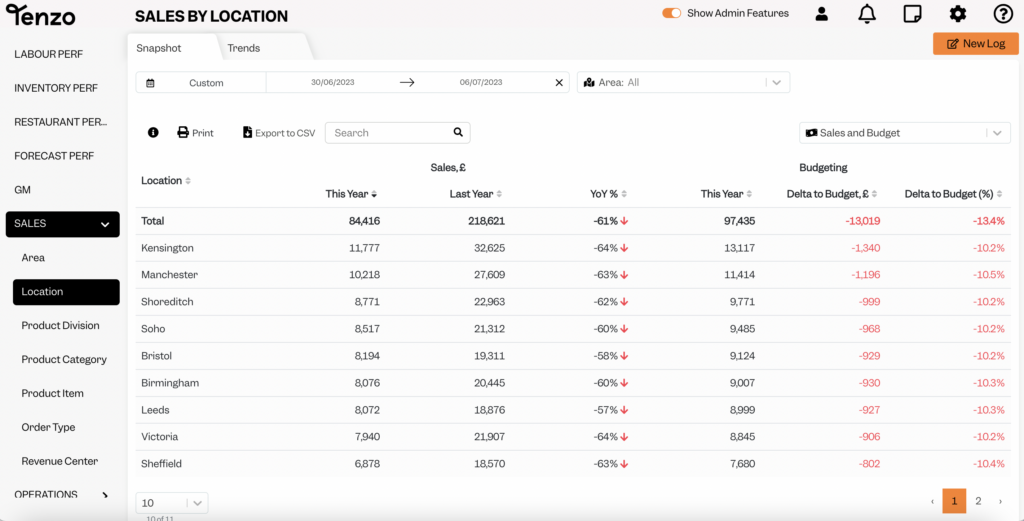
The location sales leaderboard is another means to promote a sense of competition between the different stores. In this leaderboard, we rank the locations by sales as a percentage of the total sales for the chain. In this example, Kensington is the winner for the month of May as it has increased its YoY% change by 200% from 4.2% to 12.2%.
The post How to Use Data to Increase Restaurant Sales appeared first on Tenzo.
]]>Guest blog from James Sandrini. Director at 48.1 – a creative agency for food and drinks brands. Marketing is misunderstood. Here’s one crack at it And another Third time lucky There’s 72 more of these Are they right? It doesn’t matter. The point is, you don’t know. And if you’re an operator, chances are you […]
The post Marketing Ops – the least recruited, most essential job appeared first on Tenzo.
]]>Guest blog from James Sandrini. Director at 48.1 – a creative agency for food and drinks brands.
Marketing is misunderstood.
Are they right? It doesn’t matter. The point is, you don’t know. And if you’re an operator, chances are you don’t know how to lead that department either.
It’s cool. You’re probably wildly talented and brilliant at a thousand other things. And you’re almost certainly getting paid more than your Marketing Manager anyway, so there’s that.
As a restaurant group scales, so does the operation. Over time, this process becomes more and more efficient (in theory, at least).
Unfortunately, this isn’t the case with other departments. HR & Recruitment rarely scale; sometimes due to a lack of investment, and always because each site brings with it a new team and, therefore, new challenges.
Even more sensitive to scale, is marketing.
Marketing positions are rare in single venues. New sites are better set investing their time and energy into providing a fantastic guest experience, driving advocacy and converting loyalty from early adopters into word of mouth.
Fast forward a year or two and you’re now rolling out your concept at a daring pace and across a range of new locations.
And then you go and hire a Marketing Manager.

There are a lot of hard working, capable Marketing Managers out there. And yet, no senior role seems subject to such great churn.
Marketing is not misunderstood due to a glut of definitions. Marketing is misunderstood because it can’t be measured by hours spent, or conversations had, or spreadsheets completed.
Operations will and should always take precedence in restaurants and bars. The ‘all-hands-on deck’ mentality defines the industry, but it also defies the efforts of many marketers, intent on bringing creativity and strategy to an environment that, on occasion, outright scorns it.
I don’t know a restaurant that expects its Sous Chef to cook, cocktail and host. I know many restaurant groups that expect their marketer – their only marketer in many cases – to do all or most of the following:
- Research
- Strategise
- Build campaigns
- Design
- Distribute
- Report
- Fill in for sales when they’re not about
If the focus in your business is on operations, recruit people whose default is operational. And outsource everything else.

Marketing. Takes. Time. And, if you’re an operator, I bet even reading that sentence was painful.
Let’s dispel a couple of myths here:
“Marketers don’t want to do the hard work.”
- No, marketers don’t need to run to the kitchen to make a GANT chart. Nor do they have to mop the floor after a 12-hour shift full of competitor reviews and design briefs. This doesn’t mean that the job is easy, that you could do it, or that cognitive and physical exhaustion are the same thing. Grow up.
“It’s just posting on social media.”
- I mean it’s not, but at least you helped me make my point about not knowing WTF marketing is. Thanks. Point is, there are not many operators that are versatile enough to manage strategic roles. There are even fewer organisational structures in food & drink that support functions best suited to long-term review.
Marketing, irrespective of the definition, has changed rapidly in the last 20 years. Here are a few words that didn’t exist in 1998: Blog, Facebook, Twitter, omnichannel, Google, PPC, VR, Instagram.
Today, a marketer only needs a mobile phone to launch a campaign, monitor reviews and interact with an audience. More importantly, a consumer only needs a mobile phone to communicate directly with a business.
No longer do restaurants and bars need to solely rely on marketers to create content; they can amplify the stories their guests create.
Customers can and will take pictures of your food. Now, share that content. Customers will say nice things about you to their friends. Go on, share that content. Occasionally, customers might question or challenge you. Answer those questions. And share that content!
You might not need someone to strategise and plan quite as much as you think; a more operational, reactive mindset, focused on promoting user generated content, can cover a bulk of your daily content.
Marketing Ops isn’t entirely new. Born from tech, housed in analytics, and related to process far more than creative, the ‘MO’ is tasked with aligning Marketing with Operations, Sales, IT and Finance.
Why? Because tech businesses rely on data for insight and feed that information straight back into product design. Reporting is transparent and shared across the business, enabling team members to react in real time.
The food & drink industry has started to smarten up to the role of data. Even small restaurant groups now maintain a pretty hefty tech stack, with integrations passing information from one hub to another.
But – and this is a helluva but – what are businesses doing with that data?
Who’s in charge of recording it? How is it being reported?
And what is being drawn each month from the interpretation of operational data, reputational data, social data, website data and analogue information gathered by GMs?
How is data being used in your business to aid customer acquisition and retention on a day-to-day basis?
I work for an agency. There are portions of our work that our clients could not complete themselves, irrespective of the time they contributed to it (web development isn’t easy. Yes, 3D motion is as hard as it sounds).
But there are plenty of roles we fill that our clients could. And this has everything to do with time, just not in the way you’re imagining it.
Don’t work with an agency so that they can carry out jobs you don’t have time for. Work with an agency because they structure their time differently.
Here’s a sample of a Marketing Managers day: Emails > Photography > Social > Ops Meeting > Sales Meeting > Emails > Site Visit > Social > Emails > Social > Lunch…
If you expect this person to undertake broad, strategic, slow work, you’re crazy.
This is not – I repeat, not – a reason to remove the Marketing Manager and work solely with an agency. You shouldn’t. That potent pre-lunch list still needs doing and paying an agency to fill those gaps is neither cost-effective nor sustainable.
Here’s what a Marketing Ops team member could be doing:
- Aggregating and reporting on all forms of data (if you don’t already, use Tenzo, trust me)
- Preparing briefs for and maintaining communication with third party agencies
- Project managing the execution of marketing activations
- Share user generated content and reply to queries on social channels
- And yes, they can fill in for sales on their day off
Keep the marketer; change the role.
James Sandrini is a director at 48.1 – a creative agency for food and drinks brands. For more, read the blog at www.fortyeight.one/words/.
The post Marketing Ops – the least recruited, most essential job appeared first on Tenzo.
]]>It’s always important to have a handle on your labour cost but in today’s climate more so than ever. Tenzo’s analytics platform and Bizimply’s operations management platform have partnered up to provide a set of steps to help get on top of your labour costs. 1. Ensure an accurate sales forecast to staff against First and foremost, it’s […]
The post How to use data to reduce labour costs appeared first on Tenzo.
]]>It’s always important to have a handle on your labour cost but in today’s climate more so than ever. Tenzo’s analytics platform and Bizimply’s operations management platform have partnered up to provide a set of steps to help get on top of your labour costs.
1. Ensure an accurate sales forecast to staff against
First and foremost, it’s important to understand how many staff you need on any given day. A key component of that is a sales forecast. The more accurate you can get this, the more closely you’ll be able to align your labour schedule.
A common way to do this is to look at previous patterns e.g. the last four weeks or the same day from the previous year, but it helps to take things a step further by layering in other events and patterns. For example, thinking about different weather conditions or certain days or holidays (like Mother’s Day or Valentine’s Day) can impact your business.
When you understand the top line sales expectation, you can decide how many people you need to serve that demand. We’ll talk more about that in some of the points below.
2. Identify “leakage” in your labour plan
You’ll find there are times you have staff working and you just don’t need them. Here are a couple of examples:
1. Overstaffing during shift changes: rather than change everyone all at once, you can roll the shift change – this means you don’t need to have large numbers of people overlap. You can also have some people end when you expect demand to decrease.
2. Quiet periods in the middle of the day: often there is a lull between lunch and dinner. You should consider how you can reduce your staffing level here, either by using shorter shifts. Alternatively, you can try to smooth demand with mid-afternoon promotions, or by taking advantage of the lull to catch up on prep and cleaning.
Example: Cost of labour as a percentage of sales
This fictional restaurant chain has a high cost of labour as a percentage of sales between 2pm and 3pm (e.g. staffing levels may have remained the same since lunchtime while sales have declined). Therefore, there is significant room to reshuffle or lower staff numbers at this time.
3. Ensure you have the right resources for the right type of activity
It’s important to make sure that all activities of your operation are covered at the appropriate times. For example, baristas for coffee, chefs for food, as well as staff for prepping food as well as serving food. The correct number of staff as a whole is important, but the correct type of staff even more so. Consider the following:
– Forecasting, not just total sales, but also subcategories of revenue e.g. drinks, coffees, retail, food.
– Then you can map individuals to categories of revenue (e.g., one bartender for each £50 of hourly drinks sales).
– You also want to ensure you have the right level of seniority (e.g., only one manager) — it can help to put controls on the number of hours and role types to monitor this.
4. Look for flat staffing patterns e.g. the same schedule every week despite varying demand
As we look at many different types of business, we see this mistake consistently. Not every Saturday is equal, so you should consider varying your labour plans to adapt to the changing situations. For example, if you know snow is forecast, perhaps consider how this might impact demand and adjust down the number of people you need.
If you are worried about commitments to your employees, you could consider a mix of more temporary staff to allow greater flexibility in how, and when, you set the schedule.
5. Go more granular: consider staffing at 15 or 30-minute intervals as opposed to a typical hourly rhythm
Customers don’t think in terms of hours, and neither should you. Starting shifts at 30, or even 15-minute, intervals can help you shave off an hour or two here and there. Saving an hour of labour a day can add up to over £3,500 a year, so every hour matters.
Example: Average actual cost & sales
This fictional restaurant chain has excess labour cost (on average over the last quarter to date) between 2pm and 4pm, on all days of the week at its Kensington location. The next step would be to dive in further to determine which days of the week this occurs more frequently.
6. Identify your best and worst performers and factor that into your labour plan
People tend to assume that a labour plan is only about the number of people you have on at a given time, but it’s also critical to think about the actual people. You may only need one star in comparison to two novices. Consider what’s best for your business and your employees:
1. You may want to put your best people on at your busiest times.
2. “Newbies” probably want to be paired with some old hands, and also likely at off-peak teams to start.
3. Interpersonal dynamics may also be an important factor. You want to staff teams that get on and work well together.
Example: Pairing employees
At this fictional restaurant, John Johnson was a high performer last month and should be paired with Mary Jones if possible, so John can mentor Mary to be a top performer.
7. Understand the effectiveness of training and onboarding to ensure staff are operating at maximum efficiency within the minimum time/cost
Learning and development is often an area overlooked in the data and analytics department, but it is incredibly informative. You can track metrics like the following to help you understand how training is progressing:
– Onboarding time.
– Employee errors, or void rates, to understand how effective training has been.
– Customer satisfaction is also often impacted by this, so it’s worth looking at social media reviews to understand how employees are driving this.
Of course, to do all this you need to have the right software in place. Get started with our integration to Tenzo and start transforming your business today.
The post How to use data to reduce labour costs appeared first on Tenzo.
]]>